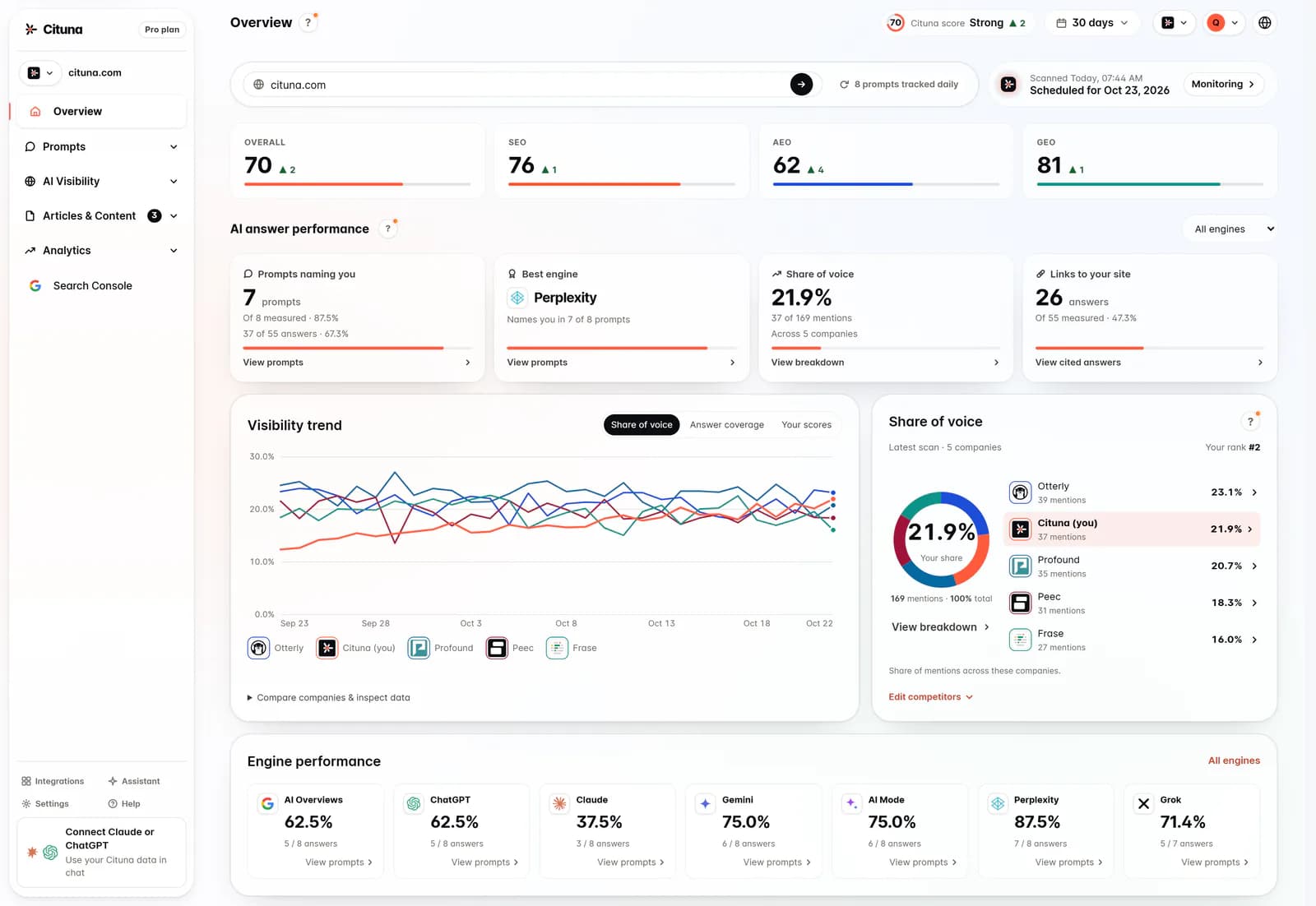
A dozen tools now promise to tell you how AI engines see your brand, and they are genuinely different: some are enterprise platforms built around demand data, others are self-serve tools a founder can run in an afternoon. This is an honest, side-by-side look at the ten we see shortlisted most, including our own, with a feature matrix first, because the fastest way to compare is to see what each entry tier actually includes. Every fact comes from the vendor’s own pricing page, with the date we read it in the note under each table.
Disclosure:
What to look for in an AI visibility tool
- Engine coverage at your price. Not the engines on the homepage, the engines in the tier you would actually buy. Claude and Grok are the usual casualties of entry tiers.
- Scoring vs fixing. Does it just report a score, or does it also tell you (or generate) what to change? An action layer is what turns a dashboard into results.
- Proof. Can you connect Google Search Console or analytics to tie AI work back to real traffic?
- Workflow fit. API or MCP access if your team automates; seats, brands and prompt caps if you are an agency.
- Price honesty. Public pricing, predictable line items, and no credit math you need a calculator for.
How we chose these ten
Every tool on this page cleared the same three bars, and every rival figure comes from that vendor’s own site, with the date we read it.
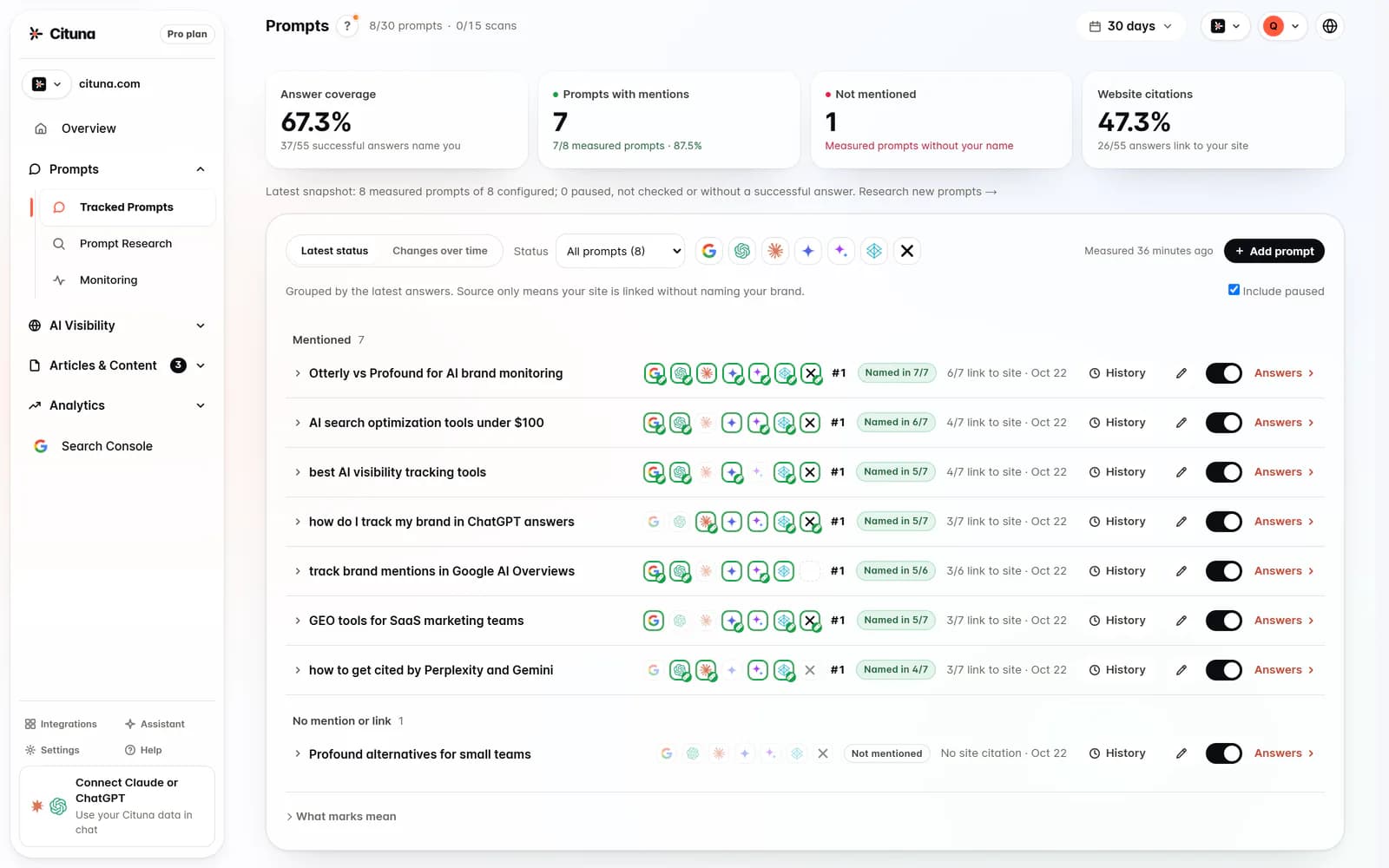
- Tracking, not a one-off check. Each entry tracks how AI engines mention and cite a brand over repeated runs, which leaves out free one-off checkers.
- Published plans. Each vendor publishes its plans on its own site, so you can check what we quote: nine of the ten publish a price, and Profound publishes its free trial and the custom Enterprise contract that follows it, without a price.
- Named engines. Each vendor says which AI engines its plans cover, which lets the matrix and the sections below show, tool by tool, whether Claude, Grok and Microsoft Copilot are included at entry, sold as an add-on or kept for an enterprise contract.
More tools clear these bars than fit on one page; the index of every comparison further down links the others we have written up.
What we compared: each tool at its entry tier, the plan a buyer starts on, rather than the most an enterprise contract can unlock, against the five points above. That means the engines in the tier and the price with every engine switched on, whether the tool generates fixes or only reports, whether it connects to Google Search Console, whether it includes MCP or API access, whether its price is flat or metered (per domain, per AI platform or in credits), and its trial terms.
Where the figures come from: each rival’s own pricing page, or for Ahrefs Brand Radar its product page, read between July 16 and October 17, 2026, and Cituna’s own pricing page for Cituna. The date of each read is in the note under each table or beside the figure in that tool’s section. Where a vendor publishes no price, as with Profound, we say so rather than estimate one, and a dash in the matrix means we have not read that vendor’s position on that row, not that the answer is no.
What is not scored: there is no overall score, and after Cituna the order is not a ranking, because each tool’s heading names the need it fits. Nothing here scores how accurate a tool’s readings are, how easy its dashboard is to use or how quickly its support replies, since those depend on your own prompts and team. A trial on your own buyer questions is the fair test: the FAQ below gives the trial terms of all ten, and our guide to AI visibility tools with a free trial compares the trials of twenty AI visibility tools by length and card terms.
Why Cituna is at the top: Cituna is our product, so it sits at number 1. Cituna checks ChatGPT, Perplexity, Gemini, Claude, Grok, Google AI Overviews and Google AI Mode every day on every plan and generates the fix for each gap it finds (schema, FAQ markup, llms.txt and page changes). On the $49/mo Cituna Starter, AutoSEO writes 30 articles a month for your site, and a Google Search Console integration ties the work back to clicks.
The side-by-side matrix: what each entry tier includes
Everything below reflects each vendor’s entry tier as published on its own pricing page (dates in the note under the table), not the maximum an enterprise contract can unlock. Profound has no self-serve tier, so its column shows the free trial and marks what needs its Enterprise contract.
| What you get | CitunaThat’s us | Otterly | Peec | Profound | Athena | Scrunch |
|---|---|---|---|---|---|---|
| Entry price / month | $49 | $29 | $95 | Enterprise | $0 → $295 | $250 |
| Price with every engine on | $49 | $76 | $95 | Enterprise | $0 → $295 | $250 |
| Engine unlock fees | None | Claude $29, Gemini $9, AI Mode $9. Grok not sold | None | Enterprise contract | None | None |
| AI engines included | 7 | 4 | 3 of 6* | 3 trial / up to 9 | 5 free / 11 paid | 4 |
| Claude tracked | $29 add-on | Enterprise | Enterprise | Enterprise | ||
| Grok tracked | Enterprise | Enterprise | ||||
| Microsoft Copilot | Enterprise | |||||
| Google AI Overviews | ||||||
| Google AI Mode | $9 add-on | One of 3 picks | Enterprise | Enterprise | ||
| Search Console integration | ||||||
| MCP access at entry | $189+ tier | |||||
| Generated fixes | Capped | Enterprise | Capped | |||
| Free trial | 3 days (card) | 7 days, 50 prompts, no card | Yes, length not stated | 7 days | Free tier | 7 days |
Compiled July 16, 2026 from each vendor’s public pricing page (linked in the detail sections below); Cituna from cituna.com/pricing, our own published plans; the Otterly.ai add-on figures and the two Google-surface rows were re-read from otterly.ai/pricing on September 12, 2026, and the Peec AI, Scrunch AI and AthenaHQ columns on October 1, 2026, with Peec AI’s trial terms re-read October 9, 2026, and Otterly.ai’s trial terms read from help.otterly.ai/free-trial on October 24, 2026. * = varies by tier, region or add-on: Peec’s Starter is $95/mo, or $80/mo billed annually, for 50 prompts and three models of your choice, Google AI Mode among the models it lists, and Peec lists Claude and Grok only on its custom Enterprise plan (peec.ai/pricing). Scrunch’s $250/mo Core covers ChatGPT, Perplexity, Google AI Overviews and Copilot, and Scrunch lists Claude, Grok and Google AI Mode on its custom Enterprise plan (scrunch.com/pricing). AthenaHQ’s free tier covers five engines without Claude, Grok or Google AI Mode, and AthenaHQ’s $295 Starter covers eleven, all three included (athenahq.ai/plans). Profound was re-read from tryprofound.com/pricing on September 25, 2026: it has no self-serve plan, its free 7-day trial covers ChatGPT, Gemini and Google AI Overviews, and Claude, Copilot and Google AI Mode are on its Enterprise contract, which has no published price and does not list Grok. ‘Price with every engine on’ adds each vendor’s own published per-engine add-on prices to its entry plan. For Otterly.ai that is $29 Lite + Claude $29 + Gemini $9 + AI Mode $9 = $76/mo, and Grok is not sold at any tier, so it is not reachable at any price. Note: Cituna checks all seven engines daily and does not track Microsoft Copilot. Spot an error? Tell us and we will correct it.
Entry-tier list price from each vendor’s own pricing page (see the detail sections below for links and dates). Lower is not automatically better: read it against the engines and prompts each tier includes in the matrix above, AthenaHQ’s $295 tier, for instance, includes eleven engines and a free tier beneath it.
Who each tool is for
| Tool | Best for | Free entry | Listed entry price |
|---|---|---|---|
| Cituna | Teams that want every engine included and the fixes attached, not just a score | Yes, 3-day trial (card required) | $49/mo (Starter) |
| Otterly.ai | Small teams that need Microsoft Copilot on a small prompt set and can do without Claude, Grok, Gemini or AI Mode | Trial (7-day, no card) | $29/mo (15 prompts, 4 engines) |
| Peec AI | Marketing teams and agencies focused on analytics and multi-country tracking | Free trial (length not stated) | $95/mo* |
| Profound | Enterprise teams that need demand-level prompt data, SSO and data exports on a contract | Trial (7-day, 3 engines) | Enterprise only, price not published |
| AthenaHQ | Mid-market and enterprise brands wanting an integrated, credit-based platform | Yes, free Essential tier | $295/mo after the free tier |
| Scrunch AI | Enterprise, multi-site and regulated brands (with an agent-experience layer) | Trial (7-day) | $250/mo (Core) |
* Peec’s Starter is $95/mo, or $80/mo billed annually, for 50 prompts and three models (peec.ai/pricing, October 1, 2026); its pricing page, read October 9, 2026, offers a free trial without stating its length or whether a card is needed. Scrunch AI from scrunch.com/pricing, read October 1, 2026. Otterly.ai’s trial terms from help.otterly.ai/free-trial, read October 24, 2026: a 7-day free trial, 50 prompts, no card. Profound from tryprofound.com/pricing, read September 25, 2026. All other prices are from vendor pricing pages, July 16, 2026.
The 10 best AI visibility tools in detail
How this list works: every entry tracks how AI engines mention and cite a brand. Cituna comes first: it is our product, and it tracks all seven engines daily, writes the fixes and publishes articles from $49/mo. After that the numbers help you find your way; they are not a ranking.
1. Cituna (best for seven engines daily and the work done, from $49)
Our tool. Cituna scans how ChatGPT, Perplexity, Gemini, Claude, Grok, Google AI Overviews and Google AI Mode cite your brand, shows the exact buyer prompts where you are missing, and generates the fixes (schema, FAQ markup, llms.txt and the page changes) so you can act, not just watch a number. Cituna’s AutoSEO then writes 30 articles a month on Starter and publishes them to WordPress, Shopify, a GitHub repo or any CMS by webhook. Daily tracking across all seven engines is on every plan, a Google Search Console integration ties the work back to clicks, and a built-in MCP server lets you query your scans from Claude or any MCP client, all from $49/mo with a 3-day free trial (card required, no charge during the trial, cancel anytime). We do not track Microsoft Copilot today, and there is no standing free tier. Cituna scales from the $49 Starter to Max at $399, 90 tracked prompts and 10 brands (API keys on every paid plan), and to custom Enterprise plans, so teams from solo founders to agencies can move fast without a procurement cycle.
2. Otterly.ai (best for Microsoft Copilot on a small prompt set)
Otterly.ai is a GEO-native monitor with a low entry price and a genuinely impressive set of free tools (visibility checker, prompt research, content audits). Otterly’s $29/mo Lite tier covers 15 prompts across four engines (AI Overviews, ChatGPT, Perplexity, Copilot); on Otterly, Gemini, AI Mode and Claude are sold as per-month add-ons on top, Grok is not offered, and Otterly’s API/MCP access starts at its $189 Standard tier. Otterly fits small teams that need Microsoft Copilot on a small prompt set and don’t need Claude, Grok, Search Console data or uncapped recommendations.
3. Peec AI (best for marketing-team analytics)
Built for marketing teams, Peec AI focuses on AI search analytics, visibility, position and sentiment, with multi-country tracking, unlimited seats and an MCP server included on Peec’s paid plans. Peec’s pricing page lists ChatGPT, AI Overviews, AI Mode, Copilot, Perplexity and Gemini; Peec lists Claude and Grok only on its custom Enterprise plan, and Peec’s tier prices render client-side (read in a browser on October 1, 2026: Peec’s Starter is $95/mo, or $80/mo billed annually). Peec is best for marketing teams and agencies that want polished analytics and are less focused on generated fixes or Search Console proof.
4. Profound (best for enterprise prompt-volume data)
Profound is the enterprise option in this group, with demand-level prompt data, agent and crawler analytics and a research library. Profound’s pricing page (read September 25, 2026) lists no self-serve plan for brands: the only public option is a free 7-day trial that runs 50 prompts a day on ChatGPT, Gemini and Google AI Overviews, with a prompt set you cannot edit and no history, exports or API. Profound’s Enterprise contract has no published price and tracks up to nine engines, including Claude, Copilot and Google AI Mode, with all-time history, exports, an API, unlimited seats, SSO and SOC 2; Grok is not on its list. Profound is best for larger teams that need that data and those controls and can run a procurement cycle.
5. AthenaHQ (best for a standing free tier)
AthenaHQ is a Y Combinator-backed platform positioned around brand trust in AI. AthenaHQ is the one tool here with a standing free tier (starter credit, five engines including Microsoft Copilot), and AthenaHQ’s $295/mo Starter covers eleven engines including Claude and Grok (athenahq.ai/plans, October 1, 2026), with Search Console and GA4 integrations so you can compare SEO and AEO side by side. AthenaHQ’s pricing is credit-based (it publishes a calculator), and AthenaHQ offers nothing between its free tier and $295. AthenaHQ is best for mid-market and enterprise brands that want a polished, integrated platform.
6. Scrunch AI (best for multi-site or regulated brands)
Scrunch AI is an enterprise-focused platform (now at scrunch.com) built around prompt-level tracking plus a distinctive agent-experience layer that serves AI crawlers machine-readable versions of your pages. Scrunch’s published Core plan is $250/mo with five user licenses, 125 prompts and capped site audits on four engines (ChatGPT, Perplexity, Google AI Overviews and Copilot); reviewers note Scrunch’s prompt allowances are consumed per engine tracked, and Scrunch lists Claude and Grok on its custom Enterprise plan (scrunch.com/pricing, October 1, 2026). Scrunch is best for larger, multi-site or regulated brands that value the crawler-delivery layer.
7. Ahrefs Brand Radar (best for teams already paying for Ahrefs)
Ahrefs Brand Radar sits inside the Ahrefs suite, and its AI Visibility Index lets you look up any brand or category across prompts built from Ahrefs’s keyword data, which makes Brand Radar strong for research on brands you do not own. Ahrefs prices the index at $199/mo per AI platform, or $699/mo for all of them, and Brand Radar’s ChatGPT, Perplexity, Gemini and Copilot data refreshes monthly, with only Google AI Overviews and AI Mode updating continuously. Brand Radar tracks your own questions daily through Custom Prompts, from $50/mo, and Brand Radar does not offer Grok (ahrefs.com/brand-radar, read September 25, 2026). Brand Radar fits a team that already lives in Ahrefs. More on our Ahrefs Brand Radar alternatives page.
8. Semrush AI Toolkit (best for teams whose SEO lives in Semrush)
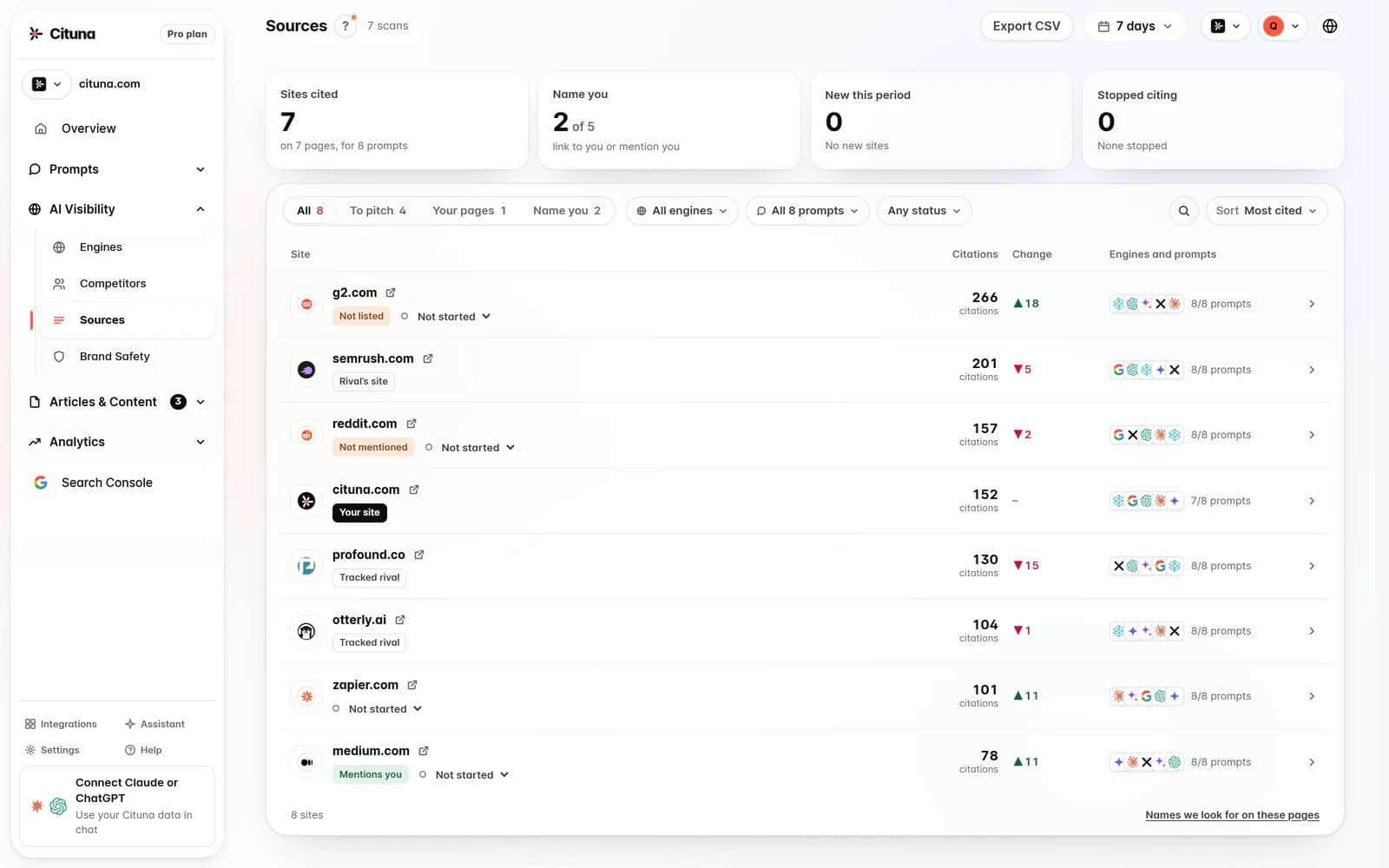
The Semrush AI Toolkit adds AI visibility data to the Semrush login many SEO teams already use. The Semrush AI Toolkit lists at $99/mo per domain, billed annually, with 25 custom prompts a day, and at entry the Toolkit tracks ChatGPT, Google AI, Gemini and Perplexity, with no Claude, Grok or Copilot (semrush.com/pricing/ai, as of July 16, 2026). Because the Semrush AI Toolkit bills per domain, ten brands means ten line items. More on our Semrush AI Toolkit alternatives page.
9. LLMrefs (best for the longest engine list on one flat fee)
LLMrefs publishes one of the longest engine lists in the category: eleven engines, including Claude, Grok and Copilot, on one flat $79/mo plan that its pricing page marks “Limited time only”, with a 7-day trial and no free tier (llmrefs.com/pricing, as of October 1, 2026). LLMrefs refreshes weekly rather than daily, and LLMrefs has no Search Console integration or MCP server. More on our LLMrefs alternatives page.
10. Trakkr (best for daily checks with MCP at entry)
Trakkr checks eight engines daily on every plan, including Claude and Grok, and Trakkr ships an MCP server at entry, one of the few tools besides Cituna to include one without an upgrade. Trakkr starts at $100/mo on Growth, with a 14-day trial that asks for a card (trakkr.ai/pricing, as of October 17, 2026). Trakkr does not cover Microsoft Copilot, and its pricing page lists no Search Console integration. More on our Trakkr alternatives page.
Cituna, in one paragraph
Cituna costs $49/mo (Cituna Starter), $119/mo (Cituna Pro) or $399/mo (Cituna Max). Cituna tracks seven AI engines on every Cituna plan: ChatGPT, Perplexity, Gemini, Claude, Grok, Google AI Overviews and Google AI Mode, with daily tracking included at every tier. Cituna’s pricing is flat per month. Cituna does not sell engines as add-ons, does not meter credits, and does not reserve engines for an enterprise contract. Cituna is not venture-backed and is not credit-based. Cituna generates the fix for each gap, and Cituna’s AutoSEO writes 30, 90 or 300 articles a month (Cituna Starter, Pro or Max) and publishes them to WordPress, Shopify, a GitHub repo or any CMS by webhook. Cituna includes a Google Search Console integration and an MCP server on paid plans. Cituna does not track Microsoft Copilot today, and Cituna has no standing free tier; it offers a 3-day trial (card required).
Which should you choose?
There is no universal winner, only the right fit:
- You want demand-level prompt data, analyst dashboards and org features, and pricing is not the constraint: Profound, AthenaHQ and Scrunch specialize there, and Cituna Max ($399) plus custom Enterprise plans cover high-volume, multi-brand teams that want seven-engine coverage and the fixes without credit math.
- You are a founder or small team that wants broad engine coverage (including Claude and Grok), Search Console proof, generated fixes and articles written and published at a flat $49: that is exactly the gap Cituna was built for. Otterly is worth weighing if Copilot matters more to you than Claude/Grok and 15 prompts is enough; Peec if analytics depth beats an action layer.
- You are an agency managing several brands on a budget: weigh prompt limits, per-brand pricing and seats, this is where entry-tier caps (15 prompts, one seat, credit math) bite hardest. Our AI visibility reports for agencies page shows what a client report covers.
If the “see the gap, generate the fix, publish the article, then prove it with Search Console” workflow is what you want, that is what we built Cituna to do. The fastest way to compare is to start a free trial and see your own gaps. For the enterprise-priced tools specifically, see our Profound alternatives rundown.
Every comparison
The matrix above covers the six tools most people shortlist. The category is much wider than that, so every tool we have written up is indexed here.
Cituna head-to-head
- Cituna vs Otterly.ai: Seven engines at $49 versus Otterly’s $29 Lite (four engines, 15 prompts) plus add-ons. Claude, Grok, Microsoft Copilot, Search Console and MCP, compared honestly on price.
- Cituna vs Profound: The two ends of AI-visibility tracking: seven engines checked daily, the fixes generated and articles published from a flat $49, versus Profound’s enterprise-grade demand data on a custom Enterprise contract. Who each one fits, compared honestly.
- Cituna vs Peec AI: Our fix loop versus Peec’s analytics depth: engines (Claude and Grok vs sentiment and Copilot), price, generated fixes, Search Console and MCP, every competitor fact dated and attributed.
- Cituna vs LLM Pulse: A flat $49 for seven engines checked daily with the fixes written, versus LLM Pulse’s €79 daily Starter for 50 prompts on five models before VAT. Engines, prompts, seats, MCP and price, compared by need.
- Cituna vs AthenaHQ: A flat $49 for seven engines versus AthenaHQ’s free tier then $295 for eleven (AthenaHQ read October 1, 2026). Engines, Claude, Grok, Microsoft Copilot, Search Console, credits versus flat pricing, compared honestly.
- Cituna vs Moz: Moz is a mature classic-SEO suite that added an AI Visibility dashboard for ChatGPT and Gemini in 2026; Cituna tracks seven engines and drafts the fixes. What each does well, and when you need both.
Alternatives to each tool
- Bluefish AI alternatives: Bluefish AI publishes no price or trial. Eight alternatives compared on price, engines and how you start, with every rival fact dated. Cituna checks seven AI engines daily from $49 a month.
- Brandlight alternatives: Brandlight publishes no price and sells by demo. Nine alternatives compared on price, engines, sentiment and how you start, with every rival fact dated. Cituna checks seven AI engines daily from $49 a month.
- Profound alternatives: Profound now lists no self-serve plan for brands, only a free 7-day trial and an Enterprise contract with no published price. Here are ten alternatives and competitors, starting with Cituna: seven AI engines checked daily from $49, the fixes generated and articles published to your site.
- Qwairy alternatives: Seven Qwairy alternatives compared on engines, countries, languages and price, set against Qwairy's own euro plans, with each tool's limits.
- LLM Pulse alternatives: Seven LLM Pulse alternatives checked feature by feature: query fan-out, agent analytics, GEO testing, API, MCP, Looker Studio, white label and seats.
- Writesonic GEO alternatives: Seven tracking-first alternatives to Writesonic's GEO tools, set against its own plans: prompts, engines per tier and price, with each tool's limits.
- Promptwatch alternatives: Seven Promptwatch alternatives compared on price, engines, seats, AI crawler logs and content writing, with every price checked on September 25, 2026.
- Otterly.ai alternatives: Otterly is a polished, low-cost GEO monitor, until its entry tier caps you at 15 prompts and four engines. Here are the alternatives worth weighing, priced honestly.
- Peec AI alternatives: Peec is strong on analytics, but keeps Claude and Grok for its custom Enterprise plan and has no Search Console. Here are the alternatives worth a look, compared on price and engine coverage.
- Semrush AI Toolkit alternatives: The Semrush AI Toolkit bills per domain and tracks four engines. Eight alternatives, two SEO suites and six dedicated AI visibility tools, compared on price, engines and how you start.
- xFunnel alternatives: HubSpot acquired xFunnel and its self-serve tiers are gone. Here are the independent AI-visibility tools for displaced buyers, compared honestly on price.
- AthenaHQ alternatives: AthenaHQ goes from a free tier straight to $295 with credit-metered billing. Ten self-serve alternatives compared on engines, refresh, price and how you start.
- Gauge alternatives: Gauge sells one self-serve plan at $599 a month and leaves Claude and Grok to Enterprise or your own API key. Here are seven alternatives, priced from their own pages.
- Scrunch AI alternatives: Scrunch AI is an enterprise platform whose $250 Core plan tracks four engines, with Claude, Gemini, Grok and Google AI Mode held for its Enterprise contract. Here are nine alternatives and competitors, starting with Cituna: seven AI engines checked daily from $49, compared honestly on price and proof.
- Ahrefs Brand Radar pricing: Ahrefs Lite, Standard and Advanced cost $129, $249 and $449 a month and Enterprise $1,499; here is what each plan includes. Brand Radar’s AI tracking is sold with them or on its own, from $50 a month. For seven AI engines, Grok included, checked daily on one flat plan, the pick is Cituna, from $49 a month.
- Ahrefs Brand Radar alternatives: Brand Radar sells its AI index per platform and refreshes most of its chatbot data monthly. Here are seven tools that track AI answers for your brand, with each one’s listed price, engines and refresh rate as read on the vendor’s own page from September 25 to October 17, 2026.
- Am I on AI alternatives: Am I on AI tracks two engines, ChatGPT and Google AI Overviews, on every tier. Here are the alternatives that cover seven from $49, compared honestly on coverage and price.
- Goodie AI alternatives: Goodie AI’s Core plan is $295 a month billed annually, or $354 billed monthly, for five engines, none of them Gemini, Claude or Grok (higoodie.com/pricing, October 17, 2026). Here are nine alternatives, compared on engines, refresh, price and how you start.
- Knowatoa alternatives: Knowatoa’s $59 Starter watches three services and saves Claude, Gemini, Perplexity and MCP for its $199 Growth plan. Here are seven alternatives, priced from their own pages.
- Trakkr alternatives: Trakkr’s Growth tier caps at one brand and 50 prompts, and multi-brand jumps to $500 Scale. Here are the alternatives with more entry-tier headroom and a Search Console proof loop.
- Omnia alternatives: Omnia offers Microsoft Copilot on request at its entry price, but holds data export behind the €279 Pro tier. Here are the alternatives worth weighing on engine coverage, Claude and Grok, Search Console and price.
- Rankscale alternatives: Rankscale tracks a wide engine list on credit-based pricing. Here are the flat-price alternatives, compared honestly on Claude, Grok and Copilot, Search Console and what you actually pay.
- LLMrefs alternatives: LLMrefs is cheap and broad on engines, but stops at tracking. Here are the alternatives that add daily checks, a fix layer and Search Console proof, compared honestly on price.
- SE Ranking AI Tracker alternatives: SE Ranking tracks AI answers inside its SEO suite, on five engines, none of them Claude, Grok or Copilot. Here are seven alternatives, with each one’s listed price and engine list as read on September 25, 2026.
- Daydream alternatives: Daydream, the SEO and AI search agency behind the “Daydream AEO” searches, publishes no price. Here are 8 software alternatives, led by Cituna (seven AI engines checked daily, articles written and published, from $49/mo), each with its plans, how to start and where it falls short.
- Adobe LLM Optimizer alternatives: Adobe LLM Optimizer, now Adobe Brand Visibility, publishes no price. Seven alternatives compared on price, engines and how you start, with every rival fact dated. Cituna checks seven AI engines daily from $49 a month.
- BrightEdge alternatives: BrightEdge sells AI Catalyst inside its SEO platform and publishes no price. Ten alternatives, from SEO suites to dedicated trackers, compared on price, engines and how you start. Cituna checks seven AI engines daily from $49 a month.
- AirOps alternatives: AirOps pairs content workflows with AEO tracking and publishes no dollar price. Eight alternatives for the content half, the tracking half or both, with every rival fact dated. Cituna checks seven AI engines daily and publishes the articles from $49 a month.
- ZipTie.dev alternatives: ZipTie.dev, now ziptie.ai, bills about a cent per check and tracks neither Claude nor Grok. Eight alternatives compared on price, engines and how you start, with every rival fact dated. Cituna checks seven AI engines daily and writes the fixes from $49 a month.
- Cognizo alternatives: Cognizo starts at $499 a month and a demo, with Claude and Google AI Mode on Enterprise. Eight alternatives compared on price, engines, sentiment and content, with every rival fact dated. Cituna checks seven AI engines daily and publishes the articles from $49 a month.
- Rank Prompt alternatives: Rank Prompt meters six AI engines in credits from $49 a month, so a daily prompt set drains Starter fast. Eight alternatives compared on price, engines and how you start, with every rival fact dated. Cituna checks seven AI engines daily and writes the fixes from $49 a month.
- Conductor alternatives: Conductor sells AI Search Credits inside an enterprise SEO suite with no published price. Eight alternatives, suites and dedicated trackers, compared on price, engines and how you start. Cituna checks seven AI engines daily and writes the fixes from $49 a month.
- seoClarity alternatives: seoClarity sells its ArcAI module by quote and its SEO platform from $2,500 a month. Ten alternatives with published prices compared on engines, cost and how you start, with every rival fact dated. Cituna checks seven AI engines daily and writes the fixes from $49 a month.
- Evertune AI alternatives: Evertune AI starts at $800 a month and sells both tiers by demo. Ten alternatives you can start online, compared on engines, price and how you start, with every rival fact dated. Cituna checks seven AI engines daily and writes the fixes from $49 a month.
- Rankshift alternatives: Rankshift bills in monthly credits from $92 a month and does not name Grok. Nine alternatives compared on how they charge, engines, price and how you start, with every rival fact dated. Cituna checks seven AI engines daily and writes the fixes from $49 a month.
- Geneo alternatives: Geneo sells credits on four AI engines, without Claude, Grok or Google AI Mode. Eight alternatives compared on engines, price and how you start, with every rival fact dated. Cituna checks seven AI engines daily and writes the fixes from $49 a month.
- Searchable alternatives: Searchable includes three AI engines on every plan and sells the rest as add-ons, from $125 a month. Eight alternatives compared on engines, prompts, articles and price, with every rival fact dated. Cituna checks seven AI engines daily and writes the fixes from $49 a month.
- Siftly alternatives: Siftly holds Claude for Enterprise and Grok for its $599 Scale plan, and adds geographies one tier at a time. Seven alternatives compared on engines, countries, price and how you start, with every rival fact dated. Cituna checks seven AI engines daily and writes the fixes from $49 a month.
- Gumshoe AI alternatives: Gumshoe AI prices per project and holds sentiment, citations and daily snapshots for its $299 Pro plan. Eight alternatives compared on engines, refresh, sentiment, price and how you start, with every rival fact dated. Cituna checks seven AI engines daily and writes the fixes from $49 a month.
- Rankability alternatives: Rankability bundles content projects, rank tracking and AI tracking on 11 platforms for agencies, from $97 a month. Nine alternatives, trackers and content suites, compared on engines, refresh, price and how you start, with every rival fact dated. Cituna checks seven AI engines daily and writes the fixes from $49 a month.
- Surfer AI Tracker alternatives: Surfer sells its AI Tracker inside a content suite, from $82 a month billed yearly, and does not track Claude or Grok. Nine alternatives compared on engines, refresh, price and how you start, with every rival fact dated. Cituna checks seven AI engines daily and writes the fixes from $49 a month.
- Wellows alternatives: Wellows sells a monthly balance of AI answers from $29 that pauses when it runs out, and does not track Claude or Grok. Nine alternatives compared on metering, engines, price and how you start, with every rival fact dated. Cituna checks seven AI engines daily and writes the fixes from $49 a month.
- Gracker.ai alternatives: Gracker.ai checks three engines weekly on its $99 Starter plan and keeps Claude, Gemini, Grok and its API for Enterprise. Nine alternatives compared on engines, refresh, articles, price and how you start, with every rival fact dated. Cituna checks seven AI engines daily and writes the fixes from $49 a month.
- Limy AI alternatives: Limy AI ties AI-referred visits to revenue events with a pixel and CDN data, from $149 a month, and every plan button books a demo. Eight alternatives compared on engines, AI traffic data, price and how you start, with every rival fact dated. Cituna checks seven AI engines daily and writes the fixes from $49 a month.
- Hall AI alternatives: Hall is now part of Tracksuit and sells no standalone plan; its home page offers a waitlist instead. Seven trackers you can buy today compared on engines, refresh, price and how you start, with every rival fact dated. Cituna checks seven AI engines daily and writes the fixes from $49 a month.
- GetCito alternatives: GetCito bundles AI search tracking with a human GEO team from $599 a month, or a free self-hosted tool. Six self-serve alternatives that also do part of the work, compared on engines, refresh, price and how you start, with every rival fact dated. Cituna checks seven AI engines daily and writes the fixes from $49 a month.
- Vaylis alternatives: Vaylis’s pricing page marks its self-serve plans with three engine logos, from €49 a month including VAT, and keeps its API for Enterprise. Nine alternatives compared on engines, refresh, API access, price and how you start, with every rival fact dated. Cituna checks seven AI engines daily and writes the fixes from $49 a month.
- Keyword.com AI tracker alternatives: Keyword.com sells AI tracking in credits from $9.80 a month billed monthly, and its pricing-page calculator charges 12 times as much for a Claude check as for a ChatGPT one. Seven alternatives compared on engines, refresh, price and how you start, with every rival fact dated. Cituna checks seven AI engines daily and writes the fixes from $49 a month.
- HubSpot AEO Grader alternatives: HubSpot’s AEO Grader, now also called the AI Search Grader, is a free one-time score of how three AI models describe your brand. Five paid trackers and two free checks compared on engines, how often they run, price and how you start, with every rival fact dated. Cituna checks seven AI engines daily and writes the fixes from $49 a month.
- xSeek alternatives: xSeek starts at $249.99 a month billed monthly, with a strategist onboarding on every plan and no published trial length. Nine self-serve alternatives compared on engines, refresh, price and how you start, with every rival fact dated. Cituna checks seven AI engines daily and writes the fixes from $49 a month.
- Nightwatch LLM tracking alternatives: Nightwatch puts AI prompts inside its rank-tracking plans, from €99 a month or €79 billed yearly, and does not track Grok or Copilot. Seven alternatives, AI trackers and SEO suites, compared on engines, refresh, price and how you start, with every rival fact dated. Cituna checks seven AI engines daily and writes the fixes from $49 a month.
- AI visibility tools under $200: Seven self-serve AI visibility tools priced under $200 a month, ranked by entry price, with the engines, refresh and what each plan covers. The cheapest is Otterly at $29; Cituna is $49 with seven engines daily and the fix written for each gap. Every price read from the vendor’s own page.
- For marketing agencies: For agencies the axis is per-client cost, whether the tool does billable work, and the proof you hand a client. Nine AI visibility tools compared, every price dated. Cituna Pro covers 3 client brands for $119 a month and Cituna Max covers 10 for $399.
- For freelancers: A freelancer needs a tool that is cheap, does the work rather than just reporting it, and proves value to a client, with no enterprise sales. The AI visibility tools that fit a solo operator, compared, every price dated.
- For in-house teams: An in-house team needs proof leadership trusts, a fit with the existing stack, and the ability to act without a dev queue. The AI visibility tools that fit a brand-side team, compared, every price dated.
- AI visibility tools with an MCP server: A vendor roundup of fifteen AI visibility trackers that ship an MCP server: the plan that includes it, the price, and whether the agent can read or write. Cituna has 22 read tools from $49 and 9 write tools on Pro; every rival figure dated from the vendor’s own page.
- AI citation tracking tools: Eight tools that show which domains and URLs AI answers cite, per engine and plan, not just brand mentions. Cituna lists every cited page per engine and prompt daily from $49 and marks the pages that cite a rival but not you; rival features dated from each vendor’s page.
- AI visibility tools with a free trial: Twenty AI visibility tools with a stated free-trial length, Cituna first, the rest ordered by length and card terms, with the paid plan after each. Cituna asks seven AI engines your buyers’ questions daily and writes the fix for each gap, from $49; every rival’s terms dated from the vendor’s own page.
- AI visibility tools that write content: Three AI visibility tools whose own pages say they write content from what they track, compared on WordPress publishing, engines and price. Cituna writes 30 articles a month and publishes them to WordPress from $49; every rival figure dated from the vendor’s own page.
Other tools compared
- Otterly.ai vs Peec AI: An honest head-to-head of two popular AI-visibility trackers: Otterly’s price and free tools versus Peec’s analytics depth, plus a clearly disclosed third option.
- Profound vs AthenaHQ: The enterprise head-to-head: Profound’s demand-level prompt data on a custom Enterprise contract versus AthenaHQ’s free tier, eleven engines and Search Console plus GA4 from $295 (October 1, 2026). Compared honestly.
- LLM Pulse vs Peec AI: LLM Pulse’s five models with add-ons from €49 a month before VAT versus Peec AI’s three-model pick from $95 with sentiment. Engines, prompts, refresh, MCP, seats and trials, every figure dated to each vendor’s page.
By segment
- Enterprise platforms compared: The demo-gated tier compared honestly: what Evertune, Brandlight and Bluefish publish, what only reviewers report, and the self-serve paths when you just want the data.
Best tools by engine
- Best Perplexity rank trackers: Fourteen tools that track Perplexity, compared on price, how often they re-check, prompts at entry and the other engines on the same plan, with every rival fact dated.
- Best ChatGPT rank trackers: Eight ChatGPT rank trackers compared on price, prompts at entry and the other engines on the same plan, with every rival fact dated. Cituna reads ChatGPT and six more engines daily from $49 a month.
- Best Gemini rank trackers: Nine tools that track Gemini, compared on price, prompts at entry and which of Google’s three AI surfaces they read. Cituna reads Gemini, AI Overviews and AI Mode daily from $49 a month.
- Best AI Overviews rank trackers: Sixteen tools that track Google AI Overviews, compared on price, prompts and how often they check. Cituna reads AI Overviews daily with six more engines from $49 a month and writes the fixes.
- Best AI Mode rank trackers: Thirteen tools that track Google AI Mode, compared on price, engines and how often they check, with each one’s AI Overviews coverage. Cituna reads AI Mode daily with six more engines from $49 a month.
- Best Grok rank trackers: Seven tools that list Grok on a plan you can buy, compared on price, how often they re-check and the other engines on the same plan. Cituna checks Grok daily with six more engines from $49 a month.
More head-to-head comparisons
- AthenaHQ vs LLMrefs
- AthenaHQ vs Omnia
- AthenaHQ vs Peec AI
- AthenaHQ vs Scrunch AI
- AthenaHQ vs Trakkr
- Cituna vs Goodie AI
- Cituna vs LLMrefs
- Cituna vs Omnia
- Cituna vs Rankscale
- Cituna vs Scrunch AI
- Cituna vs Trakkr
- Goodie AI vs LLMrefs
- Goodie AI vs Omnia
- Goodie AI vs Peec AI
- Goodie AI vs Profound
- Goodie AI vs Trakkr
- LLMrefs vs Omnia
- LLMrefs vs Otterly.ai
- LLMrefs vs Peec AI
- LLMrefs vs Profound
- LLMrefs vs Rankscale
- LLMrefs vs Scrunch AI
- LLMrefs vs Trakkr
- Omnia vs Otterly.ai
- Omnia vs Peec AI
- Omnia vs Rankscale
- Omnia vs Scrunch AI
- Omnia vs Trakkr
- Otterly.ai vs Profound
- Otterly.ai vs Rankscale
- Otterly.ai vs Trakkr
- Peec AI vs Profound
- Peec AI vs Rankscale
- Peec AI vs Scrunch AI
- Peec AI vs Trakkr
- Profound vs Rankscale
- Profound vs Scrunch AI
- Profound vs Trakkr
- Rankscale vs Trakkr
- Scrunch AI vs Trakkr
Pricing and buying guides
- SEO vs AI Optimization: What to Measure First
- LLM Pulse Pricing: What Drives the Quote
- What Changed in AI Visibility Platform Pricing
- AI Mode vs Gemini: Which One Fits Your Team?
- Profound AI Cost Per Month: Pricing and Checks
- Profound Alternatives for Small Businesses
- AI Visibility Plans for Beginners: Costs and Fit
- Cheapest AI Visibility Tool Across Seven Engines
- Fix Incorrect Pricing in AI Answers
- AthenaHQ Pricing 2026: Free, $295 a Month or Custom
- Manage AI Visibility After a Pricing Change
- Otterly AI Pricing 2026
- Peec AI Pricing 2026
- Branded vs Nonbranded AI Visibility: What to Measure
- AI Visibility Tools With GSC and API: Compare Options
- How to Compare AI Visibility Measurement Before Buying
- What to Compare Before Buying an AI Visibility Platform
- Best AI Visibility Tracking Tool for Missing Brand Mentions
- AEO vs SEO vs GEO: What to Measure and Fix First
- Alternatives to Leading SEO Platforms for AI Visibility
- Scrunch AI Pricing Explained: Costs, Plans, and Fit
- Profound Pricing Explained: What Each Plan Includes
- How to Compare AI Visibility Optimization Tools
Learn the concepts behind the tools
A tool is only as useful as the strategy behind it. If you are new to how AI answer engines pick and cite brands, these guides explain the concepts the comparisons above assume, from what AEO and GEO are to how to read an AI visibility score.
- Cituna Learn: AI visibility, AEO and GEO explained
- What is Answer Engine Optimization (AEO)?
- What is Generative Engine Optimization (GEO)?
- AEO vs SEO: how they differ
- How to choose an AI visibility tool
- Best AI visibility tools under $200
- AI visibility tools with an MCP server
- AI visibility tools with a free trial
- AI visibility tools that write content
- Best AI citation tracking tools
- How to improve AI-generated brand responses
- AI visibility: the complete guide
Drafted with AI assistance from our own research and Search Console data, and reviewed by Rahul A before publishing. Rules and prices change; check the linked official source before you act.