What Profound pricing actually buys
As of September 25, 2026, Profound pricing for a brand means an Enterprise contract with no published price. Its pricing page lists up to nine AI engines on that plan, including Claude, Microsoft Copilot, Google AI Mode, DeepSeek and Exa Search, with all-time history, CSV and JSON exports, an API, unlimited seats, SSO and SOC 2; Grok is not on the list. The public alternative is a free 7-day trial: 50 prompts a day on ChatGPT, Gemini and Google AI Overviews, with a prompt set you cannot edit and no history, exports or API. The $99 Starter and $399 Growth plans were removed in mid-September 2026, and agencies can still buy Agency Growth at $99 a month plus $399 per client workspace.
Read the quote as a set of limits and permissions. Check which engines are covered, including ChatGPT, Perplexity, Gemini, Claude, Grok, Google AI Overviews, and Google AI Mode. Then check prompt volume, tracked locations, domains, competitors, historical retention, exports, alerts, collaboration, and any recommendation or workflow features. A plan name alone does not explain these boundaries.
Profound’s current pricing page, order form, or sales proposal should be treated as the source of truth because inclusions, limits, and packaging can change. Ask for the exact terms attached to your account rather than relying on an old comparison article. The most important question is not whether a plan is expensive. It is whether the plan captures the conversations that influence your category and gives your team enough evidence to change what buyers see.
For more context, read How to Compare AI Visibility Measurement Before Buying.
Choose a Profound plan without overbuying
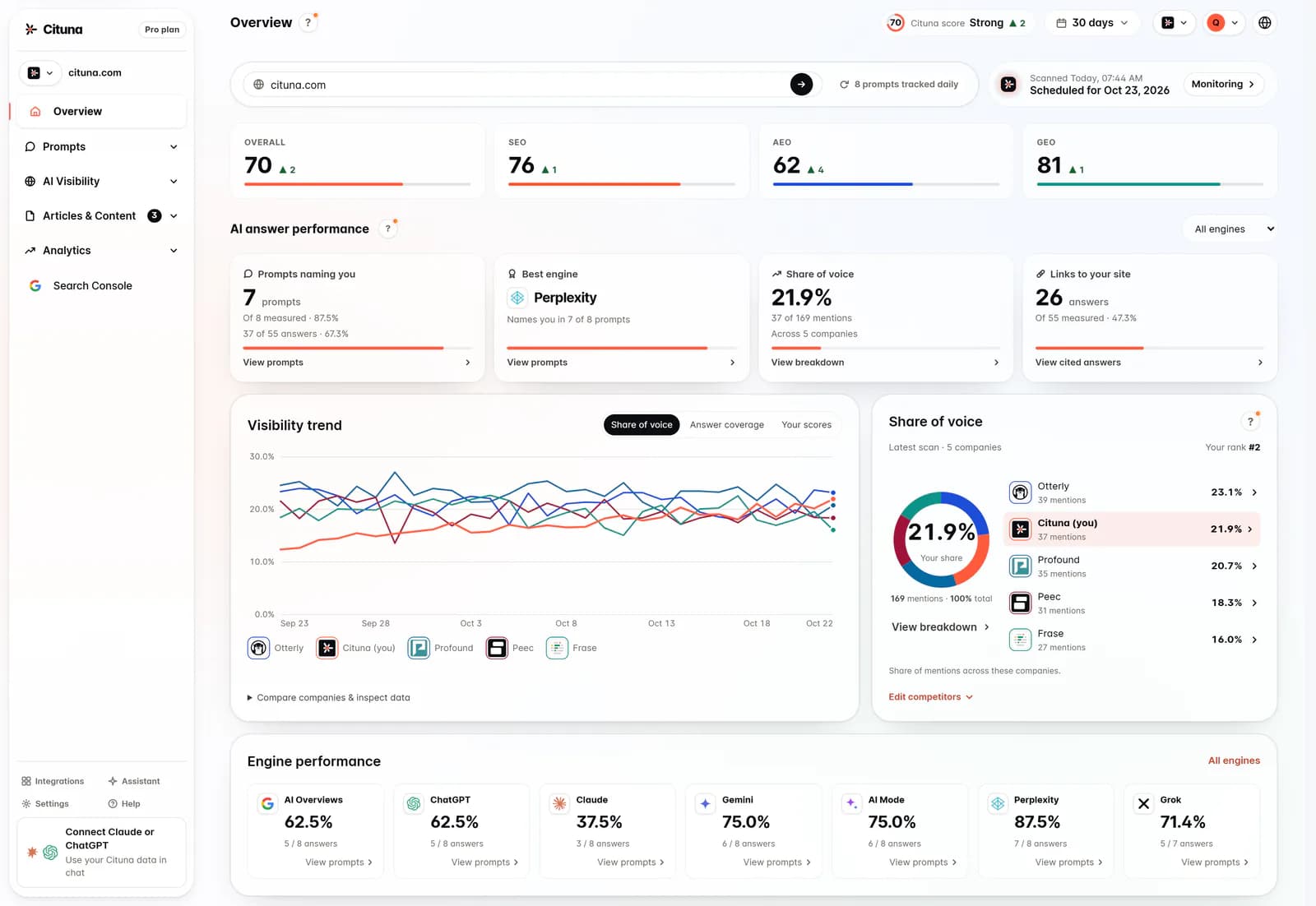
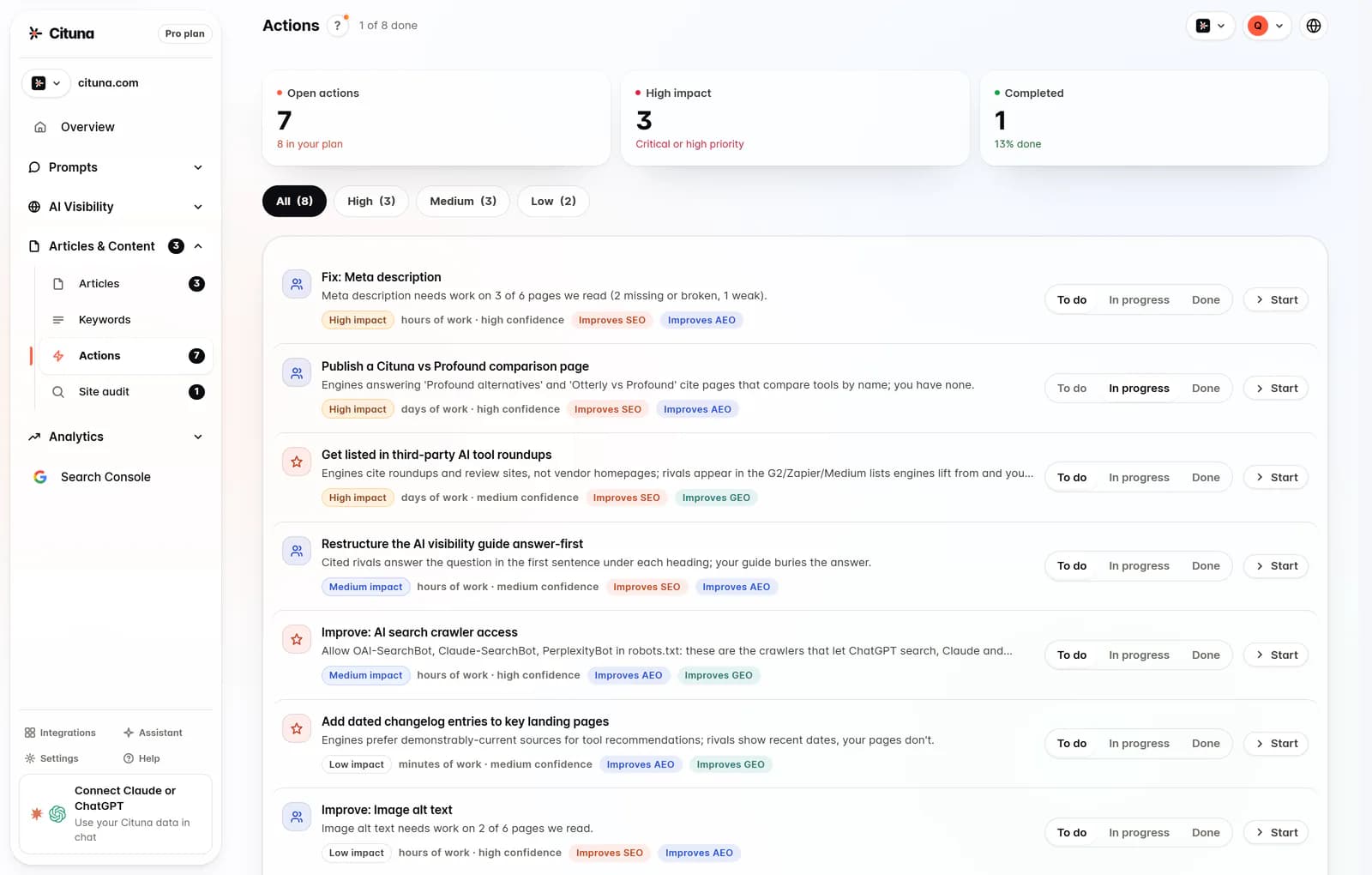
For a team that needs daily tracking without an Enterprise contract, the pick is Cituna: it asks seven AI engines your buyers’ questions every day from $49 a month. Profound’s Enterprise contract fits a team that needs Microsoft Copilot, SSO and SOC 2. Choose a Profound plan by starting with the decisions your team must make each month, then buying enough coverage to support those decisions. Company size is a weaker guide than the number of markets, brands, product lines, and stakeholders involved.
A small company may need a larger contract if it sells several products across multiple regions and wants separate tracking for each one. A larger company may manage well with a smaller one if one team monitors a narrow category and needs only a focused set of prompts. Count the distinct questions, locations, engines, and competitors you need to compare before reviewing plan limits.
Use a simple threshold test. If a plan cannot cover your priority prompts or removes the historical view needed to judge movement, it is too small. If the plan adds seats, projects, or monitoring volume that nobody will use, it is too large. Ask for the smallest scope that can support a complete decision cycle, from detecting a missing answer to changing a page or message and checking the result later.
For more context, read AI Visibility Workflow for Marketing Teams.
Which Profound inclusions matter most for a lean marketing team
A lean marketing team should prioritize prompt coverage, engine coverage, historical comparisons, and usable evidence before buying extra seats or broad reporting. Those inclusions determine whether the team can identify a real visibility problem and decide what to change first.
Prompt coverage matters because a brand can appear for general category questions while disappearing from comparison, implementation, pricing, or problem-specific questions. Engine coverage matters because ChatGPT, Perplexity, Gemini, Claude, Grok, Google AI Overviews, and Google AI Mode may produce different answers and cite different sources. Historical access matters because a single answer is an observation, not a trend.
Evidence quality is equally important. The team should be able to inspect the answer, identify whether the company was named, and understand which sources influenced the response. Reporting that compresses everything into one visibility score can hide the reason behind a change. Treat collaboration features as secondary unless several people genuinely need to review findings. A focused plan with trustworthy detail is more useful than a broad plan that produces more dashboards than the team can interpret.
What to check about citation and source data
Check whether Profound shows the actual answer and cited sources, not only a score saying that your brand was visible. The source trail is what turns an AI search observation into a marketing decision.
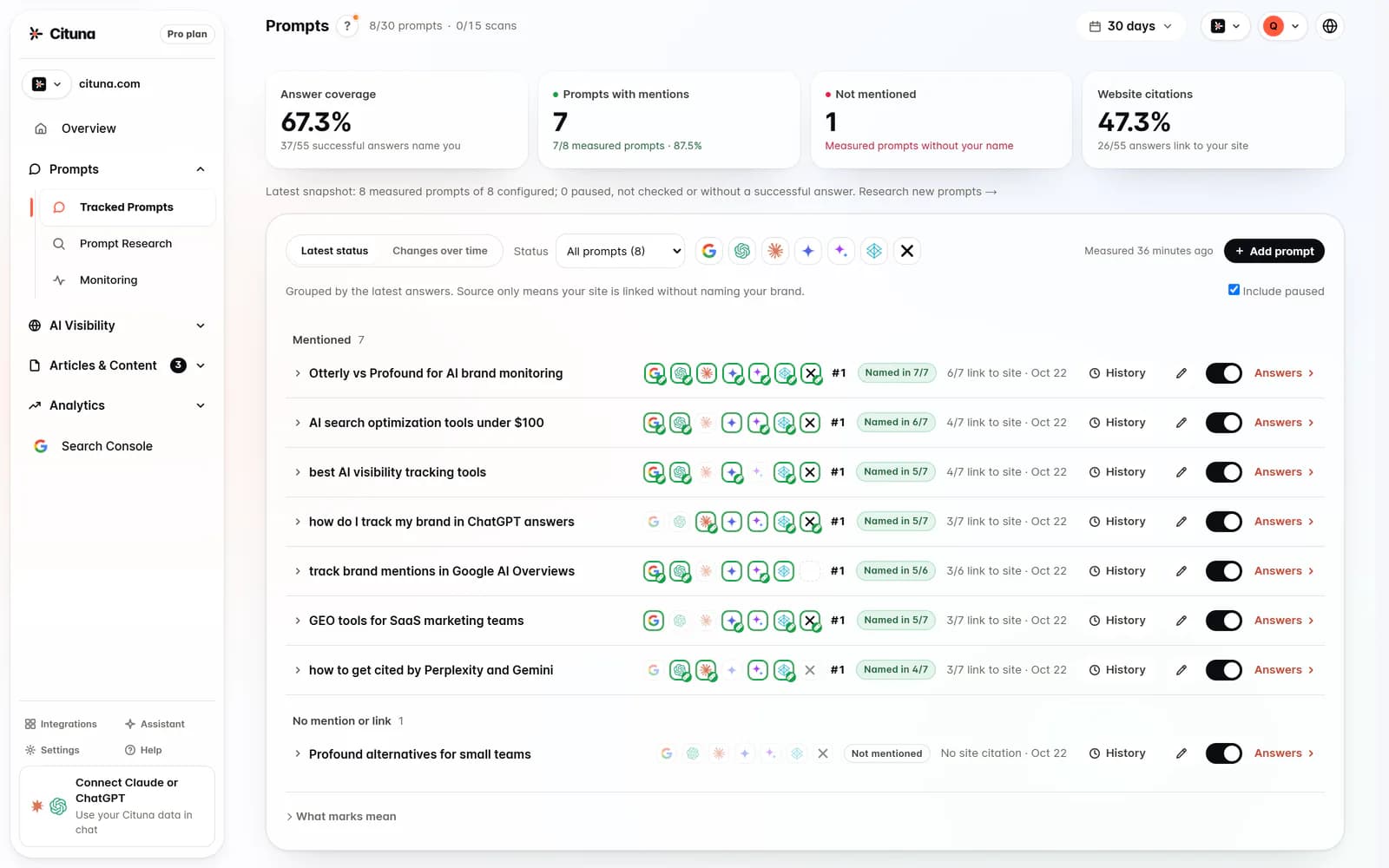
For each tracked prompt, ask whether the data distinguishes a direct brand mention, a linked citation, a recommendation without a link, and no appearance at all. These outcomes have different implications. A company can be named but unsupported, cited but described inaccurately, or omitted while a competitor receives the recommendation. A single blended metric can make those cases look alike.
Also confirm how the platform handles repeated runs, changing answers, regional results, and answer formats. ChatGPT, Perplexity, Gemini, Claude, Grok, Google AI Overviews, and Google AI Mode do not necessarily expose identical source behavior, so a plan that reports only one type of citation may leave important gaps. Ask whether source records remain available for investigation and how long they are retained. The commonly missed requirement is not more prompts. It is enough context to explain why an answer changed and what evidence supports the next action.
When is a larger plan worth the additional cost?
A larger Profound plan is worth the additional cost when its extra coverage changes a decision your team will actually make. More tracked prompts are valuable only when they reveal a priority audience, market, product, or engine that the smaller plan cannot represent.
Test the upgrade against a specific operating need. Perhaps separate regional tracking is required before a launch, or several product teams need independent prompt sets. Perhaps the team needs longer history to compare a content change with later answer movement, or needs broader access for agencies and internal reviewers. Each case connects an added inclusion to a measurable decision.
Do not upgrade because a dashboard feels incomplete in the abstract. First identify the information missing from the current plan, then ask what action that information would trigger. If nobody can name the action, the upgrade may increase reporting without increasing learning. Rules and product packaging can change, so confirm whether an apparent feature is included, capped, metered, or available only through a negotiated package. A useful upgrade removes a known blind spot, rather than adding a larger version of the same uncertainty.
Calculate whether Profound is paying off
Calculate Profound’s value by comparing its cost with the value of decisions improved by better evidence, not by counting dashboard views. AI visibility work can influence content priorities, category positioning, product messaging, and the accuracy of answers buyers encounter.
Create a monthly record with four fields: the prompts monitored, the material findings, the changes made, and the business outcome that can reasonably be connected to those changes. Record a baseline before making edits. For example, note that a product was absent from a high-priority comparison answer, identify the page or proof point changed in response, and revisit the same prompt later. Keep the observation separate from the explanation, because an answer may change for reasons outside your control.
The right financial test depends on your business model. A lead-driven company may examine qualified enquiries influenced by a changed category page. A sales-led company may review opportunities where the relevant problem or comparison appeared in research. A content team may first value avoided work and faster prioritization. Do not promise direct revenue attribution where the data cannot support it. Profound is more defensible when it improves a documented decision process, even before a complete pipeline link exists.
Which team workflow a Profound plan should support
A Profound plan should support a repeatable workflow from observation to owner to follow-up, because visibility data has little value when nobody is responsible for acting on it. The plan should fit how your marketing, content, product, and sales teams already work.
Assign an owner for reviewing findings, an owner for approving changes, and an owner for checking results. The same person may hold all three roles at a small company. Define a compact review rhythm, such as examining priority prompts, grouping failures by cause, selecting one or two changes, and recording the next check. Ask whether the plan’s user access, projects, exports, or sharing options support that rhythm before treating them as purchasing details.
Keep engine observations separate from website analytics. A visit from a cited page can be useful, but an answer can influence a buyer without producing a measurable click. Likewise, a page change can improve relevance without immediately changing every answer. The most useful plan therefore supports a clear evidence handoff. It should help a marketer explain the finding to a writer, product expert, or founder without requiring everyone to become an AI search specialist.
What to ask before signing or renewing
Before signing or renewing, ask Profound to state every important limit in writing, including engines, prompts, locations, domains, competitors, users, history, exports, alerts, and support. A concise answer to those questions is more valuable than a broad feature list.
Ask what happens when you exceed a limit, whether unused capacity carries forward, how an added project is priced, and whether historical data remains available after a plan change. Confirm which parts are included in the quoted package rather than assuming that a capability shown in a demo applies to every tier. Ask how often the tracked answers run and whether reruns, regional settings, or custom prompts affect usage.
Use one recent business question as a trial. Give the vendor a prompt where your brand is currently missing, a competitor is prominent, and the answer could lead to a real content change. Check whether the proposed plan shows enough context to diagnose the omission. If it only produces a score, it may not solve the problem that led you to buy. Run the same test on Cituna, which publishes this guide: every day, on every plan from $49 a month, it asks ChatGPT, Perplexity, Gemini, Claude, Grok, Google AI Overviews, and Google AI Mode the questions your buyers ask. It then generates the fix for each gap, its AutoSEO writes and publishes articles, and Claude or any other AI agent can work with the data over MCP.
Related reading
Sources consulted
- OpenAI platform documentation (platform.openai.com)
- Google Search documentation (developers.google.com)
- Anthropic documentation (anthropic.com)
- Perplexity documentation (docs.perplexity.ai)
Drafted with AI assistance from our own research and Search Console data, and reviewed by Rahul A before publishing. Rules and prices change; check the linked official source before you act.