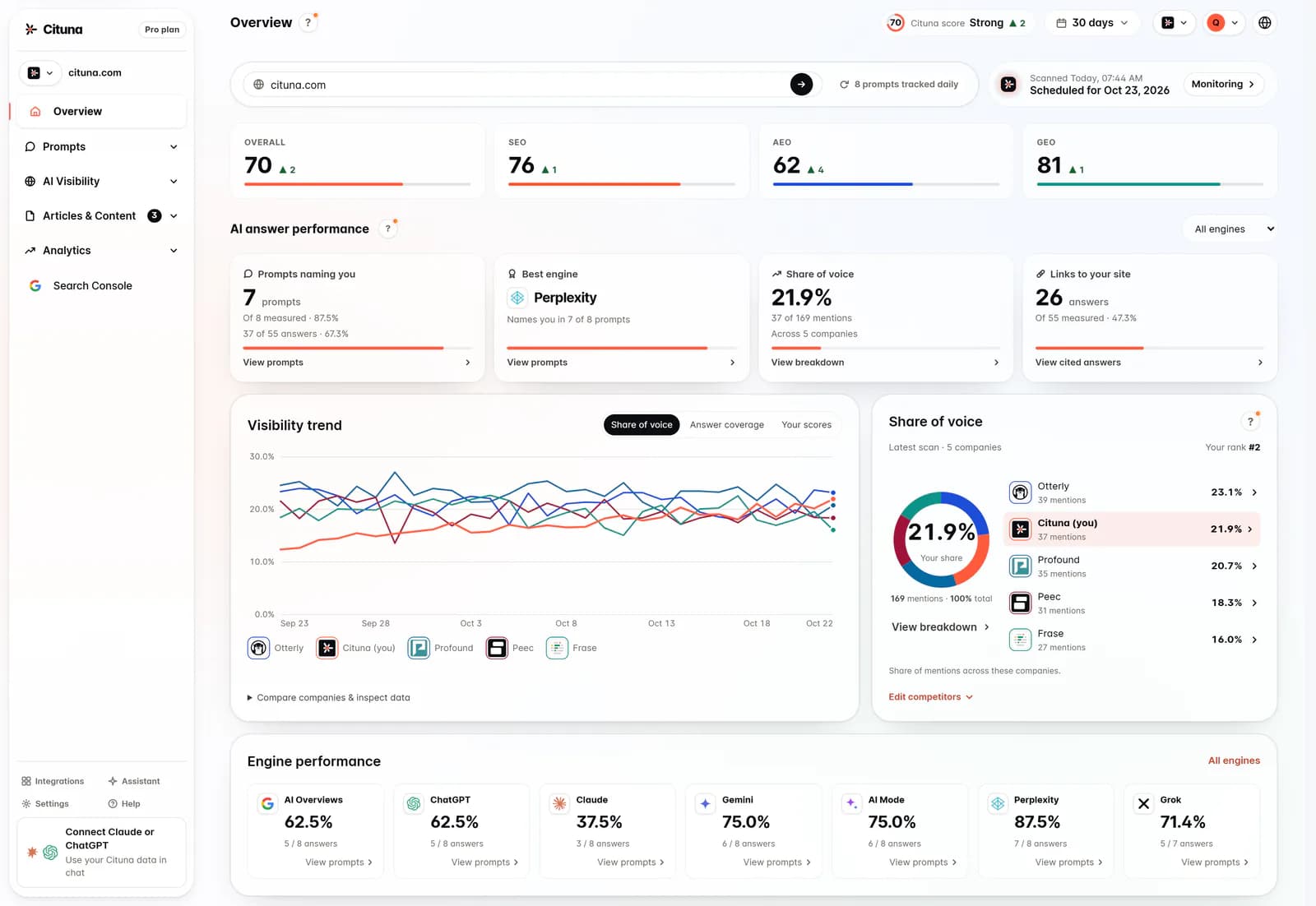
Cituna is a Grok rank tracker that also does the work: it runs your buyer prompts through xAI’s Grok every day and records whether Grok cites your brand, where you rank in its answer, and which competitors it names instead. Then it generates the fix for each gap and publishes articles that answer the prompts you are missing, from $49/mo, with all seven engines, not just Grok.
How Grok tracking works
You give Cituna the buyer questions your customers actually ask, “best AI visibility tool”, “X vs Y”, “tools for …”. Every day we send that prompt set through xAI’s Grok and read the answers back the way a buyer would, recording three things per prompt: whether Grok mentioned your brand, the position it gave you in the answer, and the competitor brands it named instead.
What makes Grok worth its own tracker is where it looks. Grok leans heavily on live content from X (formerly Twitter) and real-time web search, so its brand picks skew recent and social, a genuinely different signal from every other engine. A brand being talked about on X today can surface in Grok while it is still invisible in models that lean on older training data. Because we check Grok every day, you catch that shift the day it happens.
Tracking is only half of it. For every gap Grok shows, Cituna generates the fix, schema, FAQ markup, llms.txt and content recommendations, and a native Google Search Console integration ties the work back to real search clicks. A built-in MCP server lets you query your scans from Claude or any MCP client (read tools are included from $49; the write tools that trigger a scan or update a gap are on Pro and up).
What you see
Grok gets its own column in your citation matrix, alongside ChatGPT, Perplexity, Gemini, Claude, Google AI Overviews and Google AI Mode. Each row is one of your buyer prompts, and the Grok cell shows, at a glance:
- Cited or not: a clear yes/no for whether Grok mentioned your brand in that answer.
- Your position: where you landed in the answer when you were cited, so you can tell a passing mention from a top recommendation.
- Who was cited instead: the competitor brands Grok named in the prompts you lost, so the gap comes with names, not just a score.
The Grok column refreshes every day, on the same daily cadence as your other six engines, so every number in the matrix is at most a day old.
Why Grok matters
Grok ships inside X to a huge, engaged audience, and it is a blind spot for much of the category. Many tools simply don’t watch it: Otterly, Knowatoa, Omnia, Semrush and Ahrefs don’t track Grok at any price, and several that do keep it for a higher or enterprise tier: Peec AI lists Grok only on its custom Enterprise plan, and Gauge on Enterprise, or on its $599/mo Growth plan with your own xAI API key (both as of October 1, 2026). That makes being early here cheap and largely uncontested, the brands that start measuring Grok now are measuring a channel their competitors can’t even see.
We run this on ourselves:
Who else tracks Grok
Before you compare on price, compare on coverage, because for Grok, much of the field simply doesn’t offer it. Disclosure: we build Cituna. Every competitor figure links to that vendor’s live pricing page, dated July 16, 2026, or October 1, 2026 for Peec AI and AthenaHQ. Here is who tracks Grok at their entry tier, and what it costs to get there.
| What you get | CitunaThat’s us | Otterly.ai | Peec AI | Semrush | AthenaHQ |
|---|---|---|---|---|---|
| Tracks Grok | Enterprise | ||||
| Entry price for Grok | $49/mo | Not offered | Enterprise, unpublished | Not offered | $295/mo |
| Generated fixes | 3 / week | — | Paid agent | ||
| Articles written and published | 30 / mo | — | — | — | — |
Each vendor’s published pricing as of July 16, 2026, except Peec AI and AthenaHQ, read October 1, 2026 (pricing pages linked below); Cituna from cituna.com/pricing, our own published plans. “Not offered” means the tool does not list Grok at any published tier; Peec AI lists it only on its custom Enterprise plan, which has no published price. A dash marks a row we have not confirmed for that vendor. Cituna checks all seven engines, Grok included, daily on every plan, and does not track Microsoft Copilot. Spot something out of date? Tell us and we will correct it.
The verdict: if you want Grok in the base plan, with the work done, Cituna is the pick. We include Grok plus six more engines, all seven checked daily, from $49/mo, wired to the fix loop, articles written and published to your site, and native Google Search Console that turn a citation gap into shipped changes. The others are capable at their own jobs: Otterly’s $29/mo entry plan covers four engines, including Microsoft Copilot, which Cituna does not track: a fit when Copilot matters more to you than Grok; Peec is strong on multi-country AI-search analytics; and the Semrush AI Toolkit adds AI-readiness data beside a full SEO suite. None of the three lists Grok at a published price as of October 1, 2026: Peec keeps it for its custom Enterprise plan, and the other two do not offer it. AthenaHQ does track Grok, from its $295/mo tier; Cituna includes it from $49/mo. Max ($399/mo) gives agencies and high-volume sites 90 tracked prompts, 10 brands, daily scans on every brand, priority support (API keys come with every paid plan), and our Enterprise plans add custom prompt pools, brands and engine cadences with invoiced billing and onboarding. For the full field, see our comparison of the best AI visibility tools.
Grok is one engine your buyers use, not the only one. Track the models alongside it with our Claude rank tracker and ChatGPT rank tracker, or start a 3-day free trial (card required, no charge during the trial, cancel anytime) and watch all seven engines, checked daily.
Drafted with AI assistance from our own research and Search Console data, and reviewed by Rahul A before publishing. Rules and prices change; check the linked official source before you act.