For twenty-five years, winning search meant ranking a page in a list of links. That game is not over, but a second one has started next to it. Ask ChatGPT which tool to buy, ask Perplexity how to fix something, or run almost any query on Google and you now get an answer first, assembled by a model and backed by a short list of cited sources. Answer engine optimization (AEO) is the work of becoming one of those cited sources.
This guide explains what AEO actually is, how answer engines decide who to quote, and a practical framework you can apply this week.
What is answer engine optimization?
Answer engine optimization is the practice of structuring your content, your brand entity and your off-site presence so that AI answer engines surface and cite you when they respond to a question. An answer engine is any system that replies with a direct, synthesized answer instead of only a list of links: ChatGPT and its search mode, Perplexity, Google AI Overviews, Gemini, Microsoft Copilot and Claude when it browses.
The goal is narrower than “traffic” and more specific than “rankings.” You want the engine to do one of three things when it answers a question in your category: name your brand, link your page, or repeat a claim or framing that originates with you. Those three outcomes, mention, citation and influence, are what AEO optimizes for.
Why this matters now:
How answer engines choose what to cite
You cannot optimize for a black box you do not understand, so start with the mechanics. Modern answer engines work in two broad modes, and good AEO addresses both.
Retrieval mode (live sources, visible citations)
Perplexity, Google AI Overviews, ChatGPT search and Gemini mostly run a real search behind the scenes, read the top results, and synthesize an answer with citations. To be pulled into that answer, four things have to be true at once:
- Reachable. Their crawler can fetch your page (you have not blocked it, and the content is in the HTML, not locked behind JavaScript the crawler will not run).
- Relevant. Your page clearly matches the specific question, ideally answering it in the first sentence or two of a section.
- Extractable. The answer is a clean, self-contained passage the model can lift without stitching it together from five places.
- Trusted. The source is one the engine already treats as credible for the topic, which is where off-site authority comes in.
Training mode (what the model already “knows”)
When a model answers from memory without browsing, what matters is how strongly and consistently your brand appears in the data it was trained on: your own site, but also Wikipedia, Reddit, industry publications, review sites and comparison pages. A brand that is described the same way in many trustworthy places becomes a well-formed entity the model can recall and recommend. A brand that barely appears, or is described inconsistently, does not.
The practical implication is the throughline of this whole guide: being citable is part on-page and part off-page. You control the structure; you earn the trust.
AEO vs SEO vs GEO
These three acronyms describe overlapping work, and the boundaries are genuinely fuzzy. The distinction that helps is what each one optimizes the outcome to be.
| Dimension | SEO | AEO | GEO |
|---|---|---|---|
| Optimizes for | A ranked position in a list of links | Being the cited answer in an answer engine | How generative models describe and summarize you |
| The interface | Ten blue links | A direct answer with a few citations | A synthesized paragraph, cited or not |
| You win when | Someone clicks your result | An engine names or links you | A model repeats your framing |
| Main levers | Keywords, links, technical health | Answer-first structure, entity authority | Citable claims, original data, trust |
The line between AEO and GEO is blurry and the terms are often used interchangeably. In practice the same core work serves both.
The important thing is that these are not competing strategies you choose between. SEO is the foundation: a page that a search engine cannot crawl, understand or trust will not be cited by an answer engine either. AEO and GEO are the layer you add on top for the answer surfaces. For a deeper look at where they diverge, see our guides on AEO vs SEO and generative engine optimization.
A six-part AEO framework
Here is the sequence we recommend, ordered by impact. Do the earlier steps first; the later ones compound but rarely rescue weak foundations.
1. Make sure AI engines can actually reach you
None of the rest matters if the crawlers cannot read your pages. Confirm your robots.txt welcomes the AI crawlers you want (GPTBot, ClaudeBot and PerplexityBot among them), that your important content is server-rendered into the HTML rather than assembled only in the browser, and that your sitemap is current. A surprising number of “we are invisible in AI” cases come down to a crawler being blocked or content that only exists after JavaScript runs.
2. Structure content so the answer is easy to lift
Answer engines reward passages they can extract cleanly. Lead each section with the answer, then explain. Phrase your headings as the questions people actually ask. Keep the core answer to a tight, self-contained few sentences before you expand. Use lists, tables and clear definitions where they fit, and add an FAQ for the natural follow-up questions. This is the single most controllable lever you have.
3. Establish your brand as a clear entity
Models recommend entities they recognize. Describe your company consistently everywhere it appears, publish an Organization schema with your real identifiers and profiles, and make sure the basic facts about who you are and what you do are easy to find and identical across sources. If a legitimate Wikidata or Wikipedia presence is within reach for your brand, it is a strong entity signal.
4. Earn citations and mentions off-site
This is the hardest step and the one that most separates brands that get cited from brands that do not. Answer engines lean on sources they already trust, so you want to be present where they look: earned press, genuinely useful comparison and “best tools” lists, active and helpful presence in the communities relevant to your space, and above all original data or claims worth quoting. A single well-promoted study that others reference does more for citability than a dozen restated explainers.
5. Add the machine-readable signals
Once the higher-impact work is underway, add the low-cost signals: FAQPage and Article schema on the relevant pages, clean and descriptive metadata, and an llms.txt file if you want to publish a curated map of your most useful content (our free llms.txt generator builds one in minutes). Be honest with yourself about this tier: it helps machines parse you, but on its own it does not manufacture trust. See our honest guide to llms.txt for what it does and does not do.
6. Measure, then close the gaps
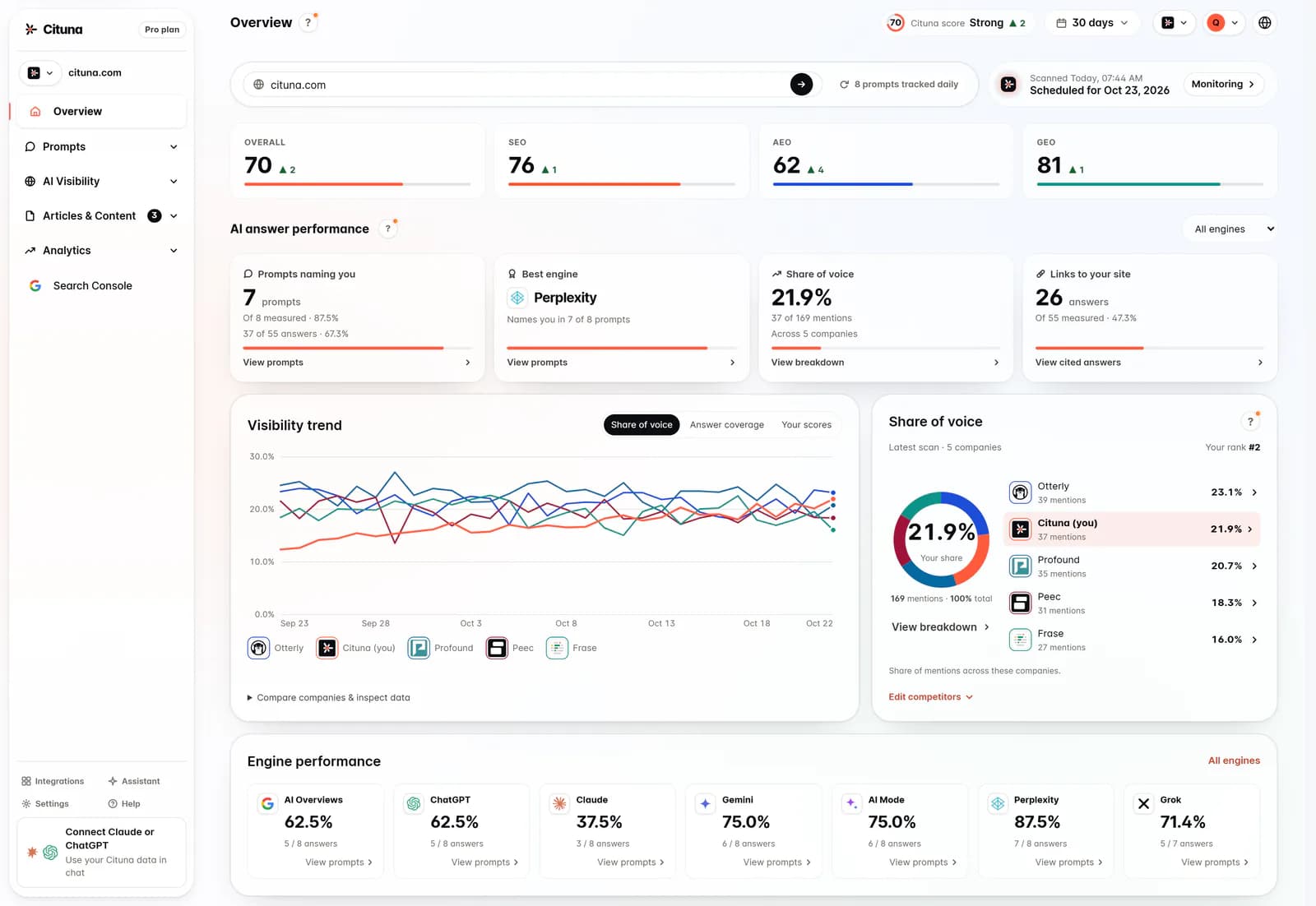
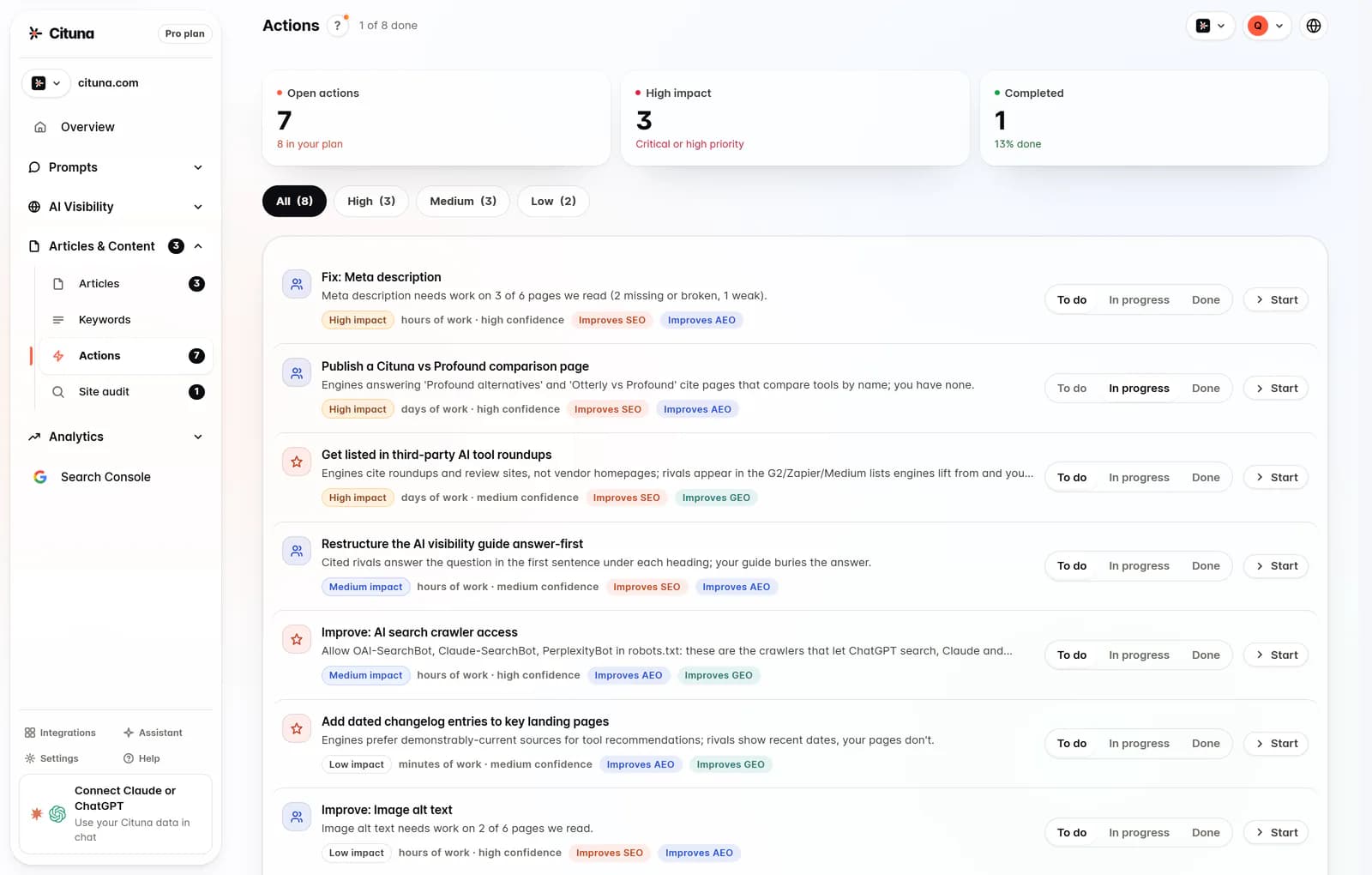
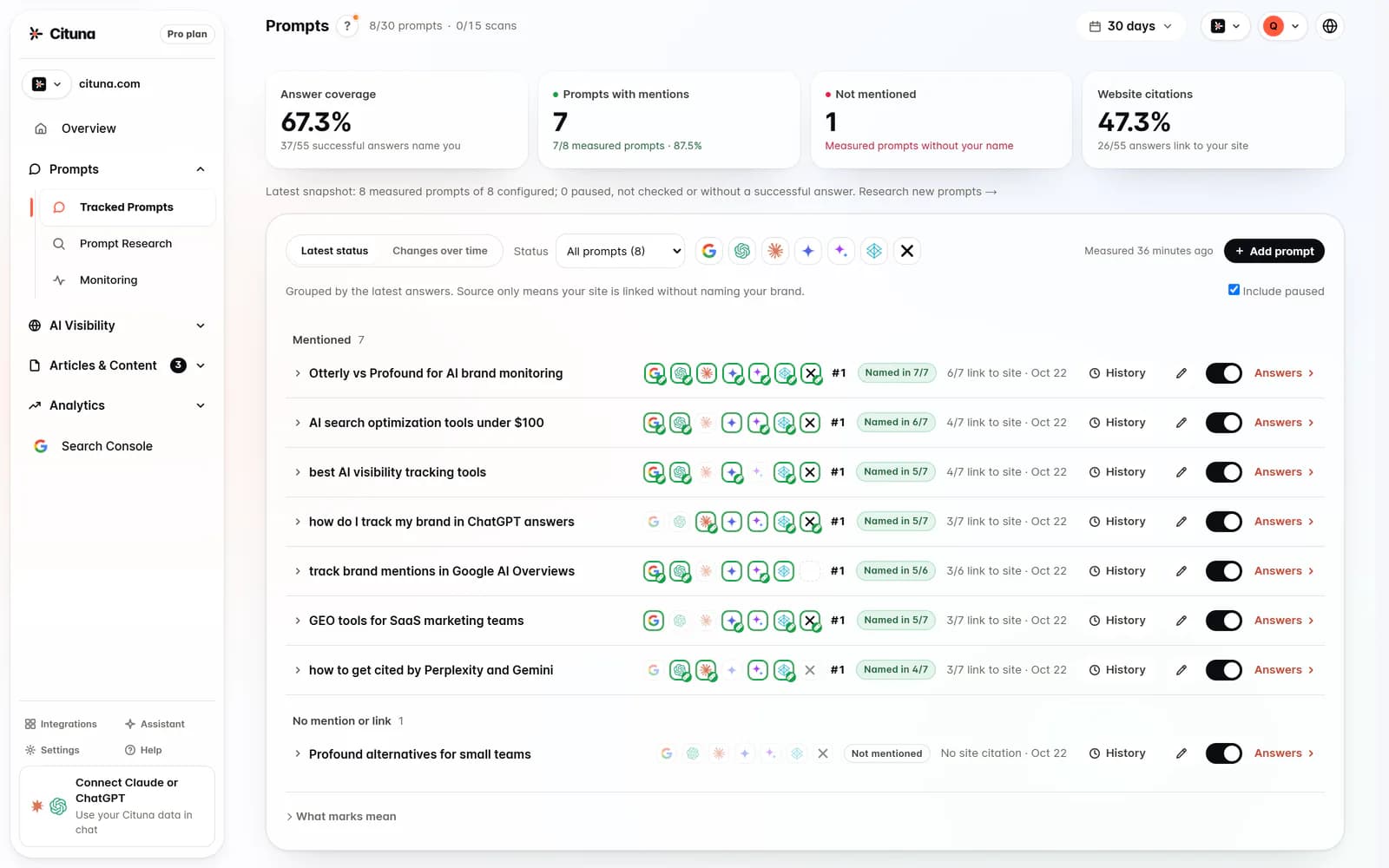
AEO is a loop, not a launch. Ask the engines your buyer questions on a schedule, record who they cite, and work the specific gaps where a competitor is named and you are not. That is the job Cituna is built for: it scans your visibility across ChatGPT, Perplexity, Gemini, Claude, Grok, Google AI Overviews and Google AI Mode every day and turns each gap it finds into a concrete schema, FAQ or content fix. The next section goes deeper on measurement.
How to measure AEO
Traditional analytics were built for clicks, so they miss most of what happens on the answer surface: an engine can name you, shape a buyer’s shortlist and never send a measurable visit. Three metrics fill the gap.
- Citation rate. Of the buyer questions in your category, what share produce an answer that names or links you?
- Share of voice. When your category is discussed, how often do you appear versus each competitor? This is the number that tells you whether you are winning or just present.
- Sentiment and accuracy. When you are mentioned, is the description favorable and correct? A confident, wrong summary of your product is its own problem to fix.
Pair those answer-side metrics with the click side. Connecting Google Search Console lets you watch real impressions and clicks move as your fixes land, so you can tie AI visibility work back to traffic rather than trusting a vanity score. For the full measurement playbook, see AI visibility: how to measure and improve it.
Common mistakes
- Chasing the head term. A brand-new site will not out-rank the encyclopedias and DR90 publishers for “answer engine optimization.” Win the specific, buyer-intent questions first and let authority compound.
- Treating schema as a growth hack. Structured data removes ambiguity; it does not create trust. Ship it, then move on to the work that does.
- Writing for the model instead of the reader. Answer engines reward genuinely useful, well-organized content because that is what they are trying to surface. Thin content stuffed with question headings fools no one.
- Blocking the crawlers you want. Double-check that an overzealous security rule or a blanket bot block is not quietly excluding GPTBot, ClaudeBot or PerplexityBot.
- Never measuring. If you are not periodically asking the engines your buyer questions, you are optimizing blind. Watch the citations, then work the gaps.
Do the fundamentals well, earn a little trust off-site, and measure the loop, and you move from invisible to cited. That is the whole game.
Drafted with AI assistance from our own research and Search Console data, and reviewed by Rahul A before publishing. Rules and prices change; check the linked official source before you act.