ChatGPT chooses which brands to recommend by combining two things: what it learned about your brand during training, and, when it browses the web, the pages it retrieves and trusts at answer time. In both modes it favors brands that are described consistently, corroborated by independent third parties, and recognizable as a single, well-defined entity.
There is no single, published formula, and the behavior shifts by prompt, by account and over time. But the mechanics are knowable, and they point to a short list of things you can influence. This guide covers how the decision gets made, what our own cross-engine scans reveal, and a checklist to become one of the brands ChatGPT names.
How ChatGPT decides which brands to recommend
Start with the mechanics, because you cannot influence a decision you do not understand. ChatGPT surfaces brands in two broad modes, and most real answers draw on both.
Training memory: what it already learned about you
When ChatGPT answers without browsing, it draws on patterns in the data it was trained on. It can only name brands that were well represented across the web it learned from, your own site, but also Wikipedia, Reddit, industry publications, review sites and the “best tools” lists people publish. A brand described the same way in many trustworthy places becomes a recognizable entity the model can recall with confidence; a brand that barely appears, or is described inconsistently, does not. Training data also has a cutoff, so a brand-new company may not exist in the model’s memory until a later version learns it.
Live web search: what it retrieves and cites right now
When a question rewards current information, ChatGPT browses. It runs a search behind the scenes, its search has drawn on Bing’s index, and OpenAI has built its own crawling and retrieval on top, reads the top results, and synthesizes an answer with links to the sources it used. To be pulled into that answer, three things have to be true at once: its crawlers (GPTBot and OAI-SearchBot) can reach your page, the page clearly matches the question, and the answer is a clean, self-contained passage the model can lift without stitching it together. That is the same core work as answer engine optimization.
In practice the two modes reinforce each other: the corroboration that builds a strong training-time entity is the same corroboration that makes your pages trustworthy enough to cite live. For the on-page playbook, see how to get cited by ChatGPT.
The signals that tip ChatGPT toward a brand
Whichever mode is running, a consistent set of signals decides who gets named. None of them is a trick, and no single one guarantees a mention, they compound.
Third-party corroboration
This is the strongest signal and the one most people underrate. ChatGPT trusts what other sources say about you far more than what you say about yourself. Being included in genuine “best X” round-ups, carrying real reviews on the sites buyers check, and being discussed helpfully in the communities relevant to your category, Reddit, forums, the industry threads that get indexed, turns a name into a safe recommendation. When many independent sources point at the same brand for the same job, the model reads that as consensus, which is what it wants to hand a user who asked for one.

Consistent entity descriptions
Models recommend entities they can place. If your name, your category and your one-line description read the same way everywhere they appear, your site, your LinkedIn and Crunchbase profiles, review directories, and ideally a Wikidata or Wikipedia entry, you resolve cleanly to a single, well-defined entity. If sources describe you differently, or your basic facts are sparse or contradictory, you stay ambiguous, and an ambiguous brand is easy to skip in favor of a competitor the model is sure about. Publishing Organization schema and keeping the facts identical across sources is unglamorous work that pays off here.
Recency and freshness
For any question that benefits from current information, recency is decisive. A recently updated page, a fresh review, or a new mention on a trusted site can be cited live even when you are absent from the model’s training memory, often the only route in for a newer brand. The reverse holds too: a company that was prominent three years ago but has gone quiet fades from the fresh signals, and eventually from the recommendations.
| Signal | What it looks like | How much it moves recommendations |
|---|---|---|
| Third-party corroboration | Best-of lists, review sites, community mentions, earned press | Highest: the strongest predictor of being named, and the hardest to fake |
| Consistent entity | Same name, category and description across your site, profiles and Wikidata | High: resolves you to one entity the model can confidently place |
| Answer-first content | The buyer question answered cleanly in the first line of a section | High and fast: your most controllable lever, and what gets lifted |
| Crawlability | GPTBot and OAI-SearchBot allowed; content server-rendered | Foundational: nothing gets cited in live search if bots cannot read it |
| Recency | Recently updated pages, fresh reviews and mentions | Medium: decisive for questions that reward current information |
There is no published formula and the mix varies by prompt, account and over time. The ordering here is a directional guide, not weights ChatGPT discloses.
How does ChatGPT choose businesses to recommend?
The mechanism is the same when the question is about a business rather than a product: training memory plus live citations. Ask ChatGPT for an accountant for a small agency or a dentist in a particular city and it still recalls what the web says and, when it browses, retrieves the pages it trusts for that question. What changes is which pages those are. For businesses, the decisive sources are review sites, directories, maps listings and local round-ups, because that is where the web actually records who serves a place and how well.
That shifts the work. A small or local business rarely earns a recommendation through its own homepage; it earns one by being present, reviewed and accurately described on the handful of third-party surfaces ChatGPT leans on for that kind of question. The corroboration signal from the previous section applies with full force here, it just lives on different pages: the local “best of” list instead of the industry round-up, the review profile instead of the analyst write-up.
Consistent naming is what makes it all resolve. If your name, category and city read the same way across your website, your maps listing, your review profiles and the local round-ups that mention you, ChatGPT can collapse those references into one entity it is confident recommending. If the listings disagree, an old trading name here, a different category there, you stay ambiguous, and an ambiguous business is easy to skip in favor of one whose details line up everywhere.
What we see across engines
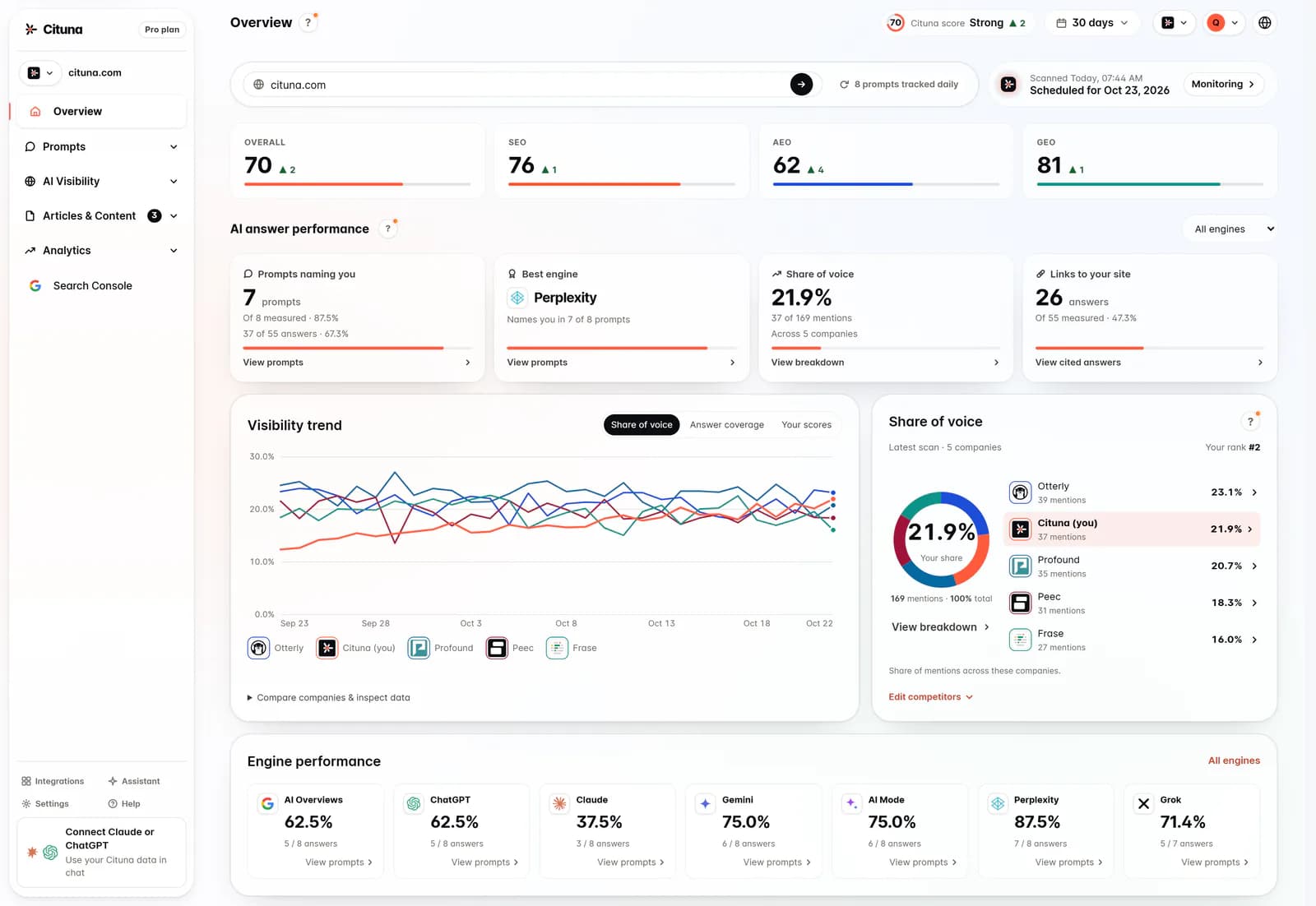
We run Cituna on our own domain, so we can show the mechanics with real numbers. What follows is our own scan data, a July 17, 2026 self-scan of cituna.com across all six engines we covered at the time: ChatGPT, Perplexity, Gemini, Claude, Grok and Google AI Overviews (Google AI Mode was added later, and we do not track Microsoft Copilot).
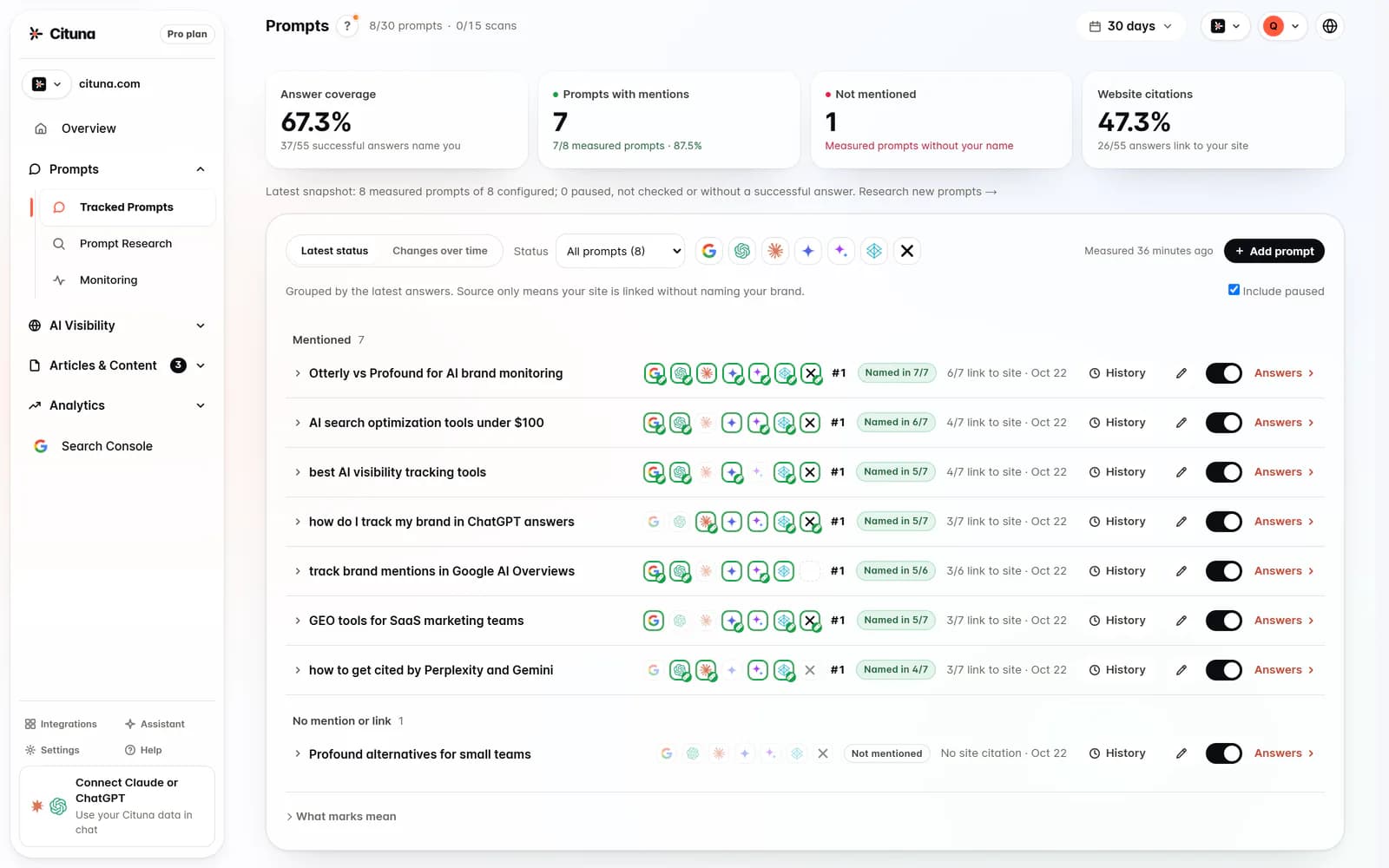
We tracked ten buyer prompts. The result lined up exactly with the mechanics above, and it was stark: every single citation we earned, on every engine, came on one of the two prompts that named “Cituna” in the question itself, “compare Cituna vs Moz for AI visibility” and “Cituna vs. traditional SEO services.” On ChatGPT specifically we were cited on both of those branded prompts, and named first each time. Not one of the eight open category questions, “best AI visibility audit service,” “how to improve brand visibility in AI,” “what is AI visibility and why does it matter”, produced a citation for us on any engine.
The branded-versus-category split:
In those category answers, the names that showed up instead were the heavily-referenced brands the model is most sure about. Across the scan, Moz and Semrush led, each cited in six of the answers, with Ahrefs, Profound and Otterly close behind: long-standing SEO names and the best-known AI-visibility tools alike, all far better corroborated than a days-old domain. The cross-engine read was the same shape everywhere: ChatGPT cited us twice, Gemini, Grok and Google AI Overviews once each, and Perplexity and Claude not at all, always on a branded prompt, never on a category one. Our domain was only days old, with almost no third-party corroboration yet, so this is precisely the starting point the theory predicts. It is also an unflattering result for our own brand, which is the point of measuring: you cannot close a gap you cannot see. For how to turn measurement into a program, see AI visibility: how to measure and improve it.
Your action checklist to become a recommended brand
Pull the mechanics together and the to-do list is concrete. Roughly in order of impact:
- Let the crawlers in. Confirm
robots.txtallowsGPTBotandOAI-SearchBot(addClaudeBot,PerplexityBotandGoogle-Extendedfor the other engines), and server-render the content you want cited so a crawler sees it without running JavaScript. - Answer the exact question first. Open each page and section with a clean, self-contained answer, then explain underneath, that first passage is what an engine lifts.
- Describe your brand identically everywhere. Same name, category and one-line description on your site, LinkedIn, Crunchbase and review profiles; publish
Organizationschema; claim a Wikidata entry where it is genuinely warranted. - Earn third-party corroboration. Get onto genuine best-of lists, collect real reviews, and be authentically useful in the communities your buyers read. This is the slowest lever and the most decisive.
- Publish something quotable. One piece of original data, a benchmark or a survey does more for citability than a dozen restated explainers, because other sources cite it and the model learns you as its source.
- Keep it fresh. Update your key pages and keep your facts current so the recency-sensitive questions can still find you.
- Measure on a schedule. Ask ChatGPT your real buyer prompts repeatedly, in fresh chats, record who is named instead of you, and work the specific category questions where a competitor appears and you do not.
That last step is the loop the rest depends on, and it is what Cituna automates. It runs your real buyer prompts across all seven engines, ChatGPT, Perplexity, Gemini, Claude, Grok, Google AI Overviews and Google AI Mode (not Microsoft Copilot), on a schedule, shows the branded-versus-category gap in a citation matrix, names the competitors cited in your place, and drafts the fixes: schema, FAQ markup and content recommendations. A native Google Search Console integration ties the work back to real search clicks, and a built-in MCP server lets you pull your own scans and gaps into Claude or any MCP client. To start with the engine most buyers ask first, see the ChatGPT rank tracker.
None of this makes ChatGPT recommend you on command, nothing does. But do the corroboration, describe yourself clearly, keep it fresh and measure the loop, and you move from an ambiguous name the model skips to an entity it is confident enough to name.
Drafted with AI assistance from our own research and Search Console data, and reviewed by Rahul A before publishing. Rules and prices change; check the linked official source before you act.