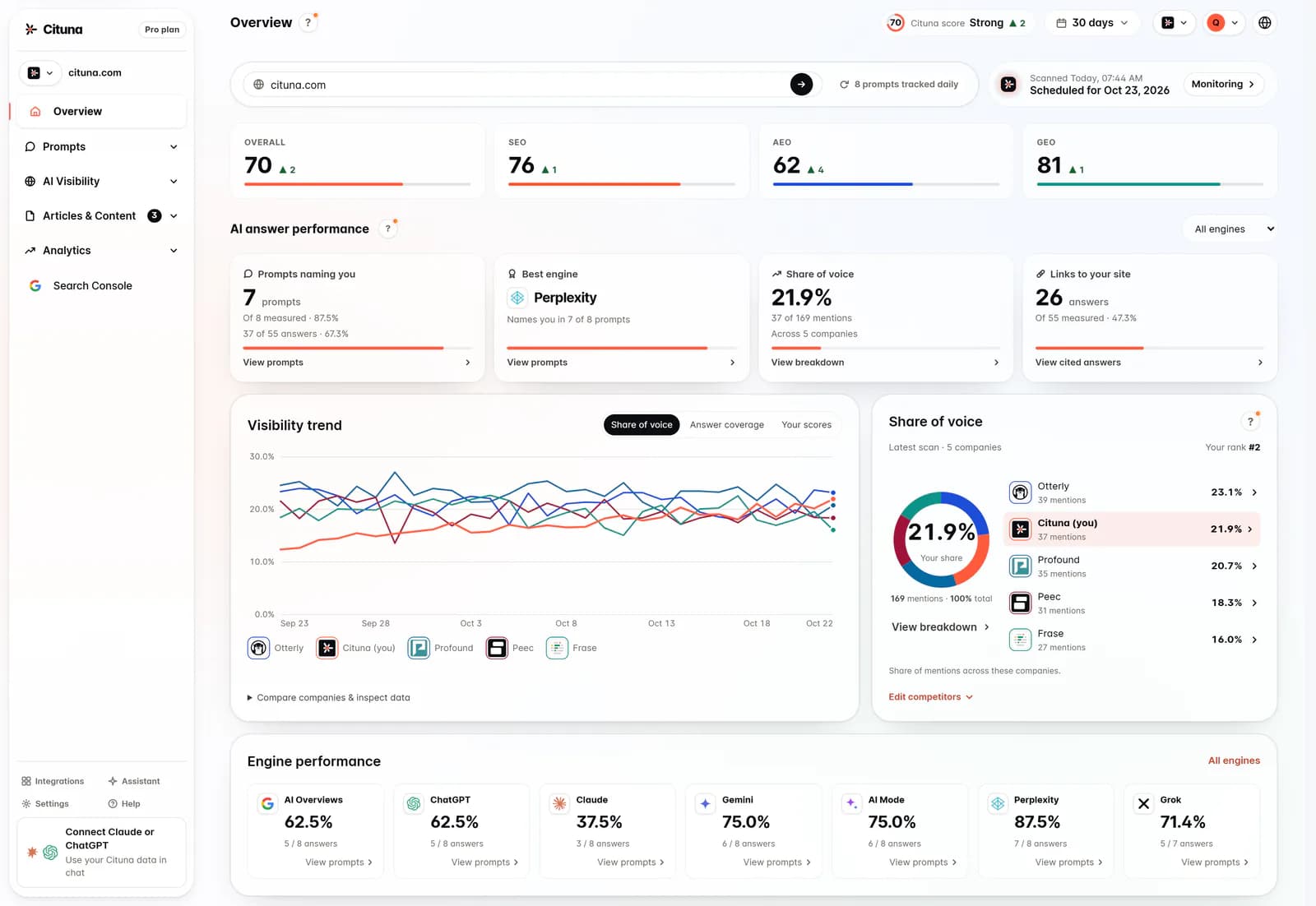
Cituna is a ChatGPT rank tracker that also does the work: it runs your real buyer prompts against ChatGPT every day and records whether your brand is mentioned, at what position, and which competitors are named instead. Because ChatGPT’s answers vary run to run, a single manual check misleads; the daily series shows the real pattern. Then it generates the fix for each gap and publishes articles that answer the prompts you are missing, from $49/mo, with all seven engines, not just ChatGPT.
What “rank” means in ChatGPT:
How ChatGPT tracking works
Cituna starts from your real buyer prompts, the questions your customers actually ask, like “best [category] tool for small teams” or “[your brand] vs [competitor].” Each prompt is sent to ChatGPT on a daily schedule, and we read the full answer back: whether your brand is mentioned or cited, where in the response it lands, and every competitor named alongside or in place of you. Because ChatGPT samples its output, the same question can surface different brands from one run to the next, so we repeat the runs and track the trend rather than trusting any single answer. One manual check tells you almost nothing; a daily series tells you whether you are genuinely present, slipping, or gaining.
The prompts are yours to edit, so you track the questions that map to real purchase intent in your category, not generic keywords, and you can watch a specific competitor’s name appear or disappear from the answer over time.
What you see
Every scan produces a citation matrix: one row per buyer prompt, one column per engine. In the ChatGPT column, each cell answers three things at a glance, were you cited (yes or no), at what position when you were, and which competitors ChatGPT named in that answer. Read down the column and you see your ChatGPT presence across your whole prompt set; read across a row and you see how ChatGPT compares to Perplexity, Gemini, Claude, Grok, Google AI Overviews and Google AI Mode on the same question. The ChatGPT column refreshes daily, so it is a live picture, not a one-time snapshot.
We run this on ourselves. In our own July 2026 self-scan, ChatGPT cited Cituna in just 2 of the 10 buyer prompts we track, first-named in both, but absent from the other eight. That is the honest starting point the tool is built to surface: you cannot close a gap you cannot see.
Why ChatGPT visibility matters
ChatGPT is the largest AI assistant by usage, and it does not hand buyers a list to evaluate, it answers their question directly, often with a specific brand recommendation. When someone asks it which tool to use, which vendor to trust, or which product fits their case, the brands ChatGPT names are the shortlist. If yours is not in the answer, a competitor’s is, at the exact moment of purchase intent, before your buyer ever reaches a search results page or your website. Tracking that answer is how you find out whether ChatGPT is sending you deals or sending them to someone else.
Which tools track ChatGPT
ChatGPT is the one engine every AI-visibility tool covers, so the question is not whether a tool tracks it, it is what you get around it, and for how much. Here is how the entry tiers compare:
| Tool | Entry price / mo | Tracks ChatGPT at entry | Generated fixes | Articles written and published | Genuine strength |
|---|---|---|---|---|---|
| Cituna | $49 | Yes, plus 6 more engines | Yes, for each gap | 30 / mo | Seven engines daily, native Search Console, generated fixes and published articles at entry |
| Otterly.ai | $29 | Yes | 3 / week | — | Microsoft Copilot at entry, which Cituna does not track, on a 15-prompt plan, plus free GEO tools |
| Peec AI | $95* | Yes | No | — | Polished analytics with multi-country tracking and unlimited seats |
| Profound | Enterprise, unpublished* | Yes, one of three engines on the 7-day trial | Enterprise | — | Demand-level prompt-volume data, SSO and data exports on an Enterprise contract |
| Semrush AI Toolkit | $99/domain* | Yes | — | — | Adds AI-readiness data to the Semrush suite you may already use |
Entry prices as of July 16, 2026, from each vendor’s linked pricing page, except Profound, read September 25, 2026; Cituna from cituna.com/pricing, our own published plans. ChatGPT is the one engine every tool here covers at entry, so compare on price and on what surrounds it: the other engines, Search Console, whether the tool generates the fixes and whether it writes and publishes articles. * Peec’s tier prices render client-side; read in a browser on October 1, 2026, its Starter is $95/mo, or $80/mo billed annually; Profound lists no self-serve plan and no Enterprise price, and its free 7-day trial covers ChatGPT, Gemini and Google AI Overviews (the $99 Starter it listed earlier in 2026 is gone); the Semrush AI Toolkit is $99/mo per domain, billed annually. A dash marks a cell we have not confirmed for that vendor. Cituna does not track Microsoft Copilot. Verify current pricing on each vendor’s site.
Every tool above tracks ChatGPT; Cituna is the one that pairs it with six more engines, Perplexity, Gemini, Claude, Grok, Google AI Overviews and Google AI Mode (we do not track Microsoft Copilot), plus a native Google Search Console integration, generated fixes and articles written and published to your site, at $49/mo. If you are comparing the whole field, see our rundown of the best AI visibility tools. And because your buyers rarely ask just one engine, the same daily matrix covers our Perplexity rank tracker and Claude rank tracker, worth tracking together, since a brand ChatGPT ignores is often one the others miss too.
Drafted with AI assistance from our own research and Search Console data, and reviewed by Rahul A before publishing. Rules and prices change; check the linked official source before you act.