Run the check
What it checks
Four public files, in the order that determines whether an answer engine can do anything with your site at all.
- robots.txt, per crawler. Eight robots.txt agents (six AI crawlers plus the Google-Extended and Applebot-Extended tokens) are tested individually against your rules, using the same precedence real crawlers apply (longest match wins; Allow beats Disallow at equal length). The result names the exact line that decided each one, so you know what to edit.
- Your homepage, as a crawler sees it. We measure how much text is present in the raw HTML response, before any JavaScript runs. Most AI crawlers do not execute JavaScript, so a client-rendered page can look completely empty to them while looking fine in your browser.
- Structured data, title, description and H1. Schema is how you state what your business is rather than hoping an engine infers it from prose. We list the JSON-LD types found, and flag a missing or duplicated H1.
- llms.txt and sitemap.xml. Whether they exist, and whether robots.txt points at your sitemap so engines can find pages that nothing links to.
What no free tool can tell you
The honest limit:
Finding out whether ChatGPT names your brand when a buyer asks a question means putting that question to ChatGPT and reading the answer. Same for Perplexity, Gemini, Claude, Grok and Google AI Overviews, and again tomorrow, because the answers change. Every one of those runs costs money. That is why free “visibility checkers” either check something cheap, as this one does and says so, or quietly show you a number they did not measure.
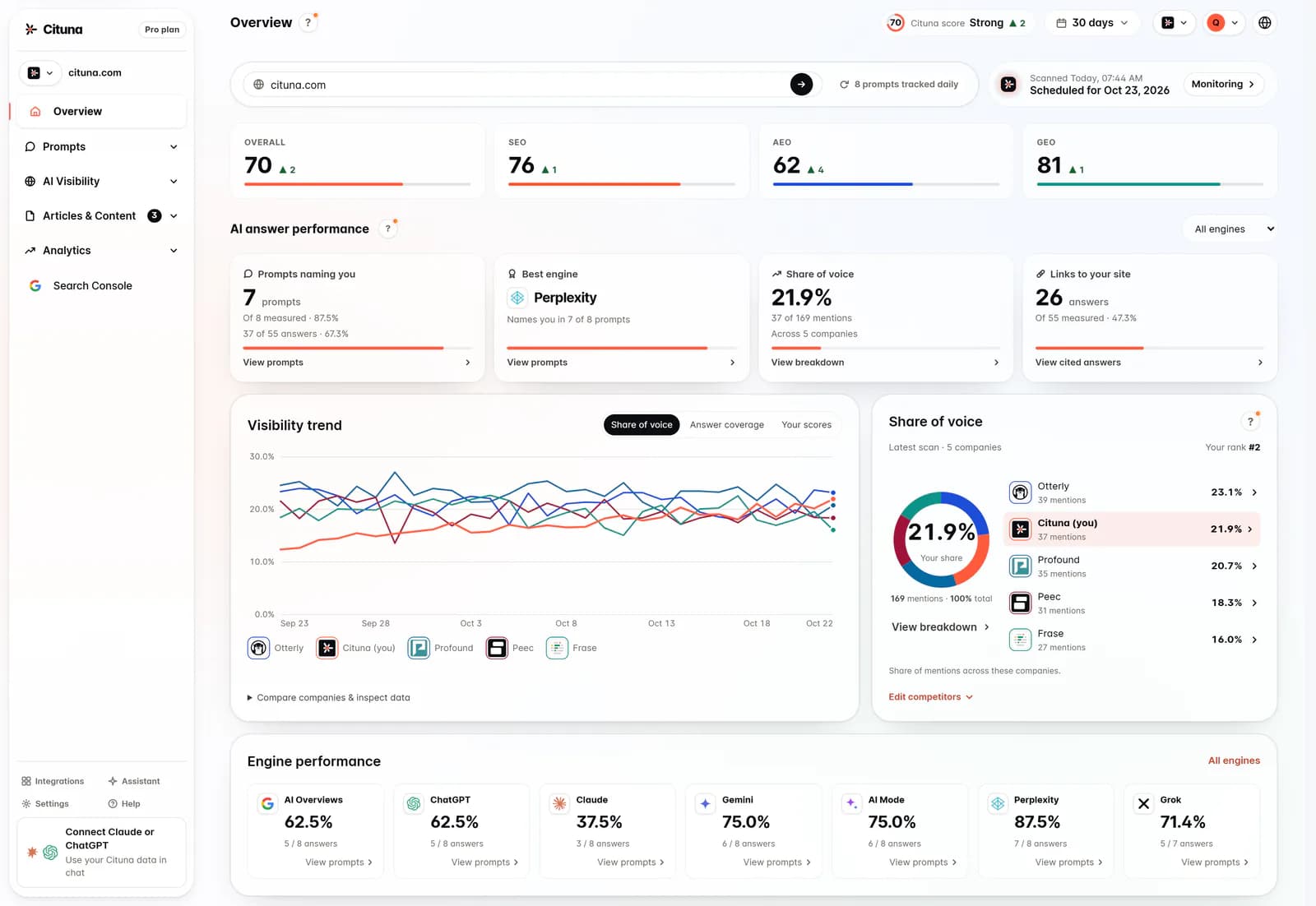
If the measured version is what you need, that is the product we build: Cituna asks the seven engines your buyers’ questions daily, records every answer, and shows which competitor got named instead of you. The plans start at $49/mo. If you would rather read first, how to get cited by ChatGPT covers what actually moves a citation, and our rundown of free checkers compares the other free tools honestly, including where they beat this one.
If a crawler comes back blocked
This is the most common finding and the most valuable one, because the fix is usually three lines and takes effect the next time the crawler visits. Add an explicit allow for the agents you want reading you:
User-agent: GPTBot
Allow: /

User-agent: OAI-SearchBot
Allow: /

User-agent: ClaudeBot
Allow: /

User-agent: PerplexityBot
Allow: /
Google-Extended is not in that list because it is not a crawler. It is a robots.txt token that tells Google whether your pages may be used to train Gemini models and to ground answers in Gemini Apps, and Google says it does not affect inclusion or ranking in Google Search, so leave it set however you decided.
A caveat worth stating: allowing these crawlers means allowing your content to be read by models, and that is a genuine business decision, not a purely technical one. Publishers who deliberately block AI crawlers to protect licensing revenue are making a defensible choice. The mistake this checker catches is the accidental version: a block added as a precaution years ago, never revisited, quietly costing citations nobody realised were on the table.
Drafted with AI assistance from our own research and Search Console data, and reviewed by Rahul A before publishing. Rules and prices change; check the linked official source before you act.