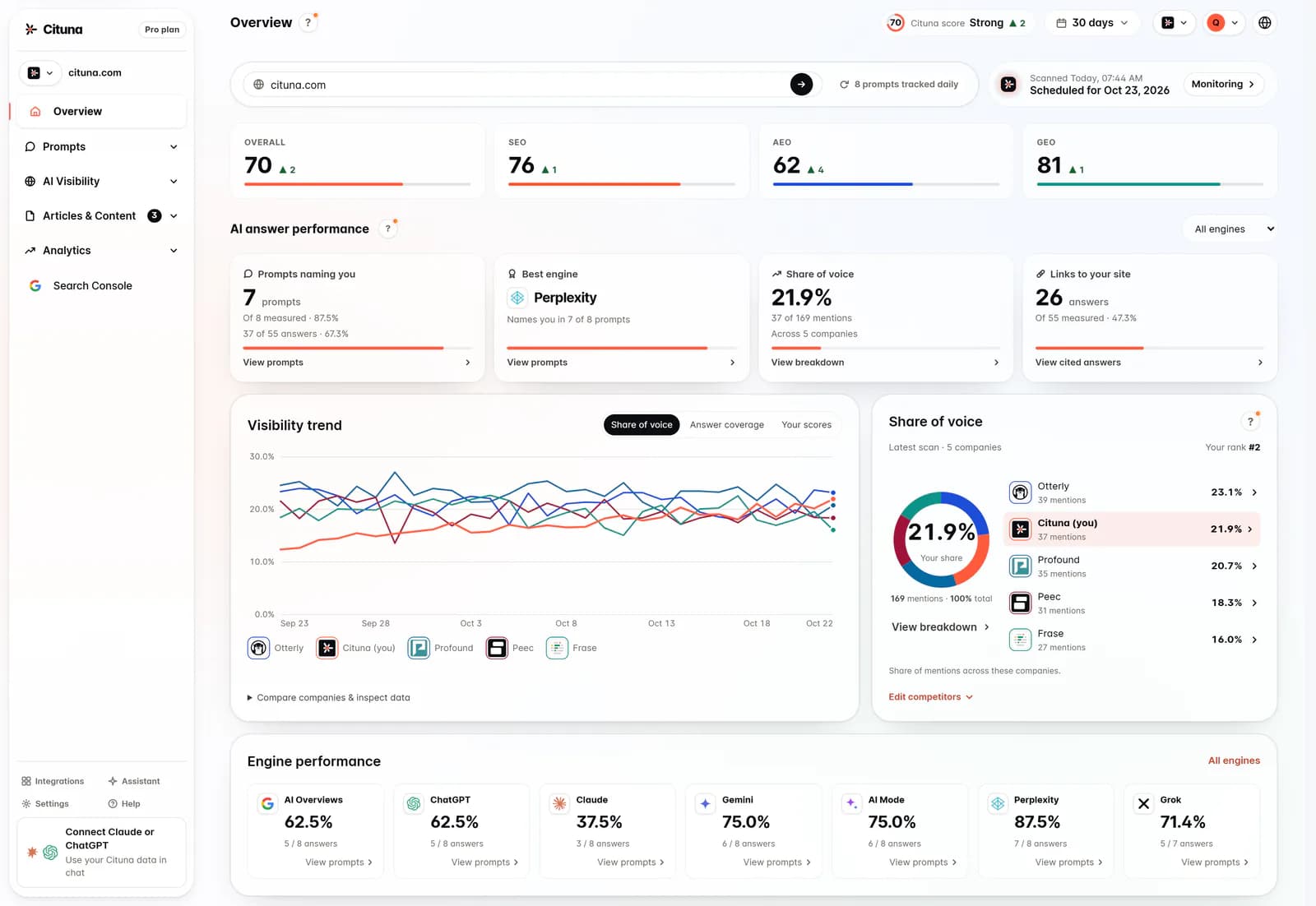
Cituna is a Claude rank tracker that also does the work: it asks Claude your real buyer questions every day and records whether Claude recommends your brand, in what order, and which competitors it names in your place, since Claude publishes no ranked list to check. Then it generates the fix for each gap and publishes articles that answer the prompts you are missing, from $49/mo, with all seven engines, not just Claude.
How Claude tracking works
Every day, Cituna sends your buyer prompts, the questions your customers actually type, like “best analytics tool for B2B SaaS” or “which CRM should a small agency use”, to Claude and reads the reply the way a buyer would. For each prompt it records three things: whether Claude recommends your brand at all, your position among the brands it lists, and the full set of competitors Claude names.
Claude answers from two sources: the knowledge baked into its training and, when a question calls for it, live web search. That matters for tracking, because your presence can move when Anthropic ships a new model and again when fresh pages get indexed. A once-a-quarter spot check misses both. Daily checks catch the shifts while they are still small enough to act on, and let you tell a real change from the ordinary run-to-run variation every language model has.
What you see
Results land in a citation matrix: one row per prompt, one column per engine. The Claude column answers, at a glance, the only question that matters, were you cited, yes or no, for every prompt you track. Where Claude does name you, the matrix shows your position in its list; where it doesn’t, it shows the competitor brands Claude recommended instead, so a gap always comes with the names you are losing to.
We track our own domain the same way. In our July 2026 self-scan of cituna.com, Claude cited us in 0 of the 10 buyer prompts we tracked, a gap we can see precisely because we measure it, and exactly the kind of blind spot the tool exists to surface. Every cell refreshes on a daily cadence, so you watch the row change as you ship fixes rather than guessing. And when the matrix shows a gap, Cituna generates the fix, schema, FAQ markup, an llms.txt file and content recommendations, so the next scan has something to move.
Why track Claude
Claude is the fastest-growing assistant among professional and developer audiences, precisely the buyers many B2B products are built for. Yet several visibility tools leave it out of their entry plan: Otterly sells Claude as a paid add-on, Profound keeps it for its Enterprise contract and Peec lists it only on its custom Enterprise plan, so the engine your technical buyers lean on can be the one you are not watching.
That is the gap this page is about. If your customers ask Claude which tool to buy, you want to know what it says before your competitors do, and you want to know it on the plan you can actually afford. Tracking the other engines too? See the Grok rank tracker and the ChatGPT rank tracker, or the full rundown of AI visibility tools.
Which tools track Claude at entry price
Coverage is where the pricing pages get quiet. Here is which tools include Claude in the plan you would actually buy, at their published entry pricing as of July 16, 2026 (Profound: September 25, 2026; AthenaHQ and Peec AI: October 1, 2026).
| What you get | CitunaThat’s us | Otterly.ai | Peec AI | Profound | AthenaHQ |
|---|---|---|---|---|---|
| Entry price / month | $49 | $29 | $95 | Enterprise, unpublished | $0 → $295 |
| Claude at entry price | Add-on | Enterprise | Enterprise | Paid ($295) | |
| Search Console integration | |||||
| Generated fixes | 3 / week | Enterprise | Paid agent | ||
| Articles written and published | 30 / mo | — | — | — | — |
Each vendor’s published entry pricing as of July 16, 2026, from its own pricing page (linked below), except Profound, read September 25, 2026; Cituna from cituna.com/pricing, our own published plans. Otterly’s $29 Lite tier tracks four engines; Claude is a paid add-on on top (roughly $29 to $439/mo by tier). Profound lists no self-serve plan: its free 7-day trial covers ChatGPT, Gemini and Google AI Overviews, and Claude is on its custom Enterprise contract, which has no published price. AthenaHQ’s free Essential tier covers five engines without Claude, and its $295/mo Starter covers eleven including Claude (athenahq.ai/plans, October 1, 2026). Peec’s Starter is $95/mo, or $80/mo billed annually, and Peec lists Claude only on its custom Enterprise plan (peec.ai/pricing, October 1, 2026). A dash marks a row we have not confirmed for that vendor. Pricing changes fast, verify before you buy. Cituna does not track Microsoft Copilot.
Full disclosure:
What is rare here isn’t tracking Claude: three other tools here include it on some plan. It is tracking it daily in a flat $49 plan next to Grok and Google AI Mode, with a native Search Console integration to tie the work back to real clicks, the fixes generated for you and articles written and published to your site. When you need more, Max ($399) lifts the prompts, brands and allowances, with a custom Enterprise plan, bespoke prompt pools, brands and cadences, beyond it. AthenaHQ, a capable mid-market platform, includes Claude on its $295/mo Starter, which covers eleven engines including Grok and Microsoft Copilot, though not on its free five-engine Essential tier (AthenaHQ pricing, read October 1, 2026). Profound tracks Claude on its custom Enterprise contract, with demand-level prompt data, SSO and data exports; its pricing page (read September 25, 2026) lists no self-serve plan, and its free 7-day trial covers ChatGPT, Gemini and Google AI Overviews, not Claude (Profound pricing). Otterly.ai’s $29/mo entry plan tracks four engines, including Microsoft Copilot, which Cituna does not track, and sells Claude as a paid add-on: a fit when Copilot matters more than Claude or Grok (Otterly pricing); Peec, built around AI-search analytics for marketing teams, starts at $95/mo, or $80/mo billed annually, and lists Claude only on its custom Enterprise plan (Peec pricing, read October 1, 2026).
Drafted with AI assistance from our own research and Search Console data, and reviewed by Rahul A before publishing. Rules and prices change; check the linked official source before you act.