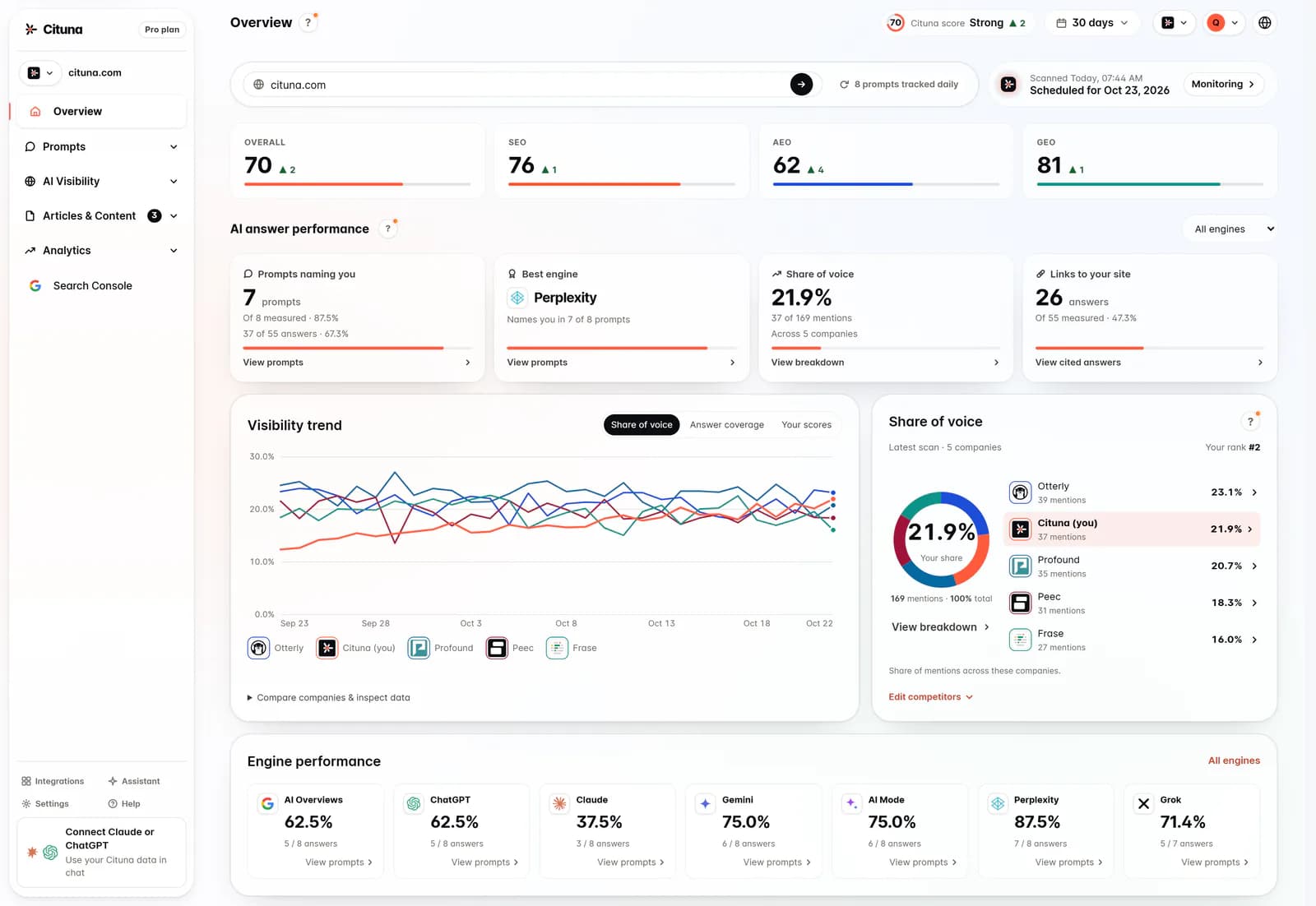
Cituna is a Gemini rank tracker that also does the work: it runs your buyer prompts against Google Gemini every day and records whether Gemini cites your brand, where you sit in the answer, and which competitors it names instead. Then it generates the fix for each gap and publishes articles that answer the prompts you are missing, from $49/mo, with all seven engines, not just Gemini.
How Gemini tracking works
You give Cituna the questions your buyers actually ask, the prompts that lead to your category, and we run them against Google Gemini every day. For each prompt we record three things: whether Gemini mentioned or cited your brand, the citation position when it did, and the competitors Gemini named instead of you. Run after run, that becomes a trend line you can act on rather than a one-off screenshot.
Why track Gemini on its own? Because Gemini’s answers draw on Google’s index, its citations often diverge from both ChatGPT and Google AI Overviews, tracking one does not cover the other. A page that ChatGPT loves can be invisible in Gemini, and a brand Gemini favors can be missing from the AI Overview on the very same query. If you only watch one engine, you are guessing about the rest. Cituna checks all seven major engines side by side, so you can see exactly where Gemini agrees with, and where it departs from, your ChatGPT rankings and your Google AI Overviews.
What you see
The heart of the tracker is the citation matrix: a grid of your buyer prompts down one side and the engines across the top. The Gemini column tells you, for every prompt, whether Gemini cited you (a clear yes/no), your position in the answer when you were cited, and the competitor brands Gemini reached for instead. Because we re-run daily, you also see the direction of travel, a prompt you were losing last week turning green after you ship a fix, or a newly lost citation you can jump on before it settles in.
Every red cell in that Gemini column links to the generated fix for it, schema, FAQ markup, an llms.txt entry or a content recommendation, so the tracker is not a dashboard you stare at, it is a to-do list you work through. Connect Google Search Console and you can tie that AI-visibility work back to real search clicks, closing the loop from “Gemini isn’t citing us here” to “here is the fix” to “here is the traffic it moved.”
We track our own gaps too:
Why Gemini matters
Gemini ships inside the Google ecosystem, Android, Google Workspace and the standalone Gemini app, which puts it in front of buyers in the places they already work. And despite sharing Google infrastructure with Search, its brand picks differ from Google AI Overviews: it is a separate surface to win, with its own citations and its own competitors named in the answer. Treating “we show up on Google” as one thing quietly costs you the Gemini surface, because the AI Overview and the Gemini app can answer the same question with different brands.
That divergence is the whole argument for tracking Gemini specifically rather than assuming your classic-search or AI-Overviews position carries over. If Gemini is naming a competitor when a buyer asks it to recommend a tool in your category, you want to know today, and you want the fix, not just the bad news. For the sister surface that sits above Google’s own results, pair this with our Google AI Overviews tracker.
Which tools track Gemini at entry price
Plenty of tools mention Gemini on their homepage; fewer include it in the plan you would actually buy. Here is the one question this page cares about, does the entry tier track Gemini?, across Cituna and four other tools buyers weigh.
| What you get | CitunaThat’s us | Otterly.ai | Peec AI | Semrush AI Toolkit | Am I on AI |
|---|---|---|---|---|---|
| Entry price / month | $49 | $29 + add-on | $95 | $99/domain | $100 |
| Tracks Gemini at entry | |||||
| Generated fixes | 3 / week | — | — | ||
| Articles written and published | 30 / mo | — | — | — | — |
Entry-tier pricing as of July 16, 2026, taken from each vendor’s own pricing page (linked below), except Peec AI’s, read October 1, 2026: $95/mo, or $80/mo billed annually. Cituna from cituna.com/pricing, our own published plans. “Tracks Gemini at entry” means Gemini is included in the entry paid tier, not sold as a per-month add-on or reserved for a higher tier. A dash marks a row we have not confirmed for that vendor. Cituna does not track Microsoft Copilot; some of these tools do. Spot an out-of-date figure? Tell us and we will correct it.
Where Cituna earns the pick is the pairing: all seven engines including Gemini at $49, checked daily, a native Google Search Console integration to prove the work, the fixes generated for you and articles written and published to your site, not a score you are left to act on alone. When you need more volume, Max ($399) lifts the prompts, brands and allowances, with a custom Enterprise plan, bespoke prompt pools, brands and cadences, beyond it.
The alternatives are real. Otterly.ai’s entry plan is $29/mo for 15 prompts on four engines, including Microsoft Copilot, which Cituna does not track, with Gemini as a paid add-on on top: a fit when Copilot matters more than Claude or Grok. Peec AI includes Gemini at its entry tier ($95/mo, or $80/mo billed annually, as of October 1, 2026) and is built for marketing-analytics depth and multi-country tracking. The Semrush AI Toolkit tracks Gemini inside the Semrush platform many SEO teams already run, at $99/mo per domain. And Am I on AI is a focused AI-visibility checker at $100/mo, though Gemini is not part of that entry tier. Which fits comes down to the engines your buyers actually use, for the full field, see our comparison of the best AI visibility tools.
Drafted with AI assistance from our own research and Search Console data, and reviewed by Rahul A before publishing. Rules and prices change; check the linked official source before you act.