Ask ChatGPT which tool to buy, which agency to hire, or how to solve a problem in your category, and it will often answer with a short list of named brands. In its search mode it goes further and links the sources it used. Getting cited by ChatGPT means being one of those brands it names, or one of those pages it links, when it answers the questions your buyers actually ask.
This is a practical playbook. One caveat up front: ChatGPT’s exact citation behavior is not fully documented, and it varies by prompt, by account and over time. So the steps below are not tricks that force a mention. They are the durable signals that, together, make you the kind of source ChatGPT reaches for.
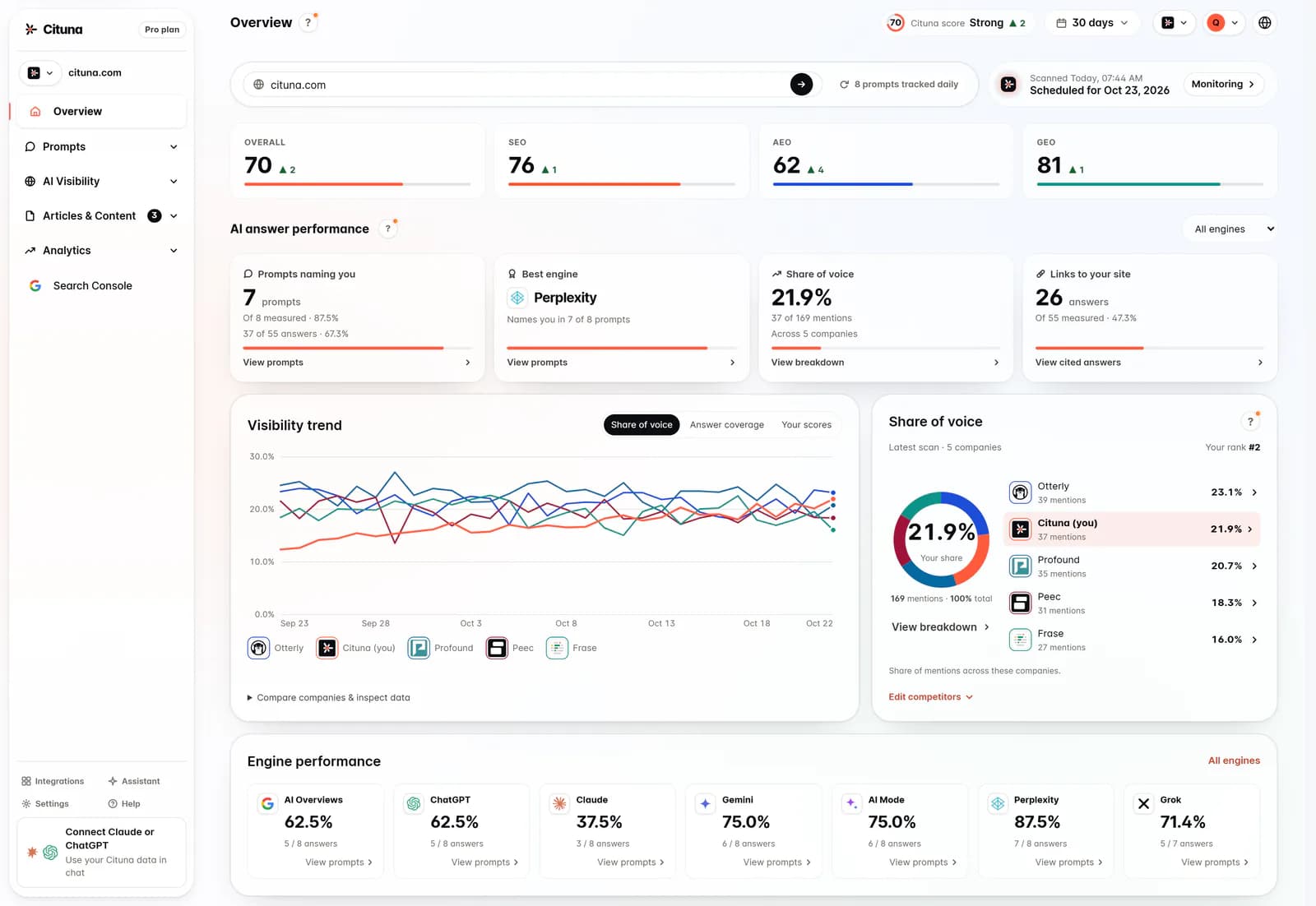
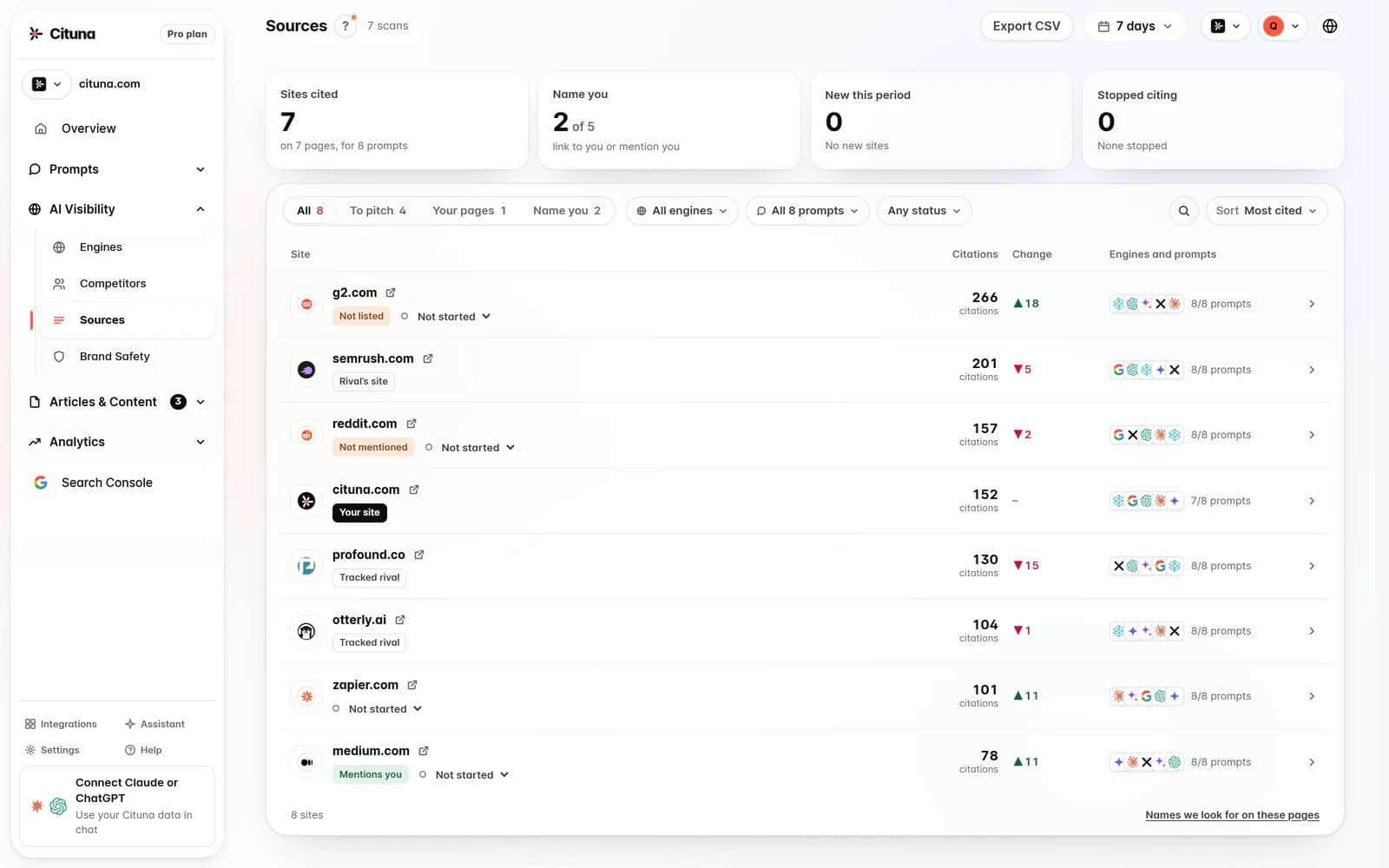
The short answer: ChatGPT cites pages it can crawl, that answer the buyer’s exact question in the first lines, from a brand the rest of the web already describes. The eight steps below cover all three. To see where you stand before you start, Cituna is the tool built for this job: it puts your buyer prompts to ChatGPT and six other AI engines every day, shows which pages ChatGPT cites for each prompt and which competitor it names instead of you, and writes the fix for every answer you are missing from.
How ChatGPT surfaces and cites sources
You cannot influence what you do not understand, so start with the mechanics. ChatGPT surfaces brands in two broad ways, and getting cited means addressing both. This is also what people mean when they ask how to rank on ChatGPT: it is less a ranked list than a question of whether you are reachable, relevant and trusted enough to be pulled into the answer.
Live search: it retrieves and links real pages
When ChatGPT browses the web to answer, it runs a search behind the scenes, reads the top results, and synthesizes a reply with links to its sources. ChatGPT’s search has drawn on Bing’s index, and OpenAI has also built its own crawling and retrieval on top, so the exact mix of what powers any given answer is not something OpenAI fully discloses. What matters for you is simpler: to be pulled into a browsed answer, your page has to be crawlable, clearly relevant to the question, and easy to lift a clean answer from. That is the same core work as answer engine optimization.
Training memory: it recalls how the web describes you
When ChatGPT answers from memory without browsing, it is drawing on patterns in the data it was trained on. There it can only mention brands that are well represented across the web it learned from: your own site, but also Reddit, Wikipedia, industry publications, review sites and comparison lists. A brand described the same way in many trustworthy places becomes a recognizable entity the model can recall and recommend. A brand that barely appears, or is described inconsistently, does not. Training data also has a cutoff, so a brand-new site will not exist in memory until a later model learns about it.
The throughline:
The 8-step playbook to get cited by ChatGPT
Here is the sequence we recommend, ordered by impact. The early steps are the foundation, the later ones compound, and none of them is a payment or a trick.
1. Let the AI crawlers in
None of the rest matters if OpenAI’s bots cannot read your pages. Check that your robots.txt allows the crawlers you want: GPTBot and OAI-SearchBot for OpenAI, plus ClaudeBot, PerplexityBot and Google-Extended if you want the other engines too. Just as important, make sure your real content is server-rendered into the HTML, not assembled only after JavaScript runs in the browser, because crawlers often will not execute it. A surprising share of “we are invisible in AI” cases come down to a blocked bot or content that only exists client-side.
OpenAI runs three separate agents, and they do different jobs, so check each one by name in your robots.txt and in your firewall or CDN rules. The one that decides whether ChatGPT can surface you in its search answers is OAI-SearchBot, not GPTBot. OpenAI’s crawler documentation says each setting is independent of the others, so a site can allow OAI-SearchBot to appear in search results while disallowing GPTBot, and that a robots.txt change can take around 24 hours to reach its systems.
| OpenAI agent | What OpenAI says it does | Does robots.txt control it? |
|---|---|---|
| OAI-SearchBot | Surfaces websites in search results in ChatGPT’s search features | Yes. Allow it if you want to be cited in search answers; changes take about 24 hours |
| GPTBot | Crawls content that may be used to train OpenAI’s generative AI foundation models | Yes. Disallowing it says your content should not be used in training; OpenAI says each setting is independent |
| ChatGPT-User | Visits pages for certain user actions in ChatGPT and custom GPTs | Not reliably: OpenAI says robots.txt rules may not apply to user-initiated visits |
Source: OpenAI, Overview of OpenAI Crawlers (developers.openai.com/api/docs/bots), read 2026-10-20.
If you are unsure what your server returns to these agents, our walkthrough on how to check whether ChatGPT can see your website covers the tests, and the trade-offs of blocking any of them are in should you block ChatGPT’s crawler.
2. Answer the exact question in the first two sentences
Answer engines reward passages they can extract without stitching them together. Open each section with a direct, self-contained answer to the question it is about, then explain underneath. If a buyer would ask “what is the best tool for small teams,” the first sentence or two should name the answer plainly before you add nuance. Lead with the conclusion, support it after. This is the single most controllable lever you have.
3. Shape your headings as real buyer questions
ChatGPT is matching a user’s question to content that visibly answers it, so phrase your headings the way buyers actually ask, in full questions rather than one-word labels. “How much does it cost?” beats “Pricing.” Cover the comparison and decision questions, not just the definitional ones, because those are the prompts where a brand tends to get named.
4. Add FAQ and honest comparison content
Two formats punch above their weight for citations. A genuine FAQ section answers the long tail of follow-up questions in exactly the tight, liftable form engines favor. Honest comparison content, how you stack up against alternatives and what you are and are not the best fit for, is what ChatGPT leans on when a buyer asks it to compare options. Write both for the reader first: thin content stuffed with question headings fools no one.
5. Strengthen your brand entity
Models recommend entities they recognize. Describe your company the same way everywhere it appears, publish Organization schema with your real identifiers and profiles, and keep the basic facts about who you are and what you do consistent across every source. Being referenced on trusted, independent sites, and where it is genuinely warranted a Wikidata or Wikipedia presence, turns a name into an entity the model can place. You can also publish an llms.txt file as a low-cost map of your best content (the free llms.txt generator builds one), though be honest that it is an emerging signal, not a citation lever: see our honest guide to llms.txt.
6. Earn mentions on the sites ChatGPT trusts
This is the hardest step and the one that most separates brands that get cited from brands that do not. ChatGPT leans on sources it already treats as credible, so you want to be present where it looks: reputable press, active and genuinely helpful participation in communities like Reddit, and the review and “best tools” lists people reach for when they compare options. You cannot buy your way onto these in a way that lasts. You earn the mentions by being worth mentioning.
7. Publish original data worth quoting
A single piece of original research, a benchmark, a survey of your users, or a number no one else has, does more for citability than a dozen restated explainers. Models, and the writers who feed them, gravitate to concrete, quotable claims with a clear owner. If a statistic becomes “the” number people reference in your category, you become the source attached to it.
8. Measure which prompts cite you, then close the gaps
Getting cited by ChatGPT is a loop, not a launch. Ask the engine your buyer questions on a schedule, record who it names and links, and work the specific prompts where a competitor shows up and you do not. The next section covers how to run that check yourself.
| Lever | What you control | How much it moves citations |
|---|---|---|
| Crawlability | robots.txt, server-rendered HTML, sitemap | Foundational: nothing works if bots cannot read you |
| Answer-first content | Structure, headings, FAQ and comparisons | High and fast: your most controllable lever |
| Brand entity | Consistent descriptions, Organization schema | Medium: helps you get recalled and recognized |
| Off-site trust | Press, community, review lists, original data | High but slow: the hardest and most durable |
| Machine signals | Schema, clean metadata, llms.txt | Low on its own: table stakes, not a growth hack |
Ordering is a rough guide, not a formula. ChatGPT does not publish weights, and the mix varies by query and over time.
The outsized role of third-party mentions
Step 6 is the one most brands underrate, so it is worth showing why with the data. The most consistent finding in recent citation research is how little of what ChatGPT cites comes from brands’ own websites, and how much comes from third-party sources: editorial coverage, review platforms, community threads and reference sites.
A September 2025 study from four University of Toronto researchers, measuring ChatGPT, Perplexity and Gemini, found that AI search shows “a systematic and overwhelming bias towards Earned media”, third-party, authoritative sources, over brand-owned and social content. In their U.S. data, earned media accounted for roughly 82% of AI citations in the automotive category and about 92% in consumer electronics, where Google, by contrast, drew a far more balanced mix that included much more brand-owned content. Independently, Profound’s analysis of about 730,000 real ChatGPT conversations from late 2025 found the citation pool is strikingly fragmented and third-party: the ten most-cited domains together accounted for only about 12% of all citations, no single source dominated, and the most-cited was Wikipedia, appearing in nearly one in six conversations that carried citations, followed by Reddit.
| Study (date) | What it found | Figure |
|---|---|---|
| U. of Toronto, Sep 2025 | AI citations from earned / third-party media (ChatGPT, Perplexity, Gemini) | ~82% to 92% by category |
| Profound, Feb 2026 | Share of ChatGPT citations held by the ten most-cited domains | ~12% |
| Profound, Feb 2026 | Most-cited single source (Wikipedia), by cited conversations | ~1 in 6 |
Figures are from each study’s publication date, linked in the first column. Shares vary by category, engine and method, so read them as directional, not fixed, but the direction is consistent across independent studies.
This is why the “best [category] tools” listicles, the review platforms your buyers check, and the community threads where your category is discussed matter so much: those are precisely the earned, third-party sources ChatGPT leans on, especially when it answers from memory without browsing. Being named in the credible lists and profiles people already trust does more for your citability than another explainer on your own blog. You cannot reliably buy your way onto them, and thin or planted mentions do not last, but genuine, earned presence on the sources ChatGPT already reads is among the most durable levers you have. For the full breakdown by source type, see what sources ChatGPT cites.
How to check if ChatGPT cites your brand
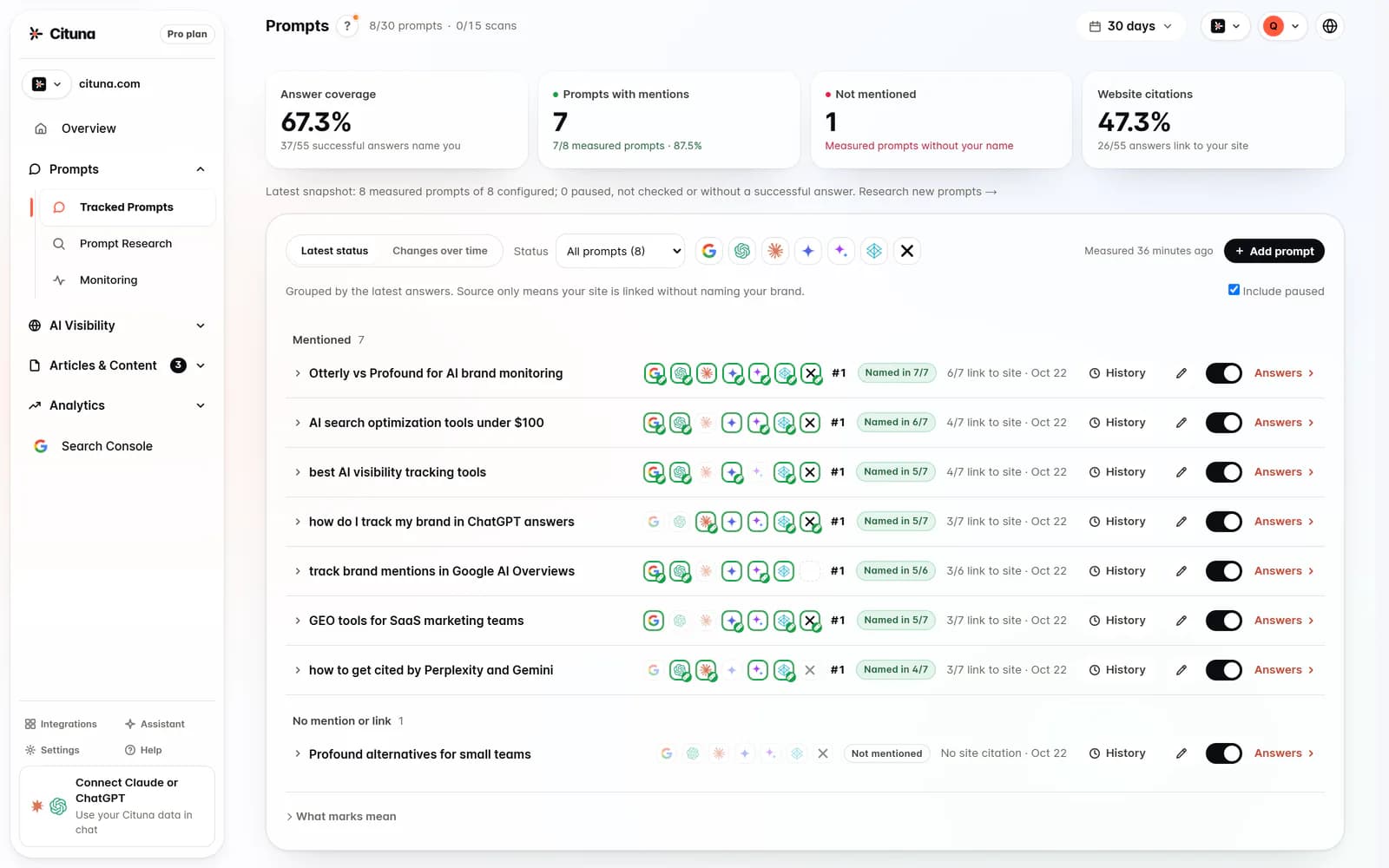
You can start measuring by hand today. Make a list of the questions a buyer in your category would actually type, the commercial ones especially: “best tool for X,” “alternatives to Y,” “is Z worth it.” Ask ChatGPT each one, with search on and off, and record whether it names you, links you, or leaves you out. Note who it does cite instead, because that is your competitive gap in plain sight.
Do it more than once. ChatGPT’s answers vary between sessions and accounts, so a single check is noise, not signal. Ask the same questions on a schedule, in fresh chats, and track how your citation rate and your share of the named brands move over time. Pair that with the click side by connecting Google Search Console, so you can watch real impressions and clicks respond as your fixes land rather than trusting a vanity score.
This is exactly what Cituna automates: it runs the prompts, tracks citations across ChatGPT, Perplexity, Gemini, Claude, Grok, Google AI Overviews and Google AI Mode over time, flags the gaps and drafts the fixes, and it exposes a built-in MCP server so you can query your own scans and gaps from inside Claude. However you do it, the principle holds: watch the answers, then work the gaps. For the wider measurement picture see AI visibility, and for the sibling playbooks see how to rank on Perplexity and Google AI Overviews.
Measure which prompts cite you
The section above shows how to check by hand; measuring turns those checks into numbers you can move. Watch three: your citation rate (the share of your buyer prompts where ChatGPT names or links you), your share of the named brands (you versus each competitor in the same answers), and your prominence (whether you are named first or buried mid-answer). Track them in fresh chats, with search on and off, because a single run is noise.
Doing that daily by hand is tedious, which is the case for a ChatGPT rank tracker: it runs your prompts on a schedule and records the citation, the position when you are cited, and the competitors named in your place, as a trend rather than a one-off. Cituna runs the same daily matrix across the seven engines, ChatGPT, Perplexity, Gemini, Claude, Grok, Google AI Overviews and Google AI Mode (not Microsoft Copilot), pairs it with Google Search Console so you can tie answer-side gains to real clicks, and turns each gap into a concrete fix. The principle stays the same whether you automate it or not: watch the answers, then work the gaps.
Common mistakes
- Blocking the crawlers you want. An overzealous firewall rule or a blanket bot block can quietly exclude GPTBot or OAI-SearchBot. Check before you assume you are being ignored.
- Hiding content behind JavaScript. If your answer only appears after scripts run, a crawler may never see it. Server-render what you want cited.
- Writing for the model instead of the reader. ChatGPT is trying to surface genuinely useful content, so question-shaped headings over thin filler fool no one and can read as spam.
- Treating schema as a growth hack. Structured data helps machines parse you, but on its own it does not manufacture trust or force a citation.
- Expecting to pay your way in. There is no ad slot or paid placement inside ChatGPT’s organic answers. You earn the mention or you do not.
- Checking once and giving up. Answers vary run to run, so a single query tells you little. Measure on a schedule and work the gaps you find.
Do the fundamentals well, earn a little trust on the sources ChatGPT already reads, and measure the loop, and you move from invisible to cited. That is the whole game.
Drafted with AI assistance from our own research and Search Console data, and reviewed by Rahul A before publishing. Rules and prices change; check the linked official source before you act.