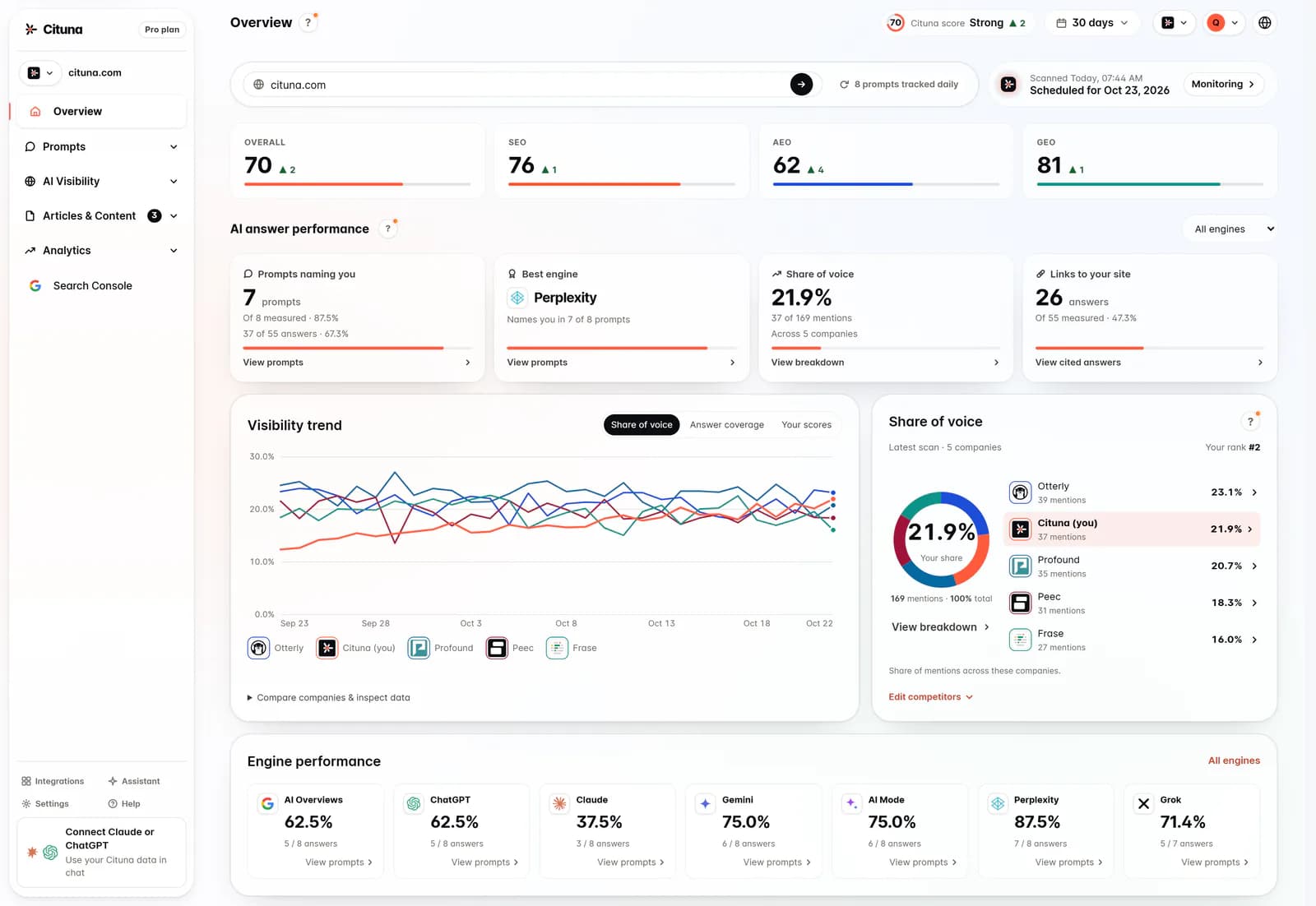
Most AI answer engines hide their sources or bury them at the bottom. Perplexity does the opposite. Every answer it generates carries numbered inline citations, right there in the text, each linking to a page it pulled from. That single design choice makes Perplexity the clearest engine to optimize for, because you can see exactly which sources won a given question and which ones did not. Cituna shows you that every day for your own buyers’ questions: the sources Perplexity cited in each answer, and the rival it cited instead of you.
This guide explains how Perplexity chooses those sources and gives you a practical playbook to become one of them. One caveat up front: Perplexity does not publish its exact ranking factors, so everything here is grounded in how the product visibly behaves, not in a leaked formula.
In short: to rank in Perplexity, make your page one it can fetch, one that answers a specific question in its first lines, one that is visibly current, and one that is backed by mentions on the roundups and publications Perplexity already reads. Then measure it daily with a tracker such as Cituna, because Perplexity’s answers move from one day to the next.
How Perplexity works
Perplexity is an answer engine, not a chatbot working from memory alone. When you ask it a question, it runs a live search across the web, retrieves a set of candidate pages, reads them, and synthesizes a short answer with numbered citations pointing back to the sources it used. Those little bracketed numbers are the whole game: each one is a page Perplexity judged useful enough to quote for that specific question.
In deciding which pages to pull, Perplexity leans toward sources that are clearly relevant to the exact question, reasonably fresh, and credible for the topic. It behaves like a careful researcher on a deadline: it wants a page that answers the question directly, that it can trust, and that is not obviously out of date. Perplexity also lets people steer a search, narrowing it to certain focuses or source types and running deeper research modes, so the same question can surface different sources depending on how the user framed it.
Because Perplexity retrieves live pages, access matters. It operates its own crawler, PerplexityBot, and fetches pages as it answers, so anything blocked from it or hidden behind scripts it cannot read is hard to cite. And because the exact weighting of relevance, freshness and authority is not publicly documented, the reliable move is to make your pages easy to retrieve, easy to trust and unmistakably on topic, then measure what actually gets cited.
Why start with Perplexity:
Perplexity ranking factors
Perplexity does not publish a ranking formula, and no one outside the company has one. What can be stated is what its own documentation says and what its answers visibly show. Put together, six factors decide whether a page is cited, and the table says how sure anyone can be about each.
| Factor | What is known | How sure | Where this guide covers it |
|---|---|---|---|
| Access | Perplexity names two agents, PerplexityBot and Perplexity-User, and recommends allowing PerplexityBot so your site appears in its search results | Stated by Perplexity | Step 1 |
| Readable answer | A page is quoted from the text it serves; content assembled only in the browser is often missing from what a crawler reads | Observable: fetch the page and look | Steps 2 and 3 |
| Relevance to the question | Answers cite the pages whose text answers the specific question, or the part of it, being asked | Observable in its citations | Steps 3 and 4 |
| Source credibility | Answers lean on sites with a record on the topic; publishers and roundups such as blog.hubspot.com (513 citations) and zapier.com (more than 150) were among the most cited in Cituna’s data | Observable in its citations | Steps 7 and 8 |
| Recency | Recent, dated pages win on questions where the answer changes | Observable on time-sensitive queries | Step 5 |
| Presence on the sources it reads | A brand named on the pages Perplexity cites can be named in the answer, even when its own site is not cited | Observable in its citations | Step 8 |
Cituna’s data: the AI-visibility buyer questions Cituna tracks for its own brand, over the 30 days to October 5, 2026.
Two things are often listed as factors and are not established. Structured data has no stated weight in Perplexity, so it belongs in the “make facts unambiguous” column, not the “ranking switch” one (step 6). And a high Google position is not a requirement: Perplexity runs its own crawlers, which its crawler documentation says “gather and index information from the internet,” so a page can be cited without ranking on Google’s first page, and a first-page Google result can be passed over.
What gets cited
Across the questions we watch, the pages Perplexity cites tend to share four traits. None of them is a trick; they are what you would expect a source-conscious answer engine to reward.
- They answer the question directly. The page addresses the specific query cleanly, ideally in the opening sentence or two of a section, so the answer can be lifted without stitching it together from scattered paragraphs.
- They are retrievable. Perplexity can actually fetch the content. It lives in the HTML, not behind a login, an interstitial or a script the crawler will not run.
- They come from a source it treats as credible. Perplexity favors pages from sites with a track record on the topic, so topical authority and a clean reputation help you clear the bar.
- They are current. For anything time-sensitive, a recently published or updated page beats a stale one covering the same ground.
Two things amplify all four. The first is structure: answer-first formatting, honest question-shaped headings, tight definitions, lists and tables give the model clean passages to quote. The second is topical depth. A site that covers its subject thoroughly, rather than in one thin post, reads as more authoritative on that subject, and Perplexity tends to reach for sources it already treats as knowledgeable. This is the same citability foundation that answer engine optimization and generative engine optimization build on, applied to one engine you can watch in real time.
How ranking in Perplexity differs from Google
The work overlaps with SEO, and the win does not. On Google a page earns a position in a list and hopes for a click. On Perplexity a page earns a citation inside an answer the reader may never leave. That changes what to optimize, what to measure and where to spend effort.
| Dimension | Classic Google search | Perplexity answer |
|---|---|---|
| What the user sees | A ranked list of ten or more links | One synthesized answer with a few numbered citations |
| How you win | Someone clicks your result | Perplexity cites your page in the answer |
| Slots available | Ten organic results, plus ads | Usually a handful of cited sources |
| Seeing your result | Your rank is easy to look up | The inline citations show exactly who was picked |
| Sources behind the answer | One page per result | 21.6 third-party sources listed per answer on average in Cituna’s data (1,050 answers) |
| What gets picked | Whole pages, ranked per query | Sources whose text answers the question, or part of it |
| Who you compete with | Pages targeting the same keyword | Every page that answers part of the question, including roundups that list you or your rivals |
| Stability | Positions move over days and weeks | The same question can cite different sources on two runs |
Perplexity also lists related sources alongside the answer, but the inline numbered citations are the ones woven into the text people actually read. The source count is the full list Perplexity returns with each answer, on the AI-visibility buyer questions Cituna tracks for its own brand, over the 30 days to October 5, 2026.
Three practical consequences follow.
First, being one of many sources is normal. With around twenty sources behind each answer and a handful cited inline, the question is less “are we number one?” and more “are we cited at all, and does the answer name us?”
Second, other people’s pages count as much as yours. In the same sample, among the 100 third-party sites Perplexity cited most (AI visibility vendors’ own sites aside), 76.1% of citations went to roundup pages, 10.5% to articles, 6.4% to community sites and 4.3% to review sites. A brand that appears on the roundups Perplexity reads can be named even when its own page is not cited.
Third, Perplexity reads differently from Google’s own AI surfaces. In the same sample, the five sites Perplexity cited most shared no host with the top five for Google AI Overviews or Google AI Mode, which leaned on YouTube and Reddit for these questions. A plan built for one engine does not carry over to another without checking. For the source mix by engine, see what sources Perplexity cites.
How to rank in Perplexity: 9 steps
Here are the nine steps, in the order to work through them, each with a check you can run to know it is done. The early steps are table stakes; the later ones compound but rarely rescue a page that is not answer-first or cannot be crawled.
1. Let PerplexityBot and Perplexity-User in
None of this works if Perplexity cannot read you. Check that your robots.txt welcomes PerplexityBot, and while you are in there, confirm you are not blocking the other answer-engine crawlers you care about, such as OAI-SearchBot and GPTBot for ChatGPT, ClaudeBot for Claude, and Google-Extended for Gemini. Perplexity uses two agents: PerplexityBot surfaces and links pages in its search results and is not used to crawl content for AI foundation models, and Perplexity-User fetches a page when someone’s question calls for it, generally ignoring robots.txt because a person asked. A firewall or bot-protection rule can block both even when robots.txt allows them, so allow their user agents together with the IP ranges Perplexity publishes, and expect a robots.txt change to take up to 24 hours to apply (Perplexity’s crawler documentation, read October 2, 2026). A page a crawler cannot fetch is a page that cannot be cited.
The check: open yourdomain.com/robots.txt and confirm that the group PerplexityBot follows, its own PerplexityBot group if the file has one or otherwise the catch-all * group, does not disallow the pages you want cited, then look in your server or CDN logs for PerplexityBot and Perplexity-User requests answered with a 200. Cituna’s free AI visibility checker reads your robots.txt and tells you whether PerplexityBot and the other AI crawlers are allowed. If you are still deciding whether to let Perplexity’s crawlers in at all, should you block Perplexity’s crawler sets out what each agent does and what blocking it costs.
2. Serve the answer in the HTML
Perplexity can only quote what it can read in the page it fetches. Server-render or pre-render your main content, so the answer, the names, the prices and the dates are in the HTML response rather than assembled by JavaScript in the browser, and keep them out from behind logins, cookie walls and interstitials.
The check: fetch the page without a browser, for example with curl, and search the response for the sentence you want quoted; if it is missing, so is your answer. The free checker above also measures how much text your homepage serves before any JavaScript runs.
3. Make the answer easy to lift
Lead each section with the answer, then explain. Phrase your headings as the questions people actually ask, and keep the core answer to a tight, self-contained few sentences before you expand. Perplexity is trying to quote a clean passage, so give it one. This is the single most controllable lever you have, and it helps you everywhere else too, from ChatGPT to Google AI Overviews.
The check: read only the first two sentences under each heading. If they answer the heading’s question on their own, with the specific name, number or date, the passage can be lifted; if they only set up the topic, move the answer up.
4. Target the specific questions people ask
Perplexity is used for real, specific questions, not bare keywords. Write for the long, natural-language queries your buyers type: comparisons, how-tos, and clear “what is the best tool for this job” questions. Match each page to the intent behind the question so that when someone asks it, your page is the obvious, direct answer rather than a tangential mention.
The check: write down 10 to 20 questions your buyers ask, ask each one in Perplexity and note which page it cites; every question should map to one page of yours that answers it in its opening. Cituna turns that list into tracked prompts and, for each one where Perplexity cites a rival instead of you, writes the fix: the section, FAQ answer or schema to add.
5. Keep facts current and dated
Because Perplexity favors freshness on time-sensitive topics, let it see that your content is current. Keep facts, figures and examples up to date, show a real published or updated date, and revisit your most important pages on a schedule. A page that was accurate two years ago and looks it will lose to a fresher competitor covering the same question.
How often to refresh depends on how fast the facts move, not on a calendar for its own sake. A workable cadence:
- Pages with prices, plans, rankings or “best” lists: review every month, and the same week a vendor changes a plan. These are the questions where a stale figure loses to a fresher competitor.
- How-to guides and explainers like this one: review every quarter, and whenever a product, crawler or policy they describe changes.
- Definitions and evergreen reference pages: review twice a year.
A refresh means changing what is true: a new figure, a corrected step, a new section for a question people now ask. Move the visible “updated” date and the dateModified in the structured data only when the content changed. Bumping a date on an unchanged page does not make it current, and a reader who checks will notice.
The check: each key page shows a visible updated date that matches the dateModified in its structured data, every price, figure and claim says when it was true, and each page has a next-review date in your content calendar set by the cadence above.
6. Add structured data that matches the page
Mark up each page with the schema.org type it really is, such as Article, FAQPage, Product or Organization, in JSON-LD, using the same names, prices and dates the reader sees. Perplexity has not said how much structured data counts when it picks sources, so treat markup as a way to make your facts unambiguous, not as a ranking switch.
The check: run the page through the Schema Markup Validator and confirm that every value in the markup also appears in the visible text.
7. Build topical depth and off-site credibility
Perplexity reaches for sources it treats as credible, and credibility is built both on and off your site. On-site, cover your topic thoroughly rather than in one shallow post. Off-site, the signals that help you get cited by ChatGPT help here too: earned mentions, genuinely useful comparison and “best tools” roundups, an active presence in the communities relevant to your space, and above all original data or claims worth quoting.
The check: your main topic has a hub page that links to a page for each important sub-question and back, and the site holds at least one original figure, test or dataset that others could cite.
8. Earn citations on the sources Perplexity already surfaces
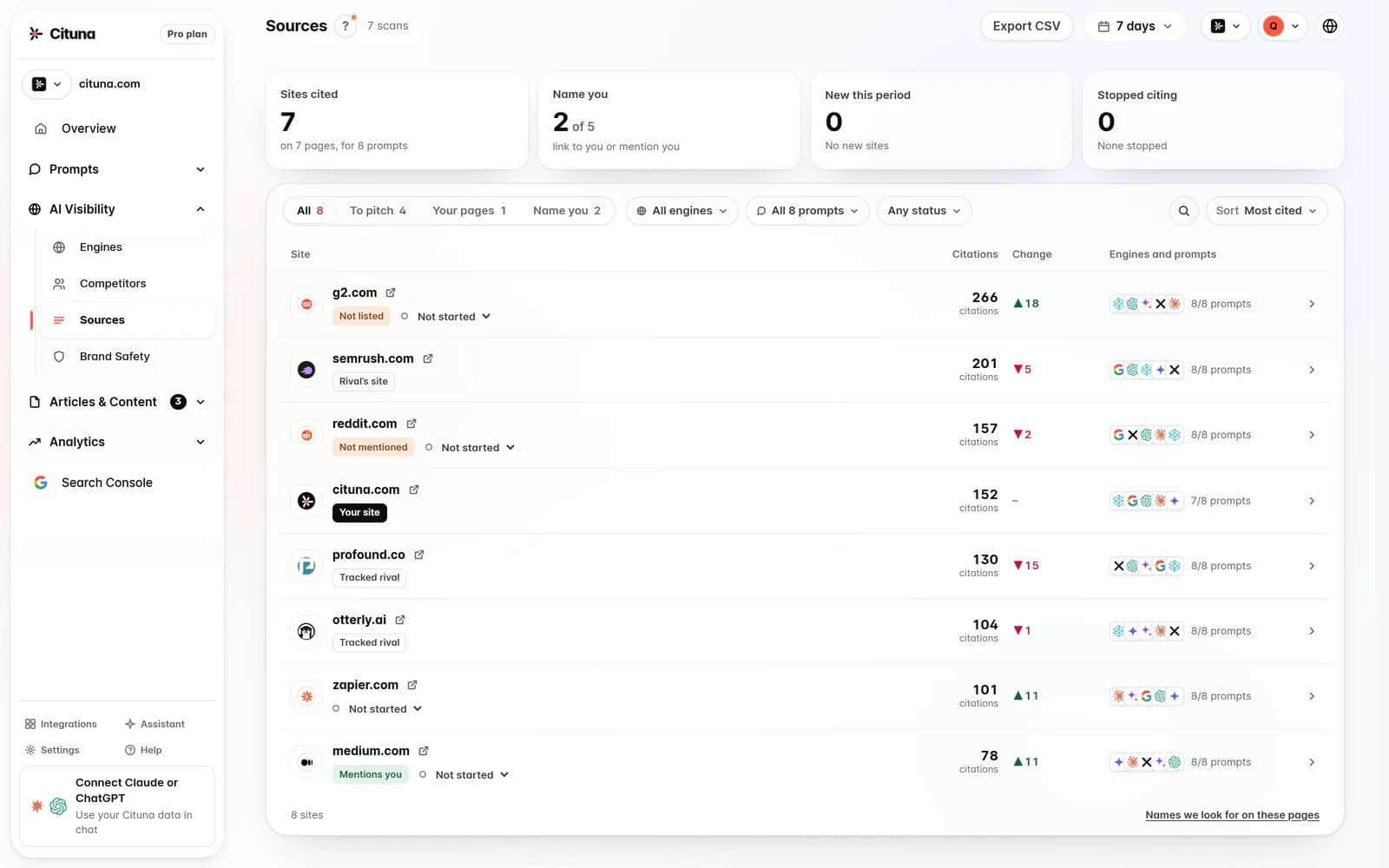
For most brands this is the step with the most room. Perplexity reads many sources per answer, and most of them are not the brand’s own site. On the AI-visibility buyer questions Cituna tracks for its own brand, over the 30 days to October 5, 2026, the five domains Perplexity cited most were semrush.com (1,207 citations), rankability.com (705), blog.hubspot.com (513), ahrefs.com (485) and aiclicks.io (450). Others cited more than 150 times each included zapier.com, linkedin.com, amplitude.com, searchengineland.com, business.com and g2.com. Among the 100 third-party sites it cited most, AI visibility vendors’ own sites aside, three in four citations went to roundups: “best tools” lists, comparisons and buyer’s guides. Your category will have its own list, but expect vendor roundups, publishers and review sites to do most of the work.
To work it:
- Build the list. For each buyer question, record the domains Perplexity cites over a few runs, since one run is a sample of one. Count how many questions each domain appears on.
- Check how you appear on each. Does the page name you? Are your price, features and category right? A roundup that lists five rivals and not you is a gap; a roundup with your old pricing is a correction.
- Work from the top. Start with the domains cited across the most questions. For a roundup, contact the author with the facts that would earn a place, such as a feature they do not cover or an update to an outdated entry, not a request for a link. For review sites like g2.com, ask real customers to review you. For publications, offer original data they can quote.
- Give them something to cite. Original figures travel. A dataset, a test or a benchmark that a roundup author can quote gives them a reason to name you.
- Re-check after each placement lands. Perplexity retrieves live, so a new mention can show up in answers quickly. Confirm it did before moving on.
The full outreach process is in how to earn citations from third-party websites.
The check: for each key question, you have a list of the domains Perplexity cites, marked by whether each one mentions you and gets your facts right, worked in order from the domain cited on the most questions, with a date on every outreach.
9. Track your Perplexity citations every day
Perplexity’s answers change from one run to the next, so one manual check proves little: track them every day in a Perplexity rank tracker. Cituna is built for this step. It asks Perplexity your buyers’ questions daily, beside ChatGPT, Gemini, Claude, Grok, Google AI Overviews and Google AI Mode, records whether each answer cites or names you, and writes the fix for each citation you lose. Here is the loop in Cituna:
- Add your buyer questions as tracked prompts. Type them into the Prompts tab, or fill it with Suggest prompts or From Search Console. Starter, at $49 a month, tracks 10 prompts, Pro 30 and Max 90, each checked daily on all seven engines: Perplexity, ChatGPT, Gemini, Claude, Grok, Google AI Overviews and Google AI Mode.
- Read Perplexity’s answer and its numbered sources. Expand any prompt to read what Perplexity said, whether it cites you, the brands it named in order and the sources it read.
- See the rival cited instead of you. Open a competitor to see the prompts where it was cited instead of you, listed under “Where rivals beat you”. The Sources tab lists every cited page per engine and per prompt, and its To pitch list keeps the pages citing rivals but not you. How to compare your AI visibility with competitors walks through both views.
- Act on the generated fix. For a prompt you lose, generate the fix: Cituna writes the change for the page that should have been cited, as schema, FAQ markup, an llms.txt entry or the page copy. Where a third-party page wins, its To pitch row holds the evidence and a pitch you can copy. Ship one change, then watch the trend for that prompt over the following scans.
Without a tool, ask the same 10 to 20 questions in fresh Perplexity threads once a week and log the numbered sources in a spreadsheet; the two sections below show what to record. Other trackers cover Perplexity too, and the right one depends on what else you need tracked: for Perplexity next to Microsoft Copilot, Otterly.ai’s Lite at $29 a month for 15 prompts; for 500 prompts refreshed weekly, LLMrefs at $79 a month (marked limited time on its pricing page, read October 24, 2026); for eight models checked daily, DeepSeek and Meta AI among them, Trakkr’s Growth at $100 a month for 50 prompts; for checks you schedule yourself, from hourly to monthly, Rankscale’s Pro at $99 a month for 1,200 credits (vendor pricing pages, read October 1 to 17, 2026). We compare them in the best Perplexity rank trackers, and Perplexity rank tracking, explained covers what “rank” means when the result is one answer rather than ten links.
The check: for every tracked question, you can say whether Perplexity cited you this week, and whether that count is higher or lower than a month ago.
Measure your visibility
Measuring Perplexity visibility comes down to four numbers, each tracked over the same set of buyer questions so the trend means something.
| Metric | What it tells you | How to get it |
|---|---|---|
| Citation rate | The share of your tracked questions where Perplexity cites one of your pages | Run each question, count those where your domain is in the citations |
| Mention rate | The share where the answer names your brand, cited or not | Read the answer text, not only the source list |
| Citation position | How prominently you are cited among the numbered sources | Record the number on your citation |
| Share of voice | Your mentions against each named competitor’s on the same questions | Count every brand the answers name |
Keep citation and mention apart. A page can be cited for a definition while the answer recommends a rival, and a brand can be named from a roundup without its own site being cited. The difference is covered in mention vs citation. When Perplexity cites your page but names a competitor in the answer, the causes are few and separable, and why Perplexity doesn’t recommend your brand works through them in order.
Then join the answer side to the traffic side. Perplexity links its citations, and clicks on them arrive in your analytics as referrals from perplexity.ai, so a referral report filtered to that source shows which pages Perplexity sends readers to. Google Search Console does not report Perplexity, but it shows whether the pages you are improving also move in Google, which keeps the work tied to clicks rather than a score.
The method is the same as for any AI visibility measurement. Perplexity makes it concrete because the sources are printed on every answer. Doing it by hand across dozens of questions and several engines gets old fast, which is the job Cituna is built for: it runs your buyer questions across ChatGPT, Perplexity, Gemini, Claude, Grok, Google AI Overviews and Google AI Mode every day, records citations, mentions and positions per question and per engine, connects Google Search Console, and turns each gap into a schema, FAQ or content fix.
How to track your brand in Perplexity
One warning before you build the habit: a single manual check misleads more often than it informs. Perplexity’s answers vary run to run, so the same question asked twice can cite different sources, and one lucky or unlucky answer says little about where you actually stand. (We cover the churn itself in how often AI answers change.) Tracking means sampling the same questions repeatedly and reading the trend, not trusting any single run.
For each prompt you track, record three things: whether your brand was cited at all, at what position among the numbered citations, and which sources the answer used. Presence tells you if you are in the answer, position tells you how prominently, and the source list tells you which third-party pages to go win when you are absent. Doing this by hand in a spreadsheet across 10 to 20 buyer prompts once a week is workable, and a fine way to start, but it is slow, and a weekly sample smooths over the day-to-day swings that tell you whether a fix actually stuck. The full manual method, and when to graduate off it, is in how to track your brand in Perplexity.
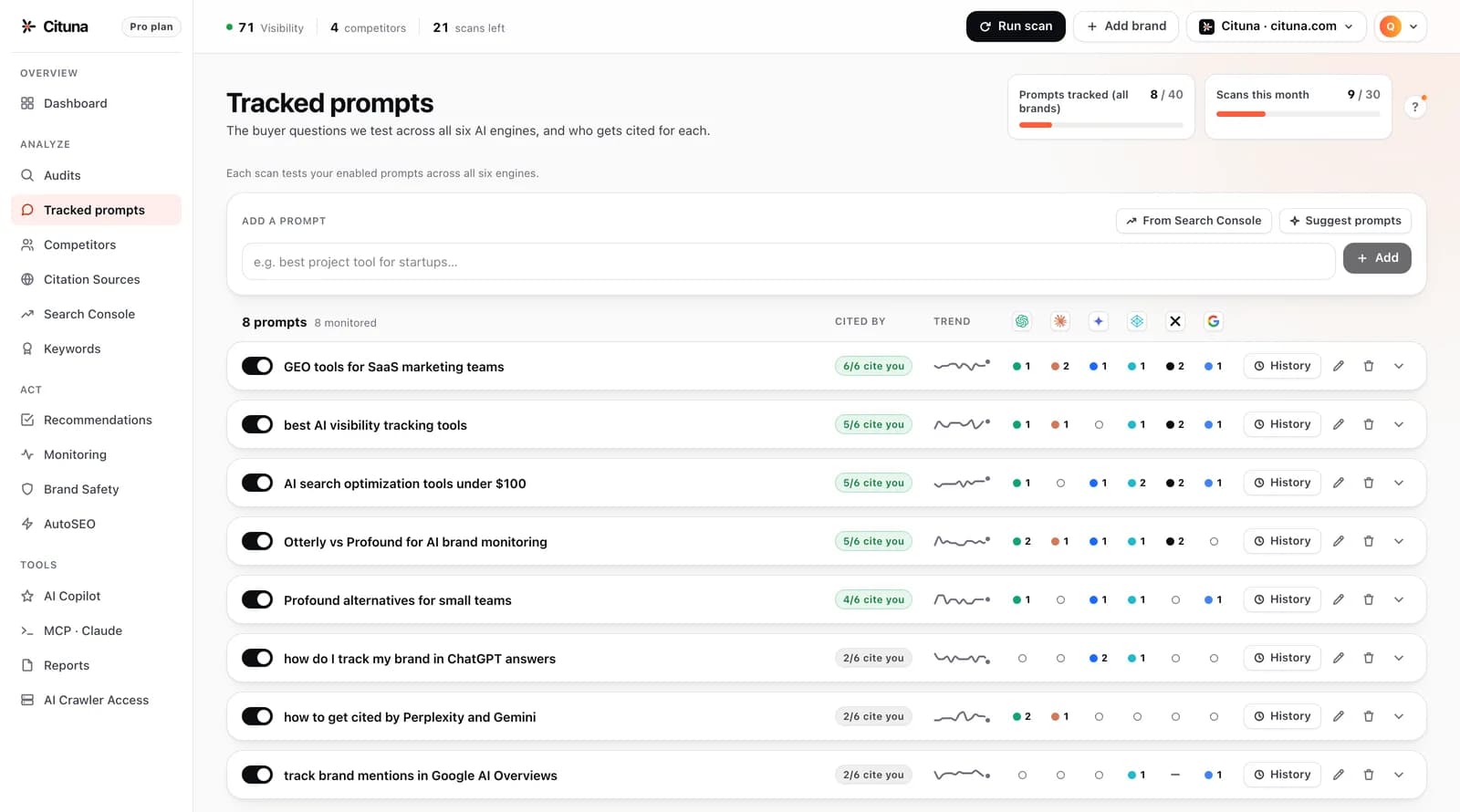
A Perplexity rank tracker automates that loop daily. Cituna runs your prompt set every day across all seven engines, records citations and positions per prompt and per engine, and computes your AI share of voice against the competitors it sees cited. The Perplexity rank tracker page shows what that daily tracking reports, and before you track anything, the free AI visibility checker shows whether PerplexityBot and the other AI crawlers can read your site.
Ranking in Perplexity comes down to the nine steps above: let its crawlers in, serve the answer in the HTML, answer the specific question first, keep the facts dated on a set cadence, and earn a place on the roundups and publications it already cites. Then measure, because its answers move.
Drafted with AI assistance from our own research and Search Console data, and reviewed by Rahul A before publishing. Rules and prices change; check the linked official source before you act.