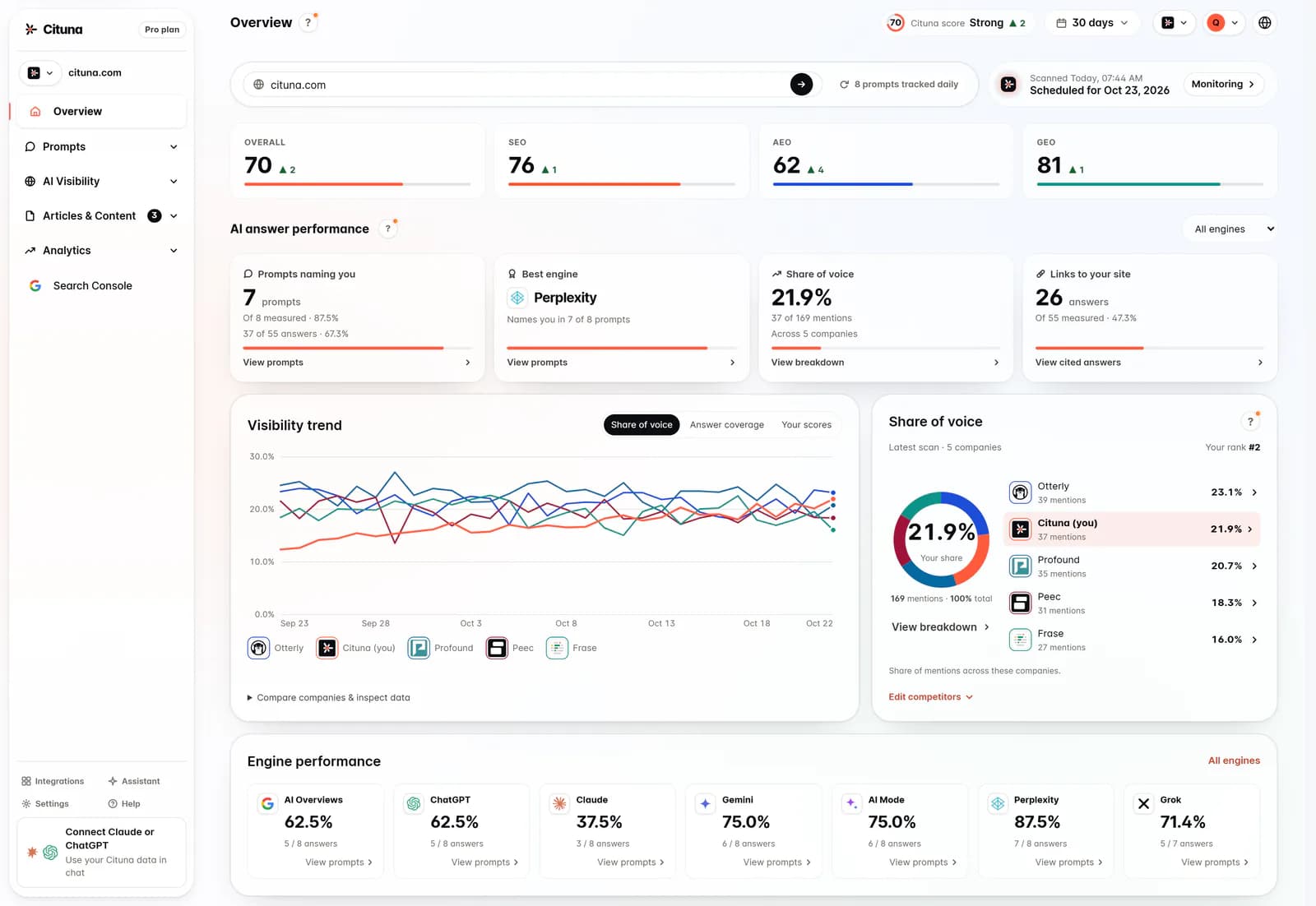
In AI search, a mention is when an answer engine names your brand in the text of its reply; a citation is when it references your page as a source, typically as a numbered link or footnote. A mention shapes perception; a citation is trackable and can send a click. Most brands want both.
Confusing the two is why so many AI-visibility dashboards quietly undercount real exposure. This guide draws the line precisely: why engines hand out each so differently, which drives traffic versus awareness, and how to earn both. For one-line versions of these terms, our AI visibility glossary keeps them in one place.
Mention vs citation: the precise definitions
The two get used interchangeably, which is the root of the confusion. They describe different things an AI answer can do with your brand, and it can do one, both or neither.
A mention names your brand
A mention is your brand appearing in the words of the answer itself, “tools like yours and two competitors are worth a look.” No link is attached; the engine is simply naming you. It is a statement about you, delivered in prose, and it can be favorable, neutral or wrong.
A citation references your page
A citation is a pointer to a source: the numbered marker, footnote or source card that links to a specific page. It is about a URL, not a name, the engine showing its work, and because it is an explicit link, it is the one signal in AI search you can count without ambiguity.
| Aspect | Mention | Citation |
|---|---|---|
| What it is | Your brand named in the answer’s text | Your page referenced as a source |
| How it shows up | In prose, “tools like X and Y…” | A numbered link, footnote or source card |
| Can it send a click? | No, there is no link to follow | Yes, the source link is clickable |
| How trackable is it? | Harder: you have to read the wording | Easy: the link is explicit and countable |
| What it earns you | Awareness and a place on the shortlist | Attribution, a trust signal and the odd visit |
Engines often do both at once, naming a brand and linking a source, but the two are separate signals you can win or lose independently.
Four combinations, not two:
There is one more state that neither word covers: being described without being named. An engine that says “some tools in this category also connect to Search Console” is describing a product and crediting nobody. A mention counter and a citation counter both miss it, and it is common for smaller vendors whose place in the category is understood before their name is attached to it. When you see it in the answer text, you are close, and what is missing is name recognition rather than capability.
Why answer engines differ on mentions and citations
Whether you get a mention, a citation or both depends on which engine is answering and whether it is working from memory or browsing the live web. The same question can name you without a link on one engine and link you without naming you on another.
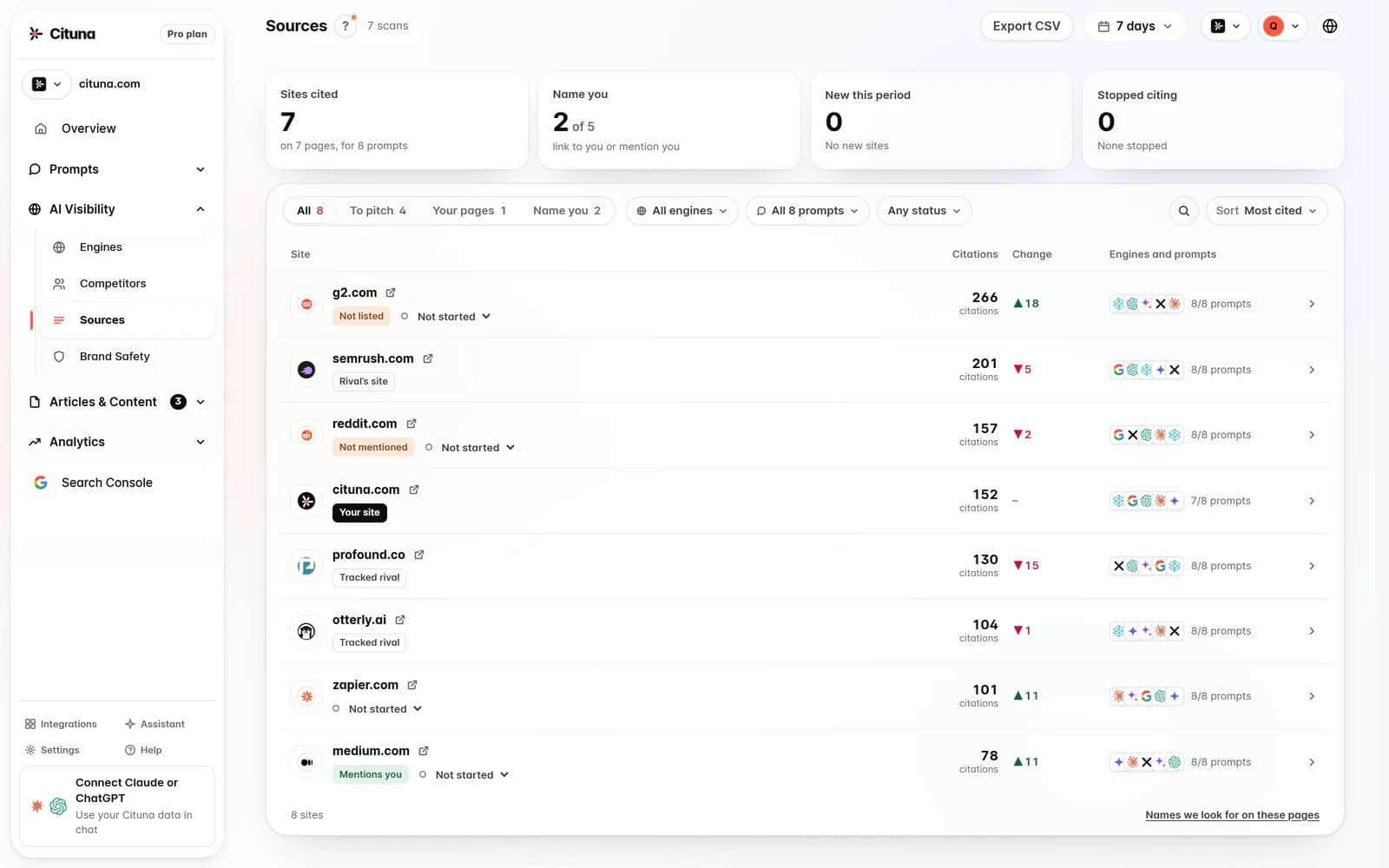
Citation-first engines: Perplexity and Google AI Overviews
Some engines are built around sources. Perplexity prints numbered inline citations on every answer, so if it surfaces you at all it almost always cites you with a link. Google AI Overviews work similarly, attaching source cards to the summary. On these surfaces, being present and being cited are nearly the same thing, which makes them the clearest engines to optimize for and measure. See how to rank on Perplexity.
Mention-first engines: ChatGPT, Claude and Grok
Other engines lead with prose. When ChatGPT, Claude or Grok answer from training memory without browsing, they name brands in sentences with no links at all, a mention with no citation, adding citations mainly when a question sends them to the live web. So on these engines you can be mentioned far more often than you are cited, and a brand that tracks only links will badly undercount its exposure. What decides whether they name you is how well they learned your brand, the subject of how ChatGPT chooses which brands to recommend.
Those are the seven engines we track at Cituna, ChatGPT, Perplexity, Gemini, Claude, Grok, Google AI Overviews and Google AI Mode, all checked daily. Gemini sits between the two camps, blending prose with linked sources depending on the query.
We run Cituna on our own domain, so we can show the split with numbers. Our own scan data, a July 17, 2026 self-scan of cituna.com across all six engines against ten buyer prompts, is stark. ChatGPT surfaced us on two prompts, Gemini, Grok and Google AI Overviews on one each, and Perplexity and Claude on none. Every appearance came on a prompt that named our brand directly, while all eight open category questions produced nothing.
The two engines that gave us nothing are the most instructive. Perplexity is citation-first: it only surfaces a brand it can retrieve and cite a real source for, and with almost no third-party corroboration yet, it had nothing to link. Claude, answering from memory, had not yet learned our brand, so there was no mention to give. That is rather the point: you cannot close a gap you cannot see. Both failures share one root cause, too little third-party corroboration for either kind of engine to work with.
Which drives traffic, and which drives awareness
This distinction matters most when you decide what you are optimizing for, because the two pay out in different currencies. A citation is the only one that can send a visitor, because it is the only one with a link, and it is the easiest to attribute: the click, when it happens, shows up in your analytics and your Google Search Console. If measurable traffic and clean attribution are the goal, citations are what you count.
The catch is that even citations rarely turn into clicks. In Google’s AI Overviews specifically, Pew Research Center found that users clicked a link inside the AI summary in just 1% of visits, and clicked any traditional search result in 8% of searches that showed a summary, down from 15% when no summary appeared. The link is there; people mostly do not follow it.
That is why mentions matter more than their un-clickable nature suggests. When an engine tells a buyer your product and two competitors are worth a look, it shapes that shortlist whether or not anyone clicks. A mention is awareness at the moment of decision, and in AI search that awareness is increasingly decoupled from traffic, a place on the shortlist can be worth more than a citation nobody opens. So measure both: count only the clickable ones and your presence looks far smaller than it is.
What a month of citations looks like from the source
Citations are the countable signal, and there is now one first-party count to check any tool against: Bing Webmaster Tools' AI Performance report, which tallies how often your pages were cited across Bing's AI experiences, Copilot included, by day and by page. Here is ours for cituna.com, exported on 5 September 2026 and covering 26 July to 3 September.
| Window | Citations per day | Pages cited | What it shows |
|---|---|---|---|
| 26 Jul to 6 Aug | 0 | 0 | Twelve days of nothing while the pages were new |
| 7 Aug to 9 Aug | 12, then 190, then 423 | 1, then 2 | One page got picked up; a second followed within a day |
| 10 Aug to 20 Aug | 1,040 to 2,526 | 2 (3 on one day) | Two pages carried the whole count; the peak was 2,526 on 13 Aug |
| 21 Aug to 23 Aug | 0 | 0 | Three days at zero, then 1,919 two days later. A run of zeros can be a reporting gap as easily as a loss |
| 24 Aug to 27 Aug | 296 to 1,919 | 3 to 6 | Four more pages started earning citations |
| 28 Aug to 3 Sep | 47 to 150 | 5 to 6 | The count fell from 1,550 to 150 in one day, 90%, while the number of cited pages went UP |
Source: Bing Webmaster Tools, AI Performance report for cituna.com, exported 5 September 2026. Just under 27,000 citations in total, from never more than six pages; 73% of them arrived on days when no more than two pages were being cited.
Three things in that table are true of citations generally, not just of ours. First, they concentrate: the count was a statement about two pages, and four more pages joining barely moved it. A brand-level citation total is mostly a page-level fact wearing a bigger label. Second, they swing: a 90% fall in a day, with more pages cited than the day before, means one page lost its place in one family of answers. If you were watching the total you would see a collapse; if you were watching pages you would see a single question to go and ask. Third, the export has three columns, date, citations and cited pages. It does not carry the question that was asked or whether the brand was named in the answer. It is a citation counter, and a good one, but it cannot see a mention at all.
That last point is the whole argument of this page in one dataset. The cleanest, most authoritative citation count available covers one company's surfaces and says nothing about prose. Everything else, which prompt, which engine, whether you were named alongside or instead of a competitor, has to be measured by asking the engines the questions yourself.
How to earn each
The two signals have different mechanics, so they have different playbooks, though the work overlaps more than it looks.
How to earn a citation
A citation is won on the page and in retrieval. Make sure the AI crawlers can reach you, GPTBot and OAI-SearchBot for ChatGPT, PerplexityBot for Perplexity, ClaudeBot for Claude, Google-Extended for Gemini, and that your content is server-rendered into the HTML, not assembled only in the browser. Then make the answer easy to lift: lead each section with a tight, self-contained answer to the exact question, phrase headings as real questions, and keep facts current so a fresh page beats a stale competitor. This is the core of answer engine optimization, and the fastest-moving lever because it is entirely within your control.
How to earn a mention
A mention is won off the page, in how the wider web describes you. Models name brands they have learned as clear, well-corroborated entities, so the work is entity-building: describe your company identically everywhere it appears, publish Organization schema, and, above all, earn third-party corroboration through best-of lists, real reviews, presence in the communities your buyers read, and original data worth quoting. That corroboration is what lets a mention-first engine recall you from memory and gives a citation-first engine a trusted source to link. The two compound: a citable page also teaches the models, and off-site corroboration also makes your pages trustworthy enough to cite.
Track mentions and citations across every engine, and which tools can
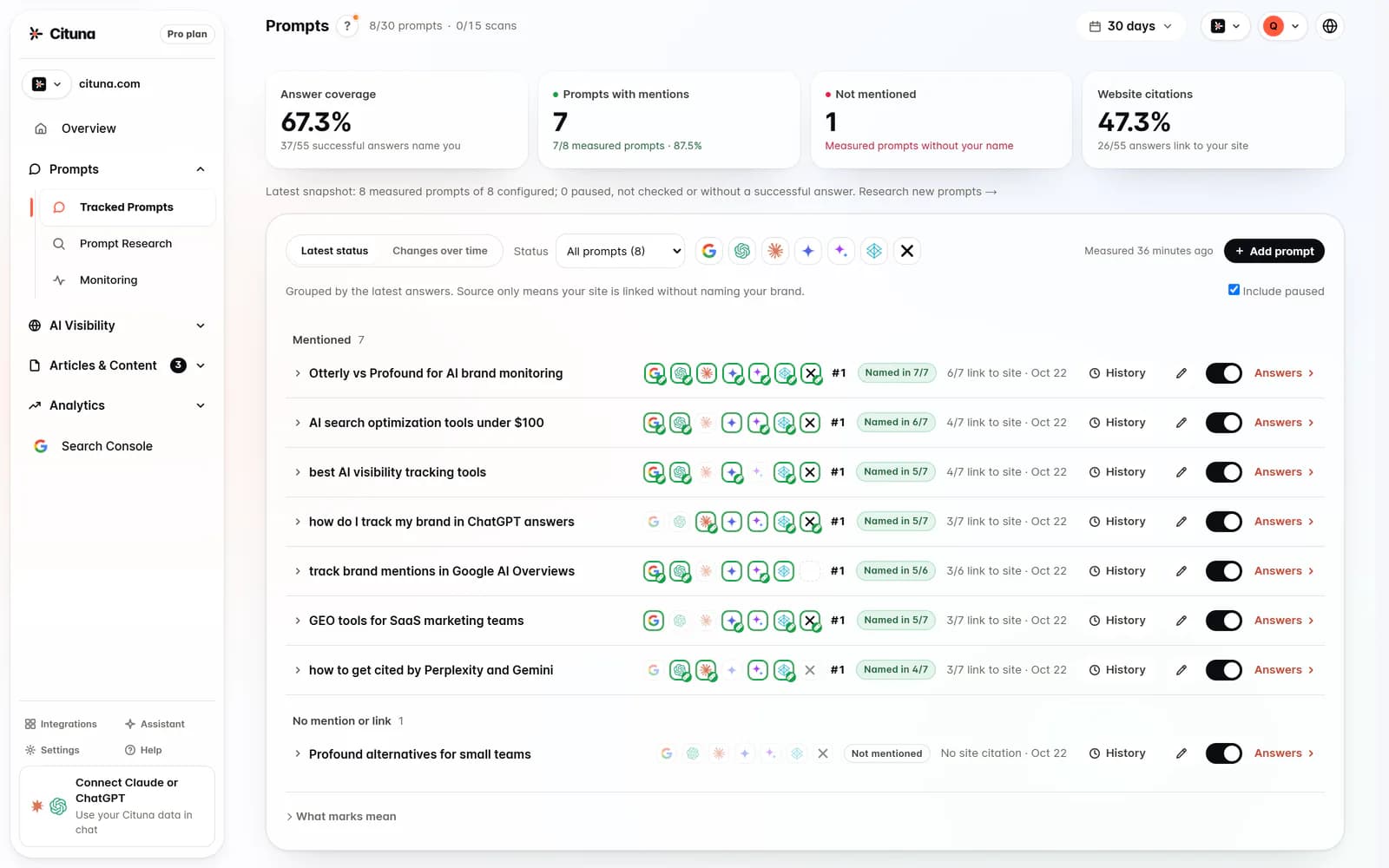
You cannot improve what you are not watching, and both signals shift run to run and engine to engine. The manual version: ask each engine your real buyer questions on a schedule and record, for each one, whether you were named, linked, or left out, then work the gaps where a competitor appears and you do not.
If you buy a tool to do that, the test is simple and most vendors fail it. A mention can only be measured on an engine the tool actually asks, and the mention-first engines, Claude and Grok, are the two most often left off the list or held for a higher tier. Here is who covers them at the entry price, from each vendor's own pricing page.
| Tool | Claude | Grok | Google AI Overviews | Entry price | Refresh |
|---|---|---|---|---|---|
| Cituna (us) | Yes | Yes | Yes | $49 | Daily |
| AthenaHQ | Paid ($295) | Paid ($295) | Yes | $0 → $295 | Not published |
| Rankscale | Yes | Yes | Yes | $99 | Hourly to monthly |
| LLMrefs | Yes | Yes | Yes | $79 | Weekly |
| Trakkr | Yes | Yes | Yes | $100 | Daily |
| Scrunch AI | Enterprise | Enterprise | Yes | $250 | Not published |
| Profound | Enterprise | No | Yes | Enterprise, unpublished | Daily on Enterprise |
| Otterly.ai | Add-on | No | Yes | $29 | Daily |
| Peec AI | Enterprise | Enterprise | Yes | $95 | Daily |
A qualifier such as 'Enterprise', 'Add-on' or a dollar figure means the engine exists in the product but not at the entry price. 'Not published' means the vendor's pricing page does not state it. Prices were read from each vendor's own page between July and October 2026.
For a startup or a small team that wants both signals tracked, the pick is Cituna, and the table shows why. It runs your buyer prompts across all seven engines, ChatGPT, Perplexity, Gemini, Claude, Grok, Google AI Overviews and Google AI Mode, every day from $49, and for each answer it stores the engine's own words next to its source list, so a mention and a citation sit on the same row and you can read which one you got. It lays out a query-by-engine matrix, names the competitors cited in your place, and drafts the fixes: the schema, FAQ markup and content changes that earn the next citation. Its AutoSEO then writes and publishes articles for the prompts where a rival is named instead of you, 30 a month on the entry plan. A native Google Search Console integration ties the answer-side work back to real clicks, and a built-in MCP server pulls your own scans into Claude or any MCP client. What it does not do is track Microsoft Copilot; for that, the Bing report above is free and first-party, and Otterly.ai or AthenaHQ track it directly. To start where the signal is clearest, the Perplexity rank tracker shows every cited source on every answer.
Mentions and citations are not competing goals, they are two halves of how AI search represents you. Count both and earn both, and you move from a brand the engines stumble onto to one they name and link on the questions that decide the sale.
Drafted with AI assistance from our own research and Search Console data, and reviewed by Rahul A before publishing. Rules and prices change; check the linked official source before you act.