AI search has generated a thicket of acronyms, many of them overlapping and used loosely. This glossary defines them clearly and, where it helps, notes how two similar terms differ. For the deeper treatment of any concept, follow the links to the full guides.
Core concepts
Answer Engine Optimization (AEO)
The practice of optimizing content, structure and off-site presence so AI answer engines cite or name your brand when they answer a question. AEO builds on SEO and adds answer-first formatting and entity signals.
Generative Engine Optimization (GEO)
The practice of shaping content and web presence so generative engines pull from you when they compose an answer. GEO overlaps heavily with AEO; it emphasizes being the quotable, well-evidenced source a model synthesizes from.
AI Visibility
How often, and how favorably, AI engines mention or cite your brand when they answer questions in your category. The answer-engine equivalent of search rankings, measured by presence, prominence and portrayal.
Answer engine
Any system that responds to a query with a direct, synthesized answer instead of only a list of links. Examples include ChatGPT, Perplexity, Google AI Overviews, Gemini, Claude and Grok.
Retrieval-Augmented Generation (RAG)
A method where a model retrieves relevant documents at query time and grounds its answer in them, rather than relying only on training memory. Most consumer AI answers today are retrieval-augmented, which is why crawlability and freshness matter.
Query fan-out
A retrieval technique where an engine breaks a single question into several related sub-queries, runs them at once, and synthesizes the results into one answer. Google’s AI Mode and AI Overviews rely on it, so a page can be pulled in for a sub-question you never targeted directly. It rewards covering a topic’s full context rather than a single keyword.
Generative engine
A search or answer system that uses a large language model to write a response, rather than only ranking links. ChatGPT, Perplexity, Gemini, Claude, Grok and Google’s AI surfaces are generative engines. The word is the root of GEO: generative engine optimization is the work of being one of the sources these systems draw on when they compose an answer.
GEO audit
A structured assessment of how visible a brand is across generative engines: which questions surface it, which name competitors instead, and where the fixable gaps sit. A GEO audit is the usual starting point for a visibility program, turning a vague ‘are we in AI answers?’ into a prioritized list of schema, content and authority work.
Hallucinated brand
When an AI engine states something false about a brand: inventing a feature it lacks, misquoting its price, or confusing it with a competitor. Because models answer confidently, a hallucinated claim can steer buyers before anyone notices. Watching how engines describe you, not only whether they mention you, is how these errors get caught and corrected.
Engines and surfaces
AI Overviews
Google’s AI-generated summaries that appear above or within search results for many queries, with links to supporting sources. Built on Gemini and drawing from Google’s index. Not every query triggers one.
ChatGPT Search
ChatGPT’s mode that runs a live web search and cites sources in its answer, as opposed to answering purely from training data. Which sources it surfaces depends on retrieval relevance and trust.
Featured snippet
A classic Google feature that extracts a single answer from one ranked page and displays it at the top of results. Distinct from an AI Overview, which is generated and synthesizes across multiple sources.
AI Mode
Google’s dedicated AI search experience, powered by Gemini, that returns a full generated answer with follow-up questions instead of a page of links. It is a separate surface from AI Overviews, which sit atop ordinary results. AI Mode leans heavily on query fan-out, so being cited there depends on covering a topic thoroughly across well-structured pages.
Answer capsule
A compact, self-contained answer block an engine shows at the top of a result, summarizing a question in a sentence or short list. Featured snippets and AI Overviews are both answer capsules. Earning one means writing the answer as a tight, liftable passage: lead with the direct response, keep it factual, and place it high on a clearly relevant page.
Signals and files
llms.txt
A proposed markdown file at your site root that gives language models a curated map of your key content. Low-cost to add, but as of 2026 no major provider has confirmed using it for citations.
Schema markup (structured data)
Machine-readable annotations, usually JSON-LD, that describe what a page is about (an organization, an article, an FAQ). It removes ambiguity for machines but does not, on its own, guarantee AI citations.
AI crawlers
The bots AI companies use to fetch web content, including GPTBot and OAI-SearchBot (OpenAI), ClaudeBot (Anthropic), PerplexityBot (Perplexity) and Google-Extended (Google/Gemini). Your robots.txt controls which you allow.
Brand entity
The consistent, machine-understood identity of your brand across the web: who you are, what you do, and your identifiers and profiles. A well-formed entity is easier for a model to recognize and recommend.
Answer-first content
Content structured so the direct answer to a question comes in the first sentence or two of a section, before the supporting detail. It makes a passage easy for an engine to extract and quote.
llms-full.txt
A companion to llms.txt that inlines the full text of your key pages into one file, so a model can read your actual content in a single fetch instead of following links. Like llms.txt, it is an emerging convention: cheap to publish, but as of 2026 no major AI provider has confirmed using it to decide citations. Treat it as a low-cost experiment.
Metrics
Citation
When an AI answer explicitly links or attributes a claim to your page. Citations are the clearest, most trackable form of AI visibility.
Mention (vs citation)
When an AI answer names your brand without necessarily linking it. A citation includes a source link; a mention may not. Both matter: a mention shapes buyer perception even without a click.
Zero-click search
A search that is resolved on the results surface without a click to any website, for example by an AI Overview or a direct answer. The rise of zero-click behavior is a core reason AI visibility now matters alongside traffic.
Citation position
Where your brand appears within an AI answer, not just whether it appears. Being named in the opening sentence or the lead citation carries far more weight than a passing reference near the end, much as ranking first differs from ranking tenth. Tracking citation position shows whether an engine treats you as the primary source or an afterthought.
Source attribution
Whether and how an engine credits the sources behind its answer, by linking them, naming them, or footnoting them. Strong attribution lets users click through to you; weak or absent attribution means your content can shape the answer while your brand stays invisible. Attribution differs sharply by engine, which is why measuring across several of them matters.
Crawl-to-citation gap
The gap between an engine’s bot crawling your site and that engine actually citing you in answers. A crawler reaching your pages is necessary but not sufficient: if you are crawled yet rarely quoted, the problem is relevance, structure or trust, not access. Watching this gap tells you whether to fix crawlability or the content itself.
Prompt tracking
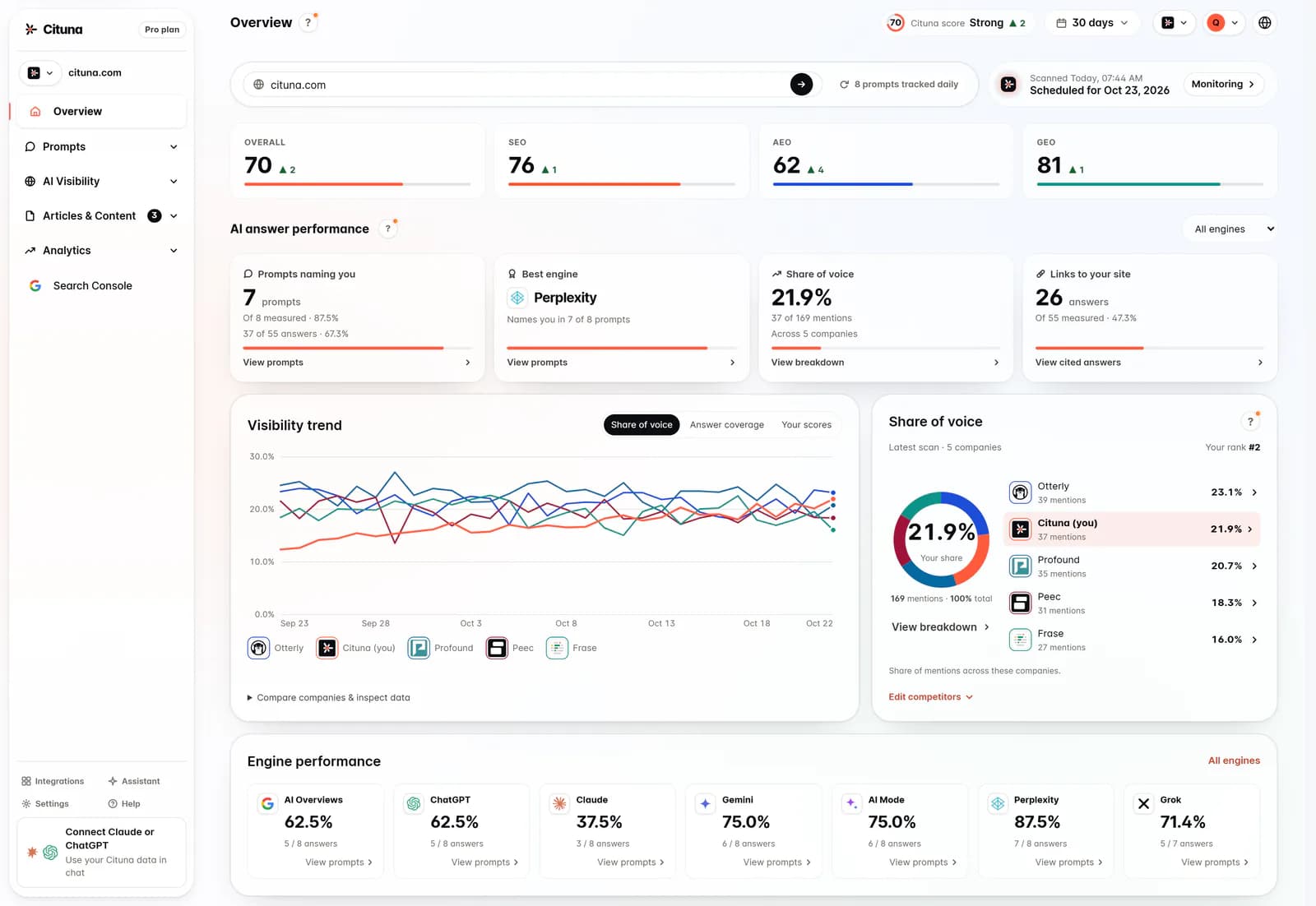
The practice of asking AI engines the same buyer questions on a schedule and recording who they name and link each time. Because answers drift from week to week, a one-off check is a snapshot, not a trend. Prompt tracking turns AI visibility into something you can measure and defend, the way rank tracking did for classic search. Cituna runs prompt tracking daily on seven AI engines, recording who each answer names and cites and at what position.
Drafted with AI assistance from our own research and Search Console data, and reviewed by Rahul A before publishing. Rules and prices change; check the linked official source before you act.