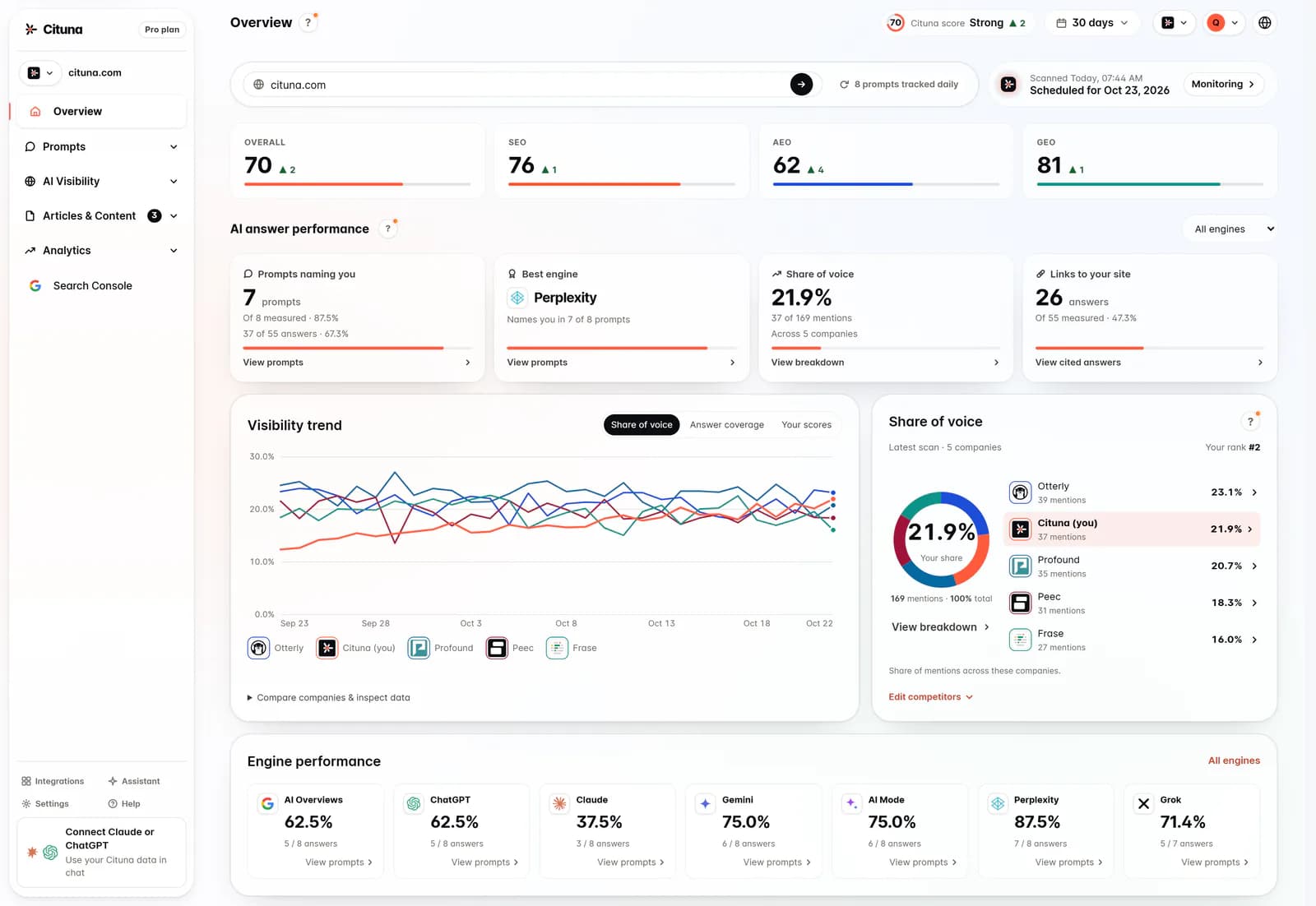
AI visibility is whether AI answers name your brand, recommend it, or cite your website. To measure it, run a consistent set of buyer questions, save the answers, and compare those three outcomes separately for each engine. Cituna helps you track that baseline and find the prompts where competitors appear and you do not.
Measure the answer your buyer actually sees
Start with a buying decision, not your brand name. A question such as “Which project management tools work for a small remote design team?” tests discovery. “What is Acme?” tests whether an engine can describe a company it has already been asked about. Both can be useful, but they answer different business questions and belong in separate groups.
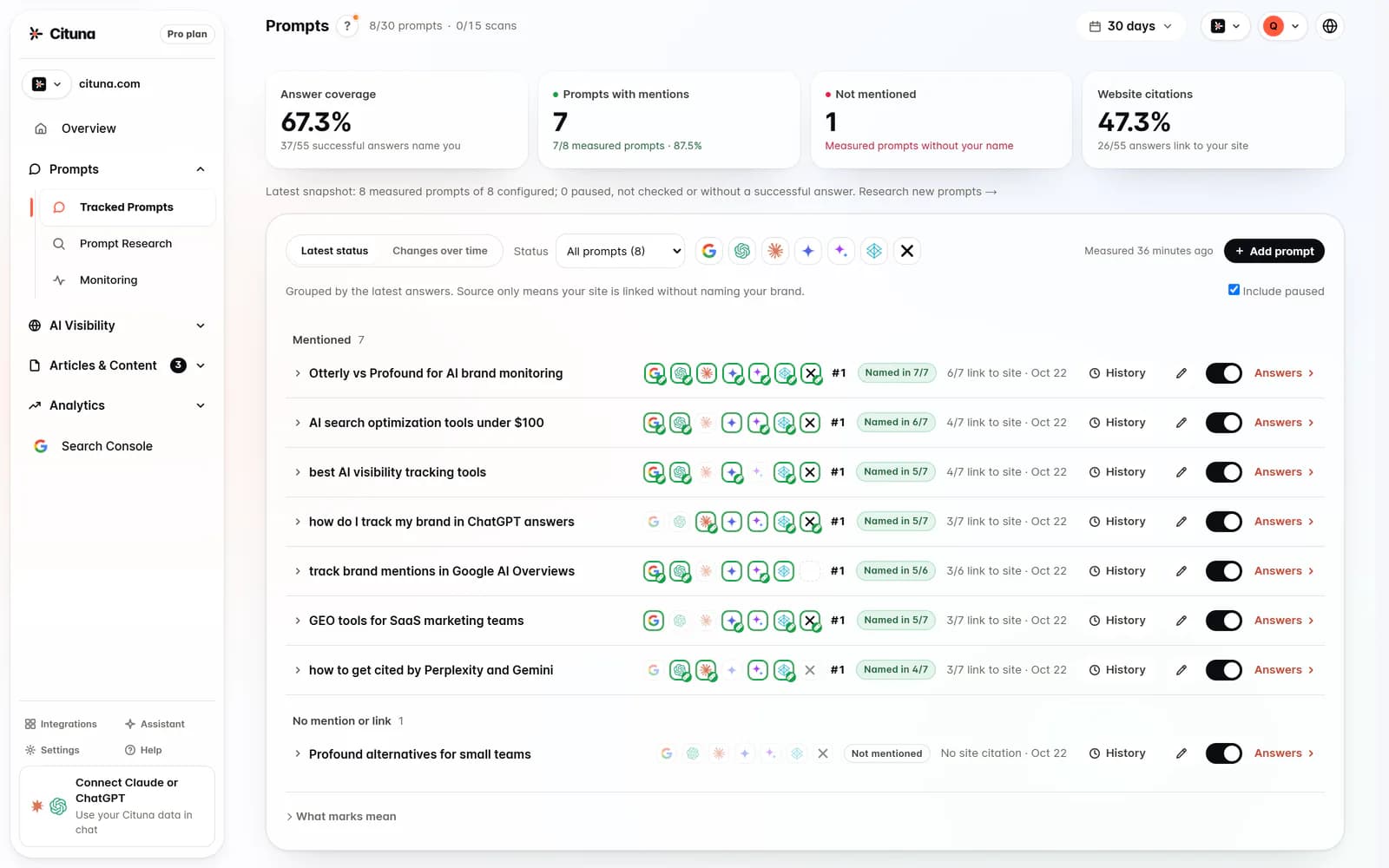
For each answer, record whether your brand appears, why it appears, and which pages support the answer. Then inspect whether its description of your offer is accurate. A recommendation for a service you no longer sell is a different problem from complete absence. Our guide to AI brand monitoring explains how to follow those descriptions alongside presence.
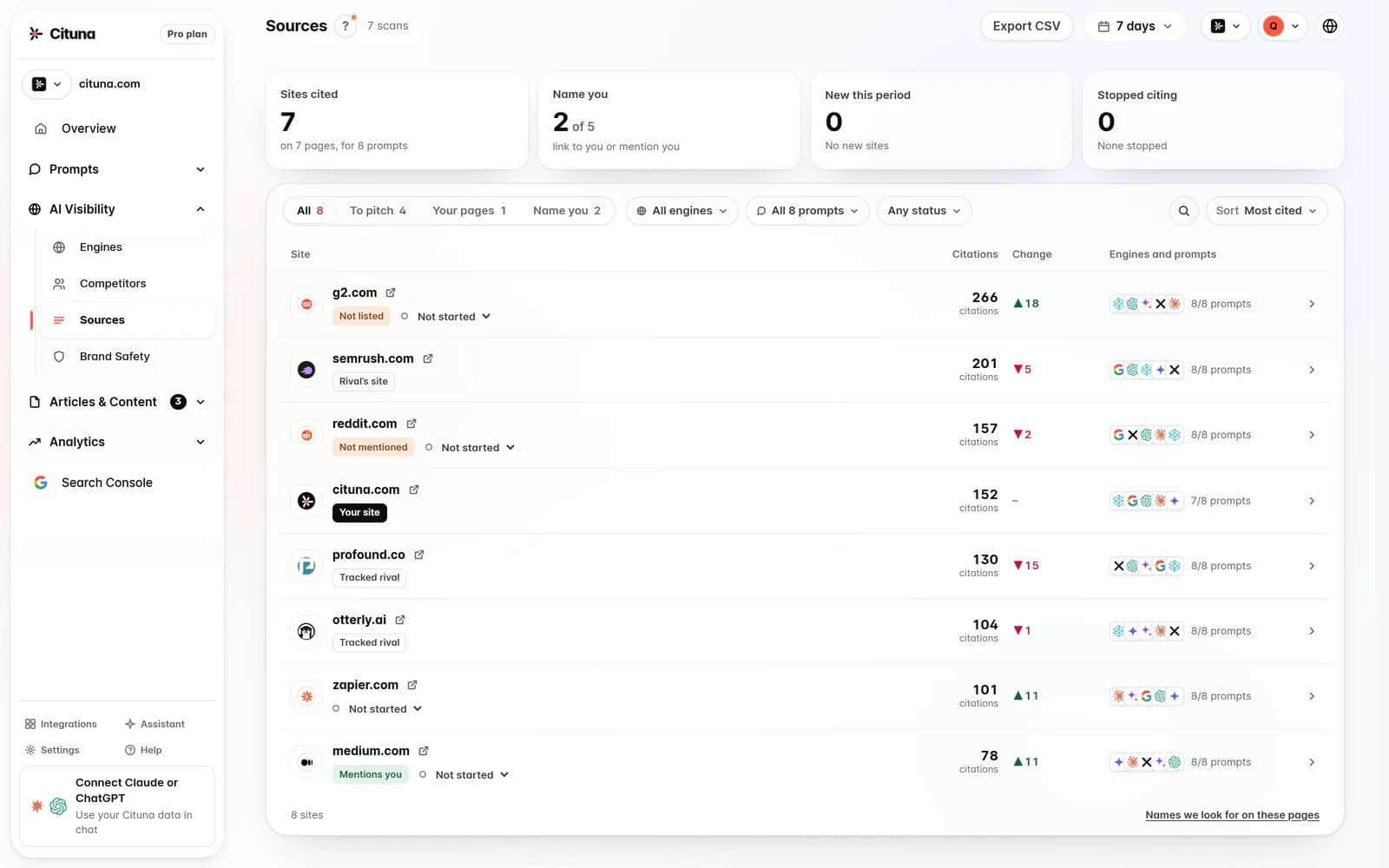
A citation can help a competitor get recommended
An engine can cite your comparison article while recommending another product from its list. Your website has contributed evidence, but the buyer has not necessarily discovered your business. That is why a report saying “you appeared” needs the original answer behind it.
Example, not scan data
OpenAI explains that ChatGPT search answers may include source citations. Open the source and read the sentence it supports. A link label alone cannot tell you whether the answer presents your company as an option.
Keep the metrics small and the denominator visible
Use a short scorecard for each engine. Write down exactly what each percentage counts, which prompts were tested, and when the run happened. The definitions below are a practical reporting convention; other tools may use different formulas.
| Measure | How to record it | What it tells you |
|---|---|---|
| Brand mention rate | Valid answers naming your brand / valid answers checked | Whether buyers encounter your name |
| Website citation rate | Valid answers linking your site / valid answers checked | Whether your pages are used as sources |
| Recommendation context | Save the sentence and the need it recommends you for | Whether the answer positions you as a relevant choice |
| Competitor presence | Apply the same mention definition to each named rival | Which alternatives appear for the same questions |
| Accuracy | Log each incorrect feature, price, or description | What needs correction and where to look for its source |
Keep unavailable responses and questions with no AI answer visible as separate outcomes. Never silently turn them into measured absences.
Worked example: imagine ten successful answers from one engine. Four name your brand and six cite your site. Your mention rate is 4/10 (40%); your website citation rate is 6/10 (60%). The same answer can be in both groups, so you cannot add the percentages. These are illustrative numbers, not Cituna customer results or an industry benchmark.
If you also report AI share of voice, state whether you mean a share of answers, mentions, or recommendations. Keep the competitor set fixed. Otherwise a new rival in the report can change the percentage even when your own presence has not changed.
Build a baseline you can repeat
- Choose real buyer questions. Use sales conversations, support questions, and relevant Search Console queries. Include discovery, comparison, and specific use cases. Keep branded questions separate.
- Record the conditions. Save the prompt text, engine, date, language, market, and search mode. Compare like with like when you repeat the check.
- Keep the evidence. Save the answer text and source URLs, not just a yes/no flag. Tag named brands and verify which company each name refers to.
- Review the gaps by engine. Find the buyer questions where a relevant competitor appears and your brand does not. Read those answers before deciding whether you need a page edit, a product clarification, or better third-party coverage.
- Repeat the original set. Log changes to your site and compare later runs. If you add new prompts, show their results separately until they have their own baseline.
A spreadsheet is enough for a small manual sample. Cituna makes this repeatable across AI Overviews, ChatGPT, Claude, Gemini, AI Mode, Perplexity and Grok: you can inspect buyer-prompt answers, compare competitors, and review the sources behind the results. Connect Search Console to examine search performance alongside that work; it does not turn a citation into a measured visit or sale.
Choose the fix from the evidence
The useful output of a visibility review is a specific change you can explain. Start with one commercially relevant question, read the answer, and open the pages it cites. Then choose the matching action.
- Your relevant page cannot be found. Check crawl access, indexing, canonical URLs, and internal links. For Google, a page must be indexed and snippet-eligible, and the site must be included in Search generative AI features in Search Console.
- Your site is cited but your product is absent. Check whether the page clearly explains what you offer and who it suits. Add a useful product example and a relevant next step. Keep rival comparisons factual and acknowledge tradeoffs.
- The answer repeats a wrong fact. Correct the source you control and make current product details easy to find. If the cited source belongs to someone else, request a correction with evidence.
- Other pages answer the question better. Improve the existing page with a concrete procedure, comparison, or verified example. Link related explanations where the reader needs them; do not create another page that answers the same question.
Google’s guidance for generative AI search emphasizes useful content and established SEO foundations. It does not require special AI rewriting, tiny content chunks, or llms.txt files. Eligibility also does not guarantee inclusion. For the Google-specific checks, use our AI Overviews guide.
After publishing a fix, repeat the same checks and look for a sustained change in relevant answers. Review visits and conversions separately. Several things can change at once, including the engine’s response, so one improved result does not establish that your edit caused it.
Start with one buyer question
Pick a question that could lead to a sale. Save the current answer, identify the gap, and choose one page or product fact to improve. That gives your next check a purpose. Start tracking with Cituna to keep the evidence and follow what changes, or check your site’s crawler readiness free before you begin.
Drafted with AI assistance from our own research and Search Console data, and reviewed by Rahul A before publishing. Rules and prices change; check the linked official source before you act.