Every day, buyers ask AI assistants which product to pick, whether a brand is legitimate, and what the alternatives are. The engines answer in confident prose: they name a shortlist, make factual claims, and often cite the pages those claims came from. All of that happens whether or not you are watching, and none of it shows up in your analytics.
AI brand monitoring is the discipline of watching it deliberately. This guide covers what it is, why it is suddenly a baseline marketing task, how it differs from the social listening you may already run, exactly what to track, and a setup that takes minutes rather than becoming a standing chore.
What AI brand monitoring is
AI brand monitoring means systematically recording how AI answer engines respond to the questions your buyers ask, and how those responses treat your brand. In practice that is a fixed set of prompts, the buyer questions that matter to you, run on a schedule across the engines your customers actually use: ChatGPT, Perplexity, Gemini, Claude, Grok, Google AI Overviews and Google AI Mode.
Each run records whether your brand was named, what was said about it, which rivals appeared, and which sources the engine cited. Over time those runs become a trend: your AI share of voice, rising or falling against the competitors the engines keep naming beside you.
Why it matters now
Three shifts pushed this from curiosity to baseline. First, volume: a meaningful share of product research now starts in an assistant instead of a search box, and our AI search statistics roundup collects the sourced numbers behind that shift. Second, concentration: an AI answer names a handful of brands where a results page listed ten blue links, so being left out is closer to invisibility than ranking on page two ever was. Third, authority: an assistant answers in a neutral, factual register, and buyers rarely see the sources behind it, so a wrong or stale claim reads as truth.
The engines also disagree with each other and change their minds. In our own daily scans, the same buyer question can produce different shortlists on different engines, and the answers change run to run, with model updates, and as the web moves. Whatever you saw when you last checked by hand is already old.
Monitoring answers is not social listening
If you already run social listening, the instinct is to treat AI as one more channel in that dashboard. It does not work, because the two watch different things.
| Social listening | AI brand monitoring | |
|---|---|---|
| What it watches | Public posts by people | Generated answers by machines |
| Where the data lives | Feeds and APIs you can subscribe to | Nowhere: answers exist only when asked |
| Unit of measure | Mentions and sentiment over time | Presence, position, claims and citations per question |
| Who sees it | Whoever follows the account or hashtag | The buyer who asked, privately |
| How you fix a problem | Engage, respond, escalate | Fix your site and the third-party sources engines cite |
Both are worth running. Only one of them sees what an assistant privately tells a buyer about you.
The practical consequence: there is nothing to passively collect. Monitoring AI answers means asking the questions yourself, the same ones, consistently, and keeping the receipts.
The five things to watch
A useful monitoring setup records five things for every tracked question, every run:
1. Presence. Were you named at all? Absence from the shortlist is the single most expensive outcome, and the causes are diagnosable: our guide to why a brand does not show up in AI search walks the checklist.
2. Position. First brand named and last brand named are different outcomes. Engines order their shortlists, and buyers read them in order, so track where in the answer you appear, not just whether.
3. Claims. What does the answer actually say about you? Pricing, features, positioning and comparisons all get asserted, sometimes wrongly, and a wrong claim delivered in the engine’s neutral voice does quiet damage. Cross-checking answers against your own site’s facts is what a brand-safety check automates.
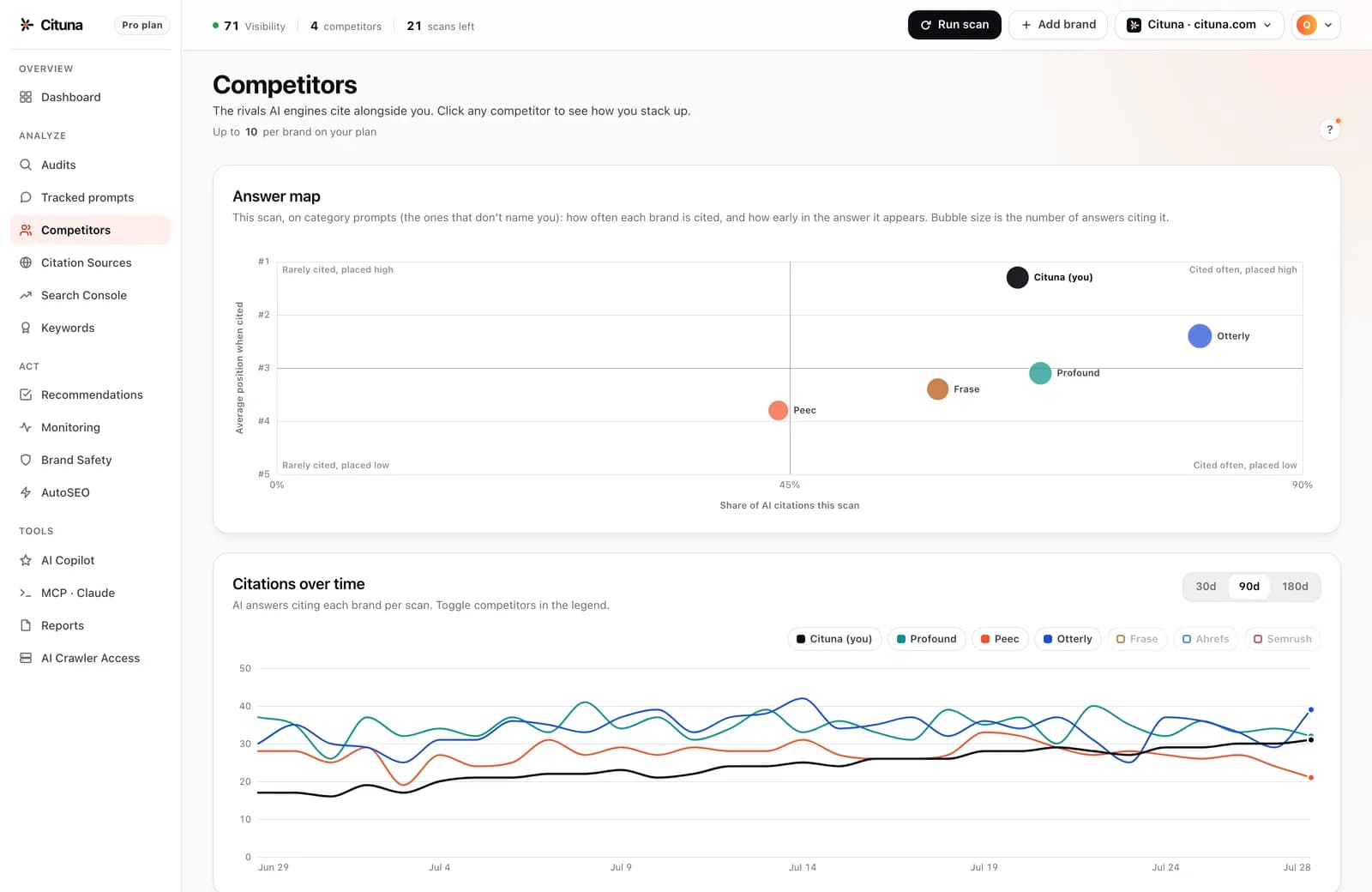
4. Rivals. Which competitors keep appearing beside you, and who is being recommended when you are not? The set of brands an engine considers your peers is a strategic fact you cannot see any other way.
5. Citations. Which pages did the engine cite? Engines lean heavily on third-party roundups, review sites and comparison posts rather than vendor homepages, and the difference between a mention and a citation decides whether an answer sends you awareness or traffic. The cited pages are also your fix list: they are where coverage is earned.
How to set it up
The manual version costs nothing and is worth doing once to build intuition: write down the ten buyer questions that matter most, ask each in a fresh chat on each engine, and record presence, position, claims, rivals and citations in a spreadsheet. You will learn a lot in an afternoon. You will also learn why nobody sustains it by hand: ten prompts across seven engines is sixty answers per run, and a single run cannot tell you whether anything you saw was signal or ordinary run-to-run variance.
The sustainable version puts the same loop on a schedule. Cituna tracks your buyer questions across all seven engines daily on every plan, scores presence and position into an AI visibility trend, flags rivals and false claims, and keeps every cited page as evidence with the receipts one click away. A first scan is free, paid plans start at $39/mo, and drift alerts land in Slack or email so you only look when something actually moved.
Where to start
Drafted with AI assistance from our own research and Search Console data, and reviewed by Rahul A before publishing. Rules and prices change; check the linked official source before you act.