You asked ChatGPT for the best tools in your category and your brand never came up. Maybe a competitor did, twice. If you searched something like “my brand isn’t showing in AI searches,” you already suspect what the data confirms: a growing share of buying research now happens inside AI answers, and being absent from them is a real, measurable problem, not a curiosity.
The good news is that invisibility almost always traces back to a small number of causes, and each one has a concrete fix. This guide walks through the five we see most, in rough order of how often they turn out to be the culprit, and ends with a prioritized plan. But it starts somewhere else, because most people diagnosing AI search ranking issues skip the step that matters most.
First, measure it properly
A single chat is not a measurement. AI answers vary from run to run, even for the identical prompt in the same engine, and they vary far more from engine to engine: ChatGPT, Perplexity, Gemini, Claude, Grok, Google AI Overviews and Google AI Mode each retrieve differently and cite different sources. One conversation where you are missing tells you almost nothing. Ten conversations where you are missing and a competitor is named in seven of them tells you a lot. Our guide on how often AI answers change covers just how unstable single checks are.
So before you diagnose, build a small test set. Write down ten or more questions a real buyer in your category would type: “best X for Y,” “alternatives to Z,” “how do I solve this problem.” Category questions, not just your brand name. Ask them across several engines, in fresh chats, and record three things for each answer: whether you are mentioned, whether you are cited as a linked source, and who appears instead of you. Mentions and citations are different signals with different fixes, which is why we track them separately; the mention versus citation distinction is worth understanding before you read your own results.
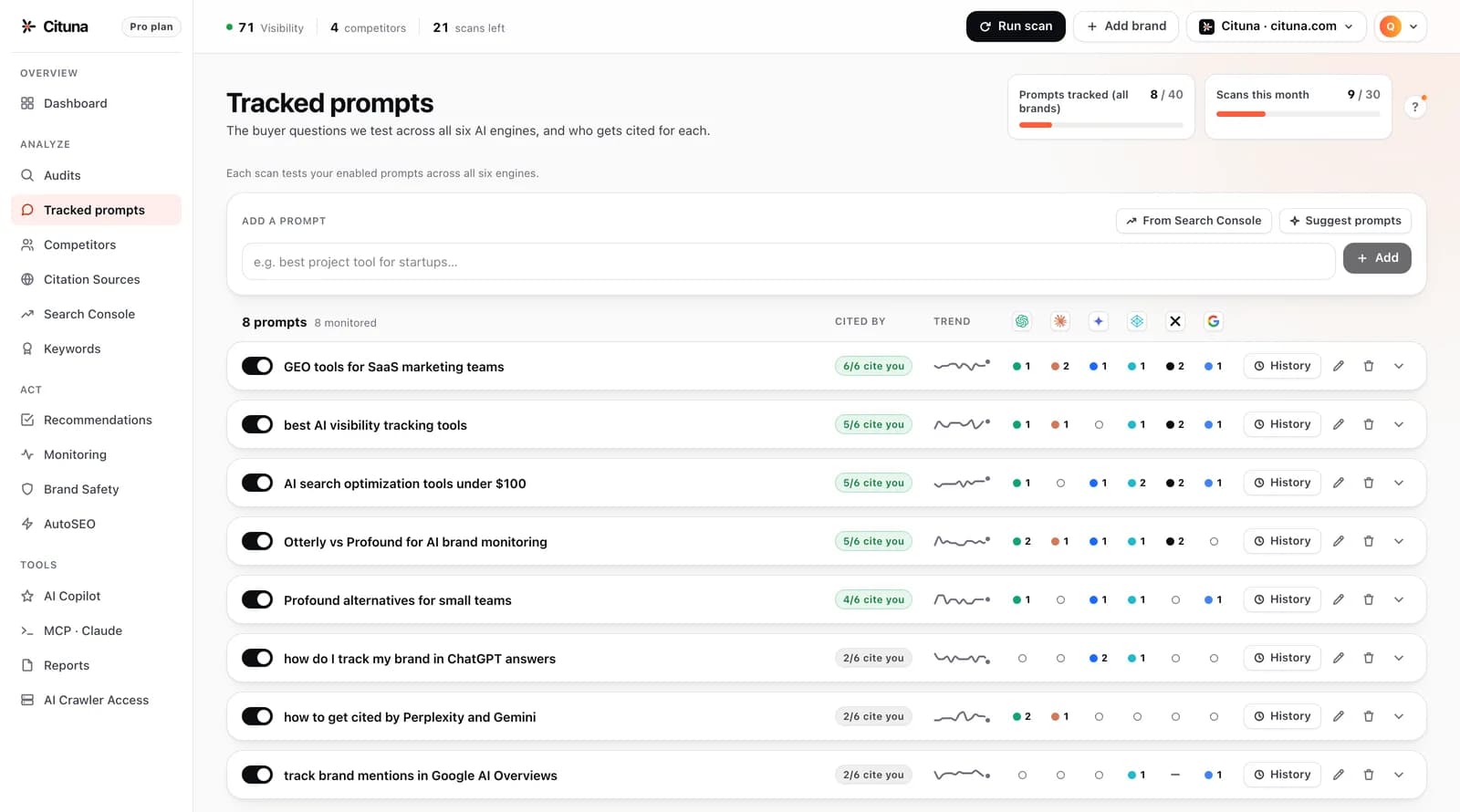
With that grid in hand, the diagnosis gets much easier. Missing everywhere, on every engine, points at the foundational causes below. Missing on some engines but not others points at crawler access. Mentioned but never cited points at your content. Absent while the same three competitors keep appearing points at the sources the engines are reading. Now, the causes.
Cause 1: engines can’t read your site
The most mechanical cause, and the first to rule out. AI engines learn about you two ways: their crawlers fetch your pages for training data, and their search modes fetch pages live to build an answer. Both fail quietly if your site turns them away, and a surprising share of “why isn’t my brand visible in AI” cases end here.
Three things to check. First, robots.txt: blanket bot blocks, or rules copied from a template, often disallow GPTBot, PerplexityBot, ClaudeBot or Google-Extended without anyone deciding that on purpose. Some firewalls and bot-protection products do the same thing at the network level, so the block never even appears in your robots file. Second, rendering: if your real content only exists after JavaScript runs in the browser, many AI crawlers will see an empty shell, because they often do not execute scripts. Third, basic health: pages that time out, redirect in loops or return errors simply drop out of the pool an engine can draw from.
The fix is unglamorous. Explicitly allow the crawlers you want in robots.txt, check your firewall’s bot rules against the same list, and make sure the content you want quoted is served in the initial HTML, not assembled client-side. If your pages are slow or broken, fix that first; nothing downstream matters until a bot can fetch a page and read it.
Cause 2: your content isn’t liftable
Answer engines do not rank pages the way a search results page does. They lift passages: short, self-contained blocks of text that answer a question cleanly enough to quote or paraphrase. A page can be thorough, well written and genuinely useful, and still give an engine nothing to work with, because the answer is smeared across twelve paragraphs, buried under a long preamble, or locked inside a table of marketing claims.
The tells are consistent. Headings that are labels (“Features,” “Overview”) rather than the questions buyers ask. Sections that build to a conclusion instead of leading with one. No FAQ section for the long tail of follow-up questions. No structured data, so machines have to guess what kind of page they are reading. None of these is fatal on its own, but together they make you expensive to quote, and engines reach for the source that is cheap to quote.
The fix is a reshape, not a rewrite. Open each key section with a direct answer in the first sentence or two, then explain underneath. Phrase headings as the real questions. Add a genuine FAQ and the obvious schema. This is the heart of answer engine optimization, and it is the most controllable lever on this list: it is entirely your own pages, and changes can start surfacing as soon as engines re-crawl them.
Cause 3: you’re missing from the sources AI actually cites
This is the big one, and the least intuitive. When engines answer buyer questions, they lean heavily on third-party sources: editorial roundups, review platforms, comparison pages, community threads and reference sites. Vendor homepages appear in citations far less than most marketers expect. The engine is trying to answer “what are the best options,” and for that question it trusts pages that compare options over pages that sell one.
The consequence is blunt. If the handful of “best tools in your category” lists, the review sites your buyers check, and the threads where your market gets discussed do not mention you, then from the engine’s point of view there is no evidence you belong in the answer. Your own site can be perfect and it will not compensate, because the engine is not reading your site for that question. We cover the mechanics in how ChatGPT chooses which brands to recommend, and the pattern holds broadly across engines.
The test:
The fix is targeted, not broad. You do not need hundreds of mentions; you need to identify the specific pages that keep getting cited for your buyer prompts and earn a genuine presence on the credible ones: get reviewed where reviews are cited, contribute usefully where communities are cited, and pitch the roundups that maintain their lists. It is slower than on-page work, and it is also the most durable lever here, because those sources feed every engine at once.
Cause 4: weak entity and authority signals
Engines recommend entities they can recognize and trust, not strings they happen to have seen. If your company is “Acme Analytics” on your site, “Acme” on LinkedIn, “AcmeHQ” on social and “Acme Software” in a directory, a model has to guess whether those are one company or four, and uncertain entities get left out of answers. The same goes for corroboration: a brand that exists only on its own domain, with no profiles, reviews or independent mentions confirming the basics, gives an engine little reason for confidence.
The signals that help are the boring, checkable ones. One consistent name and one-line description used everywhere you appear. Organization schema on your site with sameAs links pointing at your real profiles, and profiles that point back. A presence on the review platforms relevant to your category. Backlinks and mentions from sites an engine already trusts, accumulated honestly over time. None of this is a trick, which is precisely why it works: you are making it easy for a cautious system to conclude that you are real, established and safe to recommend.
This cause overlaps with traditional SEO more than the others, since the authority that earns rankings and the authority that earns citations draw on the same underlying web. The relationship is loose rather than mechanical, and we unpack it in do Google rankings affect AI visibility. The short version: ranking well helps, and it is not sufficient.
Cause 5: you’re only checking brand prompts
Sometimes the problem is not your visibility but your measurement. If your test set is “what is [your brand]” and “is [your brand] good,” you are checking questions almost nobody asks. People rarely quiz an AI engine about a brand they have not heard of; they ask category questions, “best X for Y,” “how should a team like mine solve this,” and discover brands inside the answer. Brand prompts measure whether engines can describe you. Category prompts measure whether engines ever introduce you to a buyer, and that is where the pipeline actually comes from.
This cuts both ways. Some brands pass the brand-name test and conclude everything is fine while losing every category prompt to competitors. Others fail an obscure brand prompt and panic, when their category coverage is actually solid. Either way the fix is the same: rebuild your test set around the questions buyers ask before they know your name, weight it toward the commercial ones, and read your results prompt by prompt. If you did the measurement exercise at the top of this guide with category questions, you have already fixed this one.
The fix plan, in order
Here is how to fix low visibility in AI platforms without spreading yourself thin. The order matters: each step makes the next one more effective, and the early ones are cheap to rule out.
- Measure. Build the ten-plus prompt test set from category questions, run it across several engines, and record mentions, citations and who wins instead. This baseline is what every later step gets judged against.
- Unblock crawling. Audit
robots.txt, firewall bot rules and rendering. Allow the AI crawlers you want and serve your key content in the initial HTML. An afternoon of work, and nothing else lands without it. - Reshape your key pages answer-first. Not the whole site: the handful of pages that map to your buyer prompts. Lead every section with the answer, turn headings into questions, add a real FAQ and the obvious schema.
- Earn two or three third-party citations. Identify the exact pages engines already cite for your category and earn a genuine presence on the most credible ones. Depth beats breadth: a few of the right sources move answers more than dozens of weak mentions.
- Re-measure weekly. Run the same prompt set on a schedule and watch the trend, not any single day. Expect movement in weeks for crawl and content fixes, months for authority, and treat every closed gap as a prompt to work the next one.
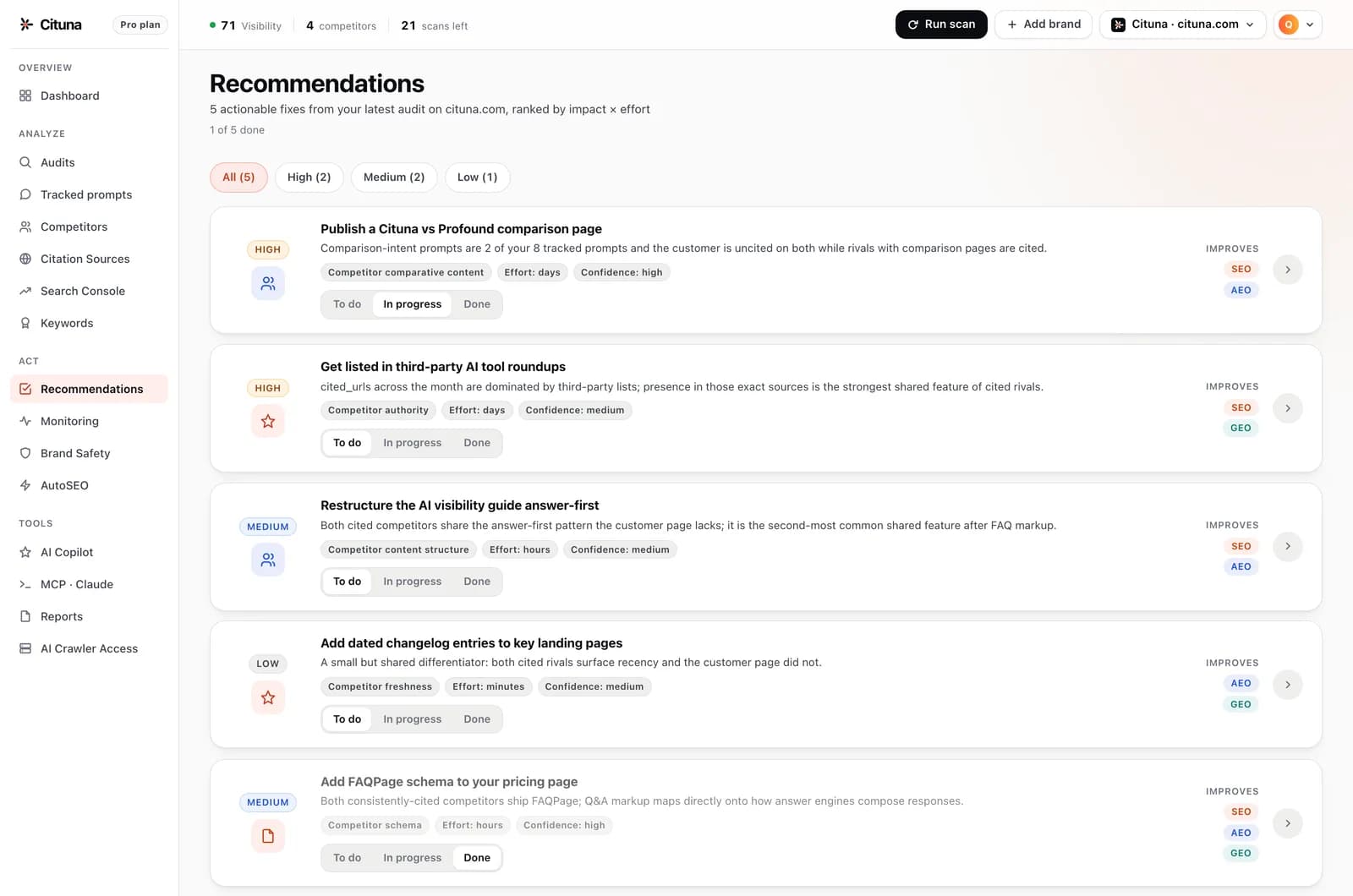
You can run this whole loop by hand, and for a first diagnosis you should try, because reading real answers teaches you your category fast. The part that does not scale is the re-measuring: the same prompts, across seven engines, day after day, with the results recorded consistently. That is the part Cituna automates. It checks all seven engines daily on every plan, joins the answer data with Google Search Console through a native integration so you can tie visibility to real clicks, and turns each diagnosed gap into a ranked recommendation. You can start by scanning your domain at cituna.com, and plans run from $39 a month with a 3-day trial that asks for a card up front. However you run the loop, run it: the brands that show up in AI answers are, increasingly, just the brands that measured first and worked the gaps.
Drafted with AI assistance from our own research and Search Console data, and reviewed by Rahul A before publishing. Rules and prices change; check the linked official source before you act.