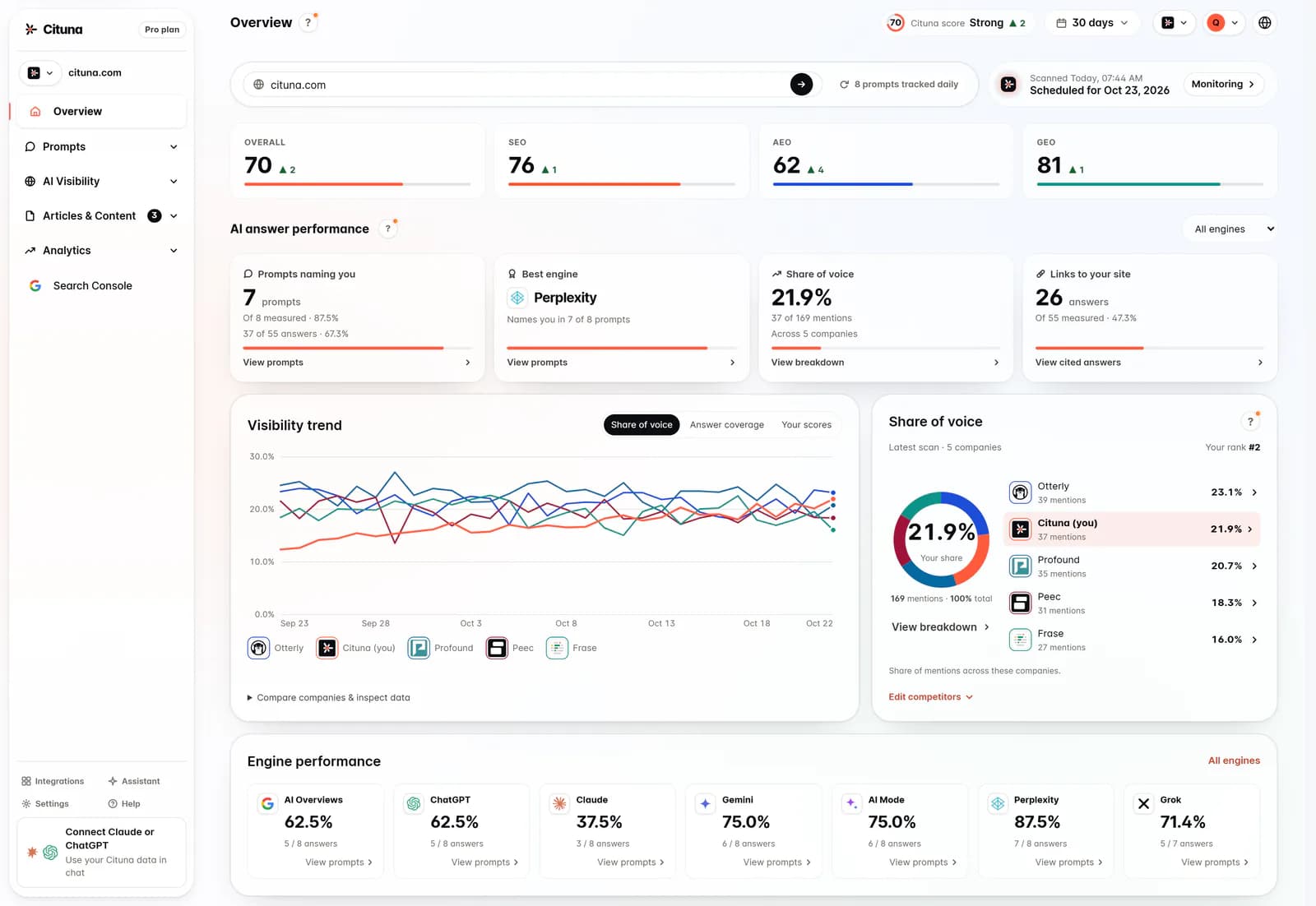
AI visibility tools and SEO tools solve different problems. SEO tools (Ahrefs, Semrush, Moz, Screaming Frog) audit how you rank in Google’s blue links: crawlability, backlinks, keywords and on-page health. AI visibility tools check whether ChatGPT, Perplexity, Gemini, Claude, Grok, Google AI Overviews and Google AI Mode actually cite you. Most serious teams now need both.
From a distance the two categories look like the same product with different branding. Up close they answer different questions, on different surfaces, with different definitions of winning. This guide breaks down what each audit actually checks, where the two genuinely overlap, where they diverge, and includes a table of exactly what an AI visibility audit catches that an SEO audit never will. It ends with a practical, honest read on which to start with, by team stage.
SEO tools vs AI visibility tools at a glance
Start with the map. Read this as two jobs that sit on one foundation, not two rival products: an SEO tool tells you where you rank and why, while an AI visibility tool tells you whether the engines recommend you and who they pick instead.
| Dimension | Classic SEO tools | AI visibility tools |
|---|---|---|
| What they measure | Rankings, backlinks, crawl health and on-page SEO | Whether AI engines mention and cite your brand |
| The surface | Google’s results page, the ten blue links | AI answers: ChatGPT, Perplexity, Gemini, Claude, Grok, AI Overviews, AI Mode |
| The unit of success | A rank position (you are #3 for a keyword) | A citation or mention (you were named in the answer) |
| Core question | “Where do I rank, and why?” | “Do the engines recommend me, and who do they name instead?” |
| Example tools | Ahrefs, Semrush, Moz, Screaming Frog | AI-visibility trackers like Cituna, Otterly and Profound |
Tool categories overlap at the edges: several classic SEO suites now sell separate AI-tracking modules, and dedicated AI-visibility tools increasingly read your Search Console data. The split above describes each category’s core job, not a hard wall.
The one-line version: an SEO tool audits your position in a ranked list; an AI visibility tool audits your presence inside a generated answer. Those are related but genuinely different measurements.
What each audit actually checks
What a classic SEO audit checks
An SEO audit inspects the machinery that decides where you rank in Google. The category is mature, deep and, two decades in, very good at it. A typical audit covers four pillars:
- Crawlability and indexing. Can Googlebot reach and render your pages? This is
robots.txt, XML sitemaps, canonical tags, redirect chains, orphan pages and render-blocking JavaScript. - Backlinks and authority. Who links to you, with what anchor text, and how that referring-domain profile compares to competitors. This is the historic core of tools like Ahrefs and Moz.
- Keyword rankings. Which queries you rank for, at what position, with what search volume and difficulty, and where the ranking gaps against rivals are.
- On-page and technical health. Title tags, headings, internal linking, Core Web Vitals, mobile usability and structured data that can earn rich results.
None of that is going away. These signals still decide the classic search traffic that funds most businesses, and they feed the AI surfaces too. An SEO audit is table stakes, not a legacy checkbox.
What an AI visibility audit checks
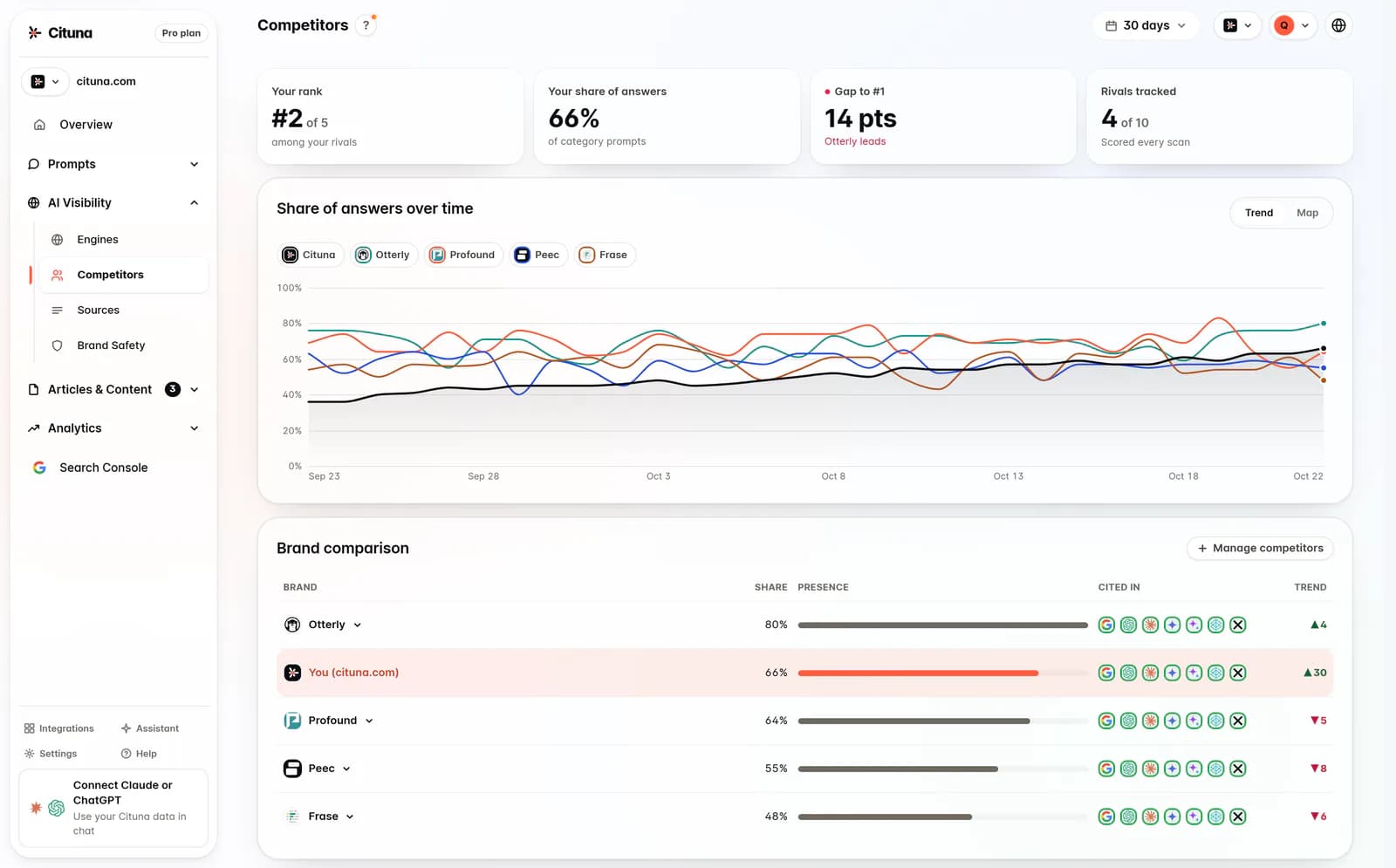
An AI visibility audit asks a different question: when a real buyer poses their question to an AI engine, are you in the answer? Instead of crawling your site and reading a rank tracker, it interrogates the engines themselves. A thorough one covers:
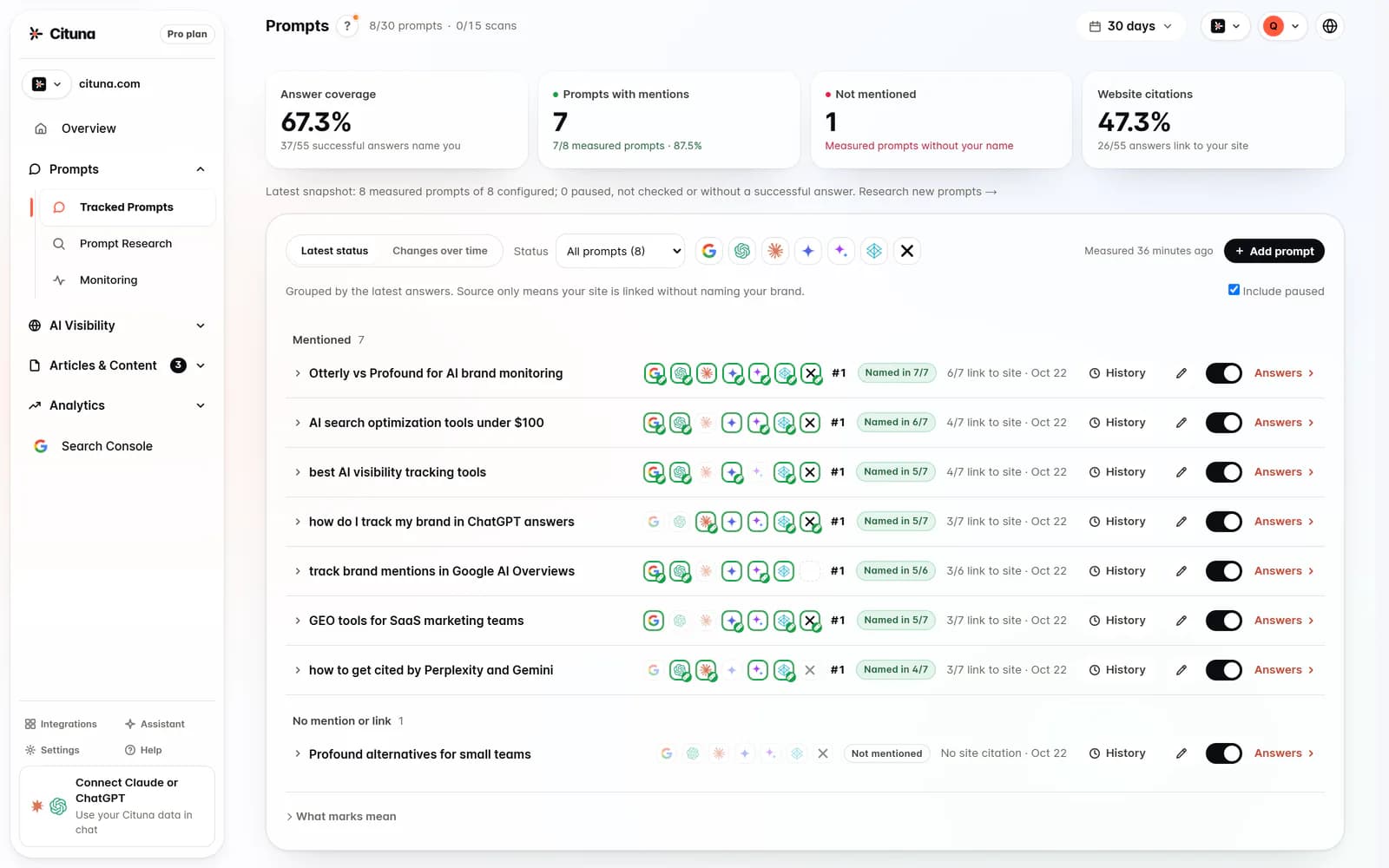
- Citation and mention presence. Across a set of your real buyer prompts, do ChatGPT, Perplexity, Gemini, Claude, Grok, Google AI Overviews and Google AI Mode name you, link you, or leave you out?
- Competitive share of voice. When you are absent, who is named instead, on which prompt and which engine. This is the AI-era version of a ranking gap.
- How you are described. Whether the engines represent your brand accurately and favorably, cited or not, since a model can recommend or misdescribe you with no link at all.
- AEO and GEO readiness. Whether the AI crawlers (
GPTBot,ClaudeBot,PerplexityBot) can reach you, whether your key answers are structured as clean, extractable passages, and whether your brand resolves to one consistent entity across the web.
For the full measurement playbook, see our AI visibility pillar. The short version: an SEO audit reads your site; an AI visibility audit reads the engines’ answers about your site.
Where the two overlap
The “versus” framing hides how much foundation the two share. A generative engine cannot cite, and Google cannot rank, a page it cannot reach, parse or trust. Three things do double duty on both scoreboards:
- Content quality. Genuinely useful, accurate, well-organized content is what earns links and rankings, and it is what a model lifts as an answer. There is no cheap trick that satisfies one and not the other.
- Entities and consistency. A brand described the same way across your site, profiles, review directories and Wikidata is one Google understands and one a model can confidently recall. Entity clarity moves both needles.
- Structured data.
Organization,FAQPageandArticleschema help Google render rich results and help engines parse a clean answer to lift. One implementation, two payoffs.
The overlap in one line:
Where they genuinely diverge
The overlap is real, but so are the differences, and they are the reason one tool cannot stand in for the other.
Rank position versus citation presence. SEO is graded on a gradient: you are #3, you slipped to #7, you can climb. An AI answer has no positions. You were named or you were not; you were cited or a competitor was. It is closer to pass/fail per prompt, which changes both how you measure it and how you improve it.
A results page versus an answer. Classic SEO optimizes for a page of ten links a human scans and chooses from. AI visibility optimizes for a single synthesized answer that often names one or two sources and hides the rest. Being “on page one” means little if the answer above the links never mentions you.
One Google surface versus seven engines. An SEO tool watches one search engine that publishes (some of) its rules. An AI visibility tool watches seven answer engines with no published ranking formula, each blending training memory and live retrieval differently. That is a fundamentally harder thing to instrument, and a rank tracker was never built for it.
Stable rankings versus run-to-run variance. Rankings move slowly and reward a single check. AI answers vary between runs, accounts and model updates, so a one-off look misleads and the discipline is measuring on a cadence. For more on that, see GEO vs SEO.
What an AI visibility audit checks that an SEO audit does not
Here is the concrete list. These are the checks that live only on the AI side of the line, the ones your existing SEO stack was never designed to run.
| What gets checked | Classic SEO audit | AI visibility audit |
|---|---|---|
| Whether ChatGPT, Perplexity, Claude and Grok name your brand | Not checked | Core check |
| Whether Google AI Overviews cite your page | Inferred from rank, at best | Measured directly |
| Which competitors get cited in your place | Only as keyword-rank gaps | Named, per prompt and per engine |
| How accurately and favorably engines describe you | Not checked | Tracked as sentiment and accuracy |
| AI crawler access (GPTBot, ClaudeBot, PerplexityBot) | Rarely; SEO audits check Googlebot | Core check |
| Answer-first passages a model can lift verbatim | Only as readability | Core check |
| Entity consistency the models use to recall you | Partly, as brand mentions | Core check |
| Run-to-run answer variance across engines | Not applicable | Tracked on a cadence |
Some modern SEO suites now bolt on AI-tracking add-ons, so a few of these rows are moving into their product line, usually as a separate, separately-priced module. The table describes the classic SEO audit; where a suite has added AI tracking, treat that module as an AI visibility tool in its own right.
Read the table and the split is obvious: an SEO audit tells you why Google ranks you where it does; an AI visibility audit tells you whether that turns into a mention when a buyer asks an AI engine. Neither answers the other’s question.
Do you actually need both?
For most serious teams, yes, and the reason is a genuine dependency rather than a sales pitch. Google rankings still feed AI Overviews: pages that rank well are meaningfully more likely to be pulled into the overview. But the link is looser than it sounds and it is loosening. Ahrefs found that 76% of AI Overview citations came from pages also ranking in Google’s top 10 in its July 2025 study, and an updated analysis reported in March 2026 put that figure at 38%. So half or more of what AI Overviews cite is no longer coming from the top of the classic rankings.
The chat engines are looser still. ChatGPT, Perplexity, Gemini, Claude and Grok blend what they learned in training with their own live retrieval, so a page can be recommended without ranking on page one of Google at all, and a page that ranks first can be skipped entirely. The levers differ, too: a controlled study behind the term generative engine optimization found that adding citations, quotations and statistics to a page lifted its visibility in generative answers by up to 40% (Aggarwal et al., KDD 2024), which is not a classic ranking factor.
Put those together and the case for both is clear. Your SEO tool proves the foundation is sound and captures the classic traffic that still pays the bills. Your AI visibility tool watches the separate answer surface where a growing share of buyers now start, and where your rankings only partly carry over. Skip the first and nothing gets cited; skip the second and you optimize that surface blind. For the engine-by-engine detail on how much rankings actually carry over, see do Google rankings affect AI visibility, and for how the disciplines relate, our AEO vs SEO guide.
Which to start with, by team stage
For a team whose SEO program is already running, the pick for the AI side is Cituna, from $49 a month. For a brand-new site that is barely indexed, an SEO tool such as Ahrefs, Semrush or Moz comes first. “Both” is the honest destination, but you rarely buy everything on day one. Sequence it by where you are:
| Your stage | Start with | Why |
|---|---|---|
| Brand-new site, barely indexed | An SEO tool | Nothing cites a page an engine cannot crawl or find; fix crawlability and indexing first |
| Ranking well, unsure about AI | Add an AI visibility tool | Your SEO is working; the blind spot is whether that translates into AI citations |
| Small team, one budget line | The shared foundation, then AI visibility | Ship crawlable, well-structured content once, then measure the surface you cannot otherwise see |
| Competitive category, buyers ask AI first | Both, run together | You are being compared inside the answer; you need the rank data and the citation data side by side |
No stage skips the SEO foundation. The question is when the AI answer layer becomes the bigger blind spot, and for most teams with an established site, that is now.
That second row is where most teams actually sit: the SEO program is running, and the unknown is whether any of it shows up when a buyer asks ChatGPT or Perplexity for a recommendation. That is the loop Cituna was built to close. It runs your real buyer prompts across all seven engines we cover, ChatGPT, Perplexity, Gemini, Claude, Grok, Google AI Overviews and Google AI Mode, records who each engine cites and how it describes you, names the competitors cited in your place, and turns each gap into a concrete schema, FAQ or content fix. It does not track Microsoft Copilot. A native Google Search Console integration ties that answer-side work back to real impressions and clicks, so the AI program and the SEO program share one source of truth, and a built-in MCP server (read tools from $49, write tools from Pro) lets you pull your scans into Claude or any MCP client. A free 3-day trial covers your first scans, card required up front with no charge until it ends and cancel anytime, and plans run $49, $119 and $399 a month.
You do not have to choose between knowing where you rank and knowing whether the engines recommend you. For the wider field of AI visibility tools and how they compare on engines, price and proof, see our rundown of the best AI visibility tools. Keep your SEO stack for the ranked list, add an AI visibility tool for the answer, and you cover both surfaces your buyers now use.
Drafted with AI assistance from our own research and Search Console data, and reviewed by Rahul A before publishing. Rules and prices change; check the linked official source before you act.