The short answer
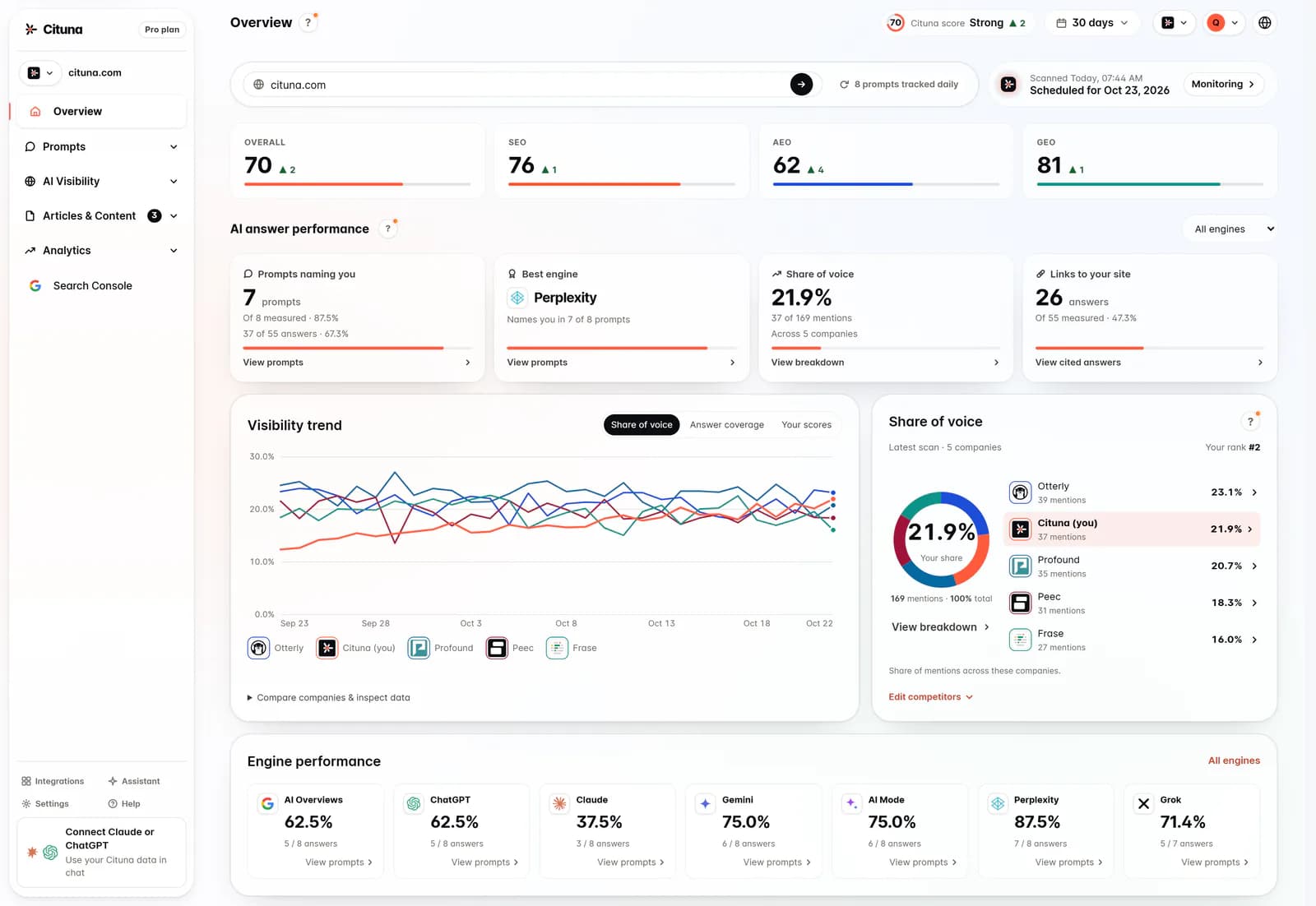
You cannot edit what an AI says about your business. There is no dashboard, no verification badge and no support queue that takes a correction and applies it to the answer. What you can do is change the material the engine reads, make the correct version of the fact the best-corroborated one on the open web, and then re-ask the question on a schedule to confirm the wording actually moved.
That sounds indirect because it is. It is also the only mechanism that works, and the good news buried in it is that the inputs are almost entirely public: pages you own, pages you can ask someone to edit, and the structured facts you publish about yourself. The work is unglamorous rather than impossible.
First, get the exact wording:
Four ways an AI answer goes wrong about you
These get lumped together as “wrong information”, which is why so much advice on the subject is useless: the four have different causes, and three of them look identical on a dashboard that only counts whether your brand was named.
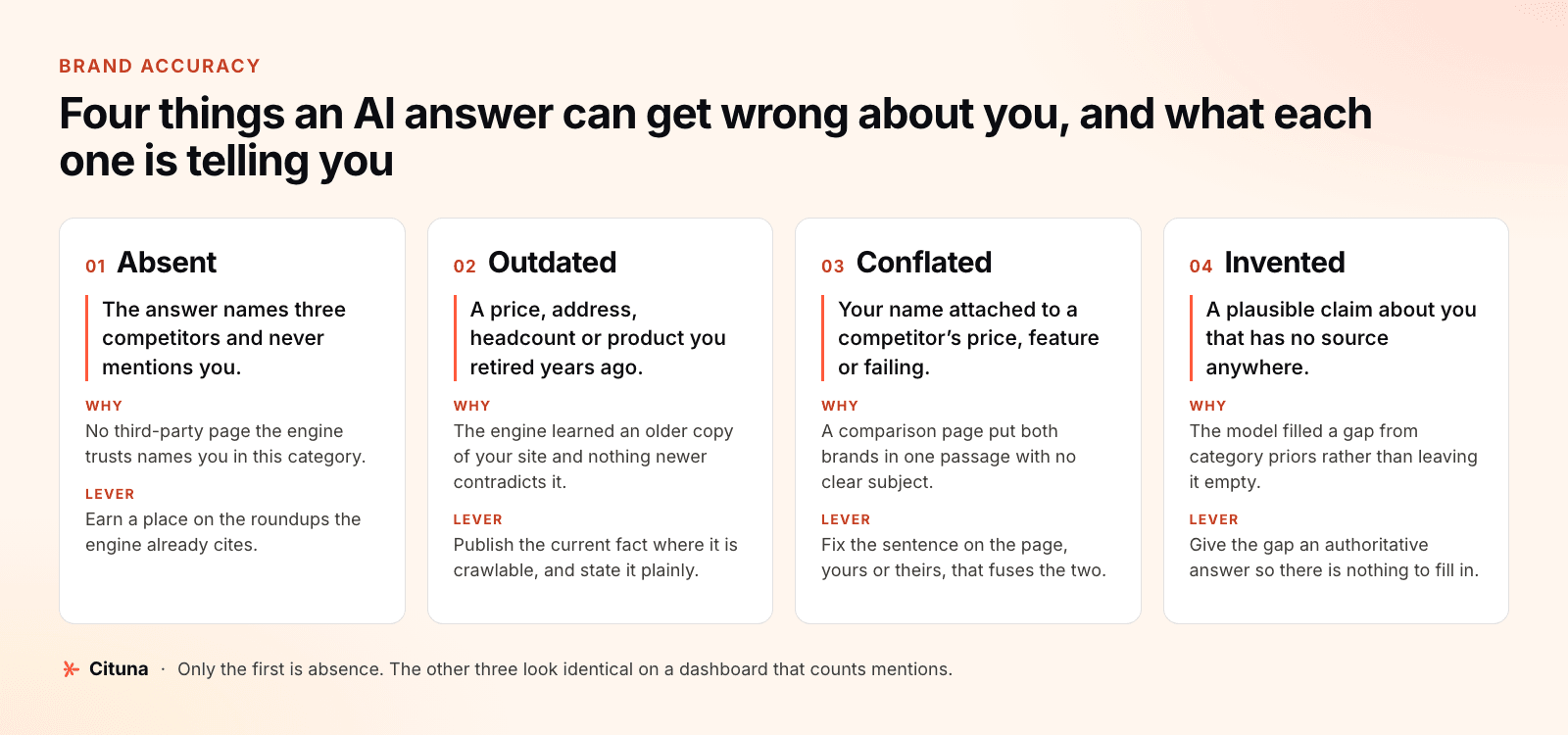
Absent is the ordinary case and the one most brands arrive with: the answer recommends three competitors and never mentions you. That is a corroboration problem rather than an accuracy problem, and it is the subject of why your brand is not showing up in AI search.
Outdated is the most common true accuracy failure. A price you raised, an address you moved from, a product you retired, a headcount from two funding rounds ago. The engine is not malfunctioning; it learned an earlier version of the truth and nothing it has read since contradicts it clearly enough.
Conflated is the one nobody expects and the one most often caused by your own site. Your brand name ends up attached to a competitor’s price, feature or failing. It has a specific, fixable cause, and it gets its own section below.
Invented is the rarest and the most talked about: a confident, plausible, entirely unsourced claim. Models produce these when a question has an obvious shape and no available answer, so they complete the pattern from category priors. The fix is counterintuitive. You do not argue with it; you fill the gap, so there is nothing left to guess at.
Why some fixes land in days and others never land
This is the single most useful distinction on the page, and it explains almost every frustrating experience people have when they try to correct an AI answer.
When an engine retrieves, it fetches live pages at the moment you ask and summarises what it finds. Perplexity works this way on nearly every query; ChatGPT does it when a question pushes it to the web; Google AI Overviews are built on a live index. On these surfaces your corrected page is being read, so a fix can show up within days of a recrawl, and the lever is simply making the page reachable and unambiguous.
When an engine answers from memory, it is reproducing patterns learned in training, and your website is not being consulted at all. ChatGPT, Claude and Grok all do this routinely for questions that do not obviously need a search. Editing your homepage changes nothing in that moment, because nothing is reading it. The answer moves when the model is retrained, or when the question starts triggering retrieval, and the only thing you can influence in the meantime is how overwhelmingly the correct version is corroborated across the web the next training run will read.
What this means in practice:
Which is also why the distinction between being named and being cited matters here rather than being pedantry. An answer that names you with no link is a memory answer, and it tells you that the fix is off your site. An answer that cites a source is telling you exactly which page to go and change. Our guide to mentions versus citations draws the line properly.
When a competitor’s facts become your facts
Conflation deserves its own section because the cause is usually a sentence on a page you control, which makes it the fastest thing on this list to fix and the easiest to never notice.
We can show it happening to us. Our own comparison pages are the second-most engine-cited section of this site. Every rival on them was written as a heading carrying the vendor name, followed by a paragraph that never named that vendor again. Read by a human, it is perfectly clear. Read by an engine that splits a page into passages, the heading does not reliably travel with the paragraph, and the only brand name left in scope is the name of the site the passage came from. Ours.
Measured live on 7 September 2026, a web search for Cituna returned, sourced to our own comparison page, that Cituna is a Y Combinator-backed platform whose $295 per month Starter plan covers nine engines and whose pricing is credit-based. Every one of those facts belongs to AthenaHQ: the $295 Starter is AthenaHQ’s price, the credit-based model is AthenaHQ’s model, and the Y Combinator backing is AthenaHQ’s. Cituna is Starter $49 · Pro $119 · Max $399, flat, 7 engines, and not venture-backed.
Why that was worse than being absent:
The rule that fixed it is narrow and mechanical, and it is worth copying: on a page whose subject is your brand, any sentence carrying a fact that belongs to someone else must name its owner inside that same sentence. Headings do not count, because the failure mode is precisely that the heading gets separated from the prose. We now enforce it with a test that reads the page source and fails the build, rather than with a style note nobody re-reads.
If you publish comparison pages, alternatives pages or any “us versus them” content, this is the first place to look when an engine attributes a competitor’s attributes to you. It is almost never malice or hallucination. It is a pronoun.
The fix, in order
Work these in sequence. Each step makes the next one more likely to hold, and the first two are the ones people skip.
| Step | What you do | Why this order |
|---|---|---|
| 1. Capture | Ask the question that produces the error, on each engine, and ask which sources were used. Save the wording and the source list with a date. | You cannot verify a fix you never baselined, and answers vary run to run, so one screenshot proves nothing. |
| 2. Read the sources | Open every page the engine cited. The error usually already exists on one of them, in writing. | This turns an abstract problem into a list of named pages, and it is usually a dozen, not a thousand. |
| 3. Fix your own page | State the correct fact in plain server-rendered text, on the page the fact belongs on. Not in an image, not painted in by JavaScript. | Some AI crawlers never execute JavaScript, so a figure assembled in the browser is invisible to them. |
| 4. Repair the entity | Publish Organization schema, and describe your company identically everywhere it appears: name, founding, location, what it sells. | A model that cannot resolve you to one clear entity is a model that will blend you with the nearest similar one. |
| 5. Fix the third-party pages | Ask the roundups, review sites and directories carrying the stale fact to update it. Lead with the correction, not with a pitch. | Corroboration beats assertion. Three outside pages with the old number outweigh your one page with the new one. |
| 6. Re-ask on a schedule | Run the same questions weekly and diff the answer text and the sources against your baseline. | This is the only step that tells you whether any of the previous five worked. |
Steps 3 and 4 are within your control and worth doing immediately. Step 5 is where the time goes and where most of the movement comes from.
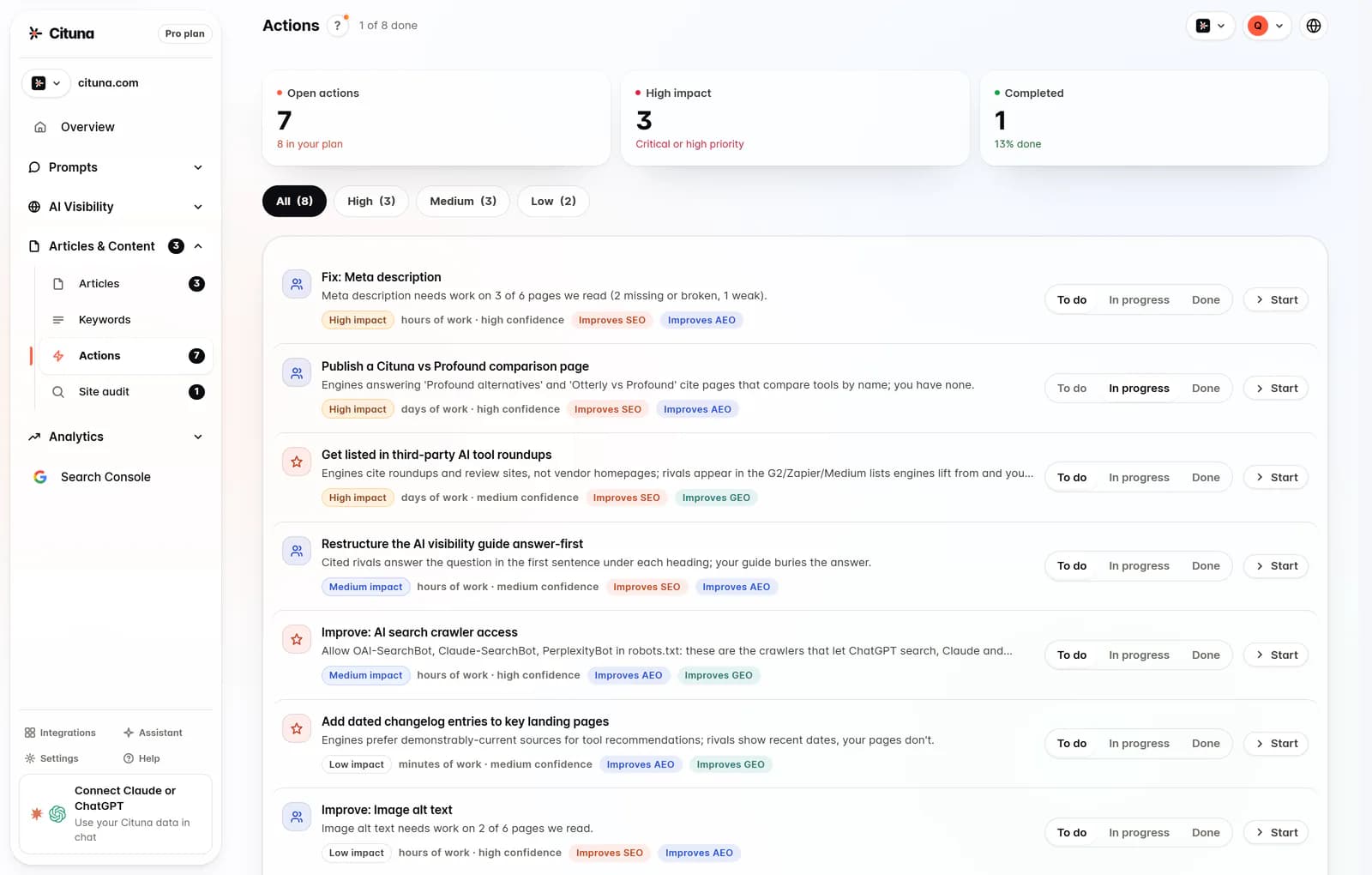
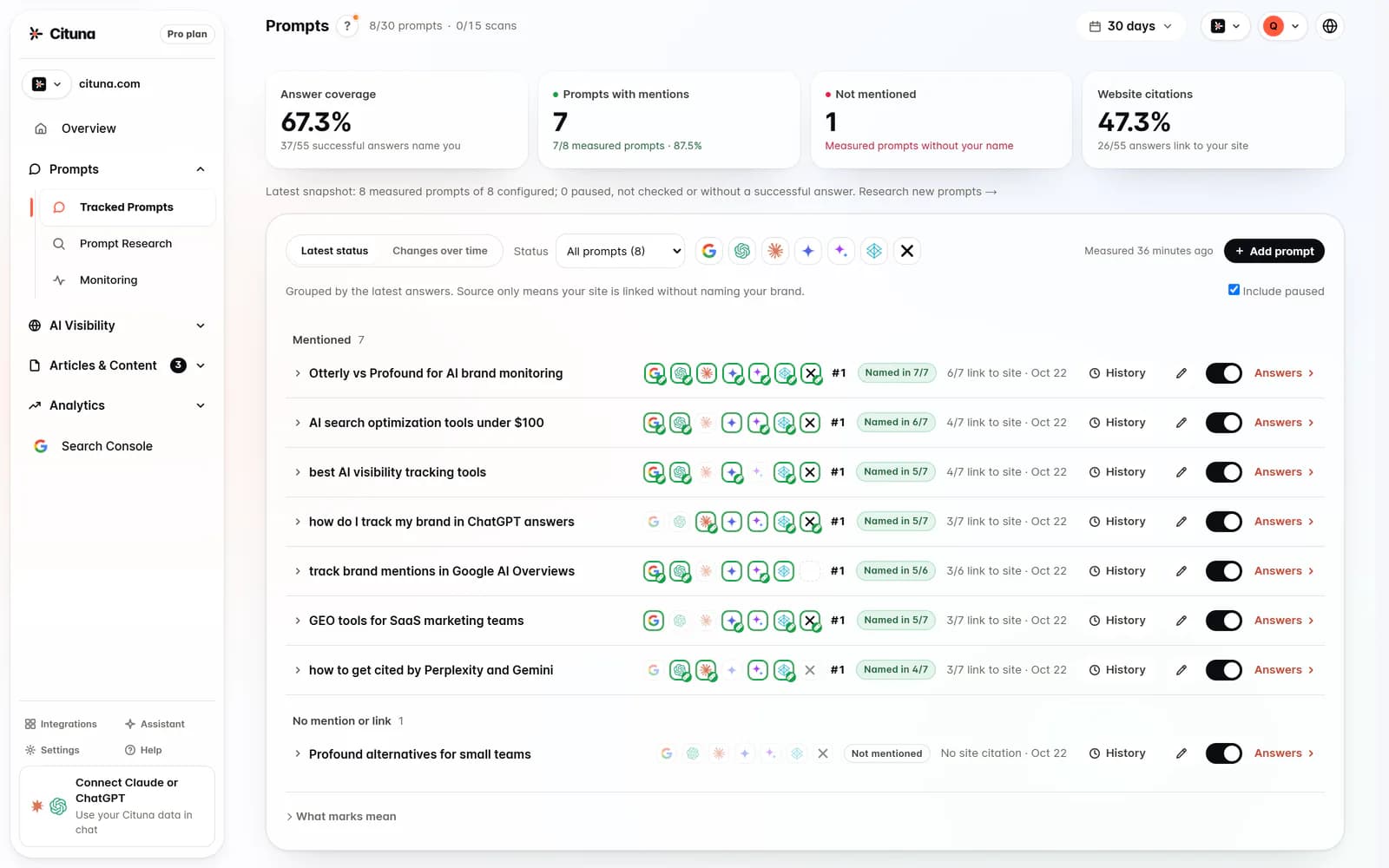
Step 6 is the one that turns this from a one-off cleanup into something you can report on, and it is the step a tool earns its money on. Cituna runs your real questions across 7 engines, ChatGPT, Perplexity, Gemini, Claude, Grok, Google AI Overviews and Google AI Mode, every day from $49, and stores each answer’s wording next to the sources it cited, so a changed sentence is a diff rather than a memory. It does not track Microsoft Copilot, which is a real gap worth naming if Copilot is on your reporting list. You can also do step 6 by hand with a spreadsheet and a recurring reminder, and for a single stubborn fact that is genuinely the right call.
What you cannot fix, and what to do instead
Three things on this topic are worth being honest about, because pretending otherwise wastes real money.
You cannot remove a fact that is true. If an engine reports a genuine outage, a real lawsuit or an unflattering review pattern, there is no correction to make. The available move is corroboration in the other direction: publish the current state of the thing, get it covered, and let the weight of newer evidence shift what a summary emphasises.
You cannot buy your way to a correction. There is no ad product that edits an organic AI answer, and anyone offering one is selling something else. That question comes up often enough that we answered it separately in can I pay to appear in AI answers.
You cannot fix it once. Models get retrained, retrieval gets re-run, and the third-party pages that describe you keep getting rewritten by people who are not you. A fact you corrected in March can come back in September because a new roundup copied an old one. The durable version of this work is a scheduled check, which is why the last step of the list is the one that never finishes.
None of this requires knowing the jargon that has grown up around the topic. If you want it anyway, the vocabulary lives in our AI visibility glossary, and the wider question of how engines decide what to say about a brand is covered in how ChatGPT chooses which brands to recommend. Start with the sentence that is wrong and the page it came from. That is almost always enough to know what to do next.
Drafted with AI assistance from our own research and Search Console data, and reviewed by Rahul A before publishing. Rules and prices change; check the linked official source before you act.