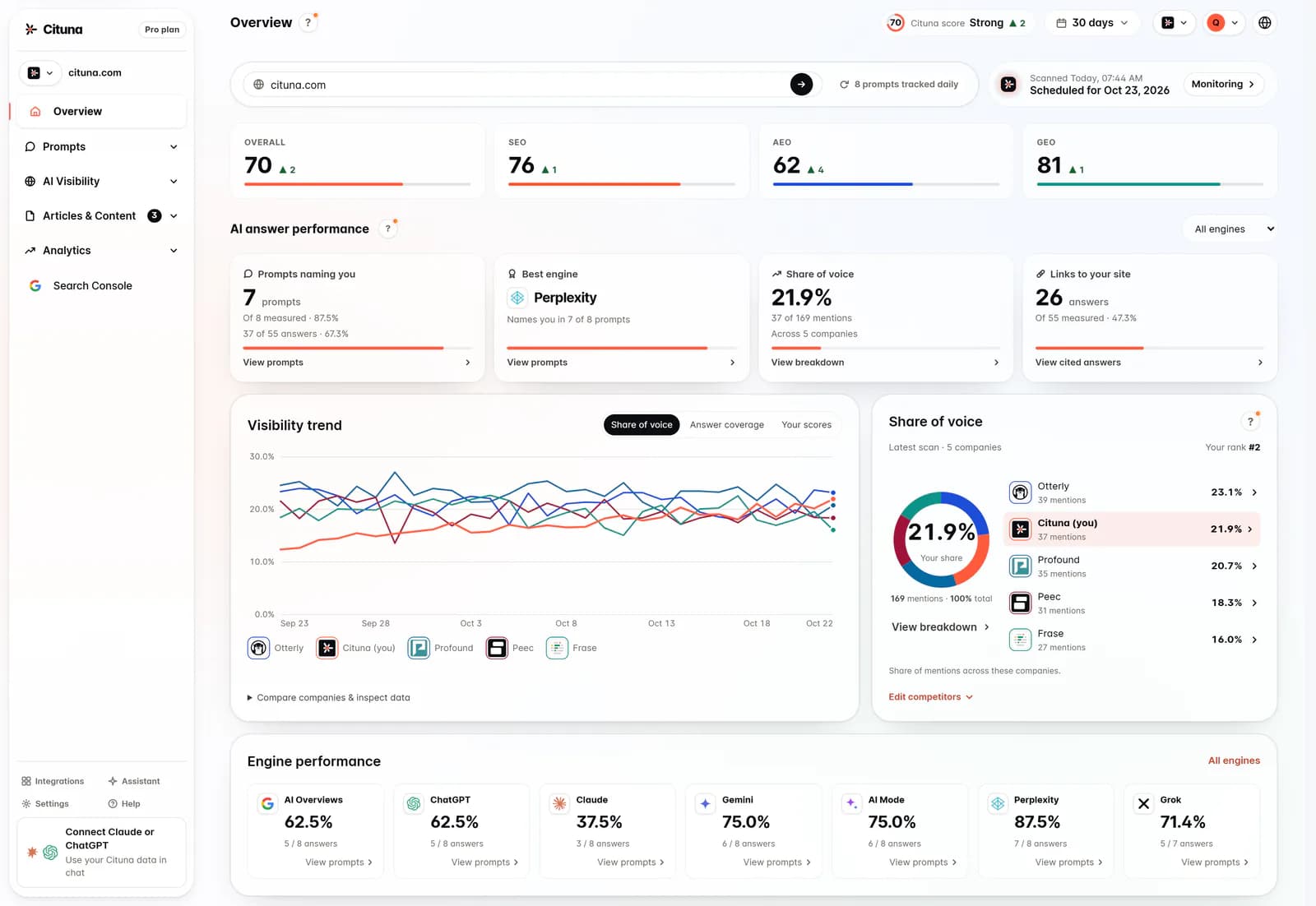
SEO (search engine optimization) earns your pages a ranked position in search results so a person chooses to click; AEO (answer engine optimization) earns your brand a mention or a cited link inside the single answer that ChatGPT, Perplexity, Gemini, Claude, Grok, Google AI Overviews or Google AI Mode writes. The work behind both is mostly the same: pages that can be crawled, that answer the question, and that come from a source the engine trusts. Google itself says appearing in its AI features needs no special optimization beyond sound SEO. What really differs is the scoreboard: SEO is measured in rankings, impressions and clicks in Search Console, while AEO is measured by asking the engines your buyers' questions and recording who they name and cite. Treat them as one program with two reports, not two programs.
The rest of this guide lays out the difference row by row, the large area where the two overlap, and how to measure each.
AEO vs SEO at a glance
The quickest way to see the difference between AEO and SEO is to line up what each one is actually trying to win.
| Dimension | SEO | AEO |
|---|---|---|
| Optimizes for | A ranked position in the list of results | Being named or cited inside a synthesized answer |
| The interface | A page of results a person scans | One direct answer with a short list of sources |
| Where it happens | Google, Bing and other classic search engines | ChatGPT, Perplexity, Gemini, Claude, Grok, Google AI Overviews and Google AI Mode |
| You win when | Someone clicks through to your page | The engine repeats your answer or links you as a source |
| Main levers | Keywords, backlinks, technical health, intent match | The same, plus answer-first passages, a consistent brand entity and mentions in sources engines trust |
| How you measure it | Rankings, impressions, clicks and CTR in Google Search Console | Mention rate, citation rate and share of voice across a fixed set of prompts, checked engine by engine |
| How fast it moves | Rankings usually shift over weeks to months | An answer can change when a model updates or re-reads the web, so it is sampled more often |
| What the result looks like | A blue link you own until someone outranks you | A sentence about your brand that you do not write and cannot edit directly |
The contrast is drawn sharp on purpose. In practice the same pages and the same authority feed both columns, and Google treats its own AI features as part of Search.
Read down the two columns and the pattern is hard to miss: almost every row is a different destination for the same underlying content, not a different kind of content. That is the throughline of this guide, and the rest explains why it holds.
The real difference between AEO and SEO
For twenty-five years, search meant a ranked list. You optimized a page, it earned a position, and the searcher decided which link to click. SEO is the craft of earning and keeping those positions: matching search intent, building authority through links and mentions, and keeping a site fast and crawlable so it can rank at all.
Answer engines change who does the choosing. When someone asks ChatGPT or Perplexity a question, a model reads the available sources and writes a single synthesized answer, then cites a handful of them. Nobody scans ten results, because the model has already picked. Answer engine optimization vs SEO comes down to that shift: SEO optimizes to be rankable so a human will choose you, while AEO optimizes to be quotable so a model will choose you as it composes the answer.
A concrete example makes the split obvious. Search “best project management tool for agencies” and Google hands you a page of competing listicles and vendor pages to sort through yourself. Ask an assistant the same thing and it returns a short recommendation with two or three named tools and a few cited sources. SEO decides which listicles appear for you to judge; AEO decides whether your product is one of the names the model says out loud.
The consequence is that a growing share of questions get resolved on the answer surface itself, with no click at all. If the engine answers without naming you, you are invisible for that question no matter how well your page would have ranked in the old list. That is the gap AEO exists to close. Our guides on answer engine optimization and getting cited by ChatGPT go deep on the mechanics; the short version is that being the answer is a different job from ranking near the top of a list.
Where AEO and SEO overlap
Here is the part the “AEO vs SEO” framing hides: the two share most of their foundation. An answer engine cannot cite a page it cannot reach, cannot understand, or does not trust, which is the exact same bar a search engine sets before it will rank you. The work that satisfies one tends to satisfy the other.
Four fundamentals do double duty:
- Crawlability. If
GPTBot,ClaudeBotorPerplexityBotis blocked in yourrobots.txt, or your content only appears after JavaScript runs, you are invisible to answer engines and handicapped in search. One fix serves both. - Authority. Search engines rank sources they trust; answer engines cite sources they trust. Earned links, mentions and a strong brand entity move both needles at once.
- Structure. Clear headings, clean HTML and a logical page make content easy to rank and easy to lift a passage from. Answer-first formatting is just good on-page SEO taken one step further.
- Intent match. Content that genuinely answers the question wins in both worlds. Thin, keyword-stuffed pages lose in both.
The overlap in one line:
Where they diverge is narrow but real. AEO leans harder on being quotable in a self-contained passage, on your brand reading as a consistent entity across the web, and on earning mentions in the sources models trust most. GEO, generative engine optimization, is the closely related practice aimed at how models describe you overall. See GEO vs SEO and our generative engine optimization guide for that layer.
Google's own documentation draws the overlap even tighter. For AI Overviews and AI Mode, its AI features guide (read October 2026) says there are no additional requirements and no special optimizations: the same SEO best practices apply, and a page is eligible to appear as a supporting link if it is indexed and eligible to show in Search with a snippet. It adds that no new machine-readable files, AI text files or special schema markup are needed. Traffic from those features is counted inside the normal Web totals of the Search Console Performance report. So for Google's answer surfaces, AEO is not a separate technique at all; it is SEO, read through a different result. The other engines publish less about how they choose sources, which is why the parts that sit outside a classic SEO checklist (being quotable in one passage, a consistent entity, mentions in the places those engines read) are worth doing and, above all, worth measuring.
Do you need both AEO and SEO?
So do you need both AEO and SEO? For almost every business today, yes, but the reasons are worth being precise about rather than accepting on faith.
SEO still pays the bills. Classic search still sends far more visitors than AI: across 101,574 websites tracked from January 2025 to April 2026, an SE Ranking traffic study (June 2026) found organic search brought 42.75% of their traffic and AI platforms 0.32%. Organic clicks remain real, measurable revenue you can attribute today. Turning it off to chase AI visibility would be trading a working channel for an emerging one.
AEO protects the next chapter. The share of questions answered by ChatGPT, Perplexity, Gemini and Google AI Overviews is climbing, and independent analyses have found a growing share of those answers resolve without a click to any source. If your buyers are starting to ask an assistant before they open a search tab, being absent from those answers is a slow leak you will not see in your rankings report.
The right mix is not fixed; it tracks how your specific audience searches. A local service business whose customers still type into Google should weight SEO heavily and add light AEO. A B2B software brand selling to early adopters who already live in ChatGPT should invest in answer visibility far sooner. Audit where your buyers actually ask, then split effort to match, rather than following whichever acronym is louder this quarter.
The two also depend on each other in one direction. You cannot really do AEO without SEO: the crawlability, structure and authority that AEO relies on are SEO fundamentals. But SEO without AEO is increasingly incomplete, because it optimizes only for the list and ignores the answer now sitting above it. The honest position is not “AEO or SEO” but “SEO first, AEO close behind.” Measuring both in one place, how you rank and how often engines cite you, is what our AI visibility guide is about.
Fitting AEO into an SEO program you already run
Most people asking about AEO and SEO are not choosing between them from a standing start. They already run an SEO program, and the real question is narrower: what changes, what stays, and what gets added. Framed that way the answer is reassuringly small.
Nothing gets removed. Keyword research, technical health, internal linking, link earning and content refreshes all keep their place. None of them stop mattering because an answer box appeared above the results.
Two habits change. First, how you format an answer: lead each section with the claim itself in one self-contained sentence, then support it, so a model can lift that passage without needing the paragraph around it. Second, how you phrase headings: match the question a person actually asks rather than the compressed keyword they might type.
Three things get added. Entity consistency, so your brand reads as the same company everywhere a model looks. Off-site presence in the sources engines lean on, which for most categories means places like Reddit, YouTube and the roundup sites that already rank. And a measurement habit, because none of this shows up in a rank tracker.
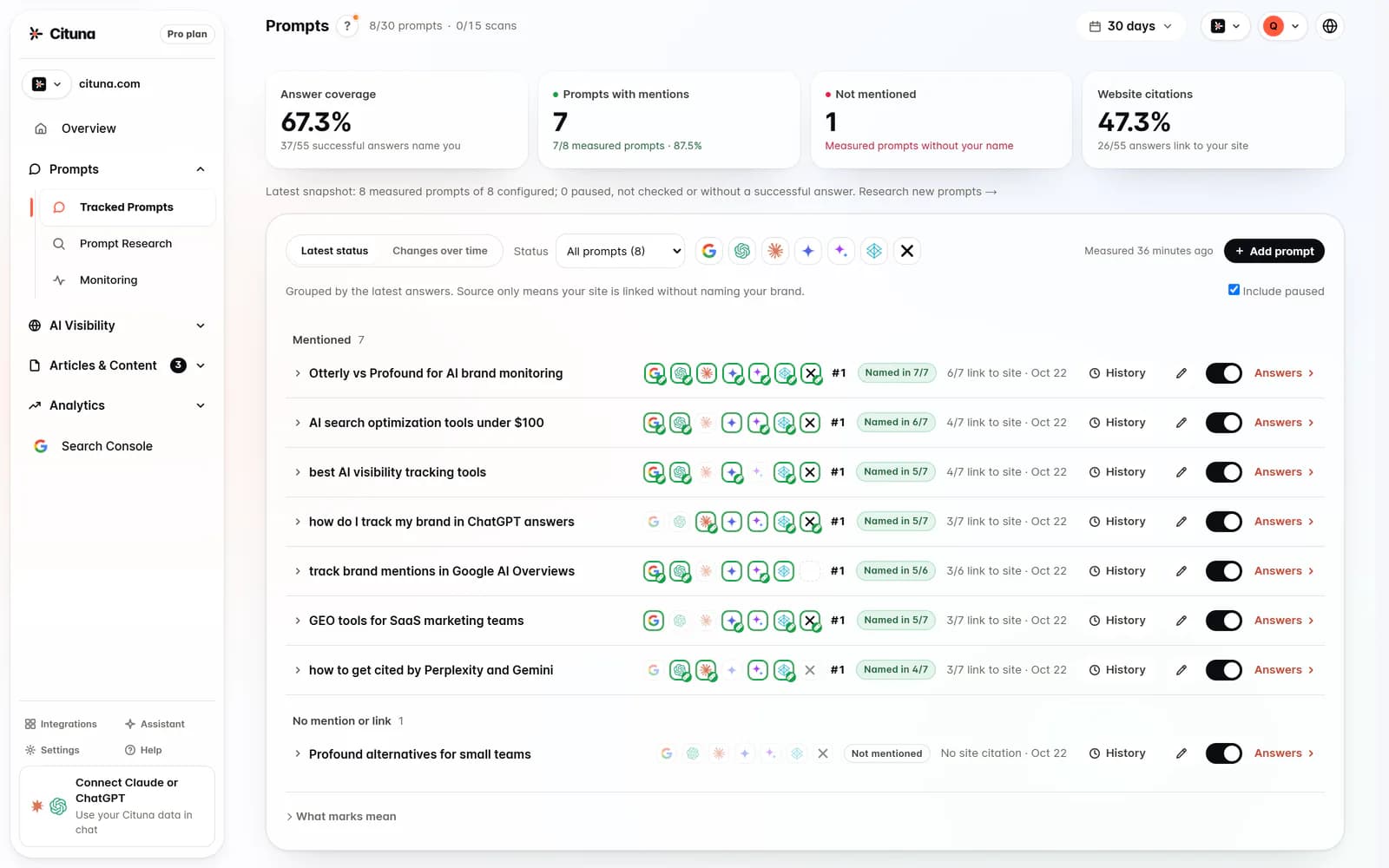
That last point is where an existing program most often stalls. Everything else on the list has an obvious owner and an obvious report. Citations do not: no tool in a standard SEO stack asks ChatGPT or Perplexity your buyer questions and records who gets named. Until something does, AEO work is being done blind, which is usually why it quietly stops.
Agencies hit a version of the same question from the client side, in the form of "how is this different from the SEO you already bill us for?" The honest answer is that roughly eighty percent of the work is the SEO you already do, and the difference worth charging for is the twenty percent that is new: the quotable formatting, the entity and off-site work, and a citation report the client has never seen before (see what goes into AI visibility reports for agencies). Selling AEO as a replacement for SEO tends not to survive the first renewal conversation. Selling it as a second scoreboard on the same work does.
How to measure AEO and SEO
SEO has had one shared measuring stick for years: a query, a results page and a position on it. AEO has no results page to inspect. Every AEO number comes from asking an engine a question and reading what came back, so the question set is the measuring stick. Keep it fixed, made of questions your buyers actually ask, and the numbers can be compared week to week; change the questions and they cannot.
| What you want to know | SEO: where to read it | AEO: where to read it |
|---|---|---|
| Are we visible at all? | Impressions per query in Search Console | Mention rate: the share of answers that name your brand |
| Are we sent the visit? | Clicks and click-through rate in Search Console | Citation rate: the share of answers that link one of your pages |
| How do we compare with rivals? | Average position against competing pages | Share of voice: your mentions against rivals' across the same prompts |
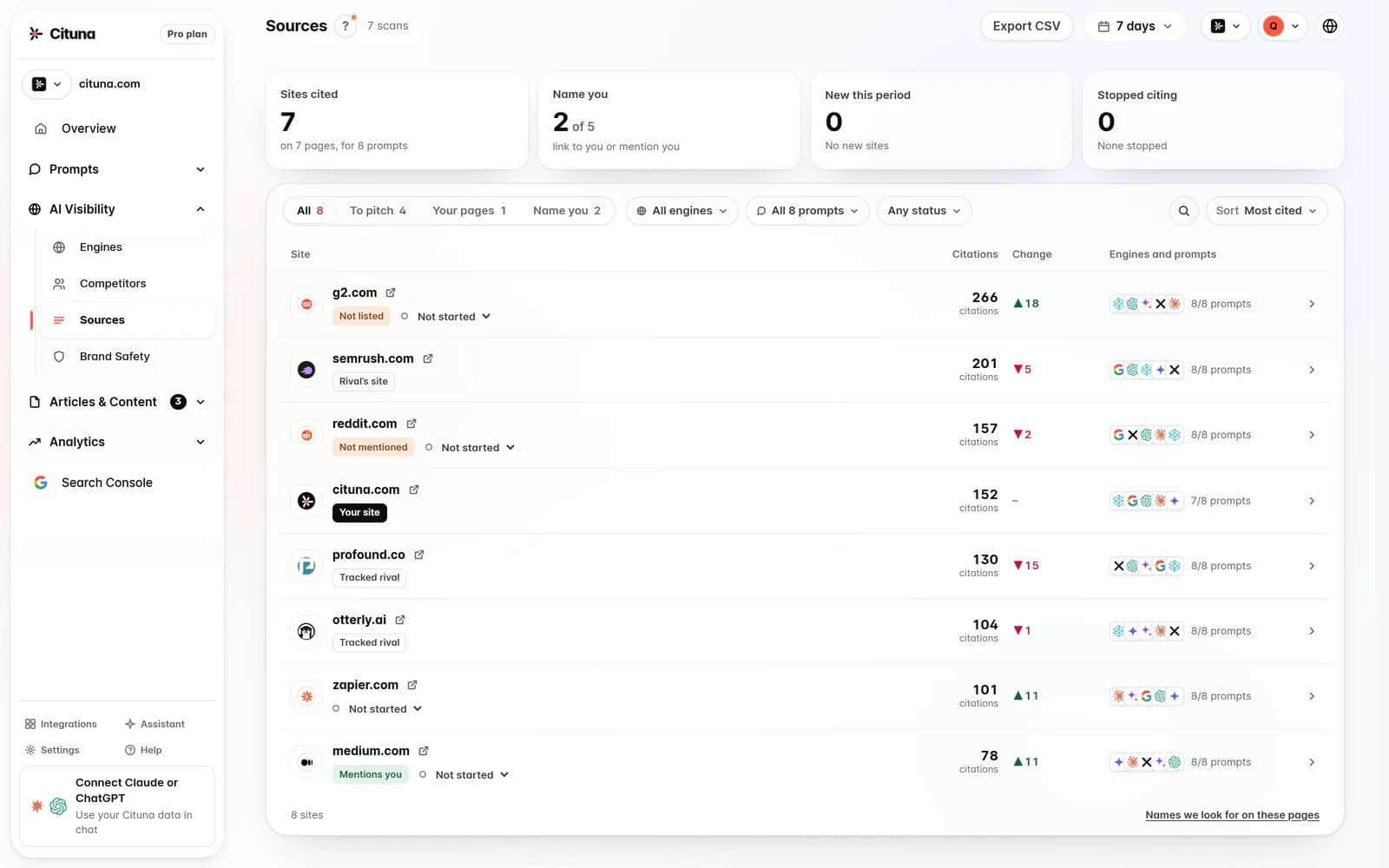
| Which pages earn it? | Pages report in Search Console | The cited pages and the third-party sources each engine uses |
| Did it reach the site? | Organic sessions in analytics | Referral sessions from chatgpt.com, perplexity.ai and similar hosts in GA4, which undercount because many answers send no click |
Two habits keep the two honest. First, read them side by side, because the same change can move one and not the other: a page that climbs to position 3 can still be missing from the answer, and a page cited by Perplexity may never rank. Second, keep "not measured" apart from "measured and absent": a zero in an AEO report only means something if the engine was actually asked. The six AI visibility metrics and tracking AI traffic in Google Analytics go deeper on each column.
How to start with both
You do not need two separate programs. Run one content operation and sequence the work by impact:
- Unblock the crawlers first. Confirm your
robots.txtwelcomes the AI bots you want (GPTBot,ClaudeBot,PerplexityBotand the rest) and that key content is in the server-rendered HTML. Nothing else matters if pages cannot be read. - Match intent, then structure the page. Answer the actual question, lead each section with the answer, and phrase headings the way people ask them. This lifts rankings and makes passages easy to quote in a single move.
- Build authority you can borrow twice. Earned links and mentions, a consistent brand entity, and original data worth citing raise both your rank and your odds of being the source a model names.
- Keep the technical basics clean, and do not overrate them. Valid structured data that matches what the page shows, descriptive titles and metadata, and pages that render without JavaScript help every engine read you. Google says none of these is a special requirement for its AI features, so treat them as hygiene, not as a separate AEO lever. Files aimed only at AI crawlers, such as an llms.txt, are optional extras for the other engines, never a substitute for the steps above.
- Measure across both surfaces. Track rankings and clicks as usual, and separately ask the engines your buyer questions to see who they cite. Pairing regular AI scans with your Search Console data (see how to connect Google Search Console), which is exactly what Cituna automates, tells you whether each fix moved the list, the answer, or both.
One practical note on cadence: rankings tend to move slowly and predictably, while AI answers can shift the moment a model updates or re-crawls the web. Check your search performance on the usual monthly rhythm, but sample the engines more often, because the answer you own today is not guaranteed to be the answer next month.
Treat AEO and SEO as one job with two scoreboards and the supposed conflict disappears. Build pages a search engine can rank and an answer engine can quote, then check both scoreboards.
Drafted with AI assistance from our own research and Search Console data, and reviewed by Rahul A before publishing. Rules and prices change; check the linked official source before you act.