When you ask an AI engine a question, it does not hand you a list of links to sort through. It reads the web for you and writes a single answer, then (usually) shows which sources it leaned on. Generative engine optimization (GEO) is the work of making sure your content is one of those sources, and that the model represents you accurately when it does.
This guide covers what GEO is, how generative answers are actually put together, the specific signals that get content included, and a playbook you can run.
What is generative engine optimization?
Generative engine optimization is the practice of optimizing your content, data and brand presence so that generative engines, the AI systems that compose answers rather than return links, use you as a source and describe you the way you want to be described. The term comes from 2023 academic research that studied how to increase a source’s visibility inside AI-generated answers.
The word “generative” is the key. A classic search engine retrieves and ranks documents that already exist. A generative engine retrieves, then writes something new that blends several sources. Your target is no longer a rank. It is inclusion in, and favorable framing within, that written answer.
How AI answers are assembled
Most consumer AI answers today are retrieval-augmented. Rather than relying only on what the model memorized during training, the engine runs a live retrieval step and grounds its answer in what it finds. The rough pipeline looks like this:
- Interpret the query. The engine expands your question into the sub-questions it needs to answer.
- Retrieve. It searches an index (its own, or a partner’s) and gathers candidate passages from the pages that look most relevant.
- Rank and select. It picks the passages it trusts most and that most directly answer each part of the question.
- Synthesize. It writes a single answer from those passages and, on most engines, attaches citations to the sources it used.
Two consequences fall out of this. First, if your page is not retrievable (crawlable, indexed, server-rendered), it can never enter the pipeline. Second, once retrieved, you compete on how quotable and trustworthy your passage is versus the others the engine gathered. GEO is about winning both stages.
The mental model:
The signals GEO rewards
Some GEO levers are technical (they get you retrieved) and some are content-level (they get you quoted). Both matter.
Retrieval signals (be in the candidate set)
- Crawlability. Let the AI crawlers in (
GPTBot,OAI-SearchBot,ClaudeBot,PerplexityBot,Google-Extended) and render your content in the HTML. - Relevance and coverage. Address the specific question and its natural follow-ups on the page, so the engine finds a match for each sub-question in one place.
- Freshness. Keep facts current and dated. Retrieval steps favor content that looks maintained.
Inclusion signals (be the quoted passage)
This is where the GEO research is most useful. It found that a handful of content changes measurably increased how often a source was included in generative answers. The strongest were:
- Cite your sources. Content that references credible sources reads as more authoritative to the engine, and gets pulled in more.
- Add relevant statistics. Concrete numbers make a passage more quotable and specific.
- Quote experts. Direct quotations add credibility signals a model can lean on.
- Write clearly and answer first. Fluent, well-structured, answer-first passages are easier to extract than buried, meandering ones.
None of these is a trick. They are the same things that make content genuinely good, which is precisely why they work: generative engines are trying to surface useful, credible, quotable material.
GEO vs AEO vs SEO
| Dimension | SEO | AEO | GEO |
|---|---|---|---|
| Optimizes for | A ranked link | Being the cited answer | Being the source a model synthesizes from |
| Unit of work | The page | The answer | The passage |
| Signature levers | Keywords, links, technical health | Answer-first structure, entity authority | Quotability: citations, stats, clarity, trust |
| Success looks like | A click | A mention or citation | Your framing repeated in the answer |
The boundaries are fuzzy and the terms overlap in everyday use. Treat them as layers of one discipline, not rivals.
For a side-by-side on the two comparisons people ask about most, see GEO vs SEO and the AEO pillar. If you arrived here from the search world’s vocabulary, the same discipline under its other name is covered in LLM SEO.
A GEO playbook
Run these in order. The first two get you into the candidate set; the rest win the passage.
- Open the doors. Confirm the AI crawlers are allowed and your content is server-rendered, not JavaScript-only. Keep your sitemap current.
- Map the questions. For each buyer question, make sure one page answers it and its follow-ups directly, in the first lines of each section.
- Make passages quotable. Add the citations, statistics and expert quotes the research rewards. Lead with the answer, then support it.
- Build the entity. Describe your brand consistently everywhere, publish
Organizationschema, and earn mentions on the sources engines trust. See our guide to getting cited by ChatGPT for the off-site side. - Go per-engine where it counts. The fundamentals transfer, but each engine has quirks. Start with Perplexity and Google AI Overviews, which show their sources.
- Measure and iterate. Track inclusion across engines and work the gaps.
Measuring GEO
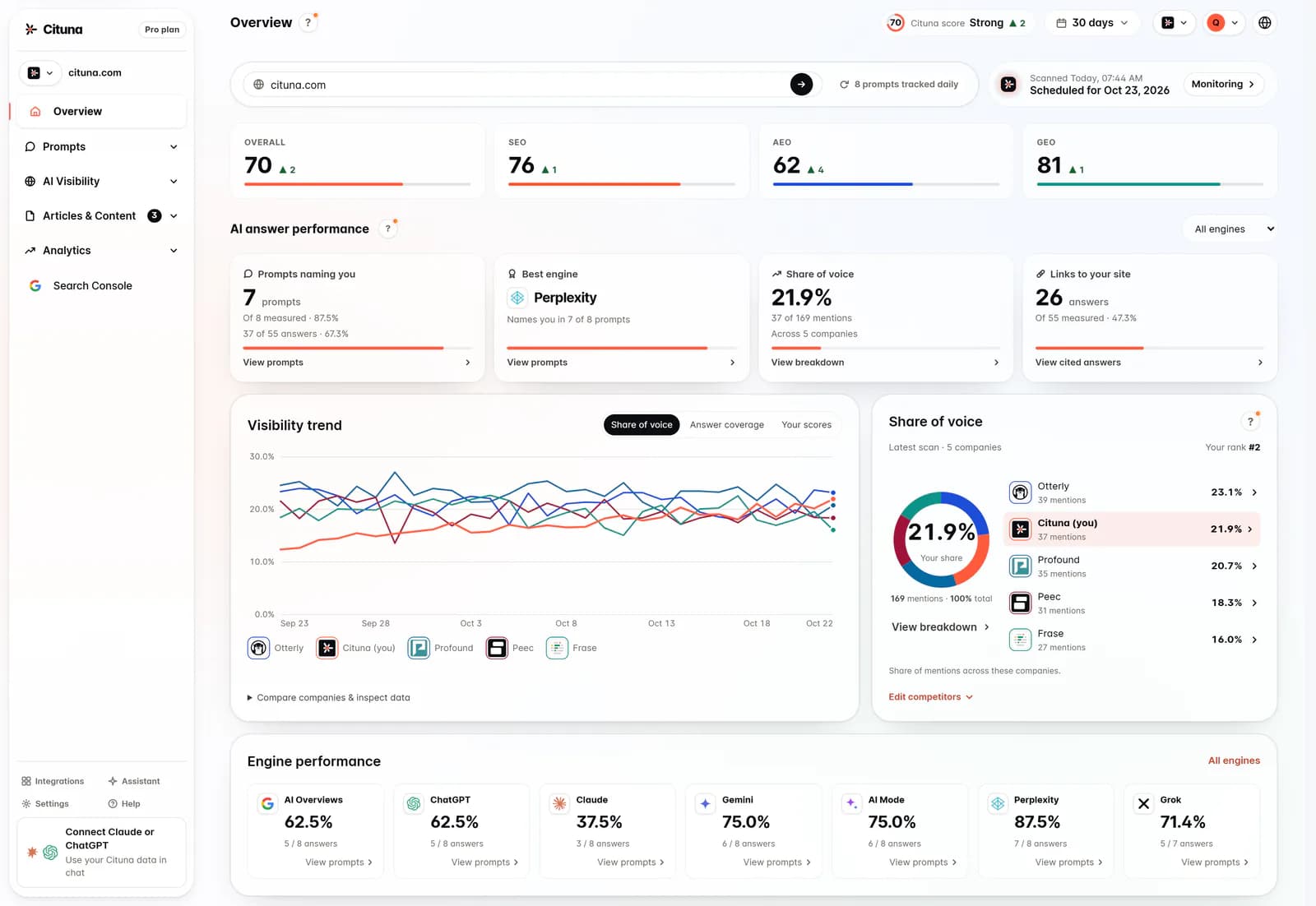
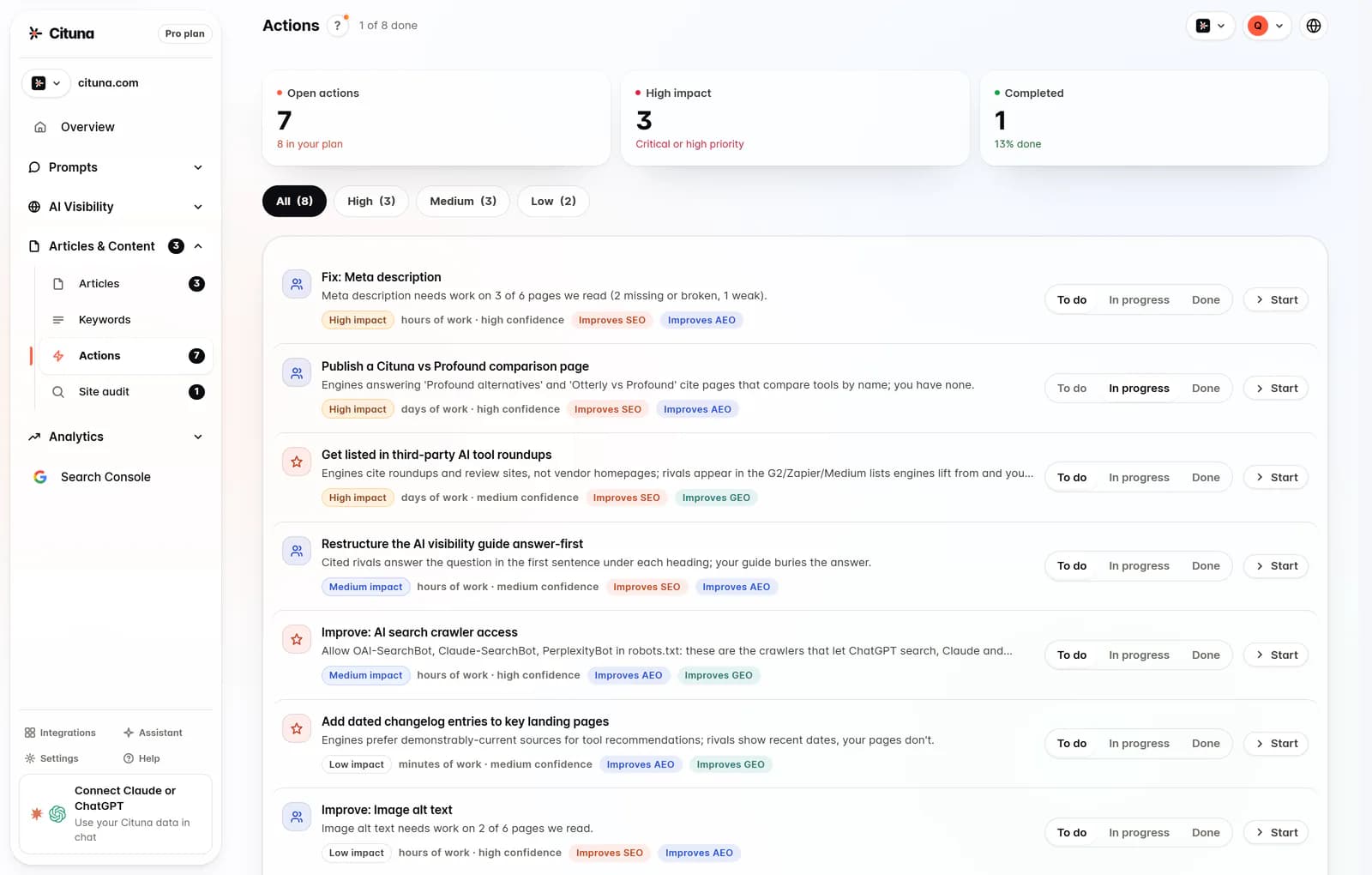
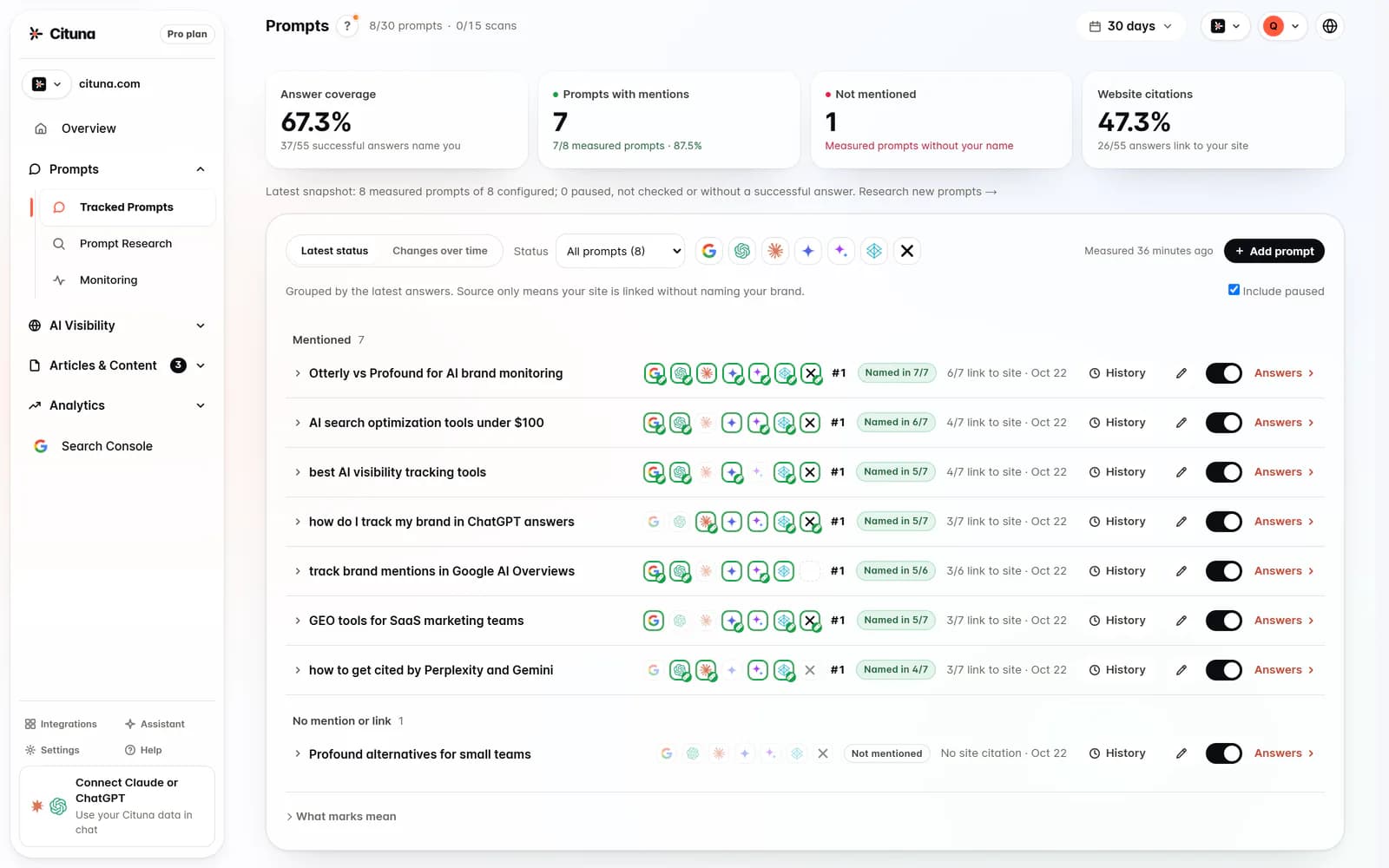
Because GEO’s payoff is a mention rather than always a click, you cannot rely on traffic alone. Measure inclusion and framing directly: ask the engines your buyer questions on a schedule, and track how often you appear, how you rank against competitors, and whether the description is accurate. This is the loop Cituna runs for you: it scans ChatGPT, Perplexity, Gemini, Claude, Grok, Google AI Overviews and Google AI Mode every day, surfaces the prompts where a competitor is cited and you are not, and drafts the fixes to close them. A Google Search Console connection ties that work back to real impressions and clicks. For the full measurement approach, see AI visibility: how to measure and improve it.
Drafted with AI assistance from our own research and Search Console data, and reviewed by Rahul A before publishing. Rules and prices change; check the linked official source before you act.