To show up in Google AI Overviews, a page has to clear one hard requirement and then win on quality. Google’s own documentation on AI features says there is no special markup or separate sign-up: a page is eligible as a supporting link if it is indexed and eligible to show in Search with a snippet. From there, seven steps move the odds: (1) make sure Googlebot can crawl and index the page, (2) find which of your queries actually trigger an Overview, (3) answer the question first, (4) cover the sub-questions the Overview assembles, (5) build topical authority and show who wrote it, (6) keep the structure clean and the facts current, and (7) check whether you are cited and repeat.
The honest starting point: Google does not publish the exact rules for which pages an AI Overview cites, and the behavior keeps shifting as the feature matures. What follows is a practical read, first written in July 2026, with Google's eligibility rules re-checked in October 2026. Wherever it matters, we separate what Google has confirmed from what is a reasonable inference, and focus on the fundamentals that hold up as the surface evolves.
What Google AI Overviews are
An AI Overview is an AI-generated summary that Google places above or within the search results for many queries. It answers the question directly in a few sentences or a short list, then links to the pages it drew from. Google builds these summaries with a custom version of its Gemini models, and, importantly, they are assembled from Google’s own search index rather than from a separate corpus. In practice that means an AI Overview is Search reading your indexed pages and paraphrasing the best of them, with attribution. The format varies: some Overviews are a single paragraph, others a labeled list or a set of steps, and Google sometimes appends related follow-up questions or a way to dig deeper.
Two honest caveats matter. First, not every query triggers an Overview. Google shows them more often for informational and how-to questions where a synthesized answer is genuinely useful, and less often for navigational, transactional or highly ambiguous queries, and it adjusts that coverage frequently. Second, the feature is young and its behavior evolves, so which queries trigger an Overview and who gets cited can change from one month to the next. Treat any snapshot, including this one, as a moving target.
It helps to see where an Overview sits relative to the two surfaces it is most often confused with.
| AI Overview | Featured snippet | Classic organic | |
|---|---|---|---|
| What it is | An AI-written summary synthesized from several sources | One existing passage Google lifts word for word | The ranked list of ten blue links |
| Sources shown | Usually several, linked beside or below the text | A single page, quoted and linked | One link per result |
| How you get in | Be a credible, extractable source for the sub-question | Own the cleanest direct answer for the query | Rank on relevance, authority and technical health |
| What you control | Structure and clarity; the selection is Google’s | The exact passage and its formatting | The page and its optimization |
AI Overviews, featured snippets and classic results can all appear on the same page of results. They are related surfaces, not the same one, and Google does not fully document how it chooses between them.
How AI Overviews choose their sources
Google has not published a ranked list of criteria for AI Overview citations, so anyone claiming a precise formula is guessing. What is visible from watching the feature, and consistent with how Google describes it, is that source selection leans heavily on the same signals that drive strong organic results, plus a few that are specific to synthesis.
- Organic relevance and quality. The pages cited tend to be ones that already rank well, or would rank well, for the query. Overviews draw from the index, so classic relevance, helpfulness and page quality do most of the heavy lifting.
- A clear answer to the specific sub-question. Overviews often break a question into parts and cite a different page for each part. A page that answers one precise sub-question cleanly, near the top of a section, is easier to pull than a page that buries the point.
- Extractable, self-contained passages. The same featured-snippet-style writing that Google can lift as a direct answer, a tight definition, a short list, a clear step, helps a model quote you without stitching fragments together.
- Corroboration across credible sources. Overviews synthesize, and they favor claims that several trustworthy sources agree on. Being one of many pages that state a fact consistently is a stronger position than being the lone outlier.
- Intent match. The cited page has to match what the searcher actually wants, not just contain the keywords. A page written for the wrong intent rarely gets pulled even when it mentions the right terms.
The honest limit:
What gets cited by AI Overviews: the data
Because Google does not publish its selection rules, the most useful evidence is large-scale analysis of what Overviews actually cite. The most-studied signal is the overlap between AI Overview citations and classic organic rankings, and it tells a clear-but-moving story: a lot of what gets cited is already ranking, but the exact share is contested and has shifted as the feature matures.
In a July 2025 analysis of 1.9 million citations drawn from a million AI Overviews, Ahrefs found that roughly 76% of cited pages also ranked in Google’s top 10 for the query, about 86% ranked somewhere in the top 100, and the cited URLs carried a median organic position of around three. Read on its own, that looks like a simple rule: rank on page one and you are in the pool. But when Ahrefs re-ran the study across 4 million cited URLs in March 2026, the top-10 overlap had fallen to about 37%, which they attributed to Google increasingly assembling answers from “fan-out” sub-queries rather than the primary results. Other trackers land elsewhere again.
| Study (date) | What it measured | Top-10 overlap | Sample |
|---|---|---|---|
| Ahrefs, Jul 2025 | Cited pages that also rank in the top 10 | ~76% | 1.9M citations / 1M Overviews |
| Ahrefs, Mar 2026 | Same measure, re-run | ~37% | 4M cited URLs / 863K SERPs |
| BrightEdge, 2024 to 2025 | Citation and ranking overlap over 16 months | 32% → 55% | 9 industries |
| Originality.AI, Nov 2025 | Organic citations from the top 10 | ~52% | AI Overview citation set |
Each figure is from that study’s publication date, linked in the first column. Methods, samples and time windows differ, so the numbers are not directly comparable, read them as a range, not one truth. Notably, Ahrefs and BrightEdge disagree even on the direction of the trend.
Two things hold across every one of these studies, and they are what actually matter. First, ranking is the single strongest lever: a large share of cited pages also rank on page one, so the classic SEO that earns first-page positions clearly feeds the Overview. Second, ranking is not a gate. A real minority of citations go to pages outside the top 10, and Originality.AI’s November 2025 analysis found roughly half of AI Overview citations came from pages outside the top 100 organic results entirely, sources that do not classically rank at all, but that answered a specific sub-question well. The practical read: earn the rankings, because they put you in the running, but win the citation by being the clearest answer to the exact question the Overview is assembling.
Does ranking help you get cited?
Short answer: ranking helps, but it is neither necessary nor sufficient. Because Overviews are built from Google’s index, pages that rank on the first page for a query are more likely to be in the candidate pool, and in practice cited sources skew toward pages that already rank well. So classic SEO is not wasted. It is the foundation.
The relationship is looser than “rank number one and you are in,” though. People who watch the feature closely consistently see two things that break the simple story. First, Overviews often cite pages that sit below the top few results, sometimes well down the first page or beyond, when those pages answer a sub-question better than the top rankers do. Second, an Overview synthesizes across several sources, so the citation slots do not map neatly onto the ranking order. The page that wins the featured snippet is not guaranteed the Overview, and the number-one organic result is not guaranteed a citation.
The practical takeaway: keep doing the SEO work that earns first-page relevance and authority, because it puts you in the running, but do not assume a high ranking alone books your seat. The extra edge comes from being the clearest, most extractable answer to the specific question the Overview is assembling. For how these surfaces relate to classic search more broadly, see our guide on AEO vs SEO.
How to appear in Google AI Overviews: 7 steps
There is no separate playbook for AI Overviews that replaces good SEO and answer engine optimization. Google says so directly: no additional requirements, no special schema. The work that earns citations is the work that earns rankings, done in order and with a bias toward clean, extractable answers.
1. Make sure Google can crawl and index the page
Google’s AI features documentation states the one hard rule: to be shown as a supporting link in AI Overviews or AI Mode, a page must be indexed and eligible to appear in Search with a snippet. Because Overviews draw from Google’s own index, the crawler that matters is ordinary Googlebot. Confirm nothing important is blocked in robots.txt, that the key content is in the server-rendered HTML rather than assembled only in the browser, that the sitemap is current, and that no nosnippet, data-nosnippet or very low max-snippet setting is hiding the passage you want quoted.
Google-Extended is a separate control. It governs whether your content trains and grounds Gemini models, not whether you can appear in an Overview. Our guide on whether to block the AI Overviews crawler walks through each control and what it costs.
2. Find which of your queries trigger an Overview
Not every query shows an Overview. Google shows them most for informational and how-to questions, less for navigational and transactional ones, and changes that coverage often. Before rewriting anything, list the queries that already bring you impressions in Google Search Console, search the important ones, and note which show an Overview and which sources it cites. Those cited pages are the bar your page has to clear, and the queries with no Overview need no work for this surface.
3. Answer the question first, then expand
Lead each section with a direct, self-contained answer, then add the detail underneath. Keep the core answer tight enough that a model can lift it without editing. This is the most controllable lever on the page, and it is the same discipline that wins featured snippets.
4. Cover the sub-questions the Overview assembles
Overviews build an answer from parts. Google calls the technique query fan-out: running related searches across subtopics behind the scenes, often citing a different page for each part. A page that covers the main question and its natural follow-ups gives Google more places to cite you. For a how-to query that usually means the what, the why, the steps and the common mistakes, so that whichever slice the Overview assembles, a passage of yours is a candidate. What sources AI Overviews cite shows the kinds of pages that win those slots.
5. Build topical authority and show who wrote it
Google leans on sources it already trusts for the topic. Depth across a subject, a named author with real experience, accurate and current facts, and a record of being referenced elsewhere all raise the odds. Thin, generic content rarely gets pulled even when it is technically relevant. These are the same trust signals that drive answer engine optimization on every AI surface.
6. Keep the structure clean and the facts current
Use clear headings, short paragraphs, and lists or tables where they fit. Article and FAQPage schema help machines parse the page, but Google states structured data is not required for its AI features, so treat it as removing friction, not as a ticket in. Freshness matters for topics that change: update facts and dates when they change, not on a timer.
7. Check whether you are cited, then repeat
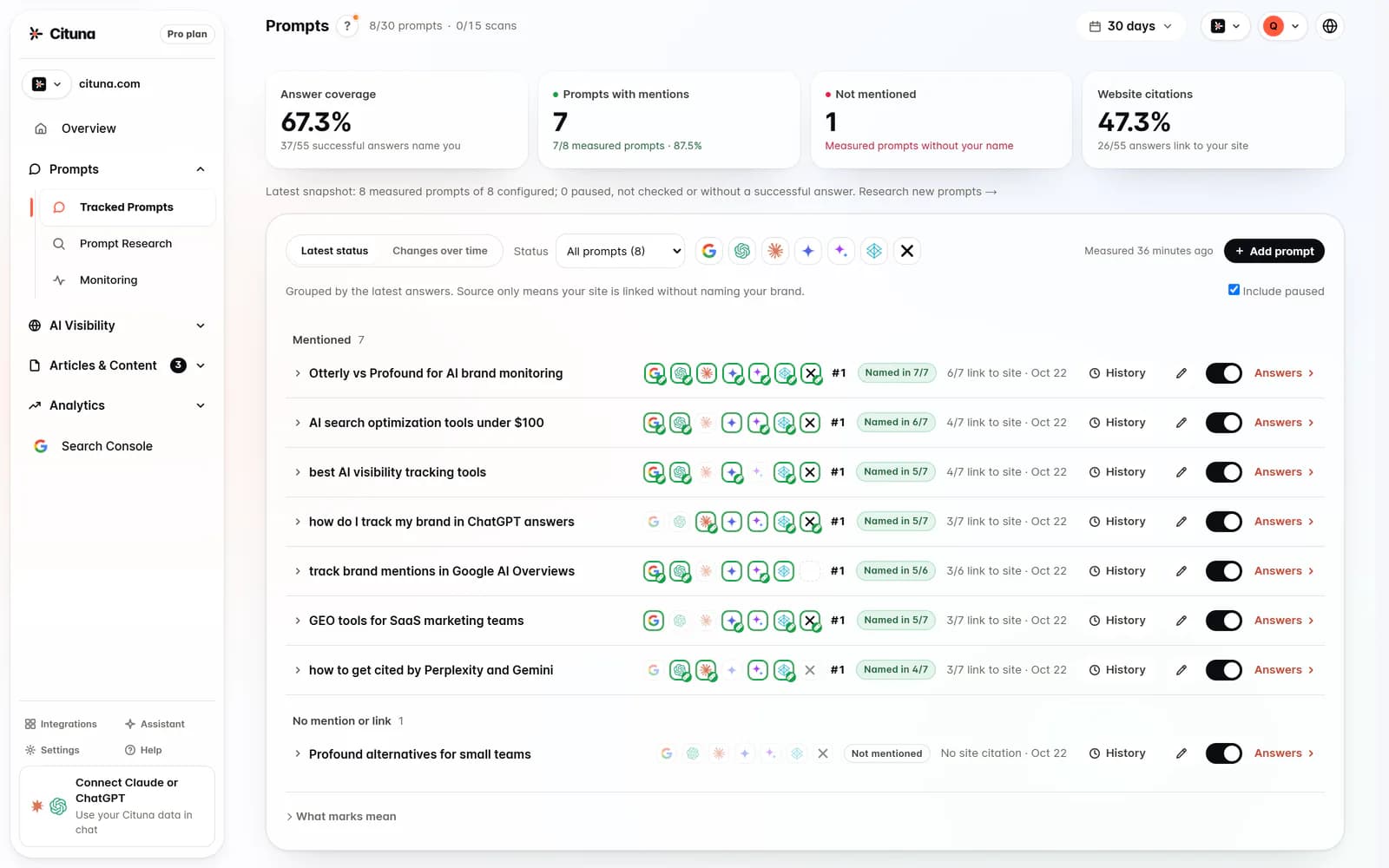
An Overview can appear, disappear or change its sources from one week to the next, so a single check proves little. Re-check your priority queries on a schedule, record whether you are cited and who is cited instead, and compare that with clicks and impressions in Search Console. Change one thing, then watch whether the citation follows. The two sections below set out the manual method and how a tracker automates it.
If you also want the other answer engines to cite you, that is a different crawl surface: GPTBot and OAI-SearchBot for ChatGPT, ClaudeBot for Claude and PerplexityBot for Perplexity. Our guides on generative engine optimization and ranking on Perplexity go deeper on those.
How to track your presence
You cannot improve what you cannot see, and AI Overviews are harder to measure than classic rankings, because they do not show up in a normal rank tracker and they vary by query, location and moment. A workable approach has two halves.
First, watch the answer surface directly. Track which of your priority queries actually trigger an Overview, and when one appears, check whether you are among the cited sources or a competitor is. Do this on a schedule rather than once, because coverage shifts. Second, watch the click side. Connecting Google Search Console lets you see how impressions, clicks and average position move on the queries where Overviews appear, which is the closest reliable read on whether the change is helping you or quietly costing you traffic.
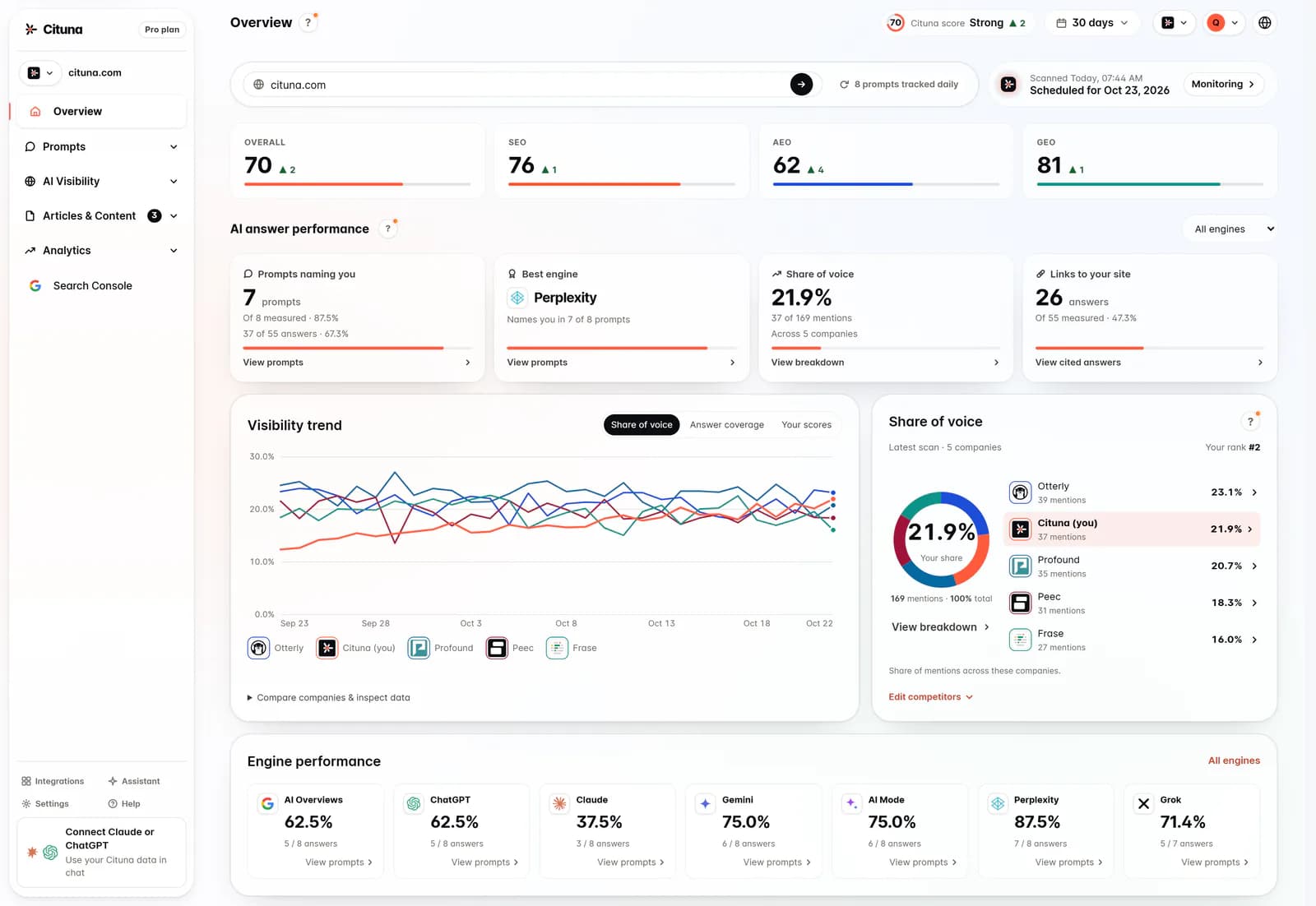
This is the loop Cituna is built to run: it tracks who gets cited across ChatGPT, Perplexity, Gemini, Claude, Grok, Google AI Overviews and Google AI Mode, ties those gaps to real Search Console impressions and clicks, and generates the fixes to close them. There is a 3-day free trial (card required), and plans start at $49/mo. For the broader measurement playbook across every engine, see AI visibility: how to measure and improve it.
Track whether AI Overviews cite you
The manual method above works, but it does not scale. AI Overview coverage varies by query, location and moment, so a handful of hand checks cannot tell you whether Google cites you across your whole query set, or whether that is trending up or down. This is where a dedicated AI Overviews rank tracker earns its keep.
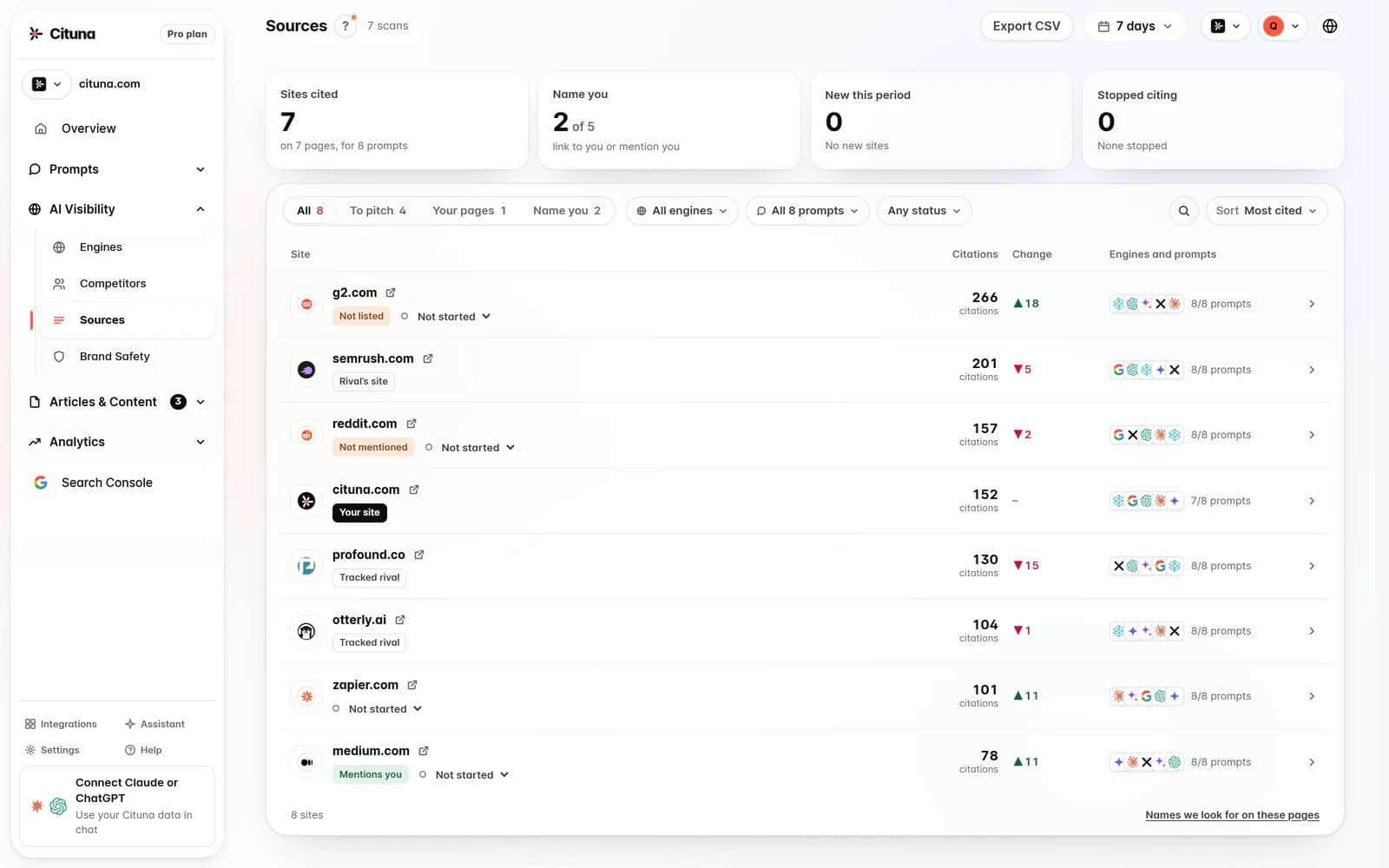
An AI Overviews tracker runs your buyer queries against Google on a schedule, detects when an Overview appears, and records whether your domain is one of its cited sources, the position you hold, and which competitors are cited in your place, a citation matrix you can read as a trend rather than a one-off screenshot. Cituna does this daily across the seven engines that answer buyer questions, ChatGPT, Perplexity, Gemini, Claude, Grok, Google AI Overviews and Google AI Mode (not Microsoft Copilot), ties each gap to real Search Console impressions and clicks, and generates the schema, FAQ and content fixes to close it. No tool can promise a citation; what it gives you is the loop, measure a query, ship a fix, and watch whether your citation rate moves.
Appearing in Google AI Overviews comes down to the seven steps above: be indexable with a snippet, know which queries show an Overview, answer each sub-question more clearly than anyone else, and keep checking.
Drafted with AI assistance from our own research and Search Console data, and reviewed by Rahul A before publishing. Rules and prices change; check the linked official source before you act.