GEO and AEO are two overlapping disciplines for the same era of search. GEO (generative engine optimization) optimizes for how generative engines like ChatGPT and Gemini describe and summarize you, cited or not. AEO (answer engine optimization) optimizes for being the direct answer an engine returns and the source it names. Most of the underlying work is shared.
This guide draws the line precisely, shows where the two overlap and where they genuinely differ, and gives you a decision matrix for picking the right tactic for each goal.
GEO vs AEO at a glance
Start with the map, then we will walk the terrain. Read this as two goals served by one content operation rather than two rival strategies: AEO earns the answer, GEO earns how you are described whenever the model discusses your category.
| Dimension | GEO | AEO |
|---|---|---|
| What it optimizes | How generative models describe, summarize and recommend you | Being the direct answer and the source the engine cites |
| You win when | The model represents you accurately and favorably, cited or not | The engine names you as the answer or links you as its source |
| Primary surface | Any generative answer: ChatGPT, Gemini, Claude, Perplexity | Direct-answer and citation surfaces: Google AI Overviews, Perplexity, featured snippets |
| Main levers | A consistent brand entity, off-site consensus, original data worth repeating | Answer-first passages, clean structure, schema, FAQ formatting |
| How you measure | Share of voice and the accuracy of the description | Citation rate: how often you are the named or linked source |
The split is drawn sharp to make the contrast legible. In practice one body of work feeds both columns, which is why the terms are so often used interchangeably.
If you want the one-line version: AEO is about being the answer; GEO is about how you are described whenever the model talks about your category, answer or not.
What GEO and AEO each mean
GEO: optimizing for what the model says about you
The term generative engine optimization comes from a 2024 research paper that coined it and showed, in a controlled benchmark, that deliberately optimizing content could lift a source’s visibility in generative answers by up to 40%. That academic root is worth knowing, because it fixes what GEO is really about: not a single trick, but the practice of shaping how a generative model represents you across everything it reads and writes.
GEO is therefore broader than any one citation. It covers whether a model recommends you by name, describes your strengths correctly, and reaches for you at all when it answers about your category, even when no link is shown. For the full treatment, see our generative engine optimization pillar.
AEO: optimizing for the direct answer
Answer engine optimization is the older and narrower of the two ideas. It grew out of the SEO world as assistants, voice search and featured snippets matured, and its unit is the extractable answer: the clean, self-contained passage a system can lift and present as the reply. AEO applies to any surface that returns a direct answer rather than only a list of links, from Google AI Overviews and Perplexity’s cited answers to classic featured snippets and ChatGPT with search.
Because the win condition is the citation or the box, AEO work concentrates on being the single most quotable, most trusted passage for a specific question. Our answer engine optimization pillar covers how engines choose what to cite.
Where GEO and AEO overlap
Here is the part the “GEO vs AEO” framing hides: the two share most of their foundation. A generative engine cannot describe well, or cite, a page it cannot reach, parse, or trust. The same four things do double duty.
- Reachability. If
GPTBot,ClaudeBotorPerplexityBotis blocked in yourrobots.txt, or your content only appears after JavaScript runs, you are invisible to both. One fix serves both goals. - Extractable structure. Clear headings, clean server-rendered HTML and answer-first passages make content easy to quote (the AEO win) and easy for a model to parse into a coherent picture of you (the GEO win).
- Trust. Engines cite, and describe favorably, sources they already trust for a topic. Earned links, real author credentials and a consistent track record move both needles at once.
- A well-formed entity. A brand described the same way across your site, Wikipedia, review sites and comparison lists is one the model can both quote accurately and recall by name.
The overlap in one line:
Where they actually differ
The differences are narrow but real, and worth being precise about.
AEO stops at the citation; GEO does not. A model can recommend you by name inside a paragraph with zero links, or quietly leave you out of one, and a citation-only view never sees it. That representation, cited or not, is squarely GEO’s concern and an AEO blind spot.
AEO is passage-level; GEO is entity-level. AEO asks whether this passage is the best answer to lift for this question. GEO asks whether the model, across everything it has read, describes your brand correctly and prefers you when the category comes up. One is about a paragraph; the other is about your reputation across the web.
The surfaces skew differently. AEO maps most cleanly to citation-bearing surfaces, where a source is shown: AI Overviews, Perplexity, featured snippets. GEO matters even on the answers a model generates from memory with no browsing and no citation at all, a large and growing share of what assistants produce.
A decision matrix: which to lean on for each goal
Labels aside, what you actually do depends on the outcome you want. Use this to pick the lever, then notice how often the honest answer is both.
| Your goal | The move that gets you there | Leans |
|---|---|---|
| Be the tool a model names when a buyer asks for a recommendation | A consistent brand entity plus off-site consensus in the sources models trust | GEO |
| Win the citation link under a Perplexity or AI Overviews answer | A clean, self-contained answer on a crawlable, trusted page | AEO |
| Own the direct-answer or featured-snippet box in classic search | Concise definitions and question-shaped headings with FAQ formatting | AEO |
| Fix a wrong or unflattering way a model describes you | Correct and align the description everywhere the model reads about you | GEO |
| Show up when the engine answers from memory with no links | Broad, consistent presence and original framing worth repeating | GEO |
| Turn a buyer question you lose today into one you win | An answer-first passage plus the entity and authority to be trusted | Both |
Most real programs end up doing all of these, which is the point: GEO and AEO are two goals served by one content operation, not two separate budgets.
Notice the “leans” column never says “GEO instead of AEO” or the reverse; it tells you which goal a tactic serves first. The foundation under every row, reachable, extractable, trusted, is shared, which is why sequencing beats choosing.
How to do both without running two programs
You do not need two teams or two content calendars. Run one operation and sequence the work by impact.
- Unblock the AI crawlers first. Confirm your
robots.txtwelcomesGPTBot,ClaudeBotandPerplexityBot, and that key content is in the server-rendered HTML. Nothing else matters if pages cannot be read. Serves both. - Restructure key pages for extraction. Lead each section with a tight, self-contained answer and phrase headings as the questions people ask. This is the strongest AEO lever, and it helps GEO too.
- Strengthen the entity and off-site presence. Describe your brand consistently everywhere, publish accurate
Organizationschema, and invest in earned mentions and original data worth quoting. This is the slow GEO lever that most separates recommended brands from invisible ones. - Measure the answer surface, then close the gaps. Ask the engines your buyer questions on a schedule and record who they cite and how they describe you, so you can work the specific prompts where a competitor is named and you are not.
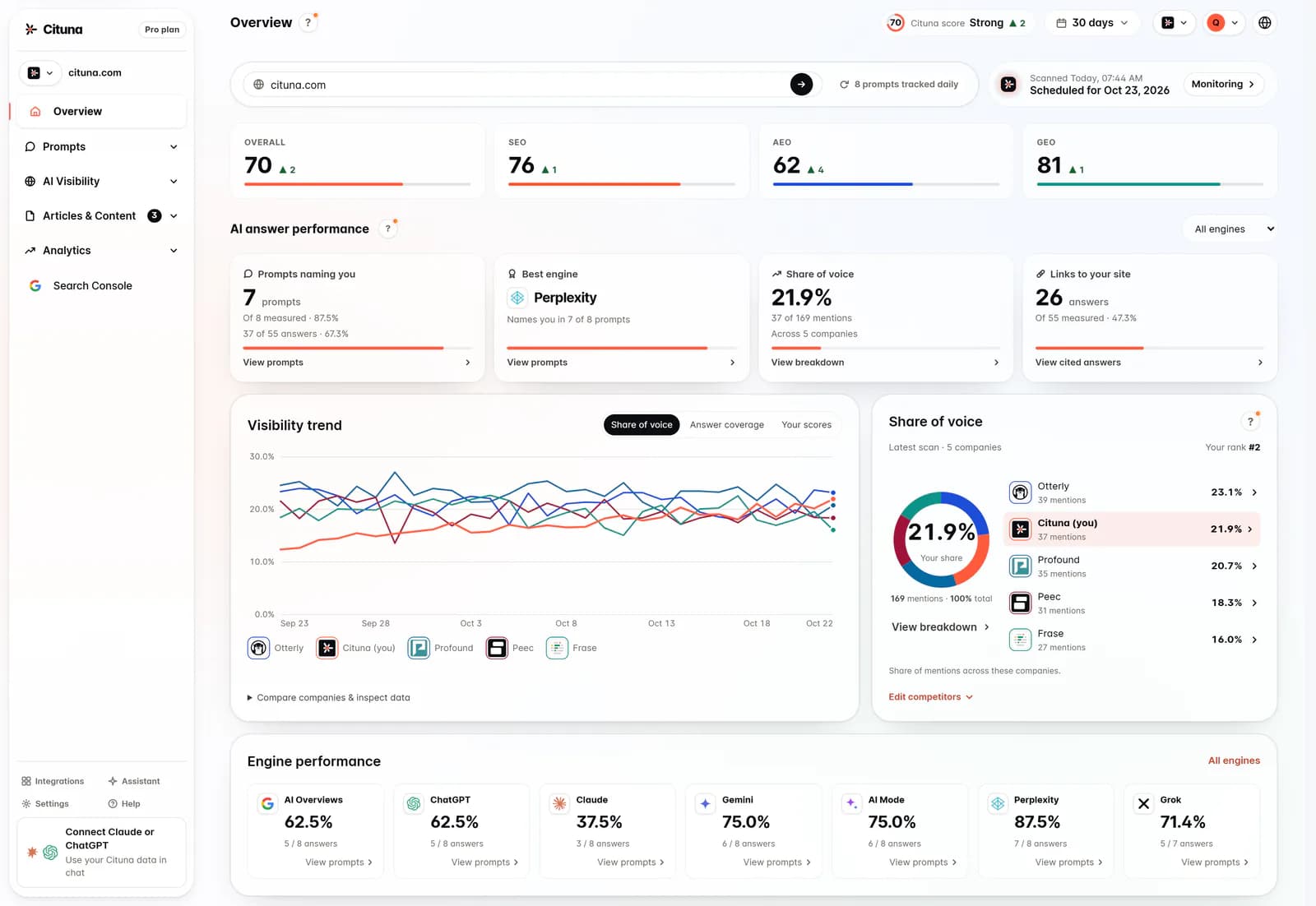
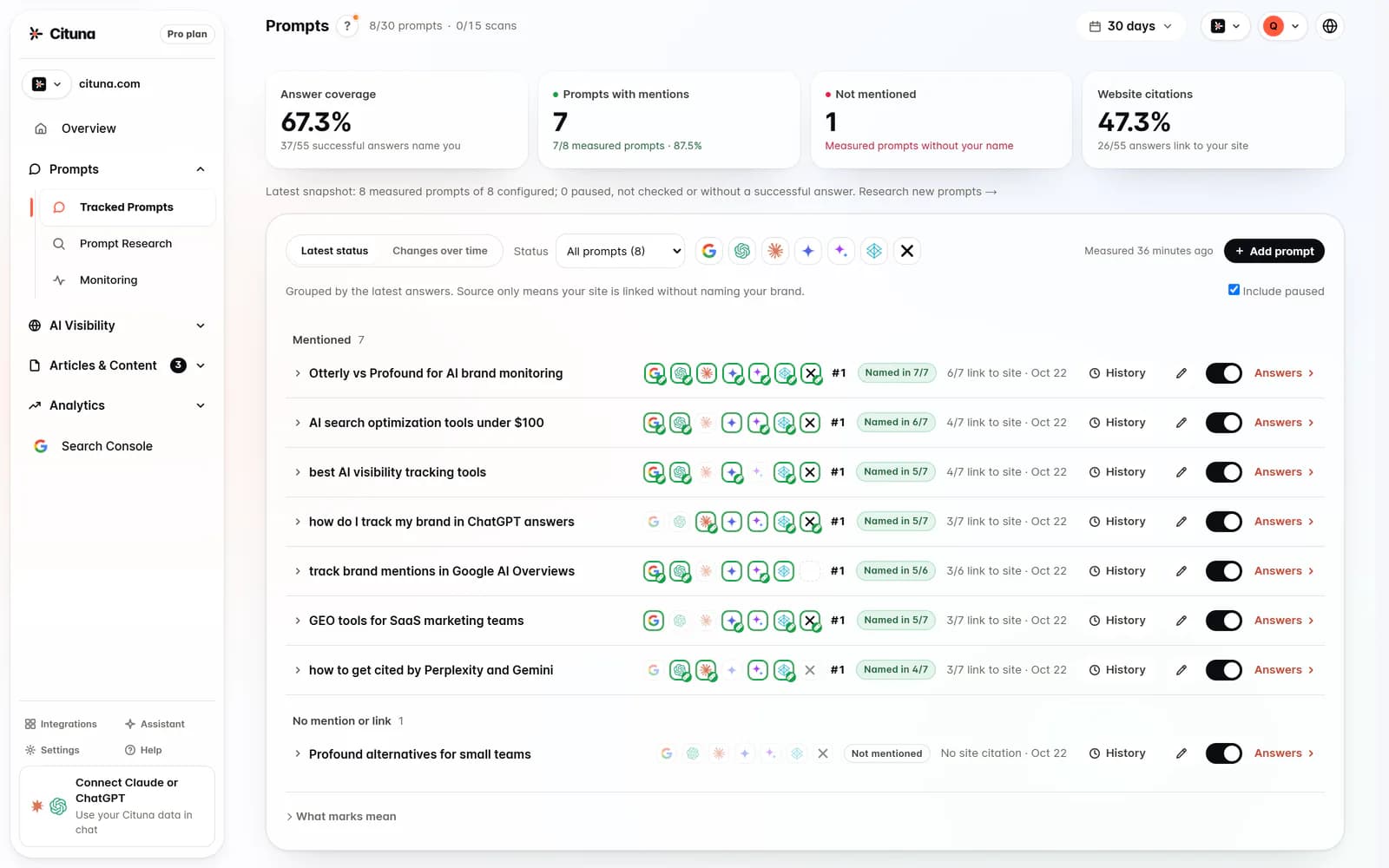
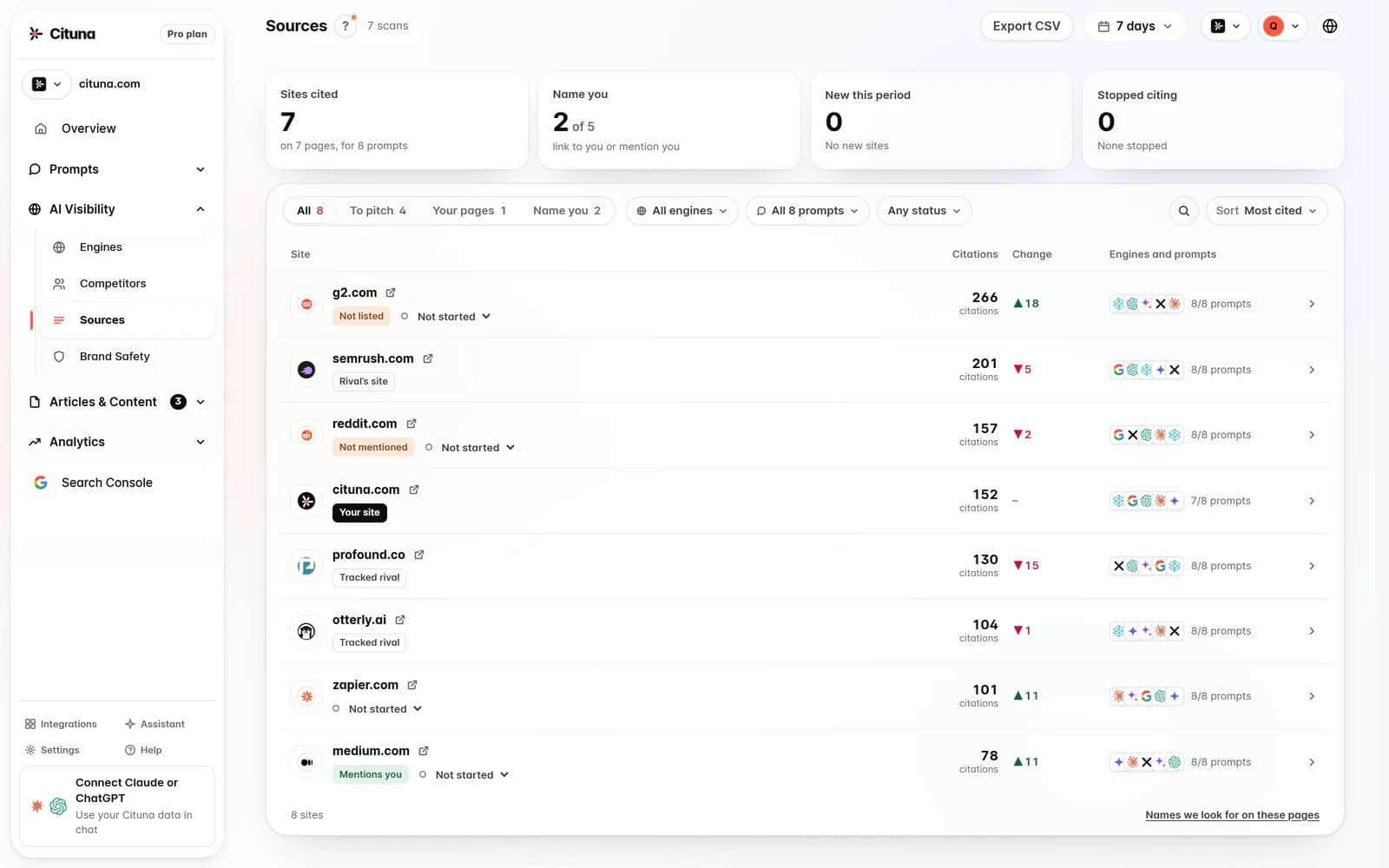
That last step is where both disciplines fail the same way without a tool: AI answers never show up in a rank tracker, so you optimize blind. That is the loop Cituna closes. It asks your buyer questions across ChatGPT, Perplexity, Gemini, Claude, Grok, Google AI Overviews and Google AI Mode, all seven checked daily, records who each engine cites and how it describes you, and turns each gap into a concrete schema, FAQ or content fix. It does not currently track Microsoft Copilot. Pairing a native Google Search Console connection on top ties the answer-side work back to real impressions and clicks. A free 3-day trial (card required, no charge until it ends) covers your first scans, with plans from $49 a month for ongoing tracking. For the measurement playbook, see our AI visibility guide.
The label debate is not worth your afternoon. GEO and AEO name two goals, being described well and being the answer, that sit on one foundation and one content operation. For the SEO angle on each, see GEO vs SEO and AEO vs SEO. Build pages a model can quote and trust, measure the answer surface, and you win both at once.
Drafted with AI assistance from our own research and Search Console data, and reviewed by Rahul A before publishing. Rules and prices change; check the linked official source before you act.