The short answer
Possibly, but the odds are against it being the whole story, and it is worth ten minutes to find out before you rebuild a content strategy around the assumption. AI answers genuinely do absorb clicks on informational queries. They also get blamed for seasonality, for new pages settling after Google tests them, for brand spikes decaying, and most often for clicks that were never happening in the first place.
The distinguishing evidence is already in your Search Console, and it comes down to reading two numbers together rather than one alone: impressions and clicks, over a window that starts before the change.
The one-sentence test:
Four causes, one symptom
Every traffic-drop investigation should start by assigning the drop to one of these. They are distinguishable with data you already have, and the fixes have almost nothing in common.
| Cause | Impressions | Clicks | Avg position | What it means |
|---|---|---|---|---|
| AI answer absorbing the click | Flat or rising | Falling | Roughly flat | You are still being shown. The question is being answered without you. |
| Lost visibility | Falling | Falling | Falling | You dropped out of the results, not out of the click. A ranking problem. |
| Outranked | Flat | Falling | Clearly worse | Someone overtook you. Competition, not a platform change. |
| There was never a click | Anything | Near zero throughout | Usually past 40 | Not a decline. The page has never been close enough to earn a click. |
Read all three columns together. Any one of them alone is consistent with at least two of these causes, which is why single-metric dashboards produce confident wrong answers.
The fourth row is the one people are most surprised by and the most common in practice, especially on younger sites and on large programmatic page sets. It is not a decline. It is a page that has never been in contention, showing up in an impressions report and creating the impression of lost potential.
We ran this on ourselves, and the answer was no
In September 2026 we investigated a suspected collapse on this domain. The premise was that our search performance had been good and had suddenly become worse. It had not. Non-brand average position had actually improved across the window in question, from the 80s in late July to 68.6 by early September, and the brand query held position 1 to 2.5 every single day without degrading.
What looked like a peak-then-collapse was three things stacked. A new page got a fresh-content honeymoon: Google tested one of our guides at position 24.7 and then 20.9 for exactly two days, it earned 7 and then 10 clicks, and it settled at around position 55 permanently because the domain could not hold the higher spot. A brand-search bump followed a package publish and registry listing, producing 9 brand clicks on one day against a baseline of 0 to 2. And a handful of single clicks recorded at positions 175 to 186 from rotating countries, which is not organic behaviour, stopped.
Strip those out and the durable truth was less comfortable than the AI story: this domain had never earned a sustained non-brand organic click. That is an authority problem. No AI engine was involved.
The zero-click audit is where it becomes concrete. Reading the full history of the property, 103 pages had earned enough impressions to judge, and 32 of them had earned no clicks at all across 8,328 impressions.
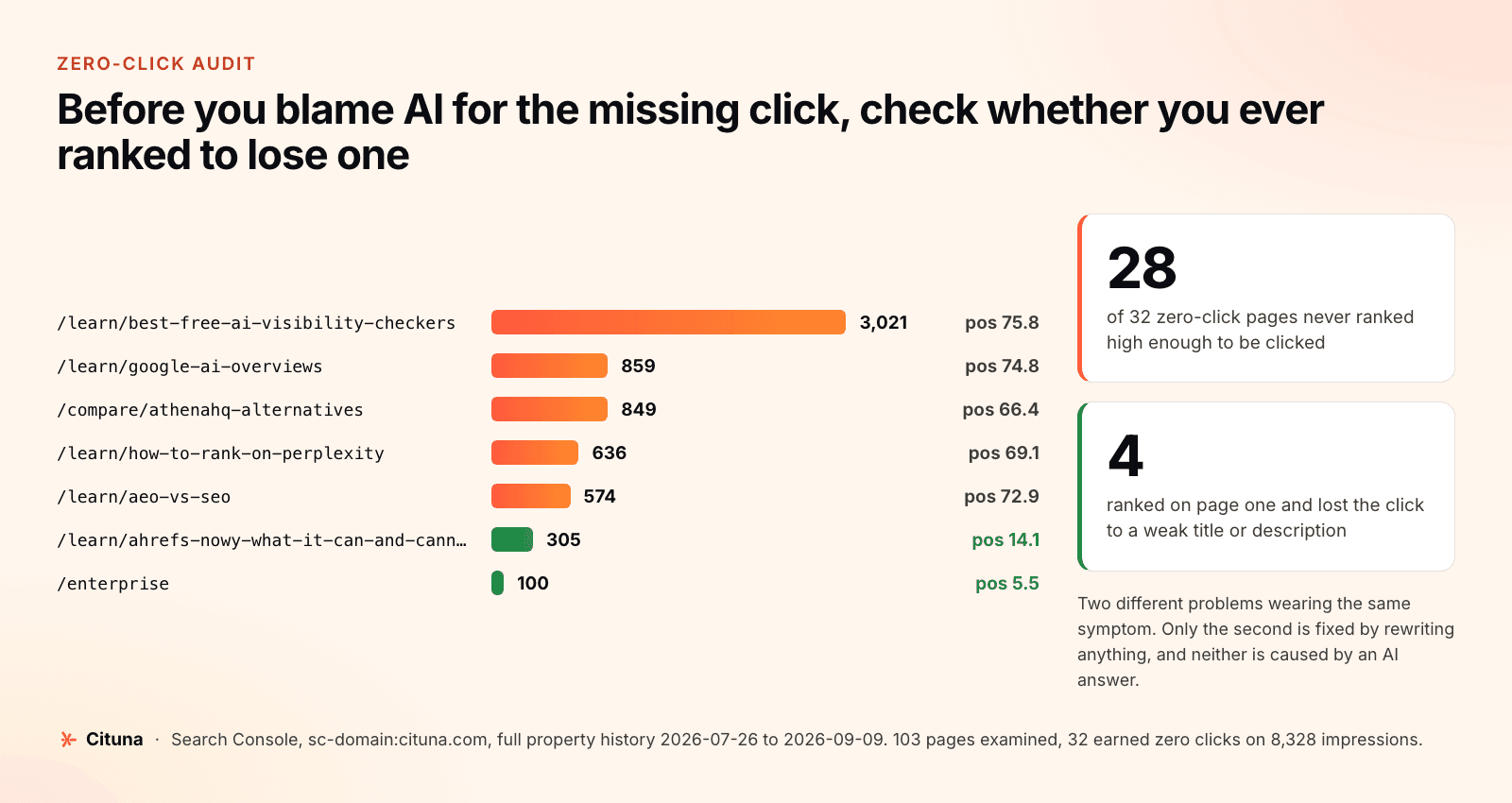
The split is the useful part. Twenty-eight of the 32 were what Search Console data makes obvious once you look: sitting past position 60, where no click was available to lose. Our largest single impression sink, a guide to free AI visibility checkers, had drawn 3,021 impressions at an average position of 75.8. Nothing took those clicks. They never existed.
Only four pages were the other kind, and they are the actionable ones. Our enterprise page ranked at position 5.5 and earned zero clicks from 100 impressions. That is a page being seen on the first page of results and skipped, which is a title and description problem, fixable in an afternoon, and invisible to anyone who only looks at the site total.
Why we published the unflattering version:
The diagnostic, step by step
This uses Search Console only, takes about ten minutes, and needs no tool.
1. Set a window that contains the change. Compare a period after the drop against the equivalent period before it. Do not use a 28-day default that starts after the event, which hides the thing you are looking for.
2. Read impressions and clicks together, not clicks alone. Use the four-row table above. This single step resolves most investigations, because it separates “still shown, not clicked” from “no longer shown”.
3. Split by query type. Filter brand queries out. Branded search is driven by your marketing, not by the results page, and leaving it in masks a real non-brand change or invents a fake one. This is what turned our own supposed collapse into a brand bump.
4. Check position before concluding anything. A page that moved from 8 to 40 was outranked. A page that has sat at 70 for its whole life was never in the running. Neither is an AI story.
5. Look at the pages, not the site. Site totals hide everything that matters. A stable total can contain one page collapsing and another rising, and the two have nothing to do with each other.
6. Only now ask what the results page looks like. Search your affected queries and see whether an AI Overview is present and whether it cites you. If impressions are flat, clicks are down, position is unchanged, and an AI Overview is sitting above your result, you have your answer, and getting cited inside that overview becomes the work.
So is SEO dead?
No, but the thing people mean by the question is real. The exchange rate changed: a given ranking now buys fewer clicks than it did, especially on informational queries where the answer fits on the results page.
The measured version of that, rather than the vibe: Pew Research Center found that users clicked a link inside an AI summary in just 1% of visits, and clicked any traditional result on 8% of searches that showed a summary, against 15% when no summary appeared. Roughly half the clicks, on the searches where a summary appears. That is a significant change and it is not an extinction.
The reason “dead” is the wrong word is that the inputs did not change much. Engines overwhelmingly cite pages that already rank, so crawlability, a clear answer near the top of the page, real expertise and third-party corroboration all still do the same job they did before. What you have to stop doing is treating clicks as the only evidence that the work paid off, because a citation with no click still shapes a shortlist. We go through the overlap in detail in AEO versus SEO and whether Google rankings affect AI visibility.
What to actually do
In the order that pays: fix the four-row diagnosis first, because it determines everything else. Then, depending on which row you landed in.
If you were never ranking, the work is authority and genuine differentiation, not snippets. Rewriting a title on a page at position 75 changes nothing. This is the least fashionable answer and it was the true one for us.
If you rank and lose the click, rewrite the title and meta description against the query actually earning the impressions, which is often not the query you wrote the page for. On our own data the same URL ranked at 75.6 for one phrasing and 17.5 for a slightly qualified version of it, so write to the phrasing that is already showing.
If an AI answer is taking the click, the goal changes from ranking to being the source the answer quotes, and the measurement has to change with it: you need to know whether you are named, cited or absent on the questions that matter, per engine. That is what Cituna does. It asks your real buyer questions across 7 engines, ChatGPT, Perplexity, Gemini, Claude, Grok, Google AI Overviews and Google AI Mode, daily from $49, keeps the answer text next to the sources cited, and ties it back to clicks through a native Search Console integration so the answer-side work does not float free of your traffic. It does not cover Microsoft Copilot, which is worth knowing if that is on your list.
And if the honest answer turns out to be that there was never a click to lose, that is worth more than a comfortable diagnosis. It is the difference between a year spent rewriting meta descriptions and a year spent earning the corroboration that moves a domain.
Drafted with AI assistance from our own research and Search Console data, and reviewed by Rahul A before publishing. Rules and prices change; check the linked official source before you act.