Yes, but the effect is weaker than most people assume and it varies sharply by engine. Google rankings feed AI Overviews most directly, yet published studies find only a moderate correlation between ranking in the top 10 and being cited. For ChatGPT and Perplexity, which run their own search layers, the tie to your Google position is weaker still.
That nuance, real but partial, and uneven across engines, is the whole answer. Below: what the published research actually measured, why the overlap is smaller than the “good rankings equal AI visibility” story suggests, and what to do about it, treat SEO and generative-engine work as compounding, and measure your own visibility instead of assuming your rankings carry over.
What the data actually shows
Several teams have now measured the overlap between Google rankings and AI citations at scale, and the honest summary is that rankings help, but they are one input among several, not the switch that flips your brand into an answer.
The clearest signal is in Google’s own AI Overviews, which are assembled from Google’s search index. An Ahrefs analysis of 863,000 search results and 4 million AI Overview links (published March 2026) found that 38% of cited pages also rank in the top 10 for the query, a genuine overlap, but down from roughly 76% a year earlier. In a separate Ahrefs study of one million AI-Overview keywords, the measured correlation between top-10 ranking and being cited was only a positive, moderate 0.347, and even a page ranking #1 appeared among the top cited links about half the time.
The studies do not fully agree, and the disagreement is the point. BrightEdge, tracking nine industries across 16 months, reported the overlap moving the other way, 54.5% of AI Overview citations now rank organically somewhere, up from 32.3%, while still finding only 16.7% in the top 10. The numbers differ because they measure different things: “ranks in the top 10” is not “ranks anywhere on page one or two,” AI Overviews are not ChatGPT, and the surface keeps changing month to month. What every study agrees on is the durable conclusion: rankings correlate with AI citations, most AI citations still come from outside the top 10, and the top-10 link is loosening over time.
The load-bearing takeaway:
Why the answer depends on the engine
“AI visibility” is not one surface. Each engine assembles its answer from a different place, so your Google ranking matters a lot for some and barely for others. Three mechanisms explain the whole spread.
1. Answers built on the Google index (AI Overviews, Gemini)
Google AI Overviews and Gemini draw on Google’s own search index, so your Google ranking is the most direct lever you have here. This is why the overlap studies above center on AI Overviews: it is the engine where rankings and citations are genuinely entangled, and where your SEO work converts into AI citations first. Our guide to showing up in Google AI Overviews covers the specifics.
2. Answers built on a separate search layer (ChatGPT, Perplexity)
ChatGPT and Perplexity do not read Google’s rankings. They run their own retrieval, Perplexity its own index, ChatGPT a Bing-based search layer, and then synthesize. The gap this creates is large: across 15,000 long-tail prompts, Ahrefs found just 12% of AI-cited URLs rank in Google’s top 10 for the original query. By engine, Perplexity overlapped most (28.6%), while ChatGPT and Gemini sat near 8%. One cause is “query fan-out”: instead of your one query, these engines search several reworded sub-queries and pull sources for each, so the pages that win are often ones that never ranked for your exact search.
3. Answers from training data (all of them, some of the time)
When an engine answers from memory without browsing, which any of them may do, your Google ranking is irrelevant to that specific answer. What matters is how consistently your brand appears across the wider web the model was trained on. That is a different game from ranking, and it is the bridge to the next section.
| Engine | Where its answer mostly comes from | Tie to your Google ranking |
|---|---|---|
| Google AI Overviews | Google’s own search index | Strongest, but only ~38% of citations rank in the top 10, and slipping |
| Gemini | Google index + live grounding | Strong, similar to AI Overviews |
| Perplexity | Its own index + live retrieval | Weak-to-moderate (~29% top-10 overlap, highest of the AI engines) |
| ChatGPT | Its own search layer + training data | Weak (~8% top-10 overlap) |
| Claude | Web search when the question calls for it + training | Weak; not built on Google’s ranking |
| Grok | Live data + training | Weak; not built on Google’s ranking |
Overlap figures are from the Ahrefs studies linked above. Cituna checks all six of these engines daily, plus Google AI Mode (not Microsoft Copilot).
Why rankings are not the whole story
If rankings only partly predict AI visibility, what fills the gap? The most striking answer in the data is off-site brand signals.
In a 75,000-brand Ahrefs study, branded web mentions, how often your brand is named across the web, link or no link, were among the factors most correlated with AI-Overview visibility (0.656), far ahead of backlinks (around 0.2) and domain rating (0.326). Read that carefully: how much the web talks about you predicted AI visibility better than the classic authority metrics SEO has chased for two decades. Correlation is not causation and these are moderate relationships, but the direction is consistent, and it reframes the question. “Do rankings affect AI visibility?” is really a sub-question of “does your overall authority affect it?”, and rankings are one expression of that authority, not its source.
It also explains why the top-10 overlap is loosening: as engines lean on fan-out queries, a widely-referenced brand can be pulled into an answer through a sub-query it never ranked #1 for, while a well-ranked but rarely-mentioned page gets passed over. For how the engines pick between candidates, see how ChatGPT chooses which brands to recommend.
SEO and GEO compound, they do not compete
Put the pieces together and the strategy writes itself. Google rankings and AI visibility are driven by heavily overlapping inputs, crawlable, authoritative, widely-referenced content, so the work compounds instead of competing.
- The crawlable, well-structured page that ranks is also the page an AI engine can extract a clean answer from.
- The off-site mentions and coverage that build ranking authority are the same signals most correlated with AI citations.
- The Google index that ranks you is literally the source AI Overviews and Gemini pull from.
The mistake is treating these as a choice, pausing SEO to “do GEO,” or assuming good rankings automatically hand you AI visibility. Neither holds. Rankings give you a head start in AI Overviews and almost none in ChatGPT; generative-engine work, answer-first structure, entity clarity, earned mentions, extends the same foundation to the surfaces rankings do not reach. For the full version of this argument, see GEO vs SEO; the short version is that GEO extends SEO rather than replacing it.
Measure it, do not assume it
Because the relationship is real but partial, engine-dependent and shifting, the one thing you should not do is assume your rankings are carrying over into AI answers. Measure both sides.
On the AI side, ask each engine the buyer questions you care about, on a schedule, and record who it names, and because AI answers themselves vary run to run, a single check cannot tell you whether a change is real. On the search side, connect Google Search Console so you can watch impressions and clicks move as your work lands. GSC is the proof layer: it is where you confirm that an AI-visibility gain is tied to real ranking and traffic movement rather than a vanity score. Our AI visibility guide covers the full measurement loop.
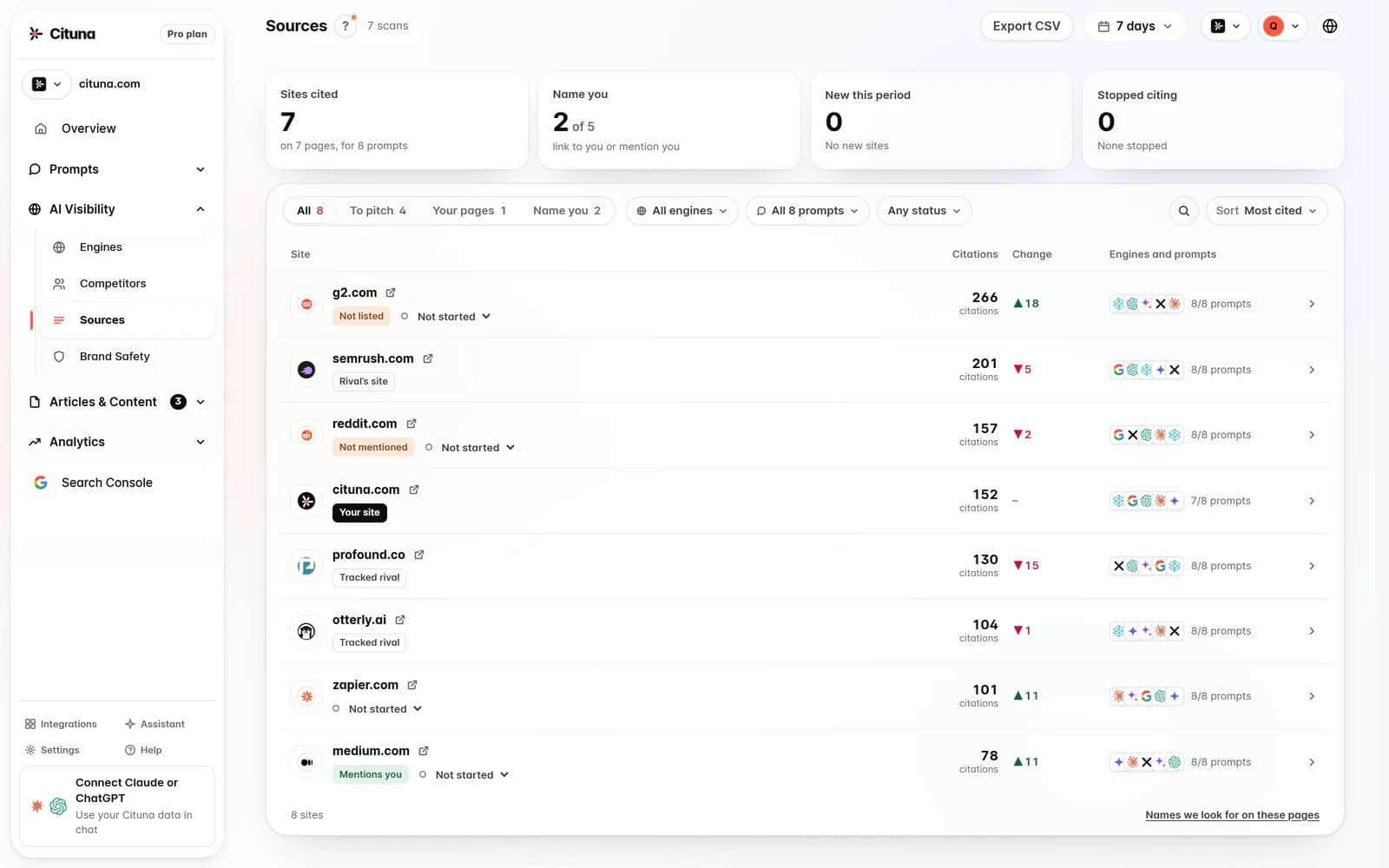
From our own scan data:
That is the job Cituna is built for: it runs your buyer prompts through ChatGPT, Perplexity, Gemini, Claude, Grok, Google AI Overviews and Google AI Mode, tracks who gets cited over time, and, through a native Google Search Console integration, ties those AI-visibility movements back to real rankings and clicks, so you can see whether your SEO is actually converting. Because AI Overviews is the surface most tied to your Google position, the AI Overviews tracker shows exactly which queries cite you there. Coverage of all seven engines starts at $49/mo on a 3-day free trial, card required, no charge during the trial, cancel anytime, and the tiers are on the pricing page.
Drafted with AI assistance from our own research and Search Console data, and reviewed by Rahul A before publishing. Rules and prices change; check the linked official source before you act.