Buyers increasingly ask AI engines what to buy, and the answers name a handful of brands. An AI visibility audit tells you whether yours is one of them, and if not, why not. It is the first step of any serious answer engine strategy, because you cannot fix a gap you have not measured.
This guide covers what an audit actually is, the five things a real one checks, how to run one yourself by hand, what good output looks like, and how often to repeat it.
What an AI visibility audit is
An AI visibility audit is a structured measurement of whether, where and how AI engines mention and cite your brand when buyers ask questions in your category, plus the on-page and off-page reasons behind the result. The measurement half asks: across the questions that matter, does ChatGPT, Perplexity, Gemini, Claude, Grok, Google AI Overviews or Google AI Mode put you in the answer, and how prominently? The diagnosis half asks: what about your site, your content and your third-party footprint explains that outcome, and what would change it?
It is a different exercise from a classic SEO audit. An SEO audit inspects how your pages rank in a results list, where being present somewhere is close to guaranteed and you compete on position. An AI visibility audit inspects whether a synthesized answer names you at all, a scarcer surface where absence is the default and the citations go to a few sources the model trusts. The two overlap on fundamentals like crawlability but diverge on almost everything else, which we unpack in AI visibility tools vs SEO tools.
What a real audit checks
A score on its own tells you that something is wrong, not what. A real audit produces evidence at five layers, from the raw answer data down to the causes, so that every number can be traced to specific prompts, specific answers and specific competitors.
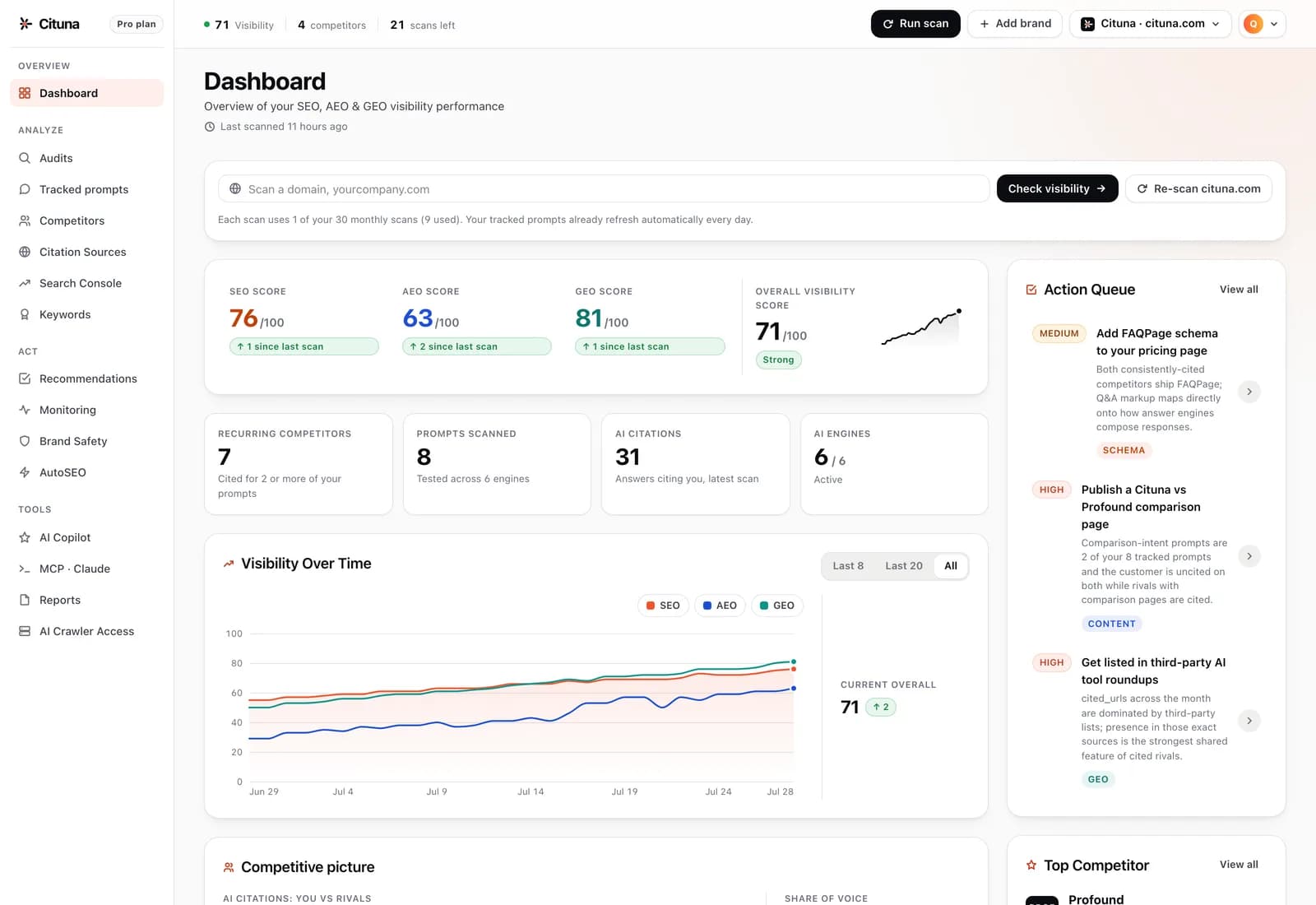
- Prompt-level citations. The core measurement: a fixed set of buyer prompts, the questions people actually ask when choosing in your category, tested across each engine. For every prompt and engine, the audit records whether your brand was mentioned or cited, and at what position in the answer. Everything else in the audit exists to explain this data.
- The on-page drivers. Whether AI crawlers can reach and render your pages at all, whether your content is structured answer-first so a model can lift a clean, self-contained passage, and whether schema markup makes each page’s meaning explicit. These are the reasons a site that looks healthy in a browser can still be invisible in answers.
- Competitor share of voice. Who wins the prompts you lose. Every answer that skips you names someone else, and the pattern in those names is the most actionable data in the audit: it tells you which rivals the engines prefer and on which questions. We cover the metric in depth in AI share of voice.
- Citation sources. Which third-party pages the engines pull from when they compose answers in your category. Engines lean on roundups, review sites, comparison pages and community threads far more than vendor homepages, so the source list tells you where coverage is worth earning, not just what to publish yourself.
- Authority signals. The off-site weight behind your brand: who links to you, who mentions you, and how that compares with the rivals the engines keep citing. Models favor brands with corroboration, so a large authority gap often explains a citation gap that no on-page fix will close on its own.
The order matters. Measure the prompt-level data first, before touching anything, because it decides which of the other four layers deserves your attention. A brand that AI crawlers cannot reach has a different problem from a brand that is crawled, readable and still losing every prompt to a rival with ten times the third-party coverage. The measurement tells you which brand you are; the diagnosis layers tell you what to do about it. Audits that skip straight to a generic checklist of on-page tips, without prompt data behind them, are guessing.
How to run one yourself
You do not need a tool to get a first honest read. The manual method is simple, and doing it once is genuinely instructive, because you see the raw answers your buyers see.
- Pick 10 to 20 real buyer prompts. Category questions, the kind a buyer asks before they know your name: best-tool-for questions, how-to-choose questions, is-X-worth-it questions. Do not include your brand name; asking an engine about yourself tests recall, not discovery.
- Run each prompt across at least three engines. ChatGPT, Perplexity and Google AI Overviews is a reasonable minimum, since they behave differently and cite different sources.
- Record three things per answer. Cited yes or no, at what position in the answer, and which sources the answer drew on. The source list matters as much as the verdict.
- Repeat on several days. Answers vary run to run and day to day, so a single pass can flatter or slander you. Two or three passes on different days gives you a fairer baseline; our guide to how often AI answers change explains why the variance is structural.
- Diff yourself against the two rivals cited most. Tally which brands appeared across all your readings, take the top two, and compare: which prompts do they win, which sources carry them, what do those pages have that yours lack?
Keep the logging boring and consistent: a spreadsheet with one row per prompt, engine and day, and columns for cited, position, brands named and sources used, is enough. Resist the urge to reword prompts between passes or swap engines mid-audit; the value of the exercise is in the comparison, and every variable you change quietly invalidates it. Save the raw answers too, because when a recommendation later claims a rival wins a prompt, you will want the receipt.
The honest cost:
What good output looks like
The failure mode of cheap audits is a single score with no path out of it. A score is useful as a trend line, but on its own it is not an audit; it is a verdict without a case file. Good output is a ranked fix list, where every item carries three things: the evidence (which prompts you lost, which competitor behavior or source pattern triggered the recommendation), the effort (a schema fix is an afternoon, earning a citation from a top roundup is a campaign), and the expected pillar it moves (whether the item should show up in your SEO, AEO or GEO score when it lands).
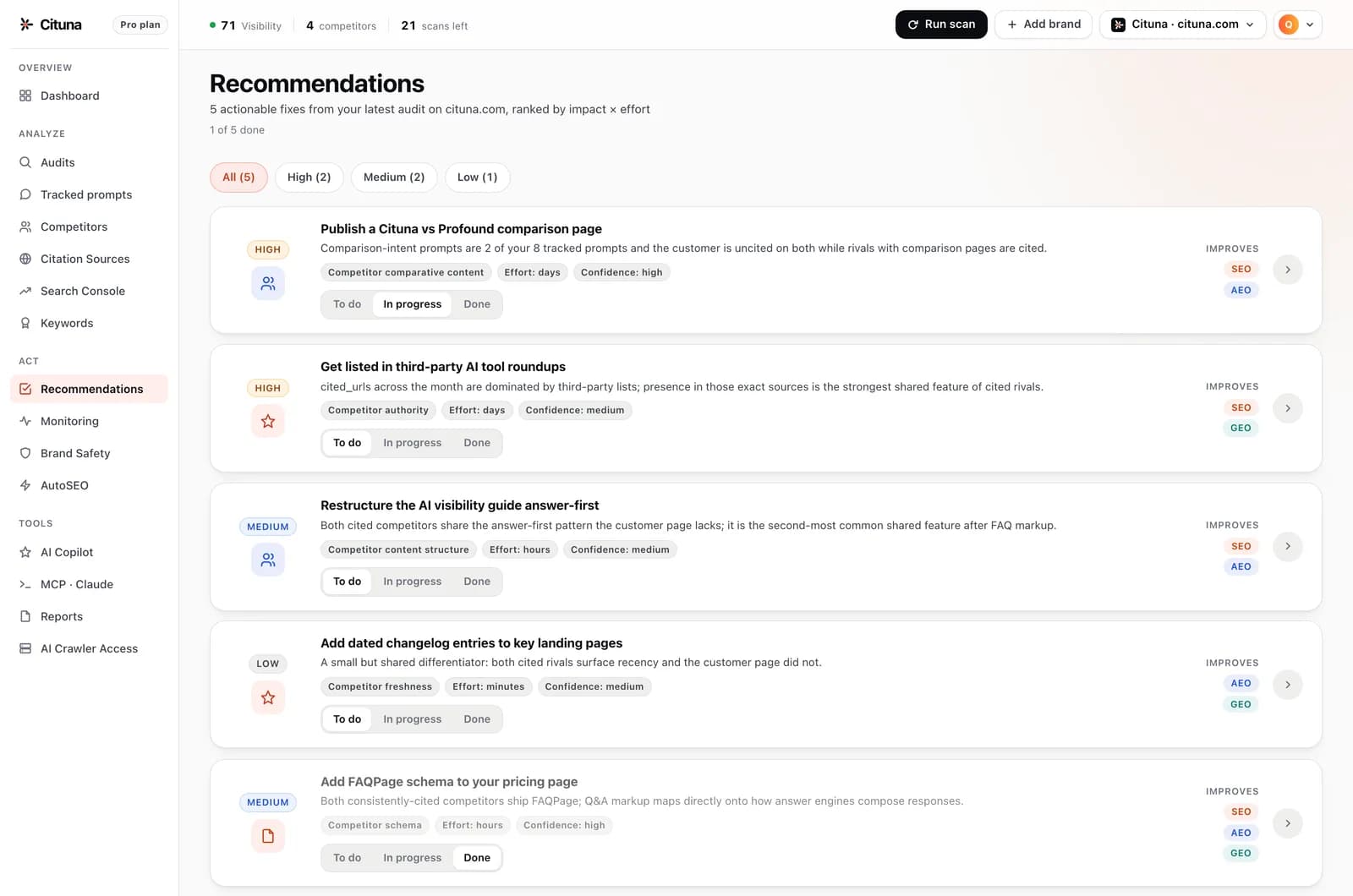
That evidence link is what makes the list trustworthy. When a recommendation says which prompts it came from, you can check it, and when you ship the fix, you know exactly which measurements to watch. This is how a Cituna scan is built: it tests your tracked buyer prompts across all seven engines, produces overall, SEO, AEO and GEO scores, and turns the gaps into a prioritized fix list where each item is tied to the answers that produced it. The first scan is free at cituna.com, so the baseline costs you nothing.
How often to re-audit
AI answers are not a stable surface. Models get updated, engines re-crawl and re-weigh sources, and your rivals keep publishing, any of which can add or drop your brand from an answer without anything on your site changing. A one-off audit is a photograph of moving traffic: accurate the day it was taken, stale within weeks.
The honest cadence for anything competitive is continuous: a fixed prompt set, re-measured daily or at least weekly, so you can separate real trend from day-to-day noise, catch a dropped citation while it is fresh, and see whether a shipped fix actually moved the answers. This is the main thing you are buying when you pay for a tool rather than repeating the manual method, and it is where the category’s pricing differences actually live, which we break down in AI visibility tool pricing. For reference, Cituna checks all seven engines daily on every plan, from Starter at $39 per month up to Pro at $119 and Max at $399, joins the answer data with Google Search Console so you can see both surfaces together, and offers a 3-day free trial, card required, cancel anytime.
However you run it, run it. The brands that win answer engines over the next few years will be the ones that measured first, fixed what the evidence pointed at, and kept measuring. An audit is simply the start of that loop.
Drafted with AI assistance from our own research and Search Console data, and reviewed by Rahul A before publishing. Rules and prices change; check the linked official source before you act.