AI engines shape brand perception every time they answer a question about you: they decide whether to mention you, which adjectives and sentiment to attach, what category to file you under, which competitors to list you beside, and which facts to state, sometimes inaccurately. That framing, not just the citation, is the impression buyers form.
This guide breaks AI brand perception into its measurable dimensions, explains where those impressions come from, and shows how to monitor the actual answer text, and shift it, across every engine your buyers use.
The dimensions of AI brand perception
When an engine answers a question that touches your category, it makes a series of decisions in a fraction of a second. “Did it mention me?” is only the first, and the least interesting. The rest are where perception is actually made.
| Dimension | What the AI engine decides | Why it shapes perception |
|---|---|---|
| Inclusion | Whether you are named at all when the category comes up | Absence is itself a verdict: a buyer never weighs a brand the answer never names |
| Sentiment | Whether it surfaces a strength, a caveat or a complaint | The same facts can read as “trusted leader” or “pricey and dated” |
| Framing | The adjectives and one-line summary it attaches to you | “Enterprise-grade and secure” and “complex and expensive” describe one tool |
| Category | Which bucket it files you under | The wrong shelf puts you in front of the wrong buyers, or none at all |
| Comparison set | Which competitors it lists you beside | Named next to the leaders lifts you; named beside weak options drags you down |
| Accuracy | Which specific facts it states about you | A hallucinated feature, a stale price or the wrong founder becomes the buyer’s “truth” |
Only the first row is binary. The other five live in the prose of the answer, which is why a brand can be cited and still be represented badly. There is no published formula, and each dimension can vary by prompt, by engine and over time.
Two of these are the easiest to overlook precisely because they hide inside an answer that otherwise mentions you.
Framing and category: the words and the shelf
Framing is the adjective problem. An engine rarely lists your features neutrally; it characterizes you. Being described as “lightweight and affordable” versus “bare-bones and limited” is the difference between a shortlist and a pass, and both can be written from the same underlying facts. Category is the shelf problem: if the model files you as a “social scheduling tool” when you sell a full marketing platform, you are compared on the wrong axis and lose to specialists you never meant to compete with. Perception is set as much by the bucket and the adjectives as by whether your name appears.
Accuracy: when the engine is simply wrong
Language models generate fluent, confident text that is not always grounded in fact, a failure mode researchers call hallucination, and an active area of study across the field (Springer, Artificial Intelligence Review, 2025). Applied to a brand, that can mean an invented feature, a price that has not been current for a year, a plan you retired, or the wrong founder’s name. Because the answer reads smoothly and carries no visible uncertainty, a buyer has no cue to doubt it, the mistake lands as fact. Accuracy is the dimension most companies never think to monitor, and the one most likely to quietly cost them a deal.
The reframe:
Why AI brand perception matters more than a mention
The reason is a shift in when and how buyers meet you. On a classic search results page you control your own snippet, and the user sees ten blue links they judge for themselves. In an AI answer, the engine reads the sources for the user and hands back a single synthesized verdict, often without a click through to anyone’s site. That answer is frequently the first and only impression formed at the exact moment of choice. And the audience is now enormous: ChatGPT alone reported 800 million weekly active users in October 2025, the most recent public figure as of July 2026 (TechCrunch), and it is one of seven engines your buyers may ask.
This is also why a citation-only view of AI visibility is not enough. A citation is binary, you were linked or you were not, while perception is the paragraph around it: the sentiment, the category, the competitors, the facts. You can win the citation and still lose the buyer to how you were described. For the precise distinction between being named and being framed, see mention vs citation.
Where AI perceptions come from
An engine does not invent its opinion of you. It assembles it from everything it has read, weighted toward the sources it trusts. Five inputs do most of the work:
- Your own content. Your site, docs and pricing pages are the model’s baseline for what you claim to be, but only if they are crawlable and current. Outdated pages become outdated answers.
- The wider web and earned press. Independent articles, roundups and “best X” lists are read as corroboration. When many sources describe you the same way, that description hardens into the model’s default.
- Reviews. Ratings and review text on the sites buyers check feed both sentiment and framing, the recurring praise and the recurring complaint alike get absorbed.
- Community discussion. Reddit threads, forums and Q&A sites are heavily represented in what models learn from, so the way real users talk about you in those places carries real weight in how you are described.
- Reference and entity data. Wikipedia, Wikidata and profiles like Crunchbase supply the “facts”, founder, category, funding, one-line description, that an engine reaches for and repeats.
The through-line is uncomfortable but useful: the model trusts what other sources say about you more than what you say about yourself. That is why perception cannot be fixed from your homepage alone, and it is the same mechanism that decides which brands get recommended in the first place, see how ChatGPT chooses which brands to recommend.
How to monitor AI brand perception
The common mistake is to monitor a checkbox, “were we cited, yes or no”, when the perception you care about lives in the sentences. To actually see how AI describes you, capture and read the answer text itself, with three principles.
- Capture the full answer, not a binary. Record what the engine actually wrote, so you can judge sentiment, category, the competitor set and every stated fact, the dimensions a yes/no can never show.
- Cover every engine, because they disagree. ChatGPT, Perplexity, Gemini, Claude, Grok, Google AI Overviews and Google AI Mode draw on different sources and reach different verdicts about you. Checking one and assuming the rest match is how a bad description hides.
- Track it over time, because answers drift. Models update and the web around you changes, so the framing, the comparison set and the accuracy of an answer all move. A single snapshot cannot tell you which way.
Done well, this turns a vague worry into specific, trackable measures: share of voice against competitors, sentiment on your key prompts, and a log of every wrong fact worth correcting. For how this fits into a full measurement program, see AI visibility: how to measure and improve it, and for the vocabulary, sentiment, share of voice, citations and more, see the AI visibility glossary.
How to shift AI brand perception
You cannot dictate an answer, but you can change the inputs the model reads, and that measurably moves the output. In a controlled 2024 benchmark, the researchers who coined the term generative engine optimization showed that deliberately optimizing content could lift a source’s visibility in generative answers by up to 40% (Aggarwal et al., KDD 2024). The levers that move perception, roughly in order of durability:
- Publish authoritative, quotable content. Clear pages that answer real buyer questions, and original data, benchmarks or definitions worth repeating, give the model accurate material to lift and learn you by.
- Make your entity consistent. The same name, category and one-line description across your site, LinkedIn, Crunchbase, review profiles and Wikidata resolves you to a single, well-defined entity the model can place with confidence, instead of an ambiguous one it hedges on.
- Correct the source material. When an answer is wrong, fix the upstream cause, the stale page, the incorrect reference entry, the outdated third-party listing, rather than the answer. Models learn corrections from the sources, not from complaints.
- Earn the right third-party mentions. Genuine inclusion in the roundups, reviews and community threads your buyers read is the slowest lever and the most decisive, because corroboration is what the model trusts most.
Be honest about the timeline: these shifts are gradual and compounding, and none of them flips an answer on command. The work is to steadily improve what the engines read about you, then measure whether the description follows.
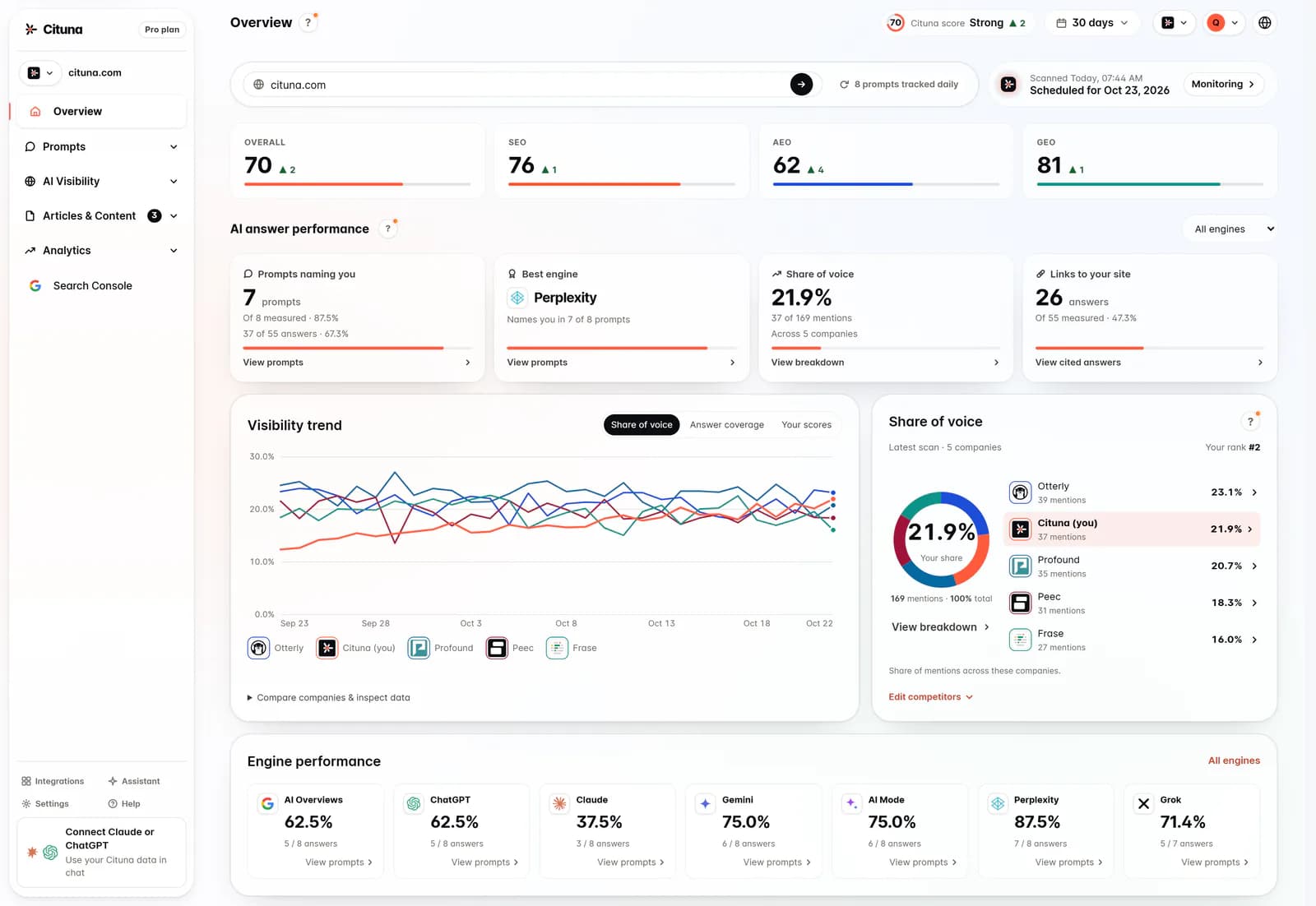
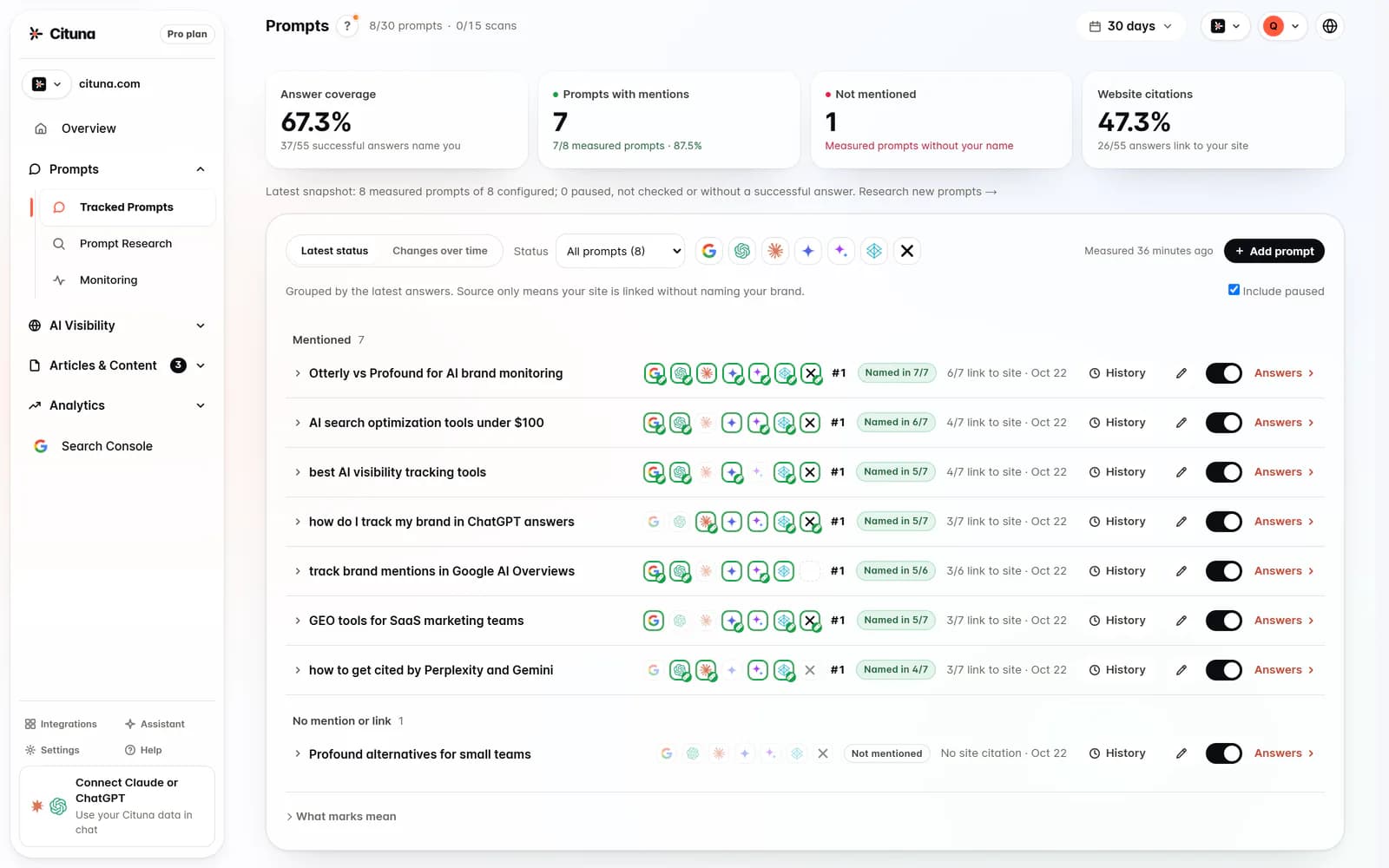
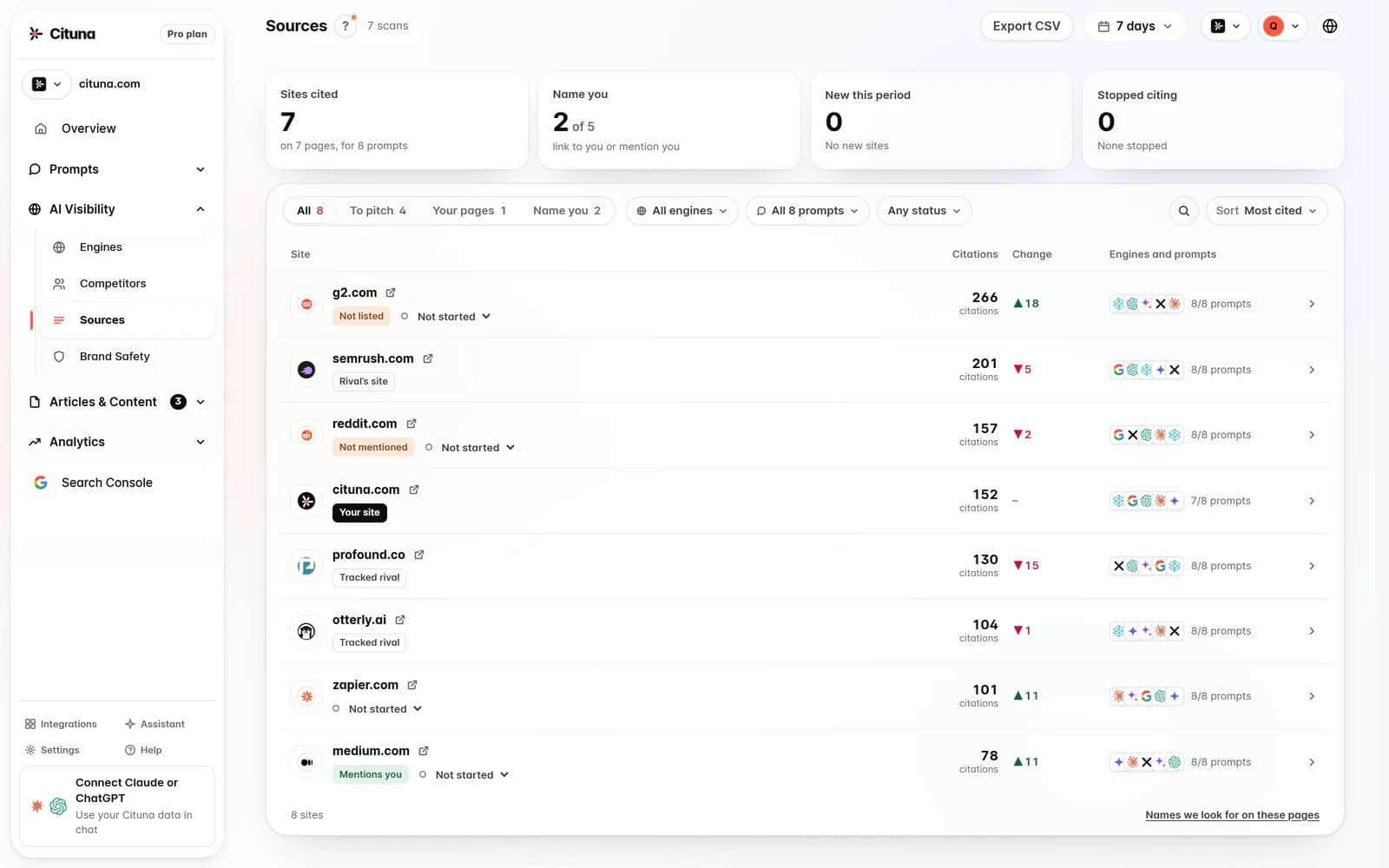
That measurement loop is what Cituna is built for. It asks your real buyer prompts across all seven engines, ChatGPT, Perplexity, Gemini, Claude, Grok, Google AI Overviews and Google AI Mode (it does not track Microsoft Copilot), and stores the full answer text, not a checkbox: where it named you, the brands it named in order, including the competitors named in your place, and the pages it cited, kept over time so you can read how each engine describes you and see a description drift before it costs you. Cituna does not score sentiment; you judge the tone from the stored answers (see how to measure brand sentiment in AI answers). It flags the wrong facts worth correcting, generates the schema, FAQ and content fixes to close each gap, and ties the work back to real search clicks through a native Google Search Console integration. A built-in MCP server (read tools from $49, write actions from Pro) lets you pull your own scans into Claude or any MCP client. A 3-day free trial (card required, no charge until it ends, cancel anytime) covers your first scans, with plans from $49 a month across Starter, Pro and Max.
None of this lets you write the answer yourself, nothing does. But read the full text across engines, fix what the models read about you, and measure whether the description moves, and you shift from hoping AI represents you well to knowing exactly how it does, and where to push next.
Drafted with AI assistance from our own research and Search Console data, and reviewed by Rahul A before publishing. Rules and prices change; check the linked official source before you act.