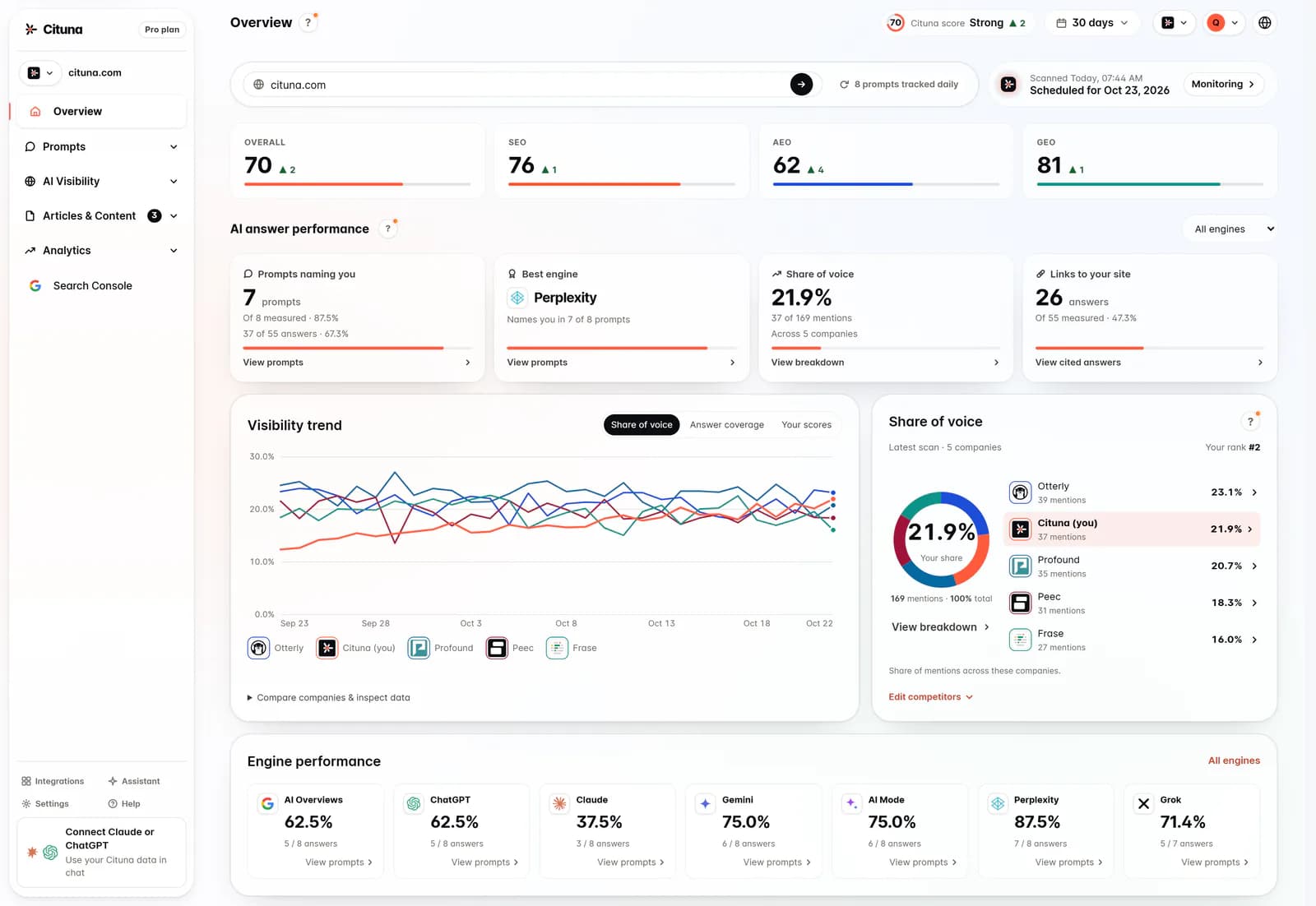
AI answers change constantly. The same question can return a different response minutes apart because language models sample their output probabilistically, and answers shift more sharply when a model is updated or when fresh web pages are retrieved. Measured on our own prompts in October 2026, the change is large: across seven engines, only 13% of answers to a buyer question named exactly the same tools as the day before, and the first tool named matched 64% of the time. Cituna measures that movement for your brand: it re-asks your prompts on seven engines every day and lays each engine’s answers out by scan day, so you can see what changed, on which engine and when.
That single fact reshapes how you should measure AI visibility. This guide explains the three forces behind the change, why eyeballing an engine once will mislead you, what the variance actually looks like in real scans, and how to set a checking cadence that separates signal from noise.
Which approach fits depends on the question you are asking. To see the effect for yourself once, ask one engine the same buyer question five times in fresh, logged-out chats and write down the brands each answer names; the spread you get is the run-to-run noise this guide describes. To know whether your own visibility is rising or falling, you need the same prompts asked on every engine on a fixed schedule, with the earlier answers kept to compare against, which is the job a daily tracker does.
Why AI answers change at all
Three distinct forces move an AI answer, and they operate on very different clocks. Understanding which is which is the whole trick to reading your visibility correctly.
1. Run-to-run sampling (seconds)
Language models do not look up a fixed answer; they generate one token at a time, sampling from a probability distribution. Two runs of the identical prompt can therefore land on different phrasing, and, crucially, different brand recommendations, with nothing about the world having changed in between. This is the baseline “noise floor” underneath every other kind of change, and it is why a result you see once is never the whole story.
2. Model updates (weeks to months)
Every engine sits on a model that its provider revises on its own timetable. When a new version ships, the knowledge, the ranking of what it recommends, and the way it phrases things can all move at once. A brand named confidently by last month’s model can quietly drop out of this month’s, no change to your site required. These releases are rarely announced to fit your reporting calendar, so the only way to catch the shift early is to be watching when it lands.
3. Fresh web data (hours to days)
Several engines retrieve live web pages at answer time rather than relying only on training. Perplexity does this on nearly every reply; ChatGPT, Gemini, Claude and Google AI Overviews do it when a question benefits from current information. That means your answer can move whenever the web moves: a new comparison article, a competitor’s fresh landing page, an updated review thread. The mechanics of that selection are covered in our guide on how ChatGPT chooses which brands to recommend.
The useful mental model:
What one manual check can’t tell you
The most common way teams measure AI visibility is also the least reliable: open ChatGPT, ask “what’s the best tool for X,” and read the answer once. If your brand appears, you relax; if it doesn’t, you panic. Both reactions are premature, because a single answer is one sample drawn from a distribution you cannot see.
The problem is not that the check is wrong; it is that it is uninterpretable on its own. Did your brand really disappear, or did this run just sample differently from the last one? Did a model update genuinely promote a competitor, or did a live page get retrieved this time that wasn’t last time? With one data point you cannot answer any of those questions. You need a baseline: a run of earlier checks that tells you what “normal” looks like for each prompt, so a real change stands out against the ordinary variance instead of hiding inside it. Measuring AI visibility well is a discipline of trend lines, not screenshots, a theme we develop in the broader guide to AI visibility and how to measure it.
What run-to-run variance actually looks like
We run Cituna on our own domain, so we can show you the variance rather than assert it. The figures below are our own scan data for cituna.com, recorded across four scans between July 15 and 17, 2026, the same ten buyer prompts and the same six engines each time.
Across those four scans our AI-citation score read 8, then 11, then 12, then 9. Meanwhile the underlying structure score, how well the page is built for an engine to extract, held flat at 55 the entire time. That gap is the thesis of this whole guide in one line: the structure barely moved while what the engines said about us bounced around it.
The sharpest illustration is the two closest scans. They ran less than two minutes apart, on the identical prompts and domain, with nothing changed between them. Even so, ChatGPT went from citing us on one prompt to two, the overall score ticked from 11 to 12, and the list of prioritized gaps changed from a single item to two. That is pure run-to-run sampling, the noise floor, visible in the space of 103 seconds.
Day to day, the swings got larger and took on the fingerprint of model and web changes rather than pure sampling. By the next morning’s scan, Gemini and Grok had each dropped one of the citations they’d given us, Google AI Overviews had slid from the first position to the second, and the set of rival names the engines returned had reshuffled, names like Ahrefs and Frase surfaced on the 17th that the previous day’s runs hadn’t returned at all. None of that reflected a change to our website overnight; it reflected the engines themselves moving.
How we know:
How much answers changed in October 2026
The July scans above covered ten prompts on six engines. To put a number on the question this page is named after, we went back to a larger set: the 34 prompts Cituna tracks for its own domain, asked on all seven engines it checks, ChatGPT, Perplexity, Gemini, Claude, Grok, Google AI Overviews and Google AI Mode, on every scan between October 18 and 23, 2026. Twenty-five of those prompts are buyer questions about AI visibility tools (“best Profound alternative”, “AI visibility tool with an API for developers”), and the answers to them are lists of tools, which makes the change easy to count.
How we counted. For each prompt and engine we compared the tools named in one answer with the tools named in the next, using a fixed list of 49 AI visibility tools and reading only the answer text, not its links. We compared three gaps: one day (the first scan of each day against the next day’s, 802 comparisons), a few hours (five same-day reruns between 18 minutes and about six hours apart, 806 comparisons) and the whole window (October 18 against October 23, 161 comparisons). A comparison counts when the engine answered both times and at least one answer named a tool.
| Gap between the two answers | Same tools named | Tools named again, on average | Same first tool |
|---|---|---|---|
| A few hours (same-day rerun) | 18% | 68% | 67% |
| One day | 13% | 66% | 64% |
| About four and a half days | 9% | 63% | 57% |
Cituna scan data for cituna.com, October 18-23, 2026: 25 buyer prompts about AI visibility tools, seven engines. “Same tools named” is an exact match of the set; “named again” is the share of the earlier answer’s tools that the later answer also named.
Three things stand out. First, an exact repeat is rare: even a few hours apart, fewer than one answer in five named the same set of tools, because a typical answer named four or five tools from our list and a list that long usually gains or loses one. Second, the core holds better than the list: about two-thirds of the tools in an answer were still there the next day, so a brand that is named often keeps being named often while the tail of the list turns over. Third, most of the change does not need a day to happen. The few-hours row and the one-day row are close, which suggests that sampling, the fastest of the three clocks, accounts for most of what moves inside a week. In July, on ten prompts, the day-to-day swings looked bigger than the two-minute ones; with 25 prompts and seven engines the gap almost closes.
The engines did not move alike. Comparing each day with the next:
| Engine | Tools named again next day | Same first tool next day | Comparisons |
|---|---|---|---|
| Grok | 80% | 67% | 120 |
| Perplexity | 79% | 77% | 108 |
| Gemini | 64% | 61% | 121 |
| ChatGPT | 63% | 65% | 121 |
| Claude | 60% | 72% | 110 |
| Google AI Mode | 57% | 55% | 110 |
| Google AI Overviews | 56% | 48% | 112 |
Same source and window as the table above, each engine as Cituna’s scans ask it.
Perplexity, which retrieves live sources for nearly every answer, was the steadiest about which tool it put first. Google’s two surfaces moved most: AI Overviews kept the same first tool in fewer than half of its day-to-day comparisons. Claude’s lists changed a lot, but its first pick held more often than ChatGPT’s or Gemini’s.
The same churn shows up for a single brand. Across the six daily scans of all 34 tracked prompts, 25 prompt-and-engine pairs cited cituna.com, by name or by link, at least once. Only 3 of those 25 cited it on all six days, and 16 cited it on just one or two. Of the 14 pairs that named Cituna in the answer text at least once, 3 named it every day. A single check on any one of those days would have given a different picture of where the brand stands.
What these figures do not show. Six days is too short to catch a model release, which lands weeks apart, so the numbers describe sampling and day-to-day retrieval, not the slower clock. They come from one category, AI visibility software, where new tools launch often; a category with fewer, older brands may hold steadier. A tool missing from our list of 49 is not counted, and a long list changes more easily than a short one, which is why the share of tools named again is a fairer number than an exact match. To run the same measurement on your own prompts, see the guide to tracking AI citations over time.
How often should you check?
Because the forces move on different clocks, the right answer is “often enough to catch the fastest thing you care about, and often enough to build a baseline.” In practice that means a daily cadence for every engine, because even the steadiest dropped about a fifth of its tools from one day to the next. Checking every hour rarely pays off: you mostly sample the noise floor, at real cost, without learning anything a daily trend line wouldn’t already tell you.
| AI surface | What moves its answer | Tools named again next day (Oct 2026) | Suggested cadence |
|---|---|---|---|
| ChatGPT | Model updates, live web retrieval, run-to-run sampling | 63% | Daily |
| Perplexity | Retrieves and cites live sources on nearly every answer | 79% | Daily |
| Google AI Overviews | Search ranking and index changes, frequent tuning | 56% | Daily |
| Google AI Mode | Google’s search results; a separate surface from AI Overviews, with its own answers | 57% | Daily |
| Gemini | Model updates; live grounding when a question triggers it | 64% | Daily |
| Claude | Model updates; web search when the question calls for it | 60% | Daily |
| Grok | Model updates and live data; slower to move, but a daily check catches it first | 80% | Daily |
Tools named again next day: the average share of the tools in an engine’s answer to one of 25 buyer prompts that its next-day answer to the same prompt also named, from Cituna’s scans of cituna.com, October 18-23, 2026. All seven engines are checked daily on every paid Cituna plan.
The reason a fast engine earns a daily check is not that it changes wildly every day, it is that when it does change, you want to know inside a day, not inside a quarter. Track the engines your buyers actually use: for engine-specific detail, see the ChatGPT rank tracker and the Grok rank tracker, Cituna checks both daily, alongside the other five.
The October figures also say where to set an alert. If about a third of the tools in an answer turn over from one day to the next as a matter of course, a brand that drops out of one answer for one day has not lost anything yet; a brand that is missing from the same prompt on the same engine for several scans in a row has. Set the threshold above the noise you measured, not at the first miss: the guide to AI visibility alert thresholds covers which changes deserve one.
Turning volatility into signal, not noise
Once you accept that AI answers move, the job stops being “take a reading” and becomes “maintain a trend line.” That is what Cituna is built to do: it runs your buyer prompts through ChatGPT, Perplexity, Gemini, Claude, Grok, Google AI Overviews and Google AI Mode on a daily cadence, all seven, every day, records every result, and shows you the trend for each prompt so a one-run blip reads as a blip and a real decline reads as a decline. When a gap persists across runs rather than flickering, it generates the fix (schema, FAQ markup, an llms.txt file and content recommendations), so the next scan has something to move.
What the daily record shows you
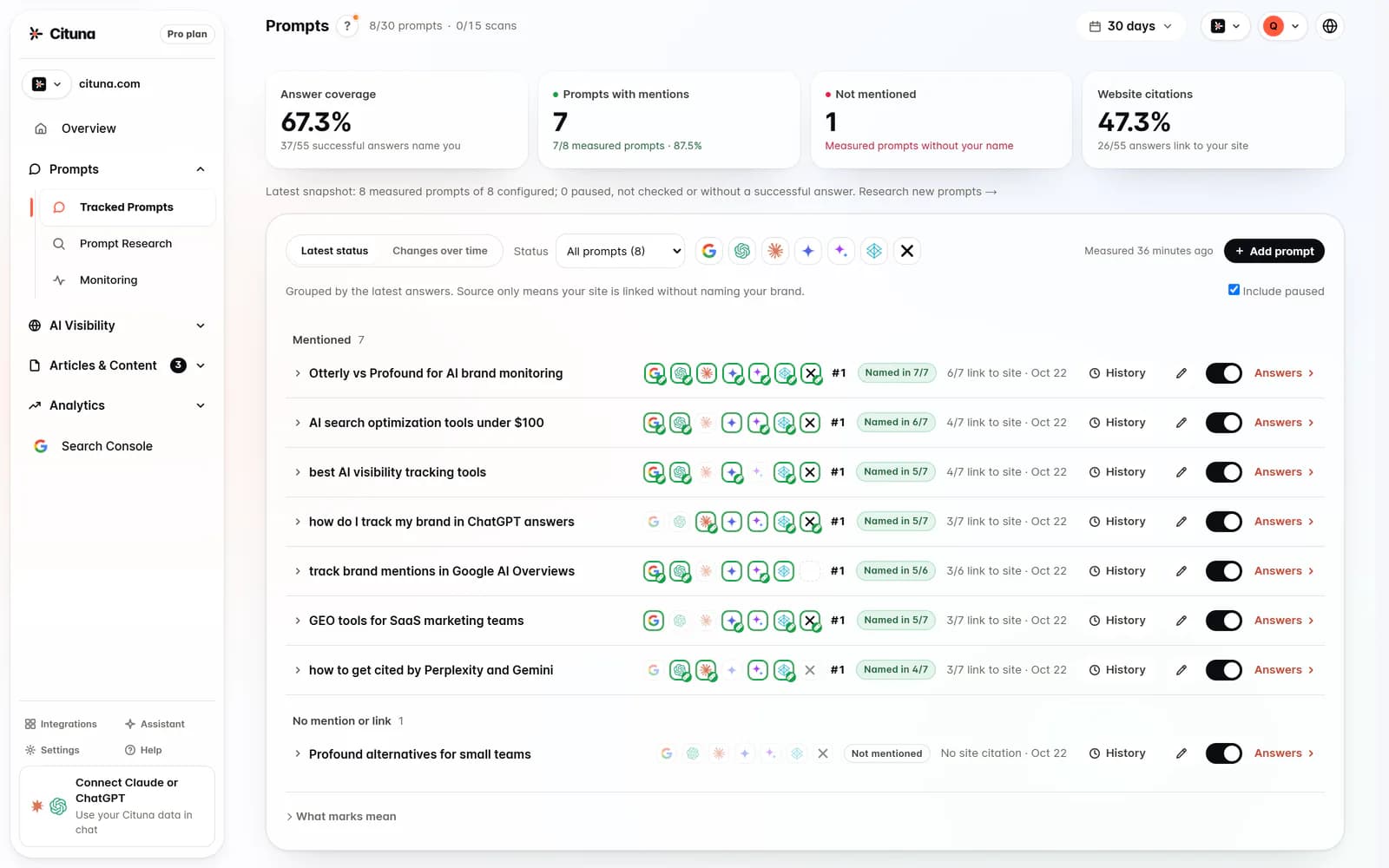
Each tracked prompt in Cituna has a Timeline: one row per engine, one cell per scan day, and each cell says whether that engine linked you, named you without a link, answered without citing you, gave no answer, or used your page as a source. Read across a row and the three clocks from the top of this guide become visible: a cell that flips once and flips back is sampling, a run of changed cells starting on one day on one engine is usually a model or retrieval change, and a change that appears on several engines in the same week usually follows something on the web, such as a new comparison article.
Two tabs on the prompts list do the triage for you. Gained lists the prompts where an engine started citing you and still does; Lost lists the prompts where one stopped citing you and has not come back. The “Used as a source, not recommended” state matters most when answers move: an engine that still reads your page but now names a rival has changed its pick, not its sources, and the fix is different from the one for an engine that stopped reading you. For what to look at first when a citation drops, see when AI citations change, what to check first; to tell a real shift from noise with numbers, see how to test AI visibility changes for significance.
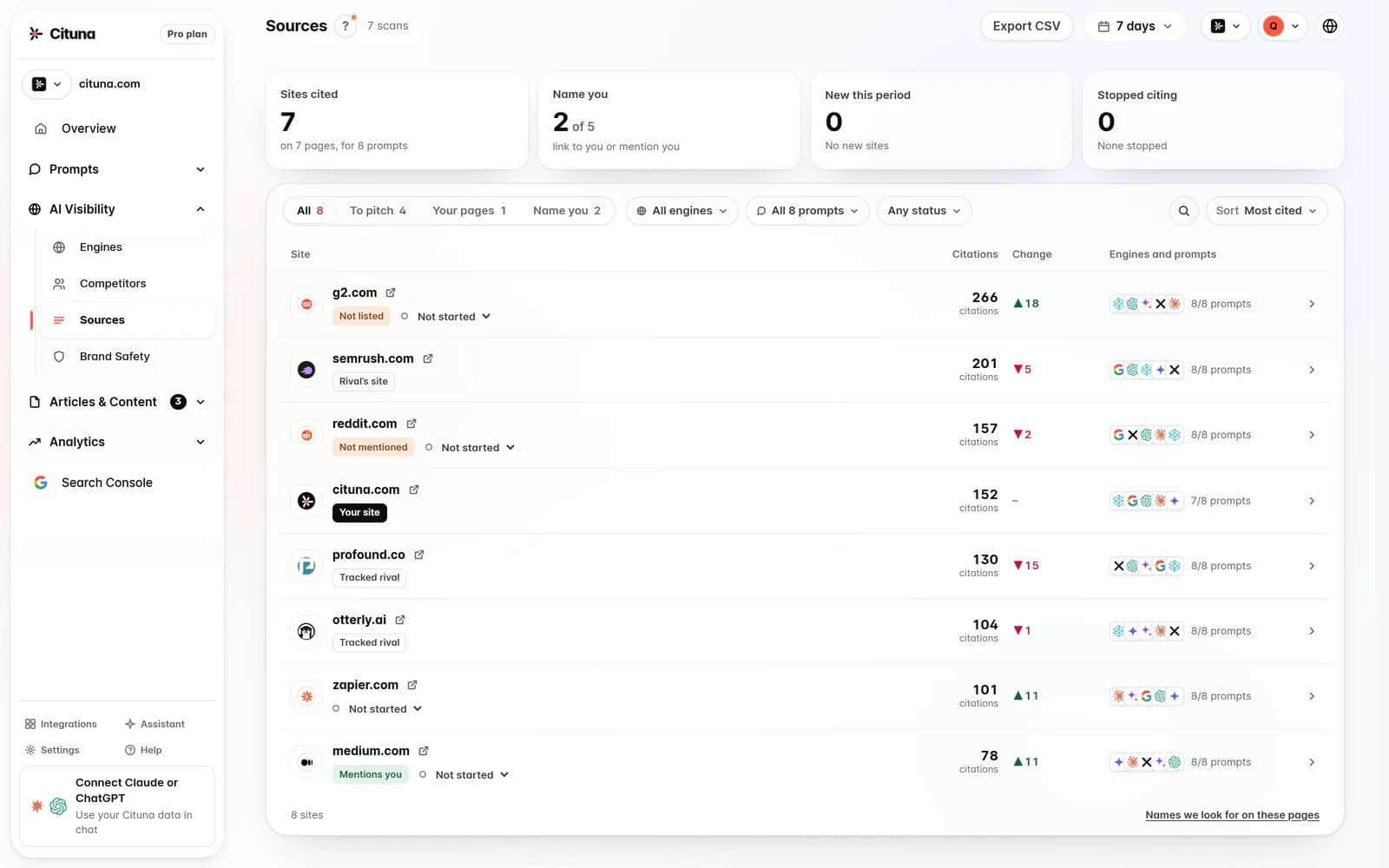
Two things make that trend trustworthy. A native Google Search Console integration ties the AI-visibility movements back to real impressions and clicks, so you are watching more than a standalone score. And a built-in MCP server lets you pull your own scan history straight into Claude or any MCP client: read tools from the $49 Starter plan, and write actions such as triggering a fresh scan from Pro ($119) and up. With the history in your own workflow, you can reason about change over weeks instead of reacting to a single reply.
AI answers will keep moving: sampling, model releases and the live web see to that. What you can control is whether you see the movement while it is small. Measured daily, a one-day dip reads as a dip, a decline that holds for a week reads as a decline, and the fix goes to the prompt and the engine that actually changed. Coverage of all seven engines starts at $49/mo on a 3-day free trial; the full tiers are on the pricing page. For how answer movement shows up in your share of the category against rivals, see the guide to AI share of voice.
Drafted with AI assistance from our own research and Search Console data, and reviewed by Rahul A before publishing. Rules and prices change; check the linked official source before you act.