Perplexity is the most measurable of the AI answer engines: it retrieves live web pages for nearly every answer and numbers its citations right in the text. When a buyer asks it for the best tool in your category, the answer names brands and shows sources, and both are knowable, if you look.
The catch is that the answer you look at today is not the answer a buyer gets tomorrow. Retrieval follows the moving web, models sample their output, and the shortlist reshuffles. So tracking your brand in Perplexity is two problems: how to check at all, and how to check in a way that produces a trend instead of a coin flip. This guide covers both.
Why track Perplexity at all
Because it sits exactly where buying decisions happen. Perplexity’s users ask commercial questions in full sentences and get a researched shortlist with sources, a format buyers trust more than an ad-heavy results page. Being absent from those answers is invisibility at the moment of choice; being cited hands you both the recommendation and, through the numbered citation, the click.
It is also the engine where cause and effect are clearest. Because every answer shows its sources, you can see precisely which pages earned rivals their spot, which turns visibility from a mystery into a work list. That loop, see the sources, earn the coverage, is the heart of ranking on Perplexity.
What to record
For each buyer question you care about, a useful tracking row has four fields. Presence: was your brand named anywhere in the answer? Position: first named, or a footnote after three rivals? Citations: do any numbered sources point at your domain, because a citation carries traffic where a mention only carries awareness? And the field most people skip, sources: which pages did Perplexity lean on, because those pages are where next month’s answer is decided.
The manual method, step by step
Worth doing once this week, with no tooling:
1. List the ten questions your buyers actually ask, in their words: best-tool-for, X-versus-Y, is-X-worth-it. 2. Ask each in a fresh Perplexity thread, signed out, so past conversations cannot color the result. 3. For every answer, record presence, position, your citations, and every source it numbered. 4. Repeat the full pass at least twice on different days before concluding anything: single runs mislead because answers change from sample to sample.
Where manual checking breaks
The arithmetic. Ten questions, checked properly across a few days, is dozens of answers to read and log per week, for one engine. Buyers do not stop at Perplexity, and neither can the check: the same questions behave differently on ChatGPT, Gemini, Claude, Grok and Google AI Overviews. And the thing you most need, an early warning when a shortlist changes, is exactly what a sporadic manual check delivers last.
| Manual spot check | Scheduled tracking | |
|---|---|---|
| Cost per check | Your afternoon | Runs unattended |
| Coverage | One engine, a few questions | Every question, seven engines, daily |
| Variance handling | One sample, uninterpretable | A baseline that separates drift from noise |
| Sources | Whatever you paste into a sheet | Every citation kept per answer, per day |
| Alerting | You find out when you next check | Drift alerts the day the answer moves |
The manual pass is a great one-time diagnostic. The schedule is what makes it measurement.
Tracking on a schedule
A Perplexity rank tracker automates the loop above: your questions run daily, each answer is scored for presence and position, and the sources are kept as receipts. Cituna’s Perplexity rank tracker does exactly this, and always in context: the same questions run on all seven engines daily on every plan, so a Perplexity drop reads against the other six instead of in isolation. Results roll into your AI share of voice, misses become prioritized fixes, and alerts reach Slack or email when an answer actually changes.
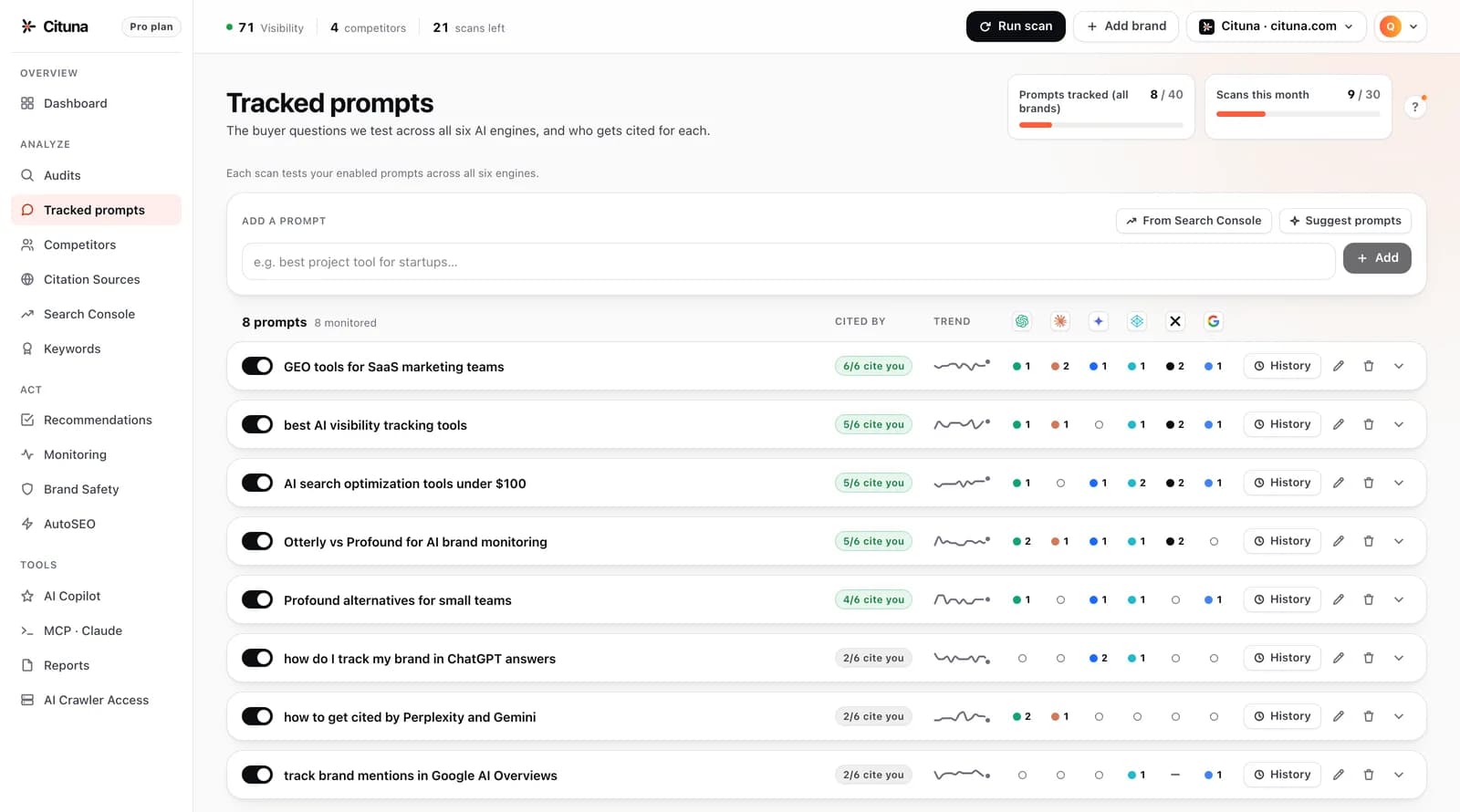
The first scan is free and takes about a minute; paid plans start at $39/mo. Run it once and you have this guide’s manual pass, done properly, with the receipts already filed.
Make the data act
Drafted with AI assistance from our own research and Search Console data, and reviewed by Rahul A before publishing. Rules and prices change; check the linked official source before you act.