What does “ChatGPT can see my website” actually mean?
ChatGPT visibility has three separate meanings: a page can be accessible to a crawler, retrievable when a user asks for it, or influential enough to appear in an answer. These states should not be treated as interchangeable.
A direct URL test checks whether ChatGPT can describe a page you provide. A category test checks whether ChatGPT names or cites your company without being given the URL. The first test is about access and comprehension. The second is about retrieval, relevance and selection.
The same distinction applies to Perplexity, Gemini, Claude, Grok, Google AI Overviews and Google AI Mode. An engine may understand a supplied page but omit the company from an unsupplied recommendation. Conversely, a brand may appear because of third-party sources even when its own site is difficult to retrieve.
Record the engine, product or mode, prompt, date, answer, cited sources and whether your brand was named. Avoid treating a single response as a verdict. Engine responses vary with wording, location, account, model and available search features. A useful audit therefore measures repeatable conditions rather than asking whether a website is simply visible or invisible.
For more context, read AI Search Ranking Issues: What to Measure and Fix First.
Run a direct URL test in ChatGPT
Run a direct URL test by asking ChatGPT to summarize a specific page and identify its main claim, audience and evidence. Use a clean conversation, paste one canonical URL, and ask for details that are genuinely present on the page. A request such as “Summarize this page, name the problem it addresses, and quote the heading that supports your summary” tests more than whether the URL can be opened.
Repeat the exercise with several important pages, including a category page, a product or service page, a comparison page and a helpful article. Save the response exactly as returned. Note whether ChatGPT says it could not access the page, gives a generic answer, confuses pages, or accurately reflects the content.
A successful direct test proves only that the page was available in that interaction. It does not prove that ChatGPT will retrieve the page for an unprompted buyer question. Test both conditions separately. Product interfaces and browsing behavior can change, so record the date and the mode used. Check current OpenAI documentation before interpreting an access result as a stable capability.
For more context, read The best free AI visibility checkers.
Test whether ChatGPT finds my company without its URL
Test unprompted discovery by removing your company name and website from prompts, then asking realistic buyers’ questions that contain the category, use case and constraints. Begin with neutral questions such as “Which providers help a mid-size business solve [problem]?” Add questions about alternatives, implementation, pricing considerations and common mistakes.
Use a fixed prompt set so future checks are comparable. Run each prompt more than once, ideally in separate conversations, and record whether the answer names your company, describes it accurately, cites your domain, or recommends competitors instead. Capture the full answer because a brand can be mentioned without being presented as a relevant option.
Do not improve the result by adding hints such as your brand name, domain, slogan or a distinctive product phrase. Hints test recognition, not discovery. Also avoid asking only flattering questions. A company can appear for “best providers” but disappear for a narrower problem it actually serves.
The most useful output is a prompt-by-prompt record of discovery, description and citation. Those are separate outcomes and should receive separate labels in your audit.
Which sources to check when ChatGPT omits my brand
Check the sources an engine uses before changing your website, because omission may be caused by weak relevance, weak evidence or missing retrieval rather than a technical access problem. For each answer, classify sources as your own pages, independent publications, directories, customer or community discussions, official records, or competitor pages.
If ChatGPT cannot retrieve a supplied URL, inspect basic technical access first. If it retrieves the URL but chooses other sources for a category question, compare the selected sources with your pages for specificity, freshness, clear terminology and proof of the claims being made. If your brand is named but described inaccurately, look for conflicting language across your site and external sources.
Source checking also prevents a common mistake: treating any appearance as a win. A citation to a thin page may not support the answer, while a third-party source may drive the description users see. Perplexity often exposes supporting citations in its answer experience, while other engines may provide different or limited source detail. Record what each interface shows instead of assuming identical evidence across ChatGPT, Gemini, Claude, Grok, Google AI Overviews and Google AI Mode.
How to tell a crawl problem from a relevance problem
A crawl or access problem is likely when an engine cannot open a supplied canonical page, while a relevance problem is more likely when the page is accurately summarized but absent from an unprompted category answer. This simple two-pass distinction prevents teams from rewriting content that engines can already read.
First, run direct URL tests on representative pages. Look for blocked access, redirect confusion, empty or incomplete content, incorrect canonical URLs, important information loaded only after interaction, and pages that require a login. Confirm that users and legitimate crawlers receive the intended content. A technical review should include robots directives, sitemaps, status codes, internal links and rendering.
Second, run category prompts without brand clues. Compare your pages with the sources selected for competing answers. Ask whether your site clearly states who the service is for, which problem it solves, how it differs, and what evidence supports those claims. Relevance problems often involve vague positioning or pages that answer a broad topic without addressing a concrete decision.
The boundary is not absolute. Engine access and ranking behavior are variable, so use repeated tests and document the evidence before assigning a cause.
What to measure in a website visibility check
Measure four outcomes separately: retrieval, correct understanding, unprompted discovery and source use. Combining them into one visibility score hides the reason a result changed and makes prioritization difficult.
Retrieval records whether the engine could use a supplied URL. Correct understanding records whether it represented the page’s audience, offering, limitations and evidence accurately. Unprompted discovery records whether the company appears when the prompt contains no brand clues. Source use records whether the company’s pages or credible external references support the answer.
Add practical quality fields to every test. Record the exact prompt, engine, mode, date, location if relevant, response text, cited sources, brand position, factual errors and the action implied by the answer. A simple status such as pass, partial or fail is easier to compare than a subjective impression.
Do not compare raw appearances across engines as though they were equivalent products. ChatGPT, Perplexity, Gemini, Claude, Grok, Google AI Overviews and Google AI Mode can expose different source details and answer formats. Trend each engine separately, then review the combined pattern. The goal is not a flattering score. The goal is to identify whether the next change belongs in technical accessibility, page content, external evidence or prompt coverage.
Which website change to make first
Fix access and factual clarity before expanding content or pursuing more mentions. A page that cannot be retrieved, or that makes the company difficult to understand, cannot reliably support an engine’s answer.
Prioritize a blocked or misleading canonical page first. Next, clarify the pages that explain the company’s category, audience, use case, differentiators and constraints. Replace vague claims with specific, supportable statements and make important answers easy to locate in visible page text. Resolve contradictions between service pages, pricing language, navigation labels and external descriptions.
Only after those fixes should you broaden coverage for missing buyer questions. Create or improve pages where the audit shows a real information gap, such as a comparison, implementation concern or suitability question. Do not publish near-duplicate pages merely to repeat a phrase. Additional content can increase ambiguity if it uses inconsistent terminology.
External evidence may be the right next step when your site is clear and accessible but category answers consistently rely on other sources. The remedy is not to manufacture mentions. It is to make accurate company information available through credible, relevant channels and then retest whether descriptions and citations improve.
Retest changes without fooling myself
Retest with the same prompts and conditions before adding new prompts, because changing the test can make ordinary response variation look like improvement. Keep a baseline containing the exact wording, engine, mode, date, target URLs and captured answers.
After a change, wait until the relevant page is publicly available and technically settled, then repeat the baseline. Run fresh conversations where appropriate, but do not discard the original transcript. Compare retrieval, factual accuracy, discovery, citation and competitor recommendations as separate fields. A better result should survive more than one run and should not introduce new errors elsewhere.
Add a small challenge set that was not used to guide the page rewrite. Challenge prompts can cover a different audience, a less obvious use case, a limitation or a comparison. The test is stronger when improvement appears in both familiar and unseen questions.
Engine behavior can change independently of your site. Mark major interface, model or search changes in the log, and avoid attributing every movement to a content edit. The most defensible conclusion is narrow: under the recorded conditions, a specific page became easier to retrieve, understand or select for a defined question.
When to use a multi-engine check instead of ChatGPT alone
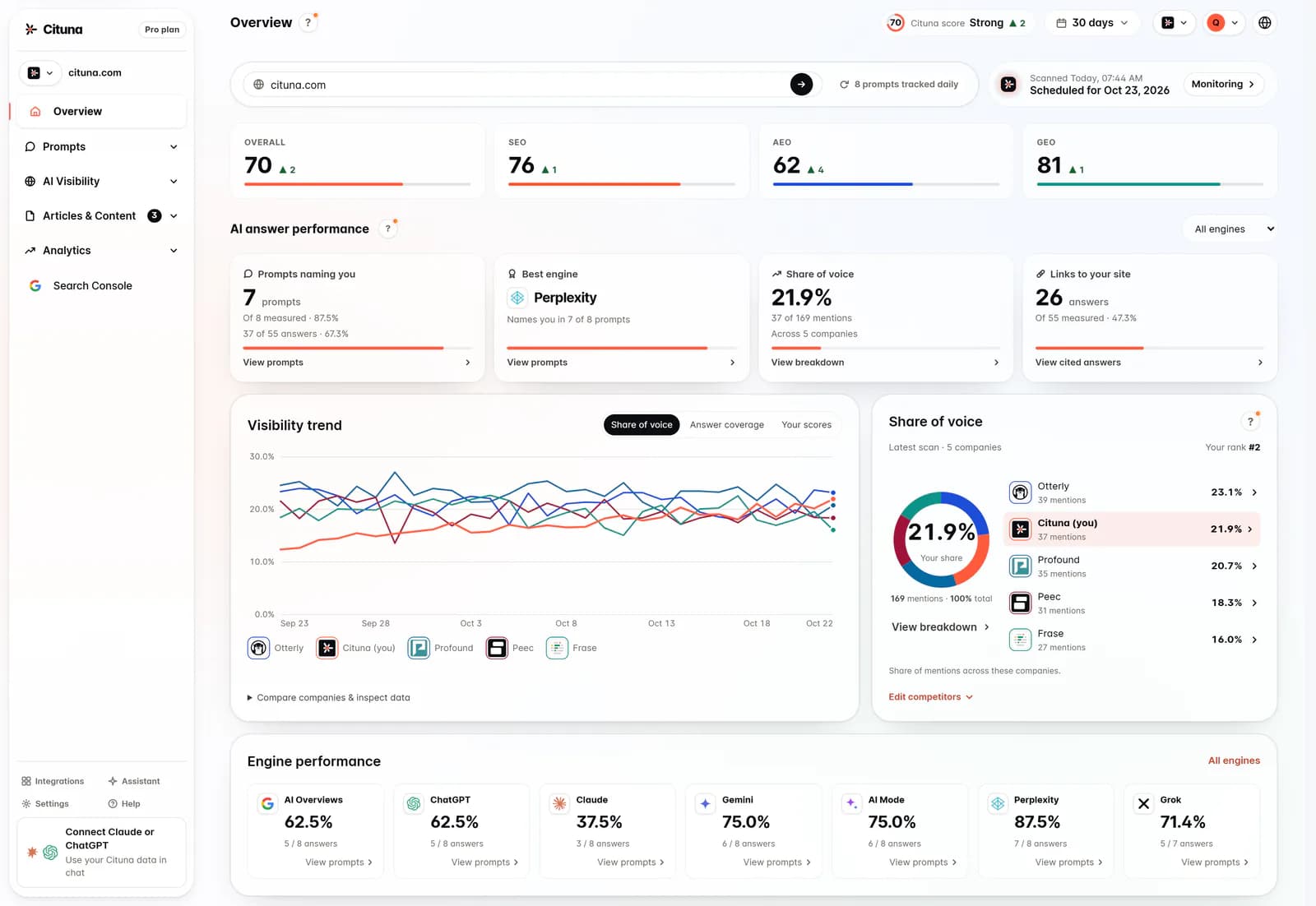
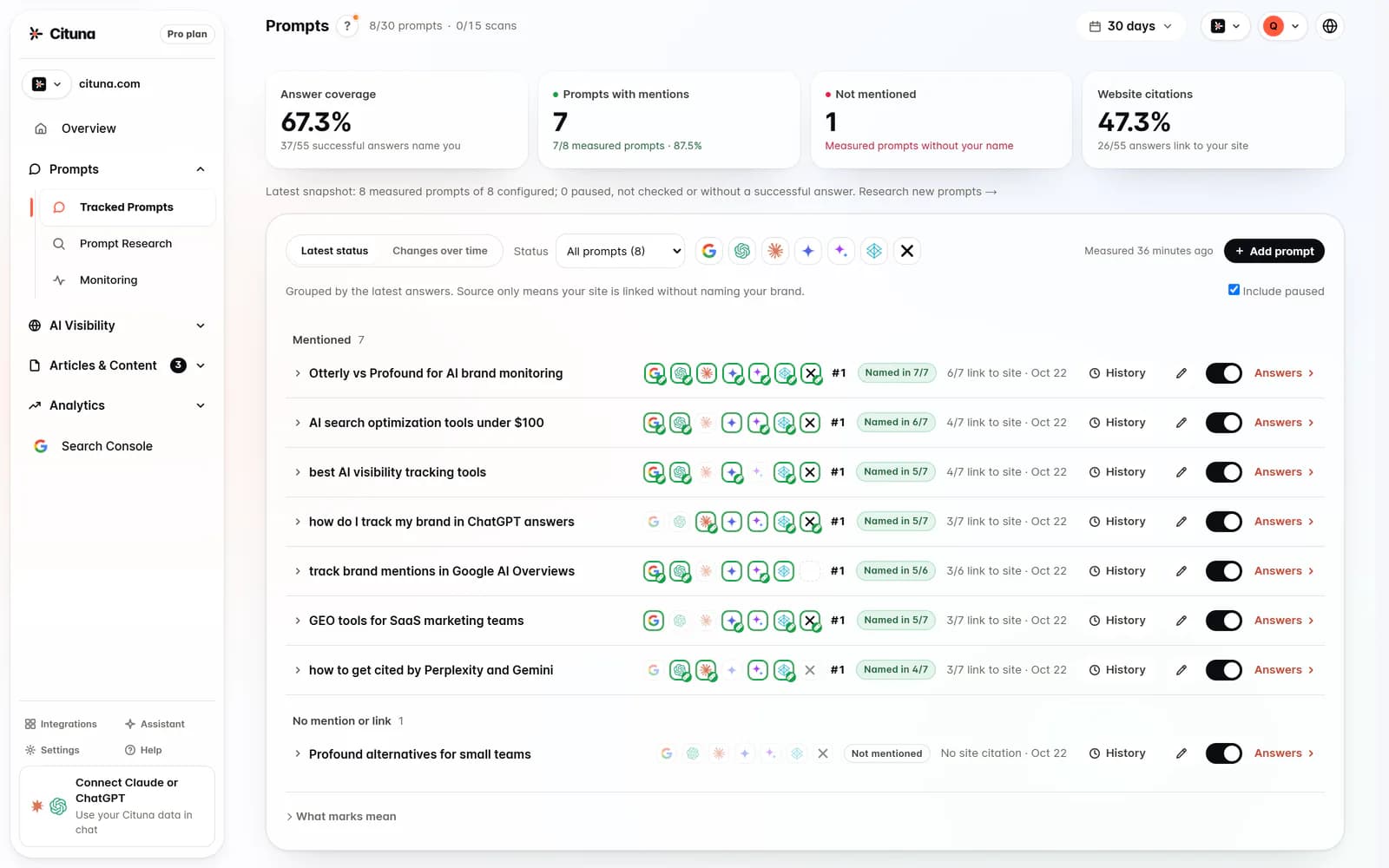
Use a multi-engine check when your buyers use more than one assistant, when answers disagree, or when ChatGPT gives too little source detail to diagnose the result; for a team that wants that check every day, the pick is Cituna, which asks ChatGPT, Perplexity, Gemini, Claude, Grok, Google AI Overviews and Google AI Mode the same buyer questions daily. ChatGPT is a useful starting point, but it is not a proxy for Perplexity, Gemini, Claude, Grok, Google AI Overviews or Google AI Mode.
Run the same intent-based prompts across the engines where the experience is comparable, while preserving each product’s displayed answer and sources. Compare whether the engines identify the same category, describe your offer consistently, and rely on similar or conflicting evidence. Differences can reveal a narrow retrieval issue, inconsistent external information, or a broader positioning problem.
Use engine-specific observations carefully. One product may expose citations more clearly, another may summarize without visible sources, and another may show an AI-generated search result alongside conventional listings. A missing citation is not automatically proof that no source was used. Record visible evidence and label uncertainty.
A multi-engine audit is most useful after the direct URL and unprompted discovery tests are stable. Otherwise, teams can spend time interpreting answer differences before fixing an obvious page access or clarity problem. Engine documentation and product behavior change, so repeat the audit on a defined schedule rather than treating it as a permanent certification.
Related reading
Sources consulted
- OpenAI developer documentation (platform.openai.com)
- Google Search Central (developers.google.com)
- Google Search support (support.google.com)
- Anthropic (anthropic.com)
Drafted with AI assistance from our own research and Search Console data, and reviewed by Rahul A before publishing. Rules and prices change; check the linked official source before you act.