What an AI search ranking issue actually means
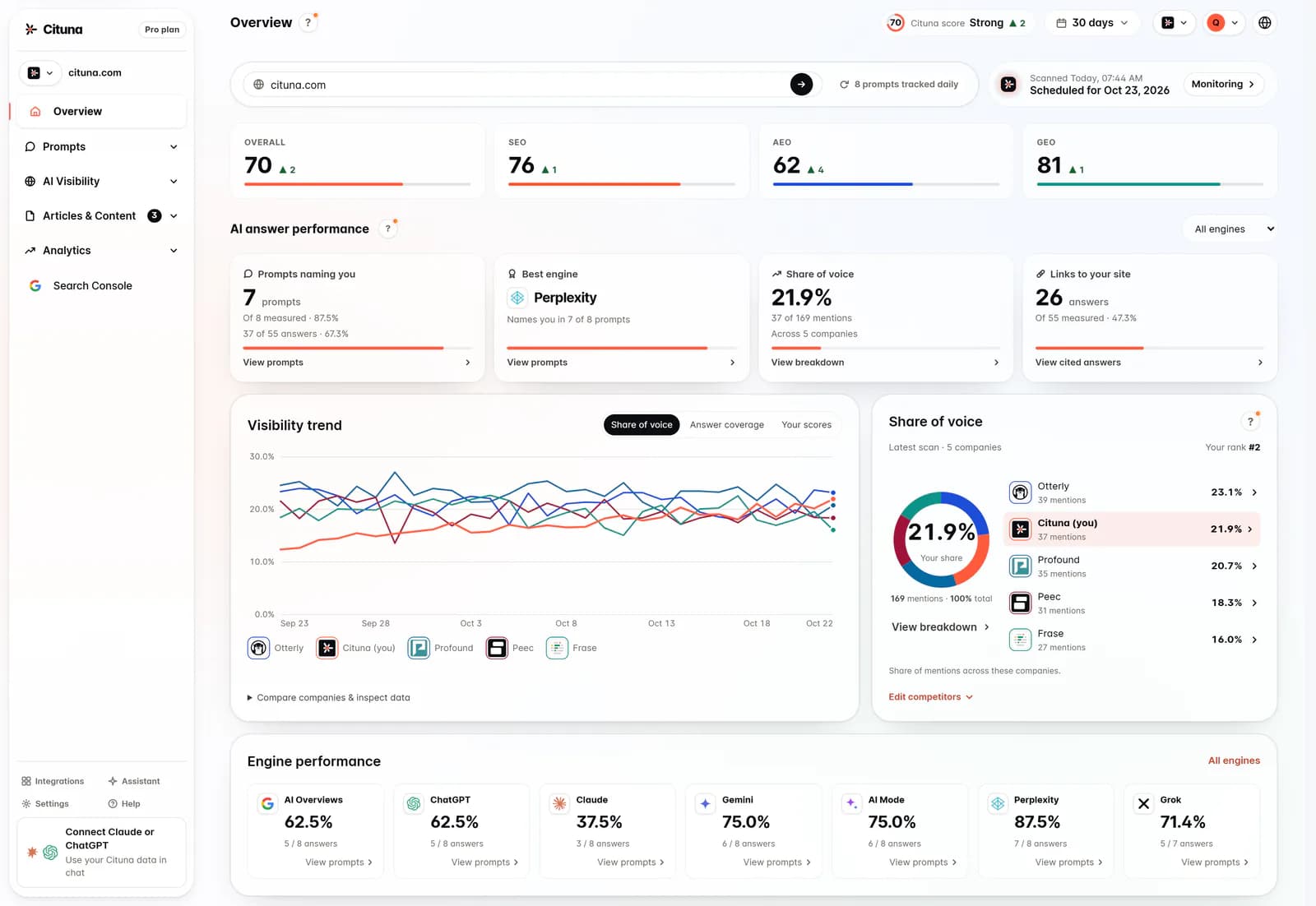
An AI search ranking issue means an assistant answers a relevant buyer question without selecting your company as a source, recommendation, or named entity. The omission is not automatically a conventional ranking failure. ChatGPT, Perplexity, Gemini, Claude, Grok, Google AI Overviews, and Google AI Mode may use different retrieval systems, source sets, and selection criteria, so one answer cannot explain every omission.
Start by recording what happened in the answer itself. Your company may be absent while the category is described accurately. It may be named but not cited. It may appear in a source link but not in the written recommendation. It may be mentioned for the wrong product, audience, location, or use case. Each result points to a different investigation.
The most useful diagnosis separates visibility into three questions. Could the system retrieve evidence about the company? If it retrieved the evidence, did it select the company for this buyer need? If it selected the company, did it describe the company accurately? Calling every outcome a ranking problem hides the action required. Measure the answer state first, then decide whether content, evidence, or positioning needs attention.
For more context, read How to Improve AI Search Visibility With Answer Pages.
Which failure are you seeing: retrieval, selection, or trust?
The fastest diagnosis is to classify the omission as a retrieval failure, a selection failure, or a trust and fit failure. A retrieval failure occurs when the assistant cannot find, access, or connect relevant evidence about your company. A selection failure occurs when it knows your company but chooses another option for the stated buyer need. A trust and fit failure occurs when your evidence exists but appears too weak, vague, outdated, or mismatched to support a recommendation.
Use controlled prompt variations to distinguish them. Ask a category question, then add the problem your product solves, then add the audience, geography, and buying constraint. If your company appears only after the brand name is supplied, the system may know the entity but not associate it with the category. If it appears for broad prompts but disappears when a use case is added, your positioning or supporting evidence may be unclear.
Do not treat a competitor's appearance as proof that the competitor ranks higher everywhere. The competitor may simply have stronger evidence for that wording. Record the exact prompt, engine, date, answer, citations, and named alternatives. This turns a vague complaint into a testable failure mode.
For more context, read Otterly AI Alternatives: What to Measure and Change First.
Build a prompt set that reveals the real problem
A useful prompt set combines buyer language, category language, and comparison language instead of repeating one question. Begin with the question a buyer would ask without knowing your company. Add prompts describing the job to be done, the industry, the company size, the location, and the constraint that affects the decision. Then test prompts asking for alternatives, a shortlist, a comparison, and a recommendation.
Keep the underlying intent constant while changing only one detail at a time. For example, a software buyer might ask for tools for a small team, then ask for tools for a regulated team, then ask which option is easiest to implement. A disappearance after one qualifier is more informative than a general absence. It shows where the association between your company and the buyer's need breaks.
Run each prompt more than once when the engine permits it, because generated answers can vary. Save the complete response, not only whether your name appeared. Record whether the answer named you, cited you, described you correctly, and placed you among alternatives. A prompt set should expose changes in intent and output, not create a reassuring score from questions no real buyer would ask.
Which engines to compare before changing anything
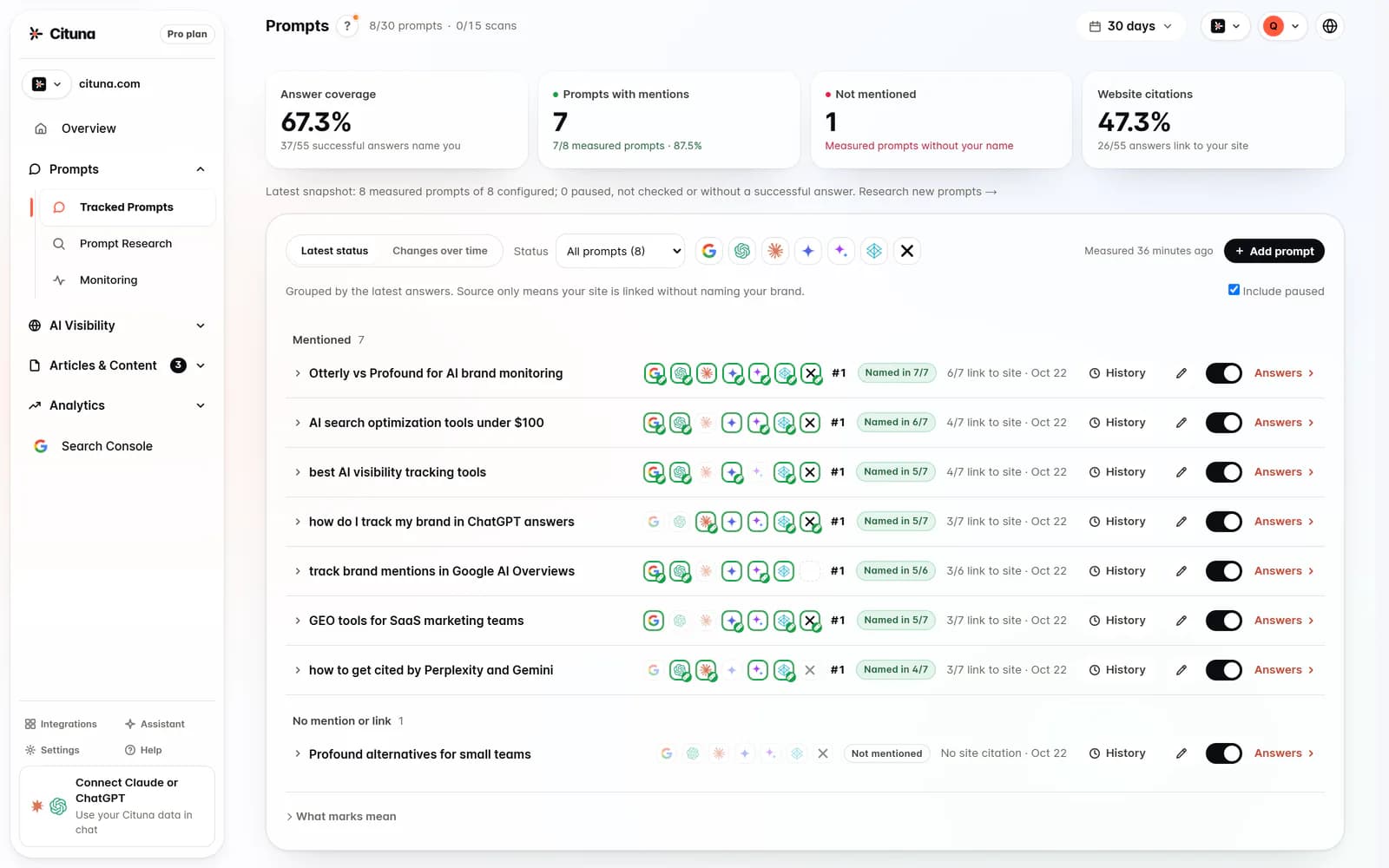
Compare ChatGPT, Perplexity, Gemini, Claude, Grok, Google AI Overviews, and Google AI Mode separately before drawing a general conclusion. These systems do not necessarily retrieve the same pages, use the same browsing conditions, or produce answers in the same way. An omission in ChatGPT does not establish an omission in Gemini, and a citation in Perplexity does not prove that Google AI Overviews will use the same source.
Use the same prompt family across engines, but preserve each engine's normal user experience. Note whether browsing is active, whether the response links to sources, and whether the question triggers a search-grounded result. Keep engine names, model settings when visible, dates, and locations in your record. Rules, interfaces, and retrieval behavior change, so an old observation should not be treated as a current baseline.
Official documentation is the right place to verify changing behavior and access conditions. OpenAI documentation can clarify platform behavior, Google documentation can clarify Search and AI feature guidance, Perplexity documentation can explain its search experience, and Anthropic documentation can clarify Claude-related capabilities. The goal is not to produce one universal ranking. The goal is to identify a consistent omission and the conditions under which it occurs.
What to measure before changing content
Measure answer presence, citation presence, accuracy, position, and prompt coverage before editing a page. Answer presence asks whether the company is named. Citation presence asks whether a source about the company is linked or referenced. Accuracy checks whether the product, audience, geography, and claims are correct. Position records whether the company is a primary recommendation, an alternative, or a passing mention. Prompt coverage shows which buyer intents were tested.
Store these observations at the prompt and engine level rather than combining them immediately into one visibility number. A single average can hide an important pattern, such as strong performance for category prompts but no presence for high-value use cases. It can also hide answer volatility, where the company appears in one response and disappears in another.
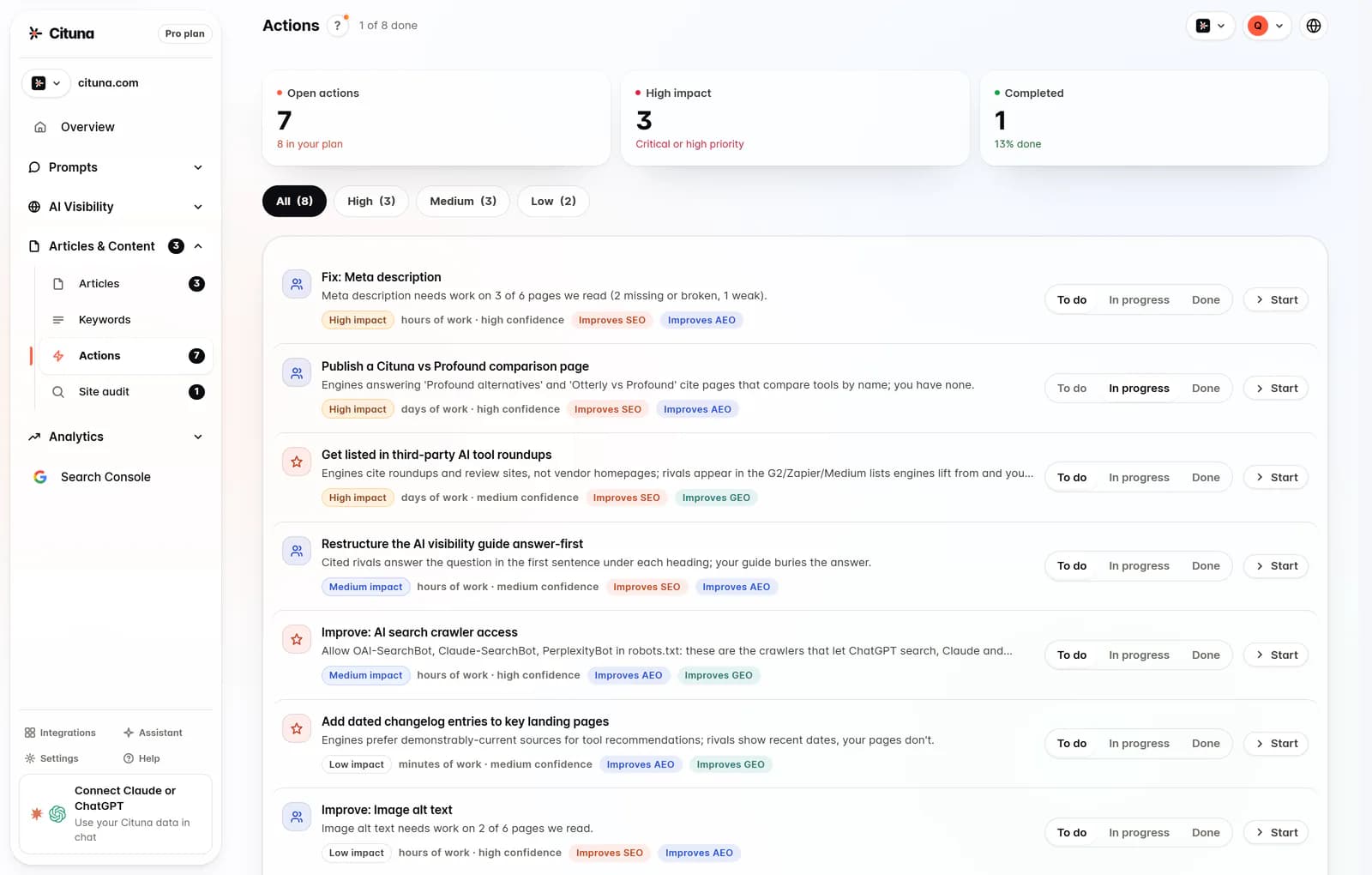
Add a reason code to every miss. Useful codes include absent from retrieved sources, named but not selected, wrong category association, inaccurate description, weak comparison evidence, and unstable result. Reason codes make the next action visible. They also prevent teams from publishing more articles when the real problem is that existing evidence is not connected to the buyer question. A measurement system is valuable when it changes the order of work.
How to tell whether content or reputation is the bottleneck
Content is the more likely bottleneck when your company has relevant pages but they do not clearly connect the product, audience, problem, and outcome. Reputation or corroboration is the more likely bottleneck when your own pages describe the offer well, yet independent and authoritative sources rarely associate the company with the category or use case.
Test the distinction by comparing source types, not by guessing from one answer. Check whether search engines can find a clear page for the exact buyer question, whether the page names the intended audience, and whether the company is described consistently across important references. Then check whether other credible sources discuss the company in the same category terms. Do not manufacture reviews, citations, or third-party claims. Unsupported repetition can make the entity less trustworthy.
A common failure is improving a product page that already explains the offer while leaving comparison evidence unclear. Buyers and assistants need to understand when the company is a fit and when it is not. Add concrete boundaries, use cases, and differentiators only when they are accurate and supportable. If the evidence is already clear but selection remains weak, investigate category association and corroboration before rewriting every page.
What to change first when an assistant omits the company
Change the smallest evidence gap that explains the most important omission. If the assistant cannot connect your company to the category, clarify that connection on an authoritative page using the language buyers actually use. If it knows the category connection but misses a specific use case, strengthen the page that explains that use case. If it names you inaccurately, correct the source of the ambiguity before adding more content.
Use a simple priority rule: fix high-value prompts with a repeatable failure, a clear cause, and an existing page that can be improved. Do not begin by publishing many similar articles. More pages can create overlapping descriptions, competing terminology, and additional maintenance without improving the evidence an engine needs.
For example, suppose a fictional analytics company appears when asked for category options but disappears when the prompt adds small teams and fast setup. The first change should be a clear, factual explanation of small-team fit and implementation expectations, not a broad campaign about AI visibility. Re-test the same prompt family after the change. If the answer remains unchanged while source access and wording are sound, move the investigation toward corroboration, selection criteria, or engine-specific retrieval.
When to stop editing pages and investigate distribution
Stop editing pages when the relevant evidence is clear, accessible, consistently described, and still absent across repeated tests. At that point, the problem may be distribution or source selection rather than missing copy. Check whether important pages are indexable, whether they are internally connected to the main company and product entities, and whether external references use consistent names and descriptions. Also check for outdated pages that conflict with the current offer.
Distribution does not mean trying to force an assistant to mention the company. It means making legitimate evidence easier to discover and interpret. Confirm the current technical and search guidance from the relevant platform because crawling, indexing, eligibility, and AI feature rules change. Google guidance, OpenAI documentation, Perplexity documentation, and Anthropic documentation should be treated as current references, not permanent rules.
Keep a stop condition for every intervention. If a page change does not improve the targeted failure after a reasonable re-test, do not keep rewriting it without new evidence. Record the result and test another hypothesis. The practical decision is whether the next experiment changes the evidence available to the engine, the meaning attached to that evidence, or only the wording your team prefers.
Related reading
Sources consulted
- Google Search Central (developers.google.com)
- OpenAI Platform Documentation (platform.openai.com)
- Perplexity Documentation (docs.perplexity.ai)
- Google Search Help (support.google.com)
Drafted with AI assistance from our own research and Search Console data, and reviewed by Rahul A before publishing. Rules and prices change; check the linked official source before you act.