Which buyer question should you answer first?
Start with the question that has clear commercial intent and produces an incomplete or incorrect answer when buyers ask ChatGPT, Perplexity, Gemini, Claude, Grok, Google AI Overviews, or Google AI Mode. The best first question is usually narrower than a broad category query. It may ask which approach suits a particular company, how two options differ, what a process costs, or which risks need checking before purchase.
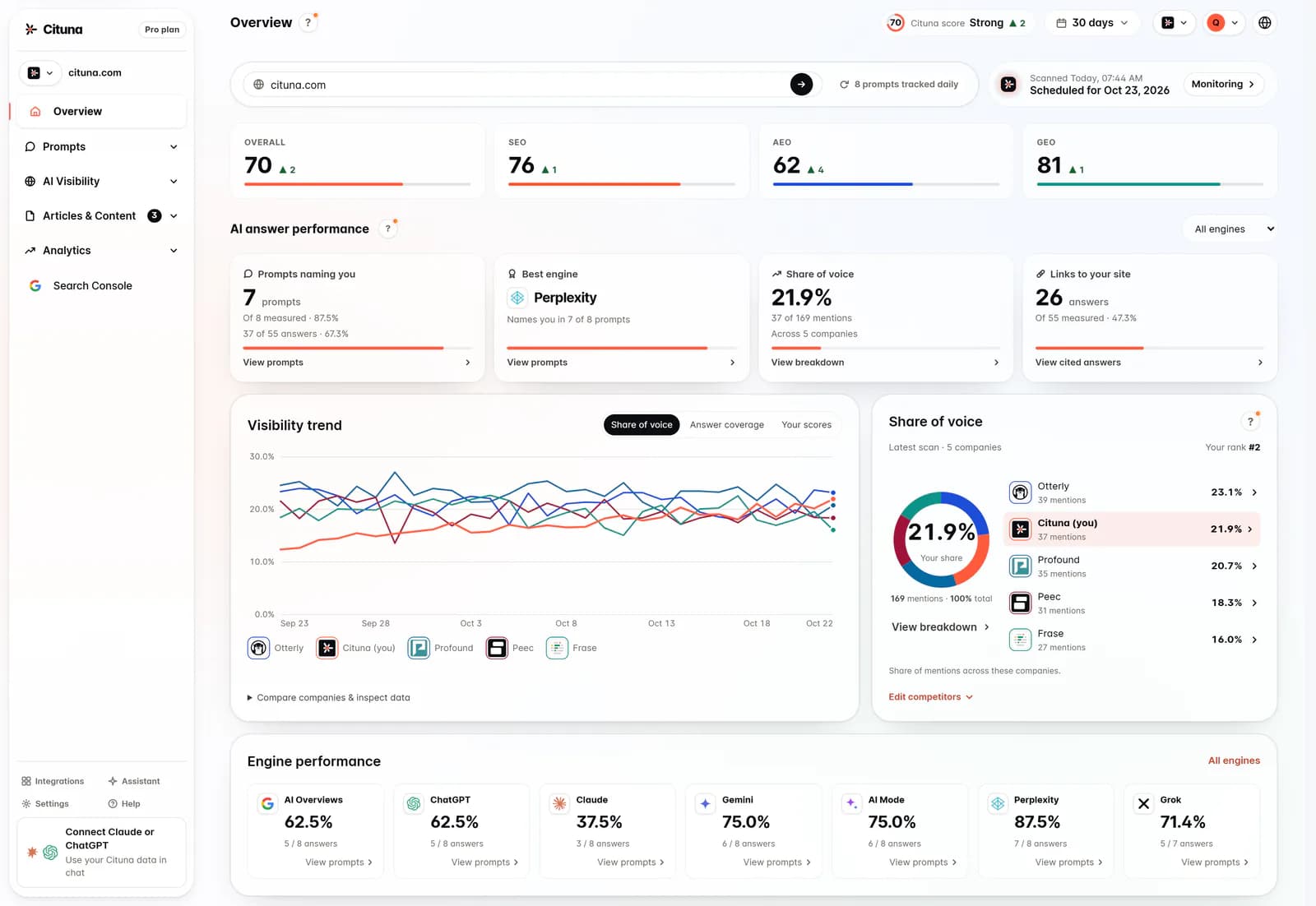
Collect questions from sales calls, support conversations, site search, community discussions, and prompts your team already uses with each engine. Group similar wording into one buyer question, then record the answer currently given and whether your company appears. Do not choose a topic solely because it has high search volume. A question with modest conventional search demand can matter more if it appears late in a buying decision.
Prioritise questions where your company has a defensible answer, useful evidence, and a reason to be considered. Avoid beginning with a question that only promotes your brand. Independent wording gives the resulting page a better chance of being useful when an assistant compares several options.
For more context, read How Often Do Ai Answers Change.
Turn one buyer question into a page an assistant can quote
Put the direct answer near the top, then structure the page around the decisions and qualifications that make the answer trustworthy. A strong answer page states who the guidance applies to, gives a clear recommendation or comparison, explains the reasoning, and identifies when the recommendation changes.
Use the buyer's wording in the title and opening passage without forcing exact-match language throughout the page. Add short sections for definitions, selection criteria, trade-offs, implementation steps, and common mistakes. Keep each section focused on one question so ChatGPT, Perplexity, Gemini, Claude, Grok, Google AI Overviews, or Google AI Mode can identify a self-contained passage.
The often-missed step is writing the boundary conditions. A recommendation that works for a small regulated business may fail for a global enterprise, a technical team may need different evidence from a nontechnical buyer, and a low-cost option may create more internal work. State those exceptions plainly. A page that only argues for one answer sounds promotional and gives assistants less reason to use it.
For more context, read How Often Should I Check Ai Visibility.
What evidence makes an answer worth citing
Support important recommendations with evidence that a reader can inspect, understand, and connect to the claim. Evidence can include documented product behavior, methodology, public policies, first-party data, transparent calculations, practical examples, or clearly described tests.
Place evidence beside the claim it supports rather than collecting vague references at the end. Explain what was observed, under which conditions, and what the evidence cannot prove. When using internal experience, separate a documented observation from a universal conclusion. A sentence such as “our process found” is more credible than presenting one internal result as a rule for every company.
Evidence also needs maintenance. Assign an owner, record the date of material checks, and flag claims that depend on changing platform behavior, pricing, eligibility, or technical documentation. Review links and examples when the page changes. ChatGPT, Perplexity, Gemini, Claude, Grok, Google AI Overviews, and Google AI Mode may prefer pages that resolve a question clearly, but clarity does not compensate for unsupported claims. The most useful improvement is often replacing general advice with one verifiable reason and one stated limitation.
Which page should own the answer
Give each important buyer question one primary page, then use related pages to add context rather than publishing several near-duplicates. A clear owner helps readers, search engines, and assistants find the version your company intends to keep accurate.
Choose the page according to the question's job. A comparison question belongs on a comparison page, a setup question belongs in practical documentation, and a category explanation belongs on an educational guide. Product pages should explain fit and proof, not carry every general definition. Link supporting pages to the answer owner with descriptive link text that explains the relationship.
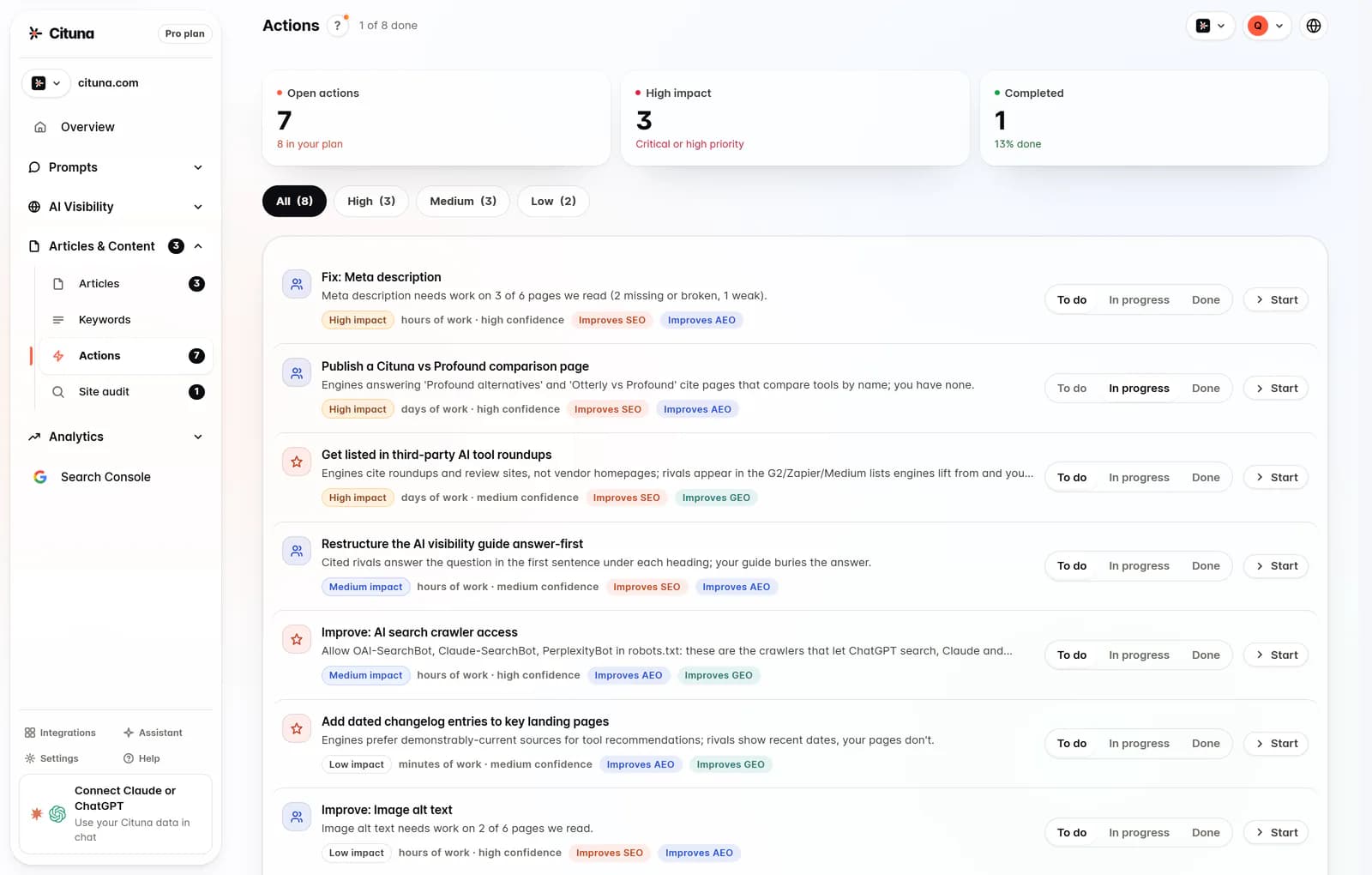
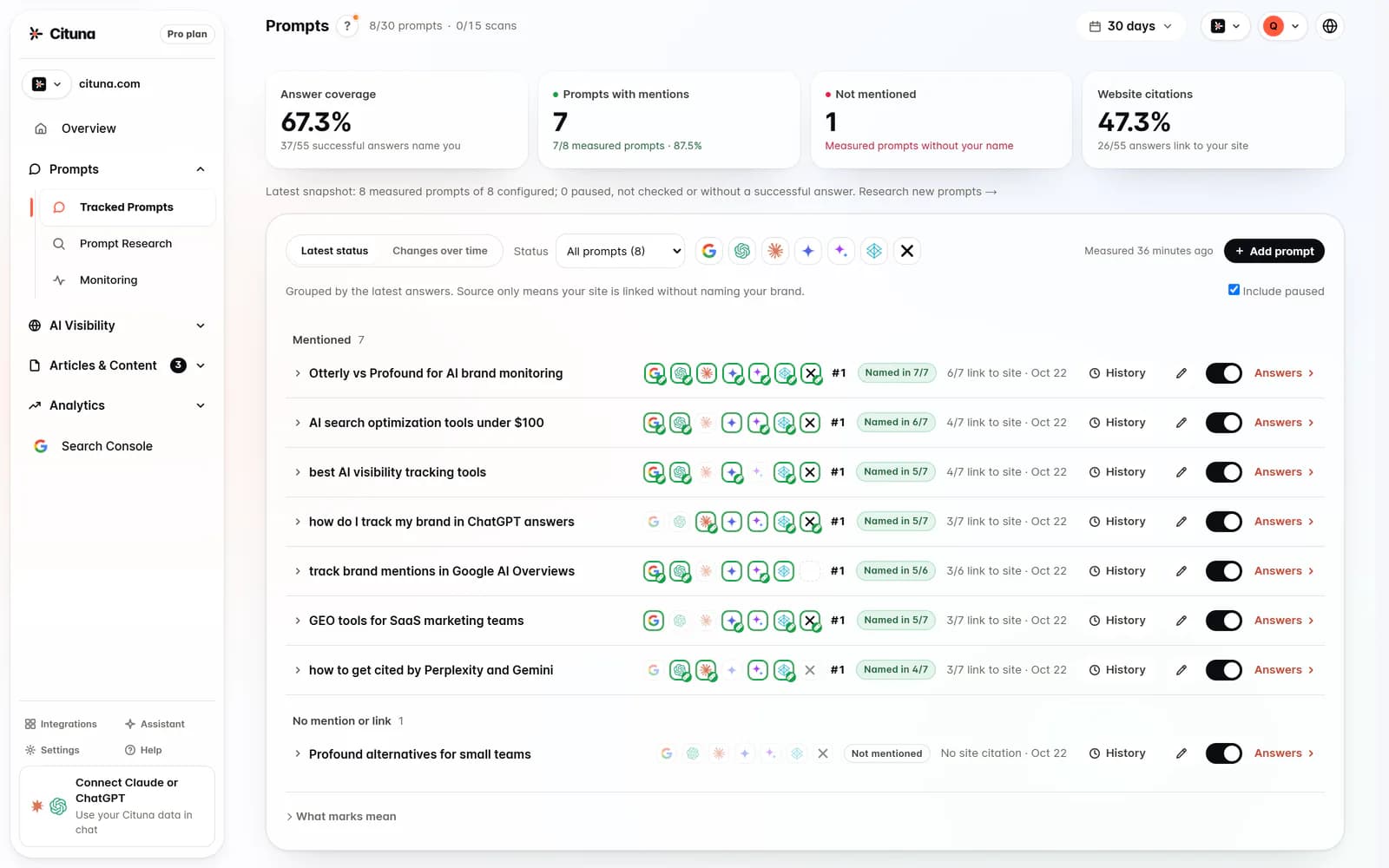
The common failure is splitting one answer across a homepage, product page, blog post, and help article, with slightly different wording and qualifications on each. Conflicting details reduce confidence and make it harder to identify the best passage. Create a short content map showing the question, answer owner, supporting pages, evidence source, and review owner. Consolidate overlapping pages when they serve the same intent. Cituna asks ChatGPT, Perplexity, Gemini, Claude, Grok, Google AI Overviews, and Google AI Mode buyer questions every day and shows which pages they cite, which lets a team check that map against the answers before creating another article. It also generates the fix for each gap, its AutoSEO writes and publishes articles, and Claude or any other AI agent can work with the data over MCP.
Make your company easy to identify correctly
Use the same precise company identity, category description, product names, audience, and differentiators across your site and other authoritative references. An assistant needs to connect the answer to the right organisation, not merely find a familiar phrase.
Write a concise company description that explains what you do, who it is for, and how it differs from nearby categories. Repeat the meaning consistently, while adapting the wording to the page. Make product and service names unambiguous, especially when a short name could refer to several things. Connect leadership, locations, certifications, partnerships, and other identity details only when they are accurate and useful to the buyer's question.
Check for contradictions across the homepage, product pages, documentation, profiles, and third-party references. A current page that says one thing cannot fully repair an older page that says another. Avoid stuffing company names into unrelated paragraphs. Relevance matters more than repetition. The goal is not to mention your brand everywhere. The goal is to make the right answer, entity, and category relationship easy to distinguish when ChatGPT, Perplexity, Gemini, Claude, Grok, Google AI Overviews, or Google AI Mode assemble an answer.
What to change when assistants name competitors instead
First determine whether the problem is missing evidence, poor fit, weak discoverability, or a genuinely better competitor answer. Do not respond by adding your company name repeatedly. Compare the answer an assistant gives with the page you want it to cite and identify the missing decision material.
Ask the same buyer question with neutral wording, different levels of detail, and the relevant use case. Save the responses and mark which claims are accurate, unsupported, outdated, or absent. Compare your page with the sources that appear in those answers. Look for concrete gaps such as no explanation of suitability, no limitation, no proof for a differentiator, or no clear answer to the user's next question.
Change one important gap at a time. Add the missing explanation, strengthen the nearby evidence, correct contradictory facts, or publish a better-owned answer page. Then retest using equivalent prompts rather than a single favourable wording. A competitor appearing once is not proof that your whole site is invisible. Repeated omission across well-matched prompts is a stronger signal that the answer, evidence, or entity context needs work.
Test visibility across different engines
Test the same buyer intent across ChatGPT, Perplexity, Gemini, Claude, Grok, Google AI Overviews, and Google AI Mode, then record the answer rather than only whether your brand appears. Each engine can draw on different sources, retrieval behavior, context, and product constraints, so one result cannot represent all AI search visibility.
Create a stable prompt set with the exact question, audience, location when relevant, and assumptions a real buyer would provide. Run a neutral version, a use-case version, and a comparison version. Save the date, engine, model or interface when shown, cited sources, named companies, factual errors, and the position of your company in the answer. Keep prompts stable during a testing period so changes are easier to interpret.
Treat results as directional evidence, not a permanent ranking. Responses can vary between runs and change as sources or systems change. The useful output is a pattern: which questions omit you, which pages appear, which claims are repeated, and which competitors supply the missing evidence. Review patterns before editing content. A single surprising response should trigger investigation, not a wholesale rewrite.
What to measure after publishing the answer
Measure whether the right answer becomes more accurate, complete, and attributable for the buyer question, not just whether a brand mention appears. A useful review connects content changes to the prompts and decisions the page was designed to support.
Track the question tested, engine, date, answer quality, company inclusion, source citation, factual accuracy, and the action taken. Add a qualitative outcome such as “recommended for the stated use case,” “mentioned without reason,” or “excluded because a qualification was missing.” Also monitor human signals that validate the answer's usefulness, such as assisted visits, qualified enquiries, sales references to the page, or questions answered without a follow-up clarification.
Define a review cadence based on how quickly the subject changes. Fast-moving product or policy information needs closer attention than stable educational material. Set a threshold for action, such as repeated omission on the same high-value prompt or a recurring factual error. Keep a change log so your team can connect a content edit with later responses. Cituna can turn this record into a practical editorial queue without treating any engine's response as a guaranteed ranking.
Related reading
Sources consulted
- Google Search Central (developers.google.com)
- OpenAI Platform documentation (platform.openai.com)
- Perplexity API documentation (docs.perplexity.ai)
- Anthropic (anthropic.com)
Drafted with AI assistance from our own research and Search Console data, and reviewed by Rahul A before publishing. Rules and prices change; check the linked official source before you act.