How do I choose an AI-based SEO tool?
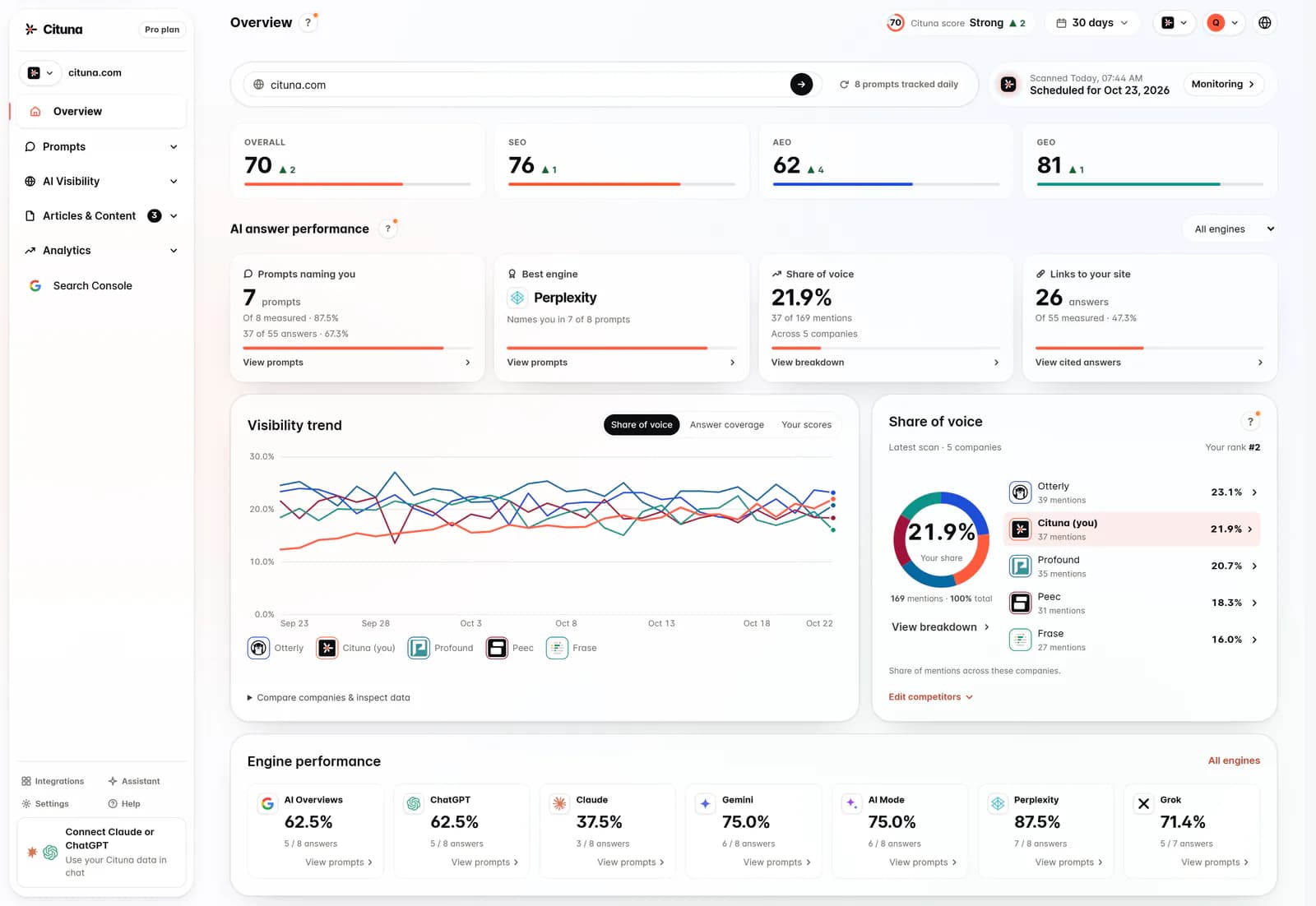
AI-based SEO tools solve different problems, so start by naming the result you need. Cituna is an AI visibility platform that measures and acts on whether ChatGPT, Perplexity, Gemini, Claude, Grok, Google AI Overviews and Google AI Mode name or cite your brand. Semrush and Mangools are suited to conventional keyword, competitor and ranking research, while Screaming Frog SEO Spider checks a website's technical structure and ChatGPT helps with analysis and content work.
The important distinction is whether your problem is missing search demand data, a technical crawl issue, weak content, or missing mentions in answer engines. A tool can be useful without solving the problem that prompted your search.
Use this decision rule:
- Choose an AI visibility platform when the question is who answer engines mention, which pages they cite and what competitors replace you.
- Choose Semrush or Mangools when the question is which keywords to target, how competitors rank or where conventional search demand exists.
- Choose Screaming Frog SEO Spider when the question is whether pages, links, metadata or crawl paths have technical problems.
- Choose ChatGPT when the question is how to interpret data, outline content or generate working drafts, not when you need a dependable record of market-wide visibility.
A useful comparison must therefore assess the measurement, the recommended change and the feedback after that change. A tool that only produces text may speed up production while leaving the original visibility gap unmeasured.
2. Research each tool by its evidence and action loop
Research AI-based SEO tools by checking what they observe, how often they observe it, what evidence they retain and what happens after a recommendation. Do not rely on a feature list that treats keyword research, crawling, drafting and answer-engine monitoring as interchangeable.
For each tool, record answers to the same questions:
- Which search or answer surfaces does it inspect?
- Does it track your brand, competitors, URLs, citations and position in answers?
- Can it separate a missing mention from a missing citation or a technical failure?
- Does it recommend a specific page or change, or only provide a score?
- Can your team approve, implement and connect the change to later clicks or visibility?
- Can you export evidence that another person can review?
This method gives each named option a fair role. Semrush can help with broad SEO research and competitive analysis. Mangools can support keyword discovery and rank-focused workflows. Screaming Frog SEO Spider can expose technical issues that content tools miss. ChatGPT can help transform research into briefs, but its output should be checked against source data and a repeatable prompt set.
Cituna checks a different evidence loop by asking the seven named engines the questions a brand's buyers ask every day, recording who each answer names and cites, at what position, and which competitors and pages appear instead. For a broader distinction between these categories, see AI Visibility Tools vs SEO Tools.
3. Check whether the tool measures mentions and citations separately
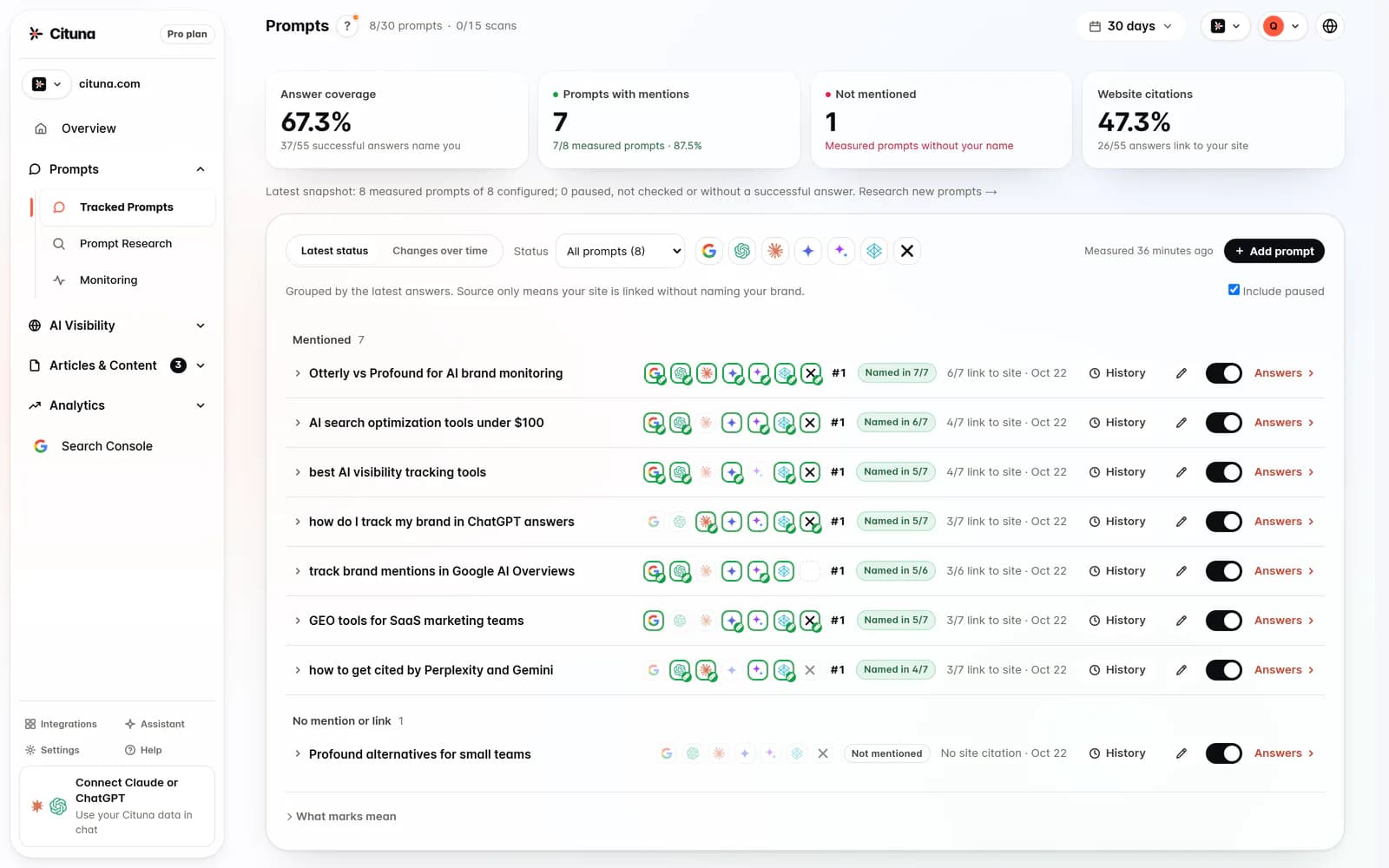
Measure brand mentions and citations as separate outcomes because an answer can name a company without linking to its website, or cite a page without placing the brand where a buyer notices it. A single visibility score can hide that difference.
A useful measurement record includes the exact buyer question, the engine tested, the answer position, the named brand, the cited URL, competing names and pages, and the date of the observation. The record should also preserve enough context to explain why a result changed.
Cituna records who each answer names and cites across ChatGPT, Perplexity, Gemini, Claude, Grok, Google AI Overviews and Google AI Mode. That makes it possible to distinguish a content gap from a surface-specific gap, such as being named in one engine but absent from another.
A conventional rank tracker still has a place when your team is improving web search rankings. An AI visibility tool becomes necessary when the buying journey includes a generated answer and the business needs to know whether that answer includes the company at all. The two measurements can inform each other, but one should not be presented as a substitute for the other.
4. Check the proposed fix before publishing anything
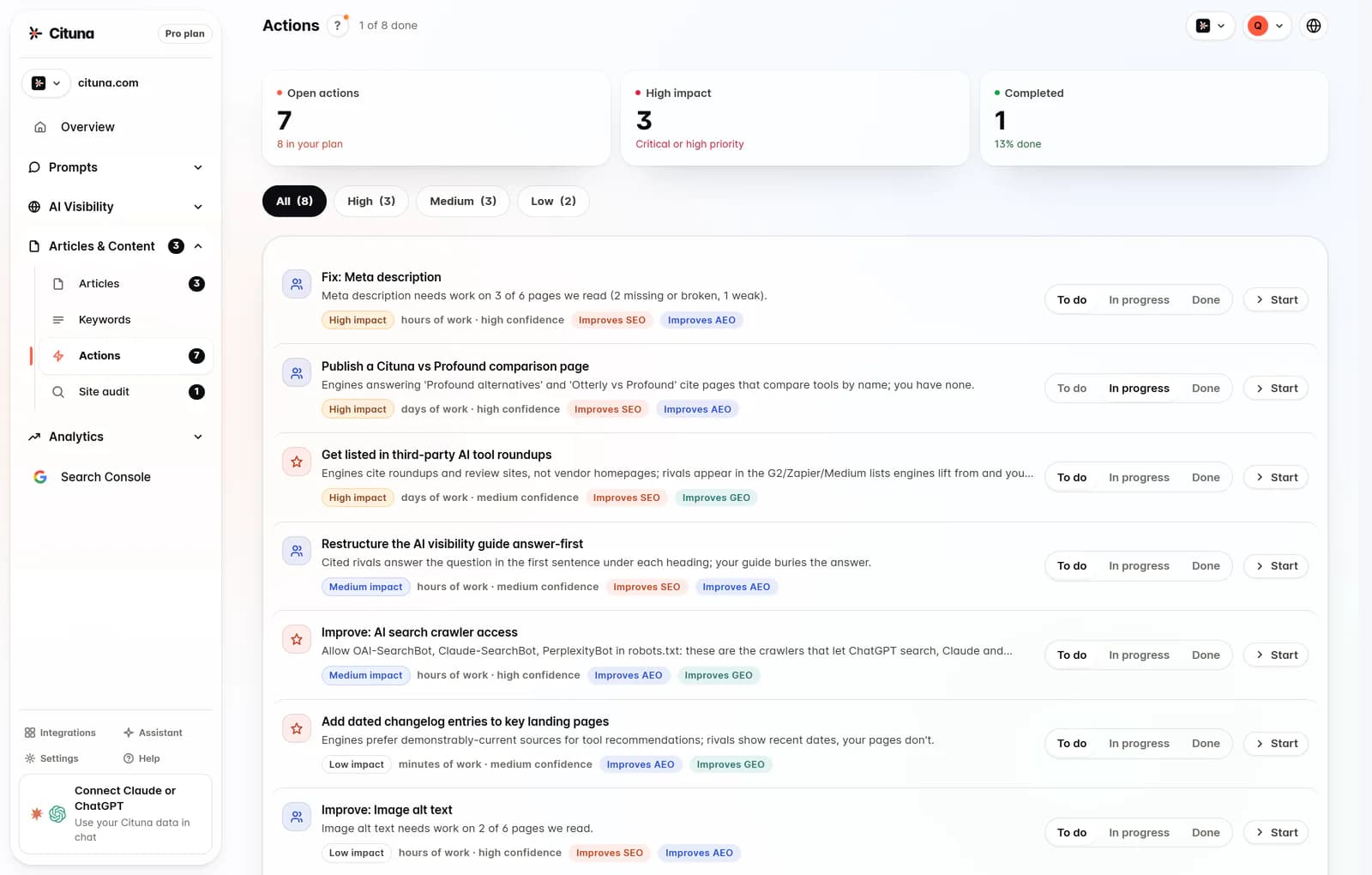
Inspect the proposed fix against the missing evidence before publishing it. A recommendation should tell you which page or content asset needs attention and why the change could make the answer more complete, rather than simply asking for more articles.
A fix may involve schema, FAQ markup, llms.txt or a page change. The right choice depends on the failure: inaccessible content calls for technical work, an unanswered buyer question calls for useful page content, and a weak explanation may need clearer evidence or structure.
Use this check before approval:
- Match the fix to the exact prompt that exposed the gap.
- Confirm that the suggested page genuinely answers the buyer's question.
- Check that claims are supported by the page and by accessible source material.
- Remove repetition, artificial keyword use and unsupported comparisons.
- Record the original answer so the post-change result has a baseline.
Cituna generates fixes from the observed gaps, including schema, FAQ markup, llms.txt and page changes. Its AutoSEO can write articles from those gaps and from Search Console demand, then send them to WordPress, Shopify, a GitHub repository or another CMS by webhook. The workflow can hold articles for approval or publish them automatically, with 30, 90 or 300 articles a month by plan.
5. Test the measurement with a concrete buyer question
Test a tool with a real buyer question and a defined pass condition before you compare dashboards. An illustrative example is the question, "Which project management platform suits a 40-person remote design team?" The input should be tested consistently across the engines the tool supports, with the answer, named companies, cited pages and positions recorded.
A practical test sequence is:
-
Run the exact question and save each answer with its date and engine.
-
Mark whether the brand is absent, named, cited, or both named and cited.
-
Identify the page or competitor that appears instead and classify the gap as technical, topical or evidence-related.
-
Apply one targeted change to the relevant page, leaving unrelated changes documented.
-
Rerun the same question and check whether the mention, citation, cited page or position changed.
The pass condition is not simply that a draft was generated. The pass condition is that the tool shows a traceable relationship between the observed gap, the change and the later answer. If the result changes, check whether the prompt, engine, page or other variable changed before crediting the fix.
6. Connect SEO demand to answer-engine changes
Connect conventional SEO demand to answer-engine monitoring when you need to decide which visibility gaps deserve work first. Search Console data can show which queries and pages already attract attention, while answer-engine checks can show where buyers receive a different recommendation or no brand mention.
A useful prioritisation order is to start with questions that are commercially important, closely related to existing pages and already supported by evidence. Then check whether the page is crawlable, whether it answers the question directly and whether competing pages supply a clearer explanation.
Cituna includes Google Search Console so a team can see which changes moved clicks, alongside its answer-engine observations. That connection does not prove that one edit caused every change, so keep a change log and compare the same prompts before and after implementation.
Semrush and Mangools remain useful for discovering search demand and comparing conventional search performance. Screaming Frog SEO Spider remains useful for finding technical problems. ChatGPT can help group questions and draft briefs, but the final prioritisation should come from the business value and the evidence collected for each gap.
7. Match automation depth to the team's approval process
Match automation to the risk of the change and the team's ability to review it. A small team may want automatic research and queued drafts but still require human approval for claims, regulated subjects, product statements and pages that affect the brand's main conversion path.
Look for separate controls for monitoring, recommending, drafting, editing and publishing. These are different permissions in practice, even when a vendor presents them as one automation feature.
Cituna's AutoSEO can publish to WordPress, Shopify, a GitHub repository or any CMS by webhook, with articles held for approval or published automatically. Its hosted MCP server connects Claude or another AI agent to the same data, with read tools on every plan from $49 and, on Pro, the ability for an agent to run scans, edit tracked prompts, move fixes along and queue articles.
For teams comparing options, the key question is not whether a tool uses automation. Ask whether the automation preserves the evidence, gives a person a review point and leaves a clear record of what changed. The AI Visibility Tools for SEO Teams comparison is useful when the buying decision involves several roles or approval paths.
8. Run a baseline scan and set the next measurement
Run a baseline scan before choosing a long-term workflow, then define the next measurement in advance. The first result should identify the buyer questions, engines, named competitors, cited pages and the highest-value gaps, not merely produce a generic readiness score.
Use the baseline to select a small group of prompts that represent the company's real buying journey. Keep those prompts stable while the team fixes one class of issue at a time. After each change, check the same answer fields and review clicks or other relevant business signals separately.
Cituna's free AI visibility scan is the practical starting point for this step. A Cituna account is required for ongoing brand mention and citation tracking, and the homepage's free check tests crawler readiness rather than brand mentions or citations. After the baseline, choose whether the team needs a monitoring-only workflow, a managed fix loop or publishing automation.
The next action is to run the free AI visibility scan, save the questions that matter most and use the results to decide which page or technical issue to address first. Teams that have already made technical changes can also use Measure AI Visibility After Technical SEO Changes to structure the follow-up check.
Related reading
- LLM SEO: How to Optimize for Large Language Models
- GEO vs SEO for AI Search (2026)
- Top GEO Companies in AI: What to Check
Official sources to check
- Google Search Central (developers.google.com)
- OpenAI Platform (platform.openai.com)
- Perplexity Documentation (docs.perplexity.ai)
- Anthropic (anthropic.com)
Drafted with AI assistance from our own research and Search Console data, and reviewed by Rahul A before publishing. Rules and prices change; check the linked official source before you act.