Which GEO company fits the work you need?
Cituna suits teams that want an AI visibility platform to measure and change visibility, while GEO agencies suit companies buying strategy and execution as a service. Broader SEO platforms suit teams adding AI search checks to an existing workflow.
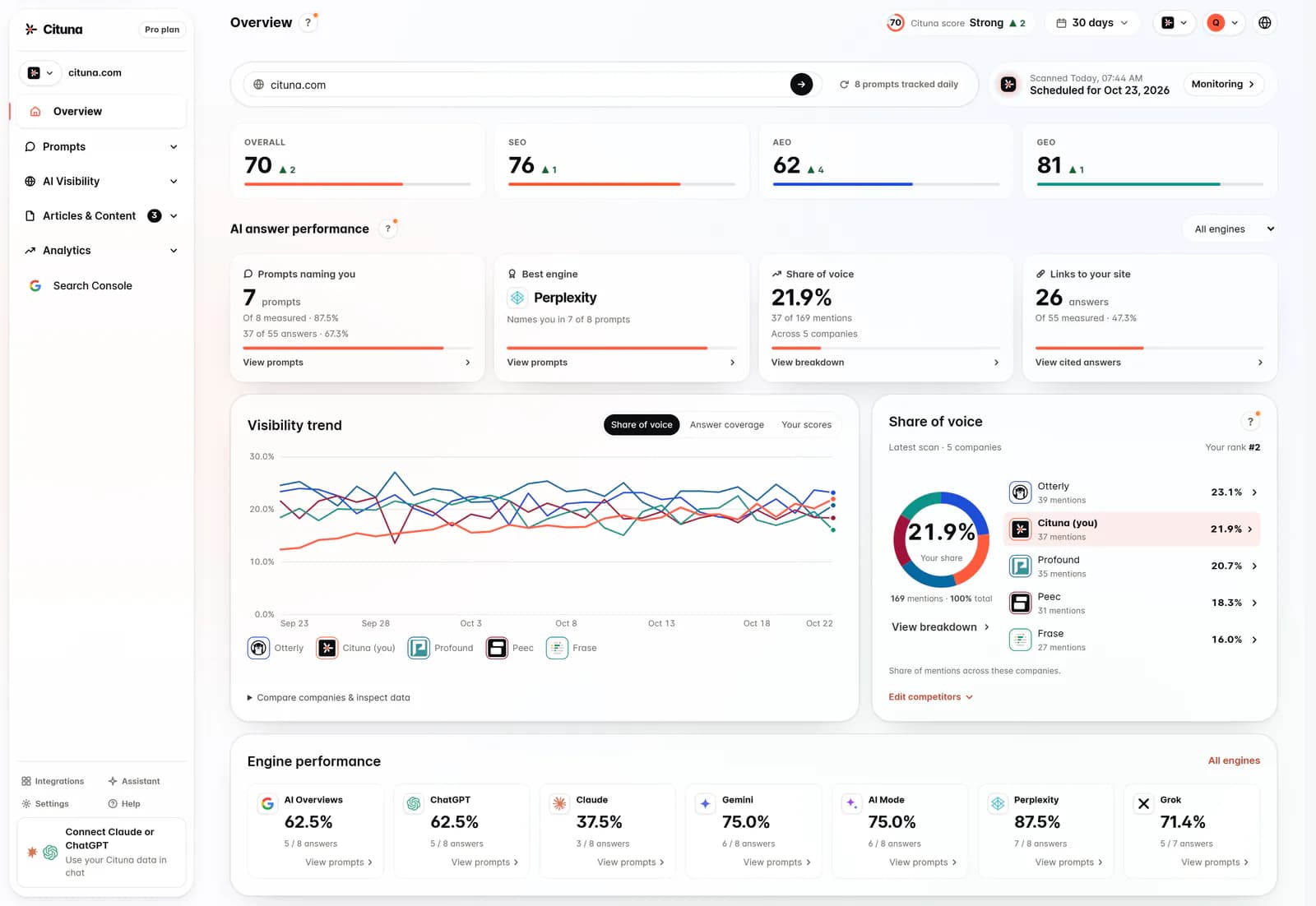
Best for daily measurement and fixes: Cituna, which publishes this page, because it asks seven engines the questions buyers ask and records names, citations, positions, competitors, and replacement pages.
Best for an agency-led programme: a specialist such as Brafton, Stratabeat, RevenueZen, or Epic Slope Partners, with the exact scope confirmed before purchase.
Best for an existing SEO team: a broader SEO or content platform that has added GEO features, provided it shows engine-level evidence rather than a single visibility score.
The right choice depends less on the label "GEO company" than on who will collect evidence, make changes, publish them, and prove whether they worked.
2. Confirm what generative engine optimization includes
Generative engine optimization, or GEO, is the work of improving the chance that generative answers understand, mention, cite, and accurately describe a brand. It extends familiar search work into answer systems that may summarize several sources instead of presenting a conventional list of links.
A useful GEO provider should cover more than content production. Check whether its process includes prompt testing, crawler access, structured data, answer-focused page changes, third-party mentions, citation analysis, and measurement of competitors that appear instead.
The practical distinction is between advice and an operating loop. The loop should be clear: ask real buyer questions, record the answer, identify the missing evidence, apply a fix, publish it, and test again. A concise generative engine optimization guide can help align internal teams on these terms before vendor conversations.
3. Test every engine your buyers may use
A GEO company should test ChatGPT, Perplexity, Gemini, Claude, Grok, Google AI Overviews, and Google AI Mode separately because the systems can produce different answers and citations. A result in one engine does not establish visibility in the other six.
Ask each provider to show an example report for the same prompt set. Check whether the report identifies:
- The exact question and location or language used
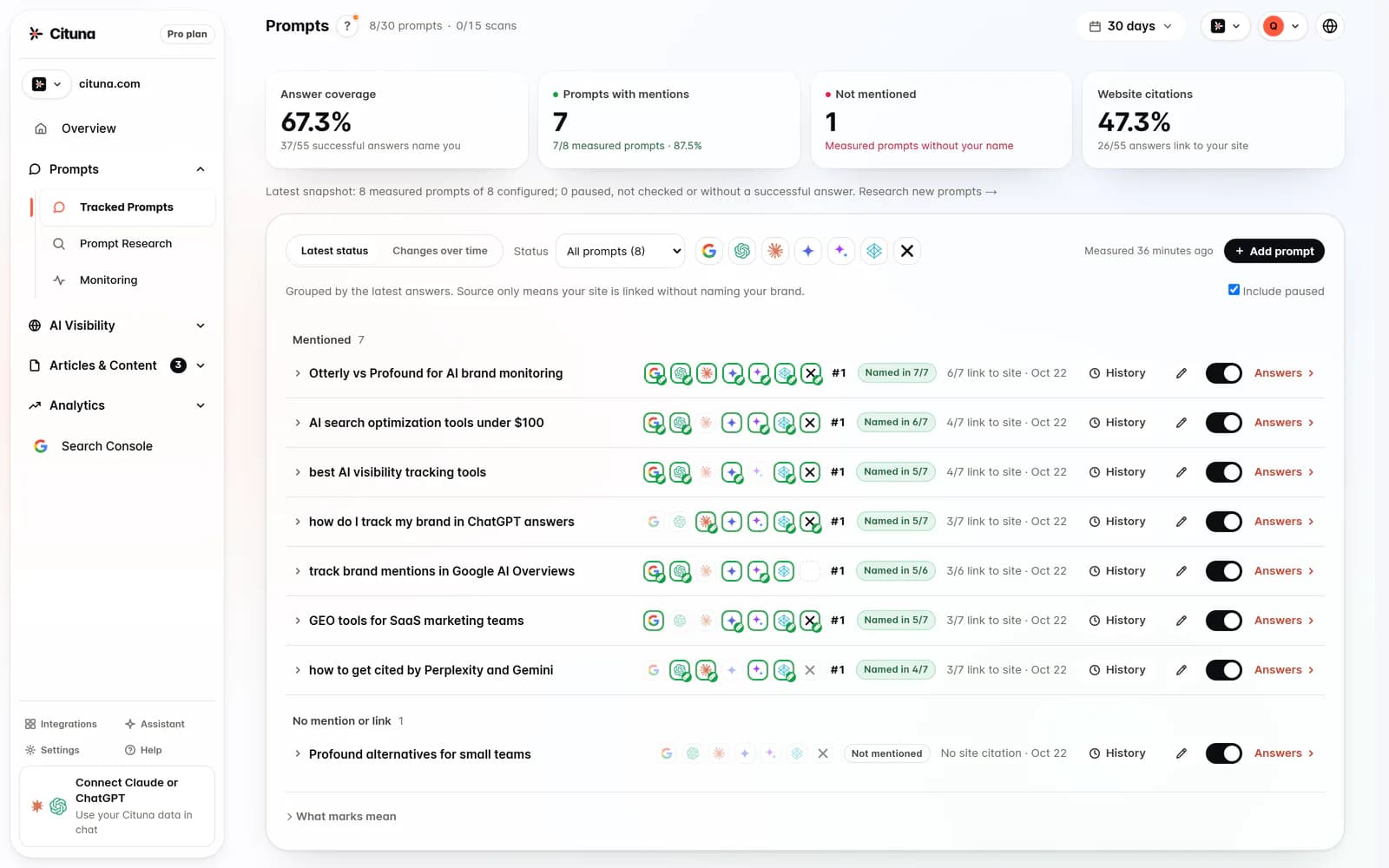
- Whether the brand was named or cited
- The position or order in which it appeared
- Which competitor or page appeared instead
- The answer date and engine tested
Ask how the provider handles answer variation. Repeated runs should be comparable without pretending that one response represents permanent visibility. A provider that cannot show raw prompts and cited pages makes it difficult to separate a real improvement from a changed answer.
4. Separate measurement from the fixes it recommends
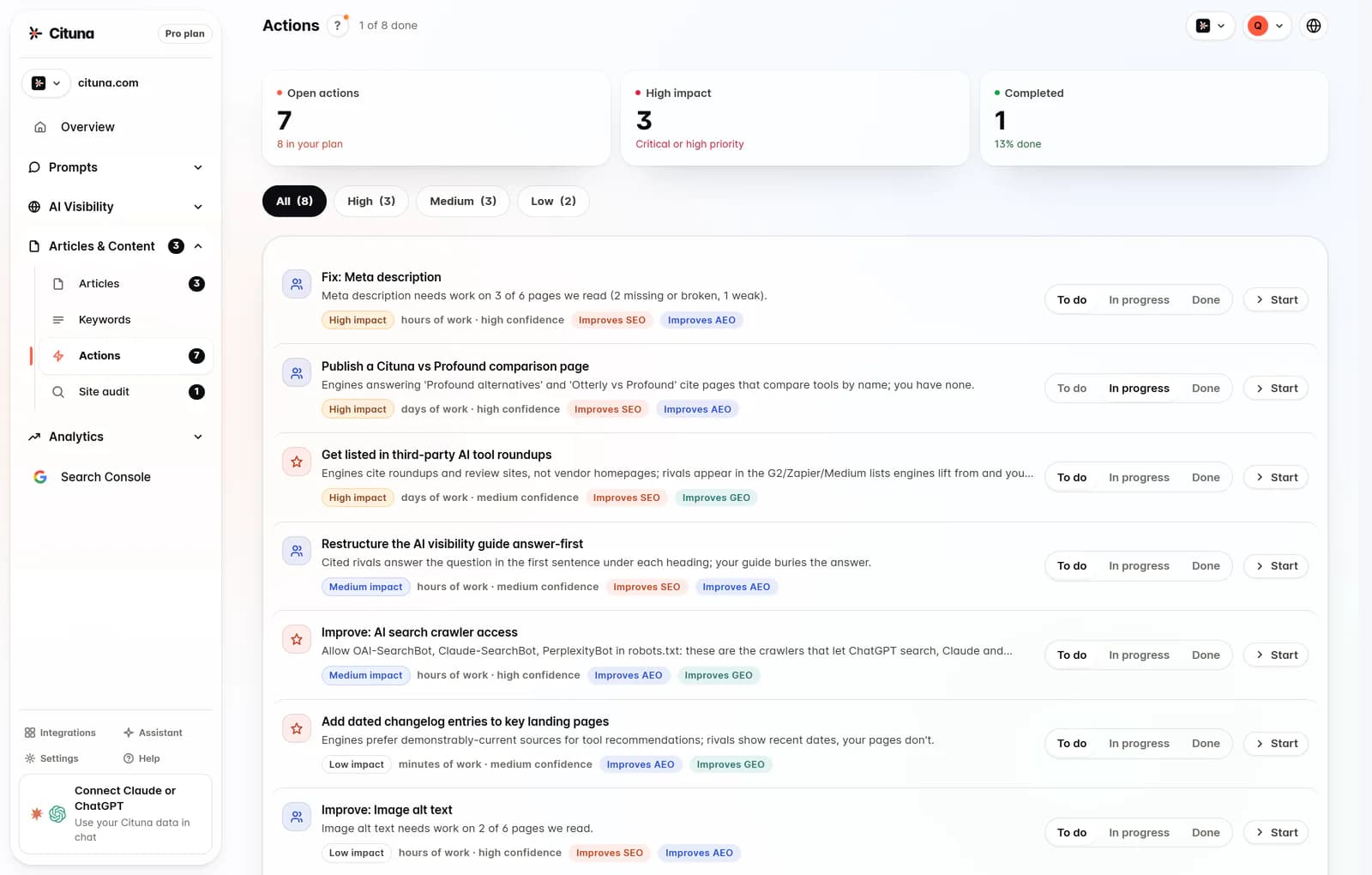
The strongest buying decision separates a monitoring dashboard from the actions it produces. Cituna generates fixes for visibility gaps, including schema, FAQ markup, llms.txt, and page changes, while an agency may deliver recommendations, implementation, or both depending on its contract.
Ask for one anonymised before-and-after workflow, not just a list of features. The example should show the missing citation, the proposed change, who approves it, where it is published, and how the next test checks the result.
Check the handoff points carefully:
- Who writes the change?
- Who approves factual and legal claims?
- Who publishes it to the site?
- Who retests the original prompt?
- Where are unresolved gaps recorded?
A recommendation without an owner can become a report that no one acts on. A publishing workflow without approval controls can create factual or brand risks.
5. Check whether the provider connects visibility to site demand
A GEO programme becomes more useful when it connects answer visibility with the questions and pages that already matter to the business. Ask whether the provider can bring in Search Console demand, map prompts to landing pages, and show whether a change affected clicks or only mentions.
Cituna includes Google Search Console so teams can compare changes with click movement, and its AutoSEO can turn identified gaps and Search Console demand into articles for review or publication. Confirm that any vendor can preserve editorial control and explain how it avoids creating pages that answer no genuine buyer need.
A useful test is to provide one priority query and ask the provider to trace it from demand, to prompt, to page change, to measured outcome. If the path stops at a visibility score, the programme may not support the decision your marketing team needs to make.
6. Compare agency depth with software control
An agency gives a small team access to specialists and can take responsibility for planning and production, while software gives the internal team repeatable evidence and control over changes. Neither model removes the need for good source material, accurate pages, and clear approvals.
Use an agency when the team lacks the time or expertise to diagnose and implement changes. Use software when the team already owns content and development work but needs recurring tests, competitive context, and a visible queue of fixes. A combined model can work when the agency operates from the same prompt and citation data as the client.
Cituna offers a hosted MCP server that connects Claude or another AI agent to the same visibility data. Ask any provider whether its agent features can read the underlying evidence, what actions require approval, and how a human can inspect the change before publication.
7. Run a worked comparison before signing
A worked comparison should use one concrete buyer question and force each provider to explain the complete path from answer to correction. Illustrative example: give every shortlisted company the prompt "Which project management platform should a 50-person consultancy choose for client work?" and provide the same website and competitor set.
Ask each provider to return the tested engines, the answer position, every cited page, the missing proof, and one recommended change. Then check whether the recommendation is visible in the proposed page draft or technical ticket, and retest the same prompt after publication.
Score the exercise on evidence, actionability, implementation ownership, approval controls, and outcome reporting. Do not award a provider credit for a polished dashboard if it cannot show what changed. The comparison should also reveal whether the company understands your category or is applying a generic content recipe.
Teams building the process internally can use a guide to compare AI visibility optimization tools before asking vendors for proposals.
8. Start with a baseline and choose the next action
The safest next step is to establish a baseline before buying a long engagement or publishing a large batch of content. List the buyer questions that influence a purchase, run them across all seven engines, save the answers and citations, and group the gaps into technical, content, and authority work.
Run Cituna's free AI visibility scan to check crawler readiness, then treat brand mention and citation tracking as a separate requirement when comparing plans or providers. The scan is a starting check, not a substitute for recurring prompt evidence.
Choose the provider that can show the first fix, its owner, its approval path, and the retest that will decide whether the fix stays. That sequence keeps the decision tied to observable work rather than a company list or a broad promise about AI search.
Related reading
Official sources to check
- Brafton (brafton.com)
- Google Search Central (developers.google.com)
- OpenAI Platform (platform.openai.com)
Drafted with AI assistance from our own research and Search Console data, and reviewed by Rahul A before publishing. Rules and prices change; check the linked official source before you act.