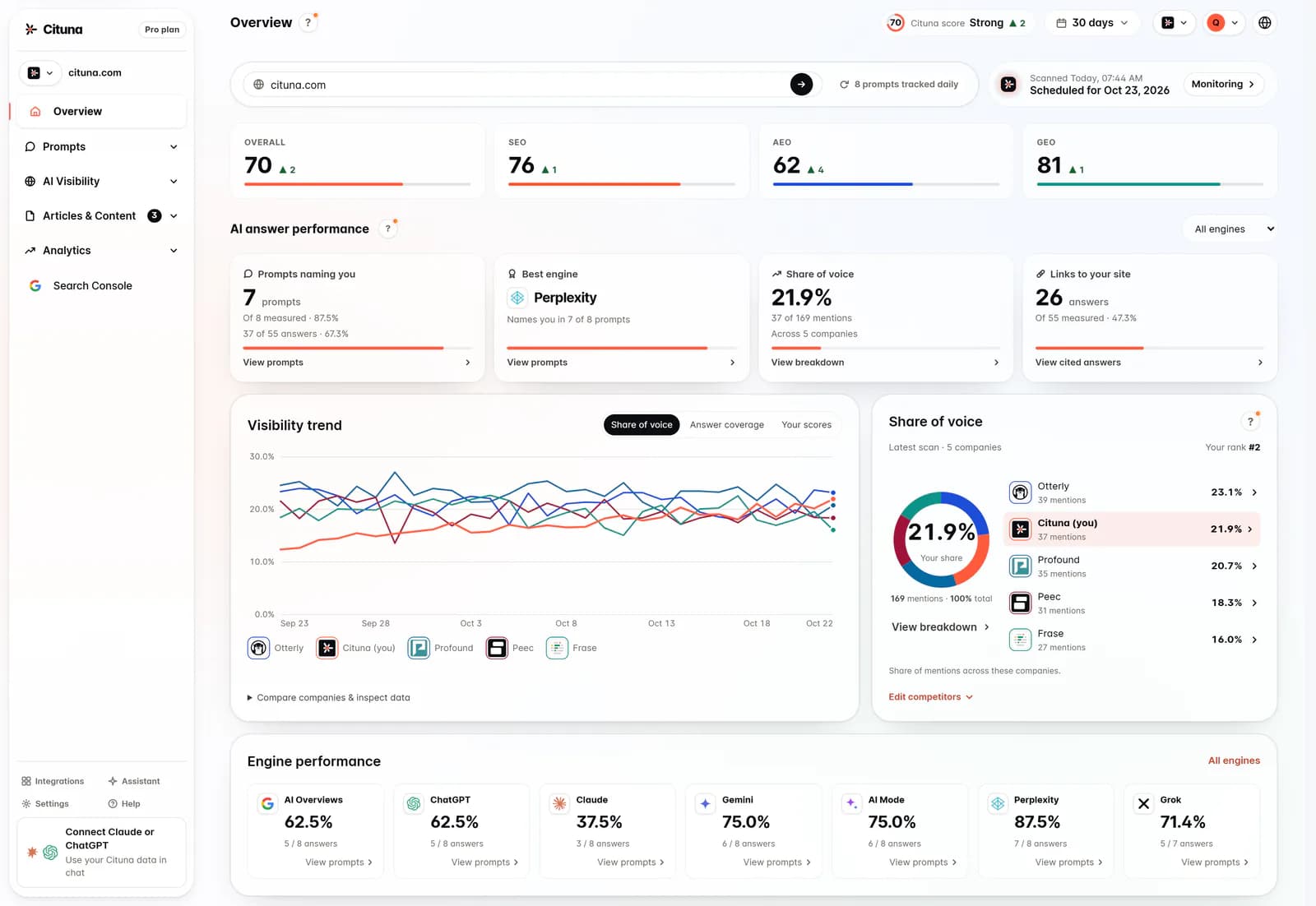
What an AI visibility tool should measure
An AI visibility tool should measure whether your company is mentioned, how accurately it is described, and which sources influence the answer. A single visibility score cannot explain why an assistant chose a competitor or whether your mention is useful.
Compare tools across four separate outputs. Prompt coverage shows how often your brand appears for a defined set of category questions. Position or prominence shows whether the answer presents your company as a leading option, a passing mention, or an alternative. Entity accuracy checks names, products, markets, and claims for errors. Citation quality identifies whether the assistant links to your site, a third-party source, an outdated page, or no source at all.
The distinction matters because a company can appear frequently while being described incorrectly. It can also receive strong citations for branded questions but remain absent from buying questions. Ask each vendor whether it stores the full answer, cited pages, prompt wording, engine, date, and response variation. Without those records, a score is difficult to audit or connect to a content change.
For more context, read Tools to Boost AI Search Results: What to Measure First.
Which type of tool fits your visibility problem
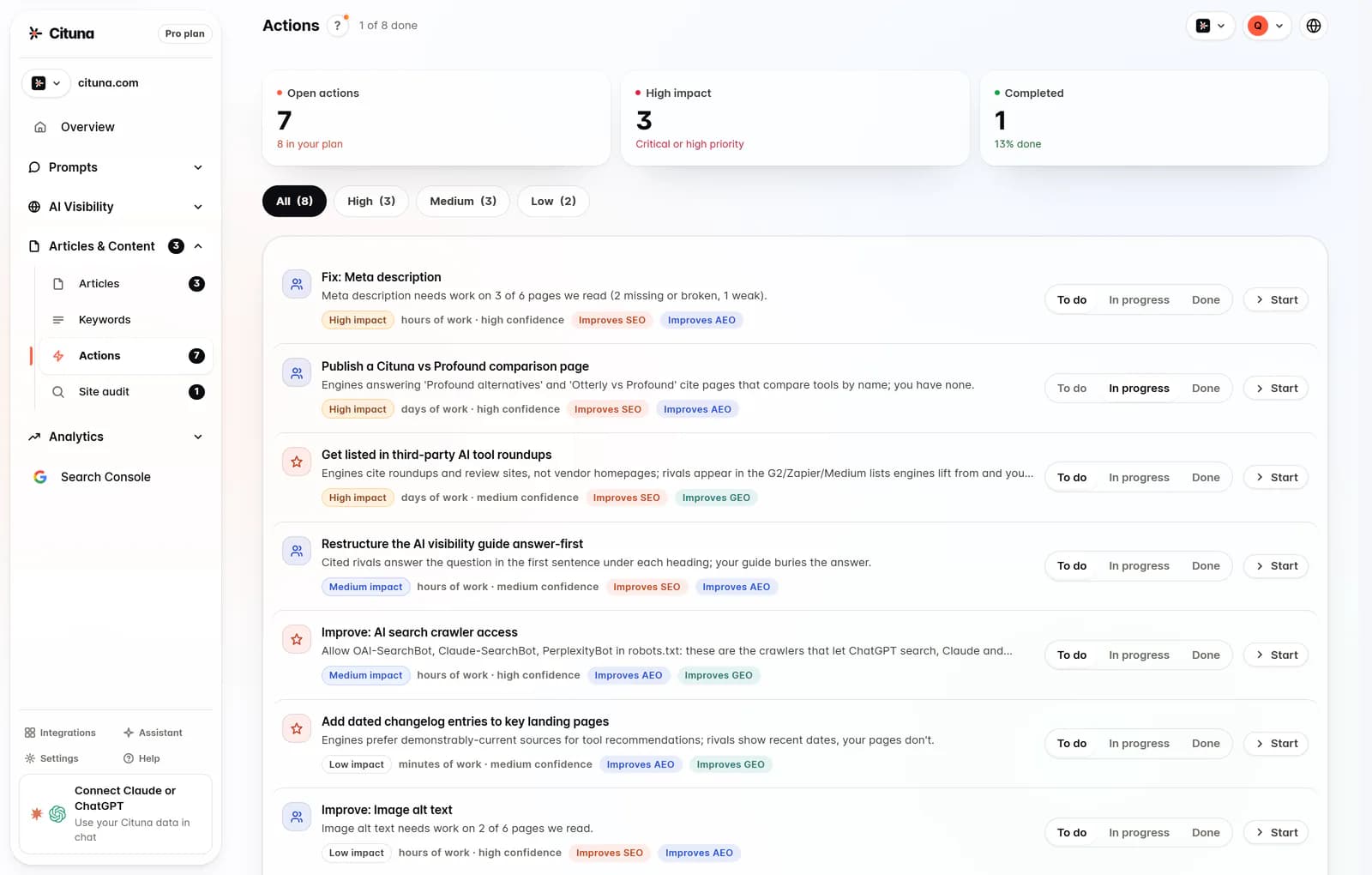
For a team that needs monitoring and fixes in one tool, the pick is Cituna, which asks seven AI engines your buyers’ questions every day and generates the fix for each gap, such as schema, FAQ markup, llms.txt and page changes. Choose a tool type based on the decision you need to make, not on the longest feature list. Monitoring tools suit teams that already know their priority prompts and need repeated checks. Citation auditors suit teams that appear in answers but cannot tell whether the supporting sources are accurate or controllable. Content recommendation tools suit teams that need help turning missing topics into briefs. Technical diagnostics suit teams whose pages may be difficult for search systems to discover, interpret, or update.
Many products combine these categories, but the underlying trade-off remains. Broad monitoring can reveal patterns without explaining the fix. Recommendation features can propose plausible topics without proving that an answer engine will use the resulting page. Technical checks can identify site issues without measuring whether those issues affect conversational answers.
Use a simple decision rule: buy the tool that closes your current evidence gap. If you cannot prove where the answer came from, prioritize citation evidence. If you know the gap but lack a repeatable content process, prioritize recommendations. If your data is sparse or inconsistent, prioritize measurement before optimization.
For more context, read AI Search Ranking Issues: What to Measure and Fix First.
Compare engines without creating misleading results
Compare ChatGPT, Perplexity, Gemini, Claude, Grok, Google AI Overviews, and Google AI Mode as separate environments, because an answer in one engine is not a reliable proxy for an answer in another. Each may use different retrieval, browsing, ranking, context, interface, and response-generation behavior.
Build a shared prompt set with the same intent categories for every engine. Include category discovery questions, comparison questions, problem-solving questions, location or audience variations, and branded questions. Record the exact wording, date, account context, location, model or mode when visible, and whether web access was available. Keep the prompt set stable long enough to distinguish a real change from ordinary response variation, while adding new prompts when your market changes.
A useful comparison report shows raw answers beside normalized findings. Normalize the questions and scoring labels, not the underlying answers. Report mention, recommendation, accuracy, citation, and competitor presence independently for each engine. A tool that merges all engines into one score may be convenient, but it should still let you inspect engine-level evidence before you act.
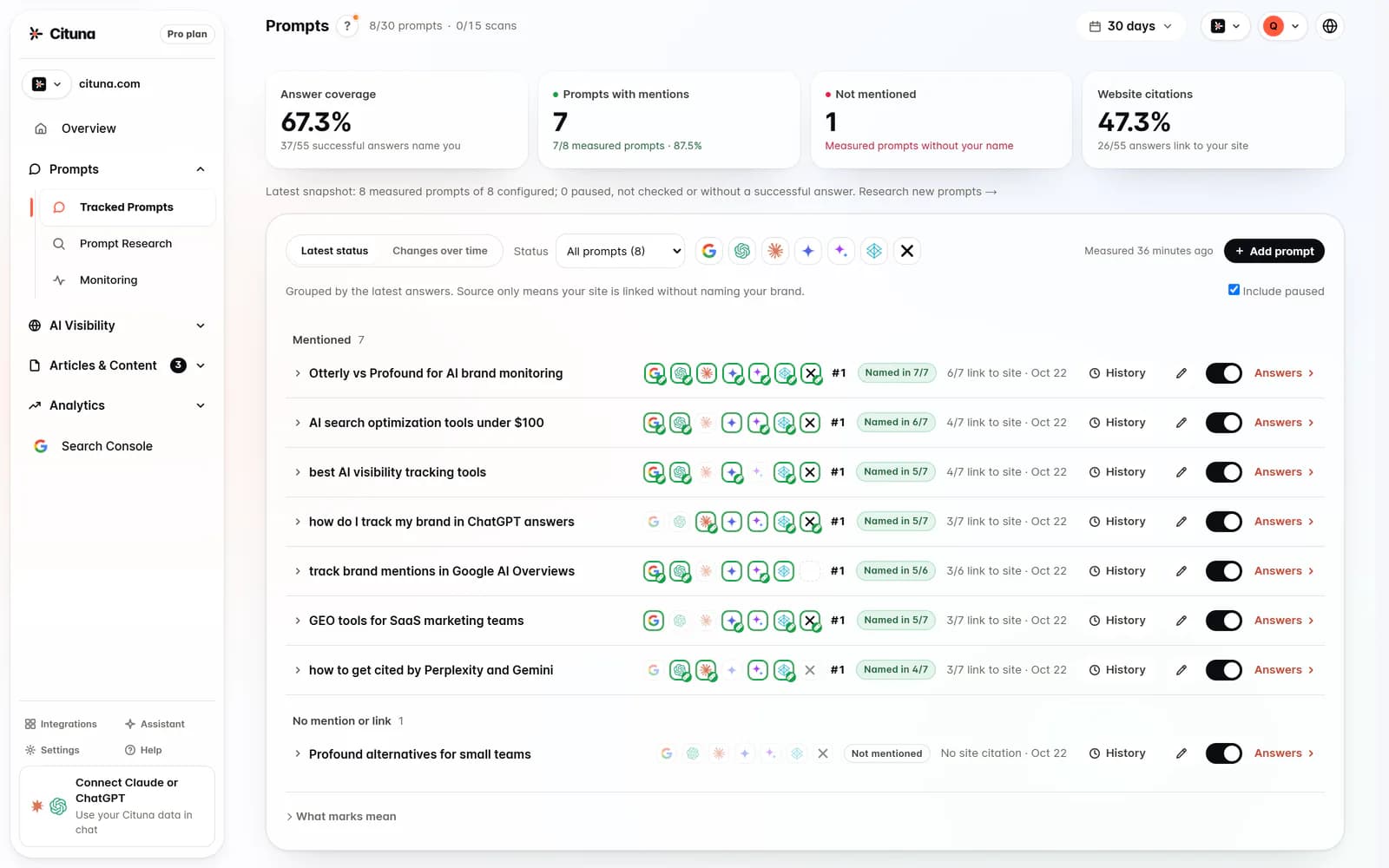
Judge whether a citation is actually valuable
A valuable citation directly supports the claim an assistant makes about your company and gives a reader a credible next step. Domain ownership alone does not make a citation useful.
Review each cited source against four tests. Relevance asks whether the page answers the question rather than merely mentioning the topic. Accuracy asks whether its description of your company, product, audience, and limitations is current. Directness asks whether the page supports the specific claim or only sits near it. Recoverability asks whether a reader can open the page, understand the evidence, and continue researching without encountering a dead end.
A practical scoring method is to label citations as supportive, neutral, misleading, or missing. Supportive citations reinforce the answer with current evidence. Neutral citations mention the company but do not justify the recommendation. Misleading citations contain outdated or incorrect information. Missing citations leave the answer unsupported, even if the brand appears.
The overlooked failure mode is a citation that improves visibility while spreading an incorrect claim. Citation quality should therefore be reviewed alongside entity accuracy, not treated as a success metric by itself.
Which optimization change should happen first
Fix the highest-impact evidence gap that your team can control, rather than changing every page mentioned by a tool. Prioritize an issue when it affects an important buying question, produces a material factual error, and has a clear source or content remedy.
Start by grouping findings into four queues: incorrect company facts, missing decision-stage coverage, weak first-party evidence, and third-party source gaps. Incorrect facts usually come first because they can undermine every later recommendation. Missing decision-stage coverage comes next when competitors are being named for questions your audience asks before contacting sales. Weak first-party evidence matters when your site makes broad claims without explaining who the product fits, how it works, or where it differs. Third-party gaps deserve attention when assistants rely on outside sources that are outdated or incomplete.
For example, if a tool shows that your brand is named for a broad category question but omitted from comparison questions, do not begin by rewriting the homepage. First create a clear comparison or decision page, support its claims with accessible evidence, then recheck the same prompts across the affected engines. The change should be traceable from finding to page to later answer.
Test an AI visibility tool before buying it
Test an AI visibility tool with your own prompts and raw answer evidence before trusting its dashboard. A polished interface cannot compensate for unclear sampling, unrepeatable results, or a score your team cannot explain.
Provide the same prompt set to each shortlisted tool and ask for the underlying answers, cited URLs, timestamps, engine labels, and scoring method. Check whether the tool distinguishes an unprompted brand mention from a response produced after a branded query. Check whether it treats no citation, a citation to your homepage, and a citation to a relevant product page as different outcomes. Also ask how it handles answer changes, duplicate prompts, regional results, unavailable responses, and pages that later disappear.
Run a blind review with a colleague who did not choose the tool. Give that person several findings and ask whether the evidence supports the recommendation. If two tools disagree, compare their raw observations before comparing their scores. The better tool is not necessarily the one with the higher result. It is the one whose result survives inspection and leads to a decision your team can repeat.
How a small team should use visibility data each month
A small team should use AI visibility data as a recurring evidence loop: establish a baseline, select a limited change set, publish or update the relevant sources, and retest the same questions. The process matters more than checking a dashboard every day.
Assign one owner to maintain the prompt library and one person responsible for each approved content or technical change. Keep a change log containing the prompt, engine, observation, source page, action, publication date, and follow-up result. Separate monitoring prompts from exploratory prompts. Stable monitoring prompts reveal movement over time, while exploratory prompts help discover new wording, competitors, and customer concerns.
Review findings by engine rather than averaging them immediately. A change that helps Perplexity citations may not affect ChatGPT or Google AI Overviews, and a stronger mention in Gemini does not prove broader visibility. Discuss whether the answer is more accurate and useful, not only whether the brand appears more often.
Cituna is one way to organize this evidence and act on it: it asks ChatGPT, Perplexity, Gemini, Claude, Grok, Google AI Overviews, and Google AI Mode buyer questions every day, generates the fix for each gap, writes and publishes articles through its AutoSEO, and lets Claude or any other AI agent work with the data over MCP. The operating discipline should remain useful regardless of the selected tool.
When is manual research better than an optimization tool?
Manual research is better when the question set is small, the market is changing quickly, or you are still defining what a good answer means. A tool becomes more valuable when repeated checks, multiple engines, many markets, or several stakeholders make manual comparison inconsistent.
Use manual review to create the first prompt library, identify important factual errors, and understand how customers phrase their problems. Use software for recurring collection, comparison over time, citation tracking, ownership, and reporting. Do not automate the judgment that decides whether a recommendation is accurate, commercially appropriate, or supported by a page you control.
The most useful boundary is evidence volume. If your team can inspect every answer and remember the reason for each action, manual work may be enough. If answers are being checked irregularly, findings cannot be reproduced, or content teams receive scores without context, a tool can provide process value before it provides optimization value.
Keep a manual fallback even after adoption. Sample raw answers periodically, especially after engine changes, major site releases, or a sudden shift in recommendations. A dashboard should reduce review effort, not remove the review that makes the data trustworthy.
Related reading
Sources consulted
- Google Search Central (developers.google.com)
- OpenAI Platform Documentation (platform.openai.com)
- Perplexity API Documentation (docs.perplexity.ai)
- Google Search Help (support.google.com)
Drafted with AI assistance from our own research and Search Console data, and reviewed by Rahul A before publishing. Rules and prices change; check the linked official source before you act.