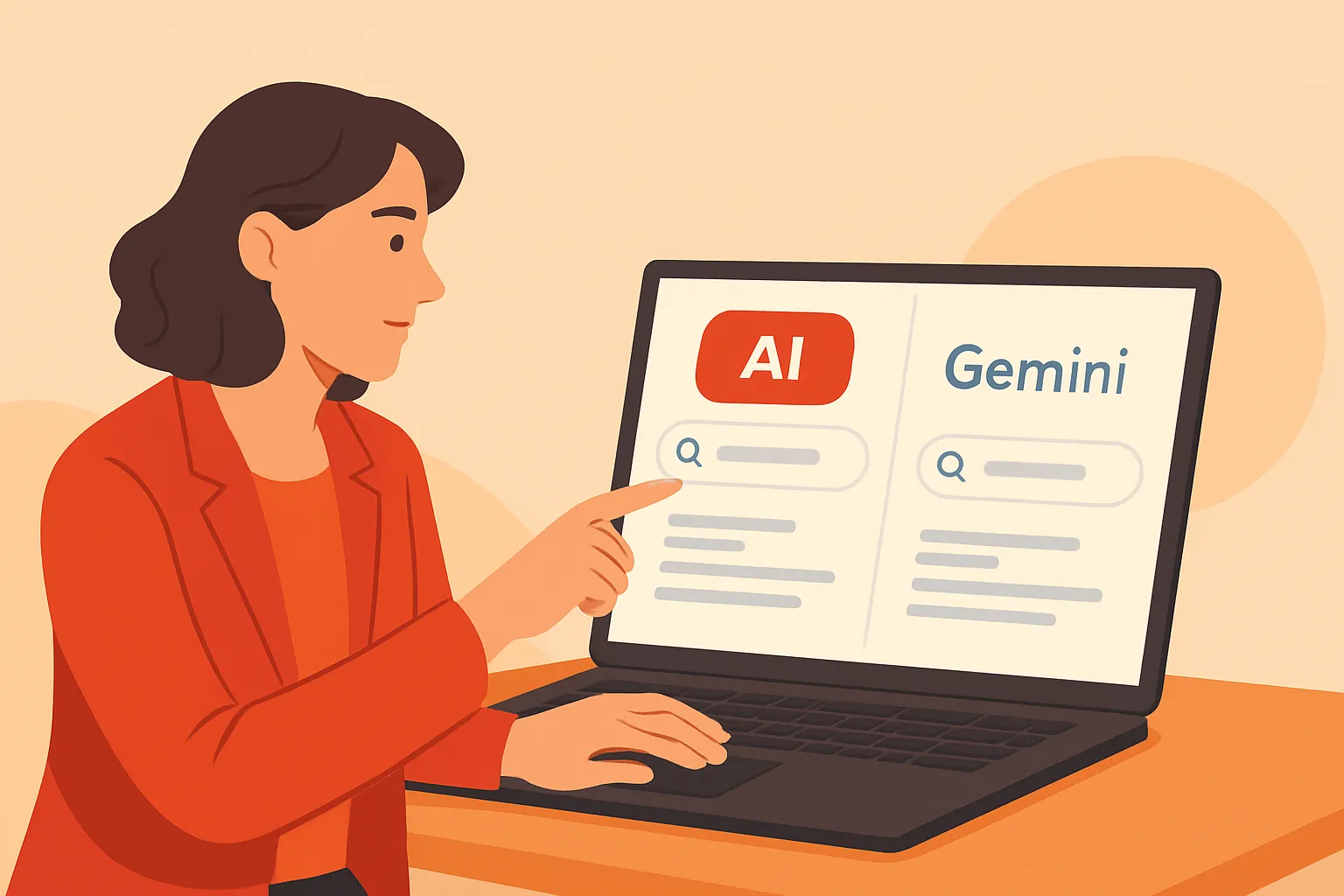
Which surface should I check first?
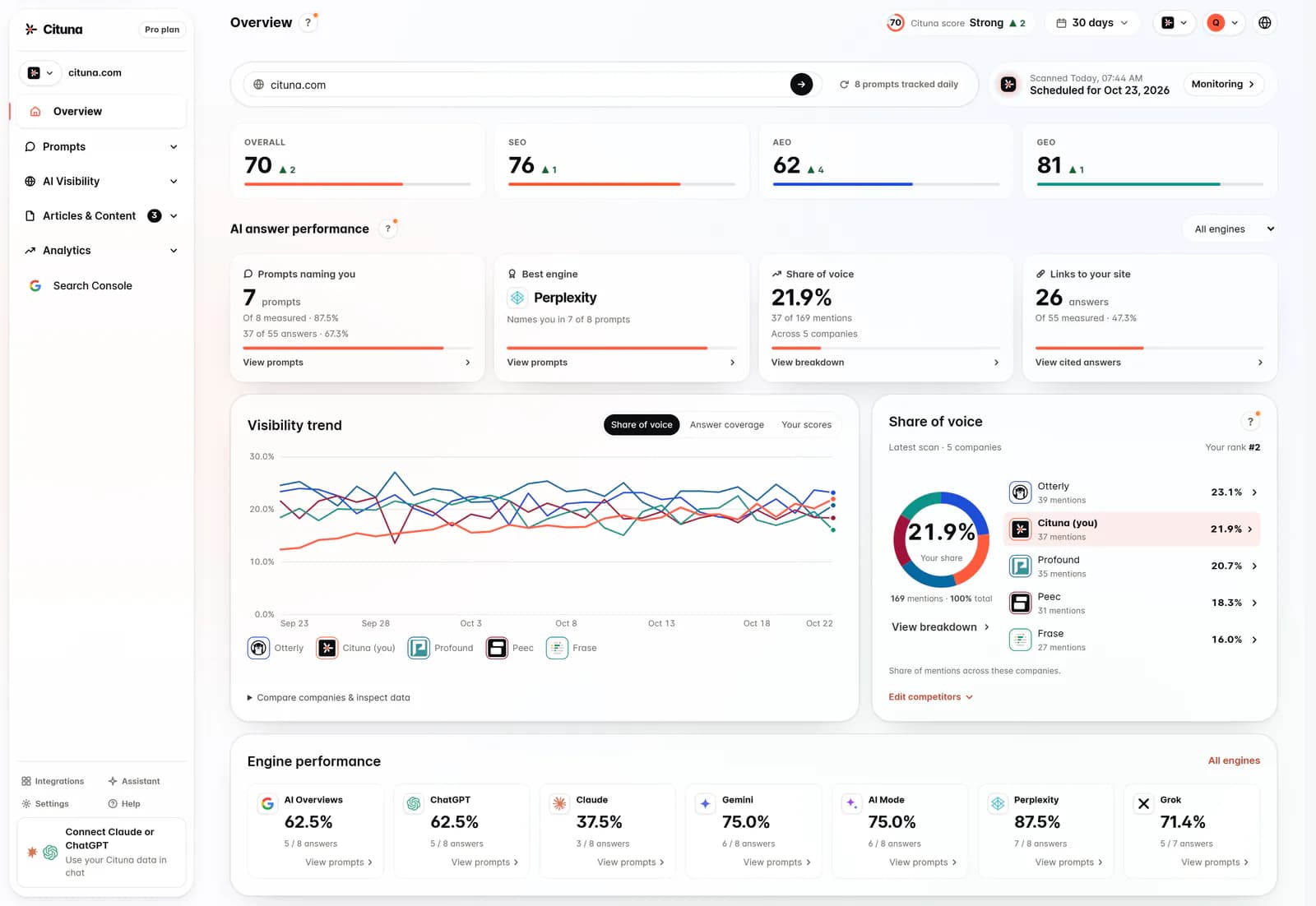
Best for measuring whether buyers can name your company: Cituna, which publishes this page, because it asks seven answer engines the questions your buyers ask and records names, citations and competitors. Best for understanding Google search behavior: Google AI Mode, because it is a conversational search surface rather than a standalone chatbot. Best for testing direct assistant answers: Gemini, because it lets you examine responses outside the Google search results page. Best for short search summaries: Google AI Overviews, because it appears within a results page and gives a compact answer with sources.
Those choices are not interchangeable. A company can appear in Gemini but disappear from Google AI Mode, or appear in an AI Overview while missing from a longer AI Mode conversation. The first decision is therefore not which system is generally better. It is which buyer question, surface and outcome you need to inspect.
Cituna also tracks ChatGPT, Perplexity, Claude and Grok alongside Gemini, Google AI Overviews and Google AI Mode. That broader view matters when a founder assumes a Google result explains every answer engine's behavior.
Use this quick decision rule:
- Choose Gemini testing when you want to inspect how a model answers a prompt directly.
- Choose Google AI Mode testing when your concern is branded visibility inside Google search conversations.
- Choose Google AI Overview testing when the problem is a missing or inaccurate short summary.
- Choose multi-engine tracking when buyers may ask the same category question in several assistants.
Separate Gemini from the Google experiences built around it
Gemini is the model family, while Google AI Mode and Google AI Overviews are search experiences that use Google's models together with search retrieval, page selection and interface-specific citation behavior. Treating them as one destination hides the reason a brand may receive different answers from each surface.
Gemini is useful for asking a question directly and examining the language, entities and recommendations that appear in the response. Google AI Overviews gives a shorter answer inside a conventional search journey. Google AI Mode supports a deeper conversation, where the user can refine the request and the system can investigate several related angles before producing a response.
Google AI Mode also changes the job for a marketing team because the user may not repeat the original words. A broad prompt can lead the system to investigate related needs, comparisons, constraints and use cases. A page that answers only the literal opening phrase may therefore miss the follow-up context that determines which sources are cited.
Google AI Overviews and Google AI Mode should be measured separately even when they draw on related Google technology. An Overview citation is evidence about a short search answer. An AI Mode citation is evidence about a longer conversational path. Neither is a universal ranking for Gemini, ChatGPT, Perplexity, Claude or Grok.
Compare answer length, follow-ups and citation roles
Google AI Overviews suits a reader who wants a quick orientation, while Google AI Mode suits a reader who wants to investigate, compare and refine a decision. Gemini suits a direct assistant interaction, but the exact response can change with the prompt, conversation history and available grounding.
The practical distinction is the role each surface plays in the buying journey. An Overview may introduce a category and show a small set of supporting pages. AI Mode may assemble a comparison from several sources and carry the user into follow-up questions. Gemini may answer the same question without presenting the same search context as either Google surface.
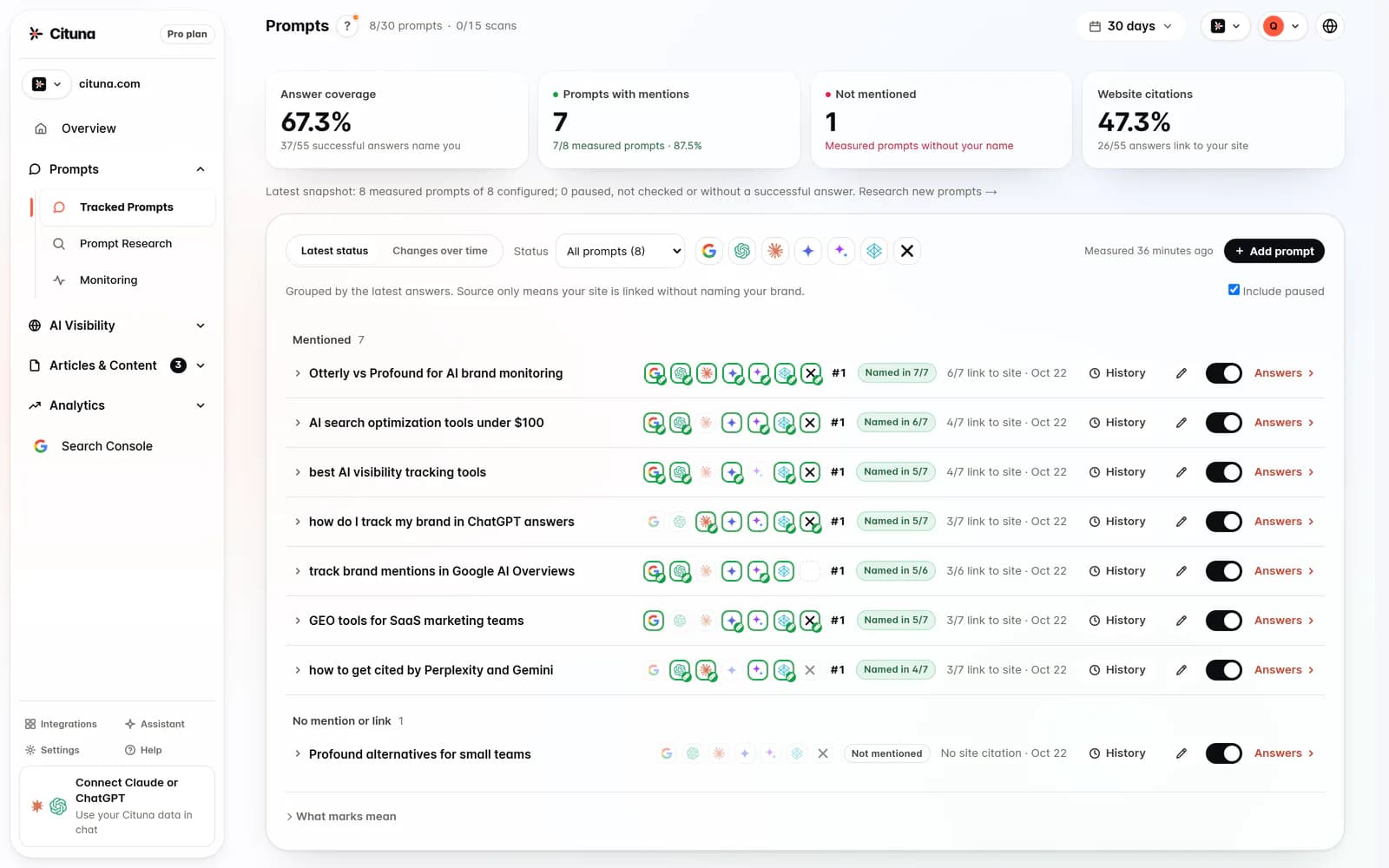
A marketing lead should record more than whether a brand appeared. Capture the question, the answer's recommendation, the cited page, the competitor named, the position of the brand mention and whether the answer supports or weakens the buyer's intended decision.
Do not treat a citation as a recommendation by itself. A page can be cited as a definition, a source of a limitation or a counterpoint while a competitor receives the actual recommendation. Record the surrounding sentence and the role assigned to the page.
Map how Google AI Mode can retrieve your content
Google AI Mode can break a broad request into related lines of investigation, so content should answer the decision behind the query rather than repeat one keyword. The useful test is whether each likely follow-up has a clear, supported answer on your site.
For a category query, map the questions a buyer is likely to ask next:
- What does the category include, and who needs it?
- Which capabilities matter for a small or mid-size company?
- What limitations, integrations or implementation work should the buyer expect?
- Which alternatives fit a different budget, workflow or risk tolerance?
- What evidence supports the recommendation?
Create a page or a linked cluster only when the question deserves its own answer. Avoid making several near-duplicate pages that repeat the same claim. A clear definition, comparison, use-case explanation and evidence page give the system distinct passages to retrieve.
The overlooked failure mode is a polished category page that never states where the company fits. If the page explains the market but leaves its own audience, limits and use cases vague, an answer engine can cite it without naming the company as an option.
Measure visibility by prompt, surface and buyer outcome
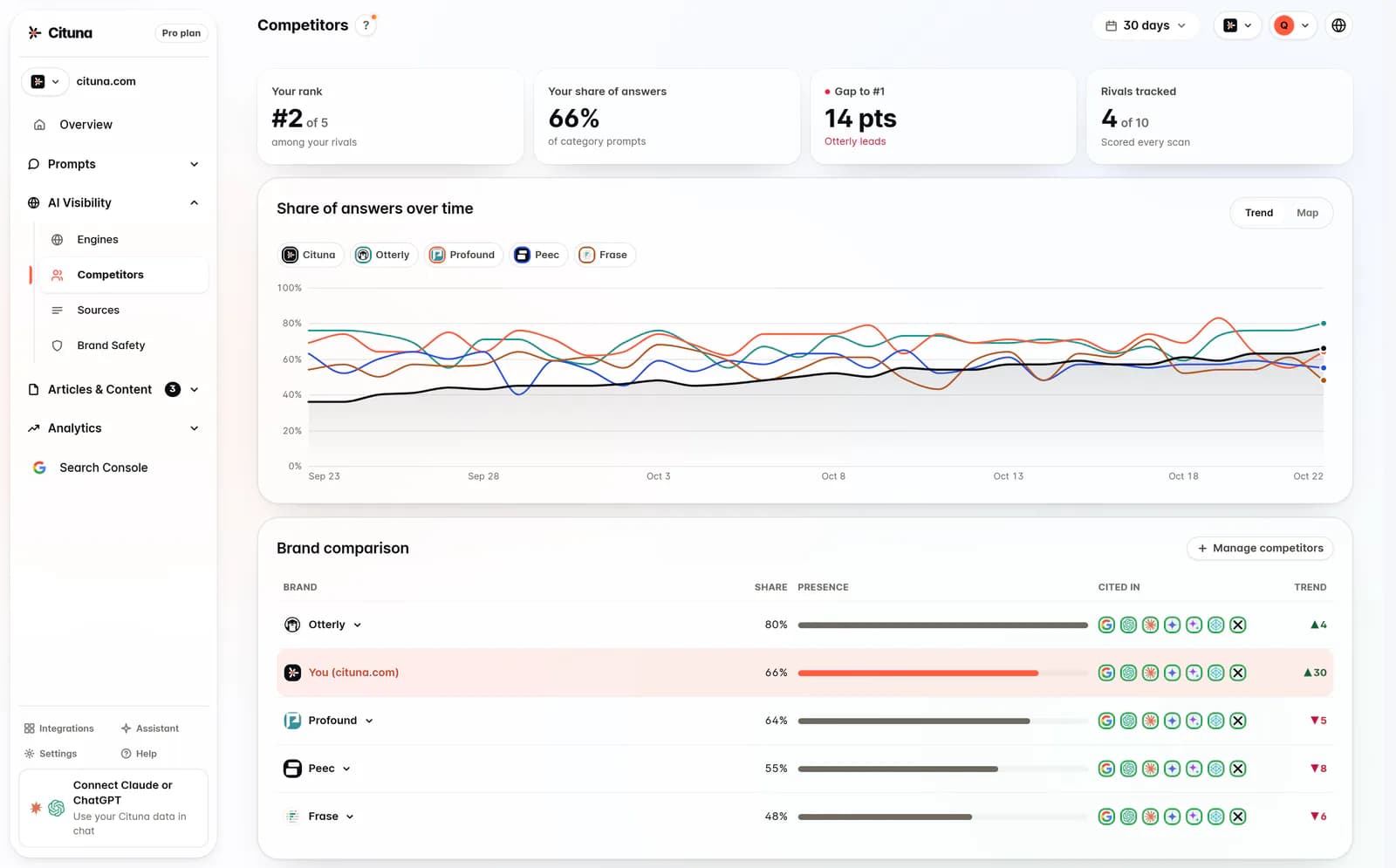
Measure each buyer prompt separately across Gemini, Google AI Mode and Google AI Overviews, then compare those results with ChatGPT, Perplexity, Claude and Grok. A single visibility score can hide a serious gap on the surface that matters most to your customers.
Track these fields for every observation:
- The exact prompt and the buyer stage it represents.
- The engine or Google surface that produced the answer.
- Whether the brand was named, cited, recommended or omitted.
- The position and context of the brand mention.
- The competitor and page that appeared instead.
- The factual issue, missing page or weak passage that may explain the result.
Use a Google AI Mode Tracker when the specific question is how your brand appears in that search experience. Use a Gemini Rank Tracker when you need a separate view of direct Gemini responses. Keeping those records apart prevents a strong result in one environment from masking an absence in another.
A useful first baseline contains the questions buyers actually ask, not only phrases chosen from keyword research. Include comparison, problem, alternative, cost, implementation and trust questions. Then rerun the same prompts after each material content or technical change.
Fix the page or evidence gap before adding more content
Fix the smallest evidence gap that explains the missing citation before producing another broad article. If the answer omits your brand because a page lacks a direct definition, add the definition. If a competitor is recommended because your limitations are unclear, state the limits and the audience you serve.
Start with this check:
- Confirm that the relevant page is crawlable and has one clear subject.
- Put the direct answer near the beginning, followed by supporting detail.
- Use descriptive headings for distinct buyer questions.
- Add specific evidence, examples, qualifications and source references where appropriate.
- Connect related pages so a broader answer can reach the supporting detail.
- Check that structured data describes the visible content rather than adding unsupported claims.
If the check fails, correct the page before changing the prompt or declaring the engine inconsistent. If the page passes but the answer still omits the company, inspect the cited competitor page and identify the decision detail it supplies more clearly. The next fix may be a comparison page, an FAQ passage, a product limitation or a stronger explanation of who the service suits.
Cituna generates proposed fixes such as schema, FAQ markup, llms.txt and page changes from observed gaps. Its AutoSEO can turn those gaps and Search Console demand into articles, with publication held for approval or sent to a connected CMS by webhook. The team still needs to review whether each proposed statement is accurate and useful.
Use a controlled prompt example to interpret the result
A controlled prompt reveals whether the problem is a missing brand, a missing use case or a surface-specific retrieval difference. The following is an illustrative example, not a reported customer result.
Suppose the input is: “What should a small software company check before choosing an AI visibility platform?” Run that exact prompt in Gemini, Google AI Mode and Google AI Overviews, then repeat it in ChatGPT, Perplexity, Claude and Grok.
-
Save each complete answer, cited URL, named competitor and brand position.
-
Mark whether the answer mentions measurement, content changes, technical readiness and search demand.
-
Compare the pages cited when the company is omitted. Note the missing decision detail rather than merely counting mentions.
-
Add one precise passage or supporting page that answers the missing detail, then rerun the same prompt.
-
Check whether the new citation appears on the intended surface and whether the surrounding answer assigns the company the right role.
If Gemini names the company but Google AI Mode cites a competitor's comparison page, do not conclude that Gemini has ranked the company higher. The result says that the two surfaces exposed different retrieval and context conditions. The useful next action is to strengthen the comparison evidence and test the same prompt again.
Run the next check across all seven engines
The next practical step is to run a free AI visibility scan, then turn the result into a small set of repeatable prompts and page fixes. The scan should be treated as an initial readiness check, not as a free substitute for ongoing brand mention and citation tracking.
After the first check, prepare a working prompt set that includes your category, customer problem, alternatives, comparisons and implementation concerns. Label each prompt by audience and decision stage. This makes a later change easier to interpret because you can see whether visibility improved for a real buyer need rather than for an isolated query.
Cituna's platform asks ChatGPT, Perplexity, Gemini, Claude, Grok, Google AI Overviews and Google AI Mode buyer questions on every plan. It records which answer names or cites the brand, where the mention appears, which competitors appear instead and which pages are involved. Google Search Console is included so teams can compare visibility changes with search clicks.
Start with one meaningful gap, make one defensible change, and rerun the same prompts. That sequence gives a marketing lead a clearer explanation than treating Gemini, Google AI Mode and every other assistant as one undifferentiated AI ranking system.
Related reading
- AI Content Visibility: An 8-Step Check
- Fix Low AI Visibility: An 8-Step Diagnosis
- How to Check If AI Answers Cite Your Website
Official sources to check
- Singularity Digital (singularity.digital)
- AIOSEO (aioseo.fr)
Drafted with AI assistance from our own research and Search Console data, and reviewed by Rahul A before publishing. Rules and prices change; check the linked official source before you act.