Does your company need an AI visibility tool?
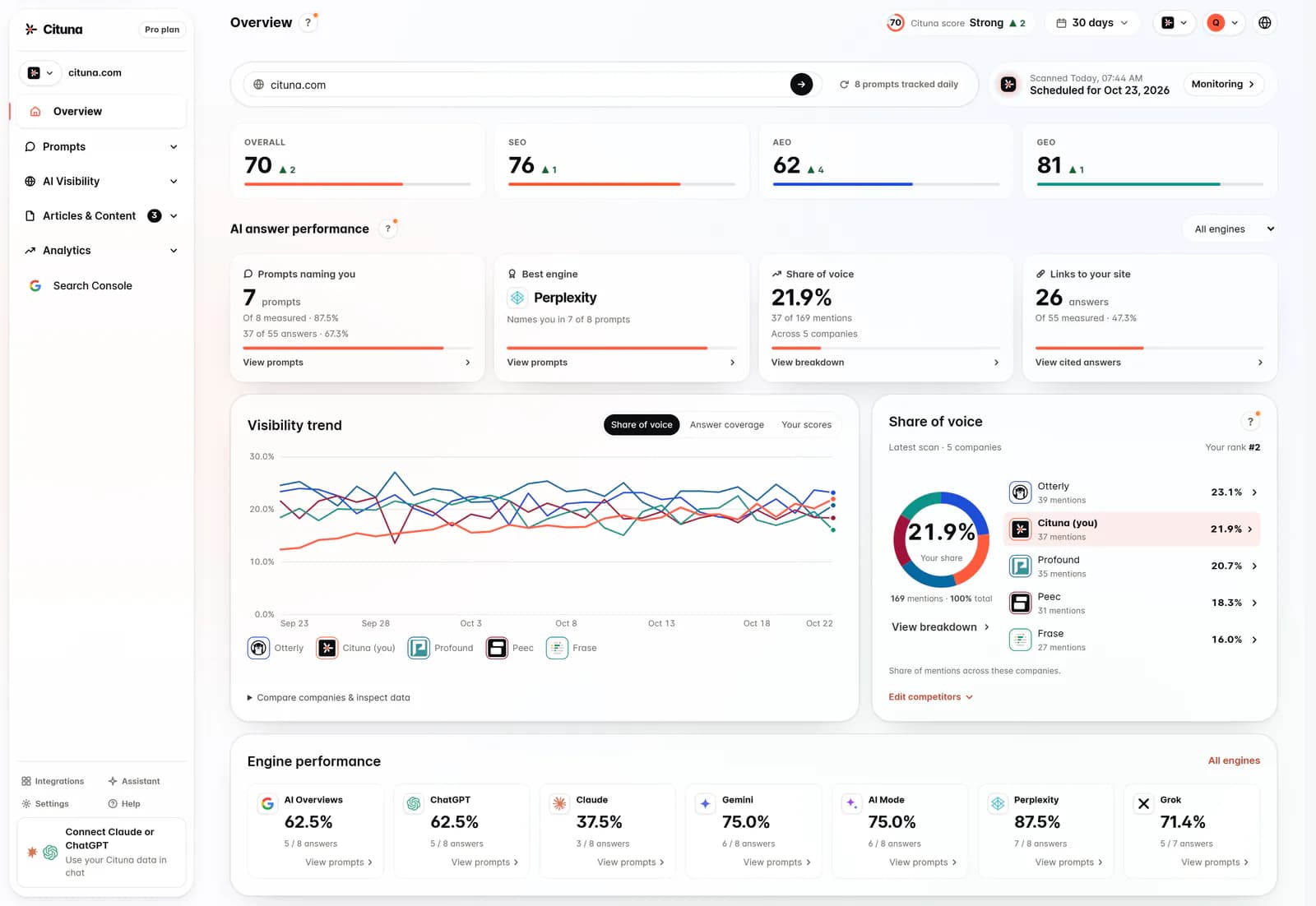
A company needs an AI visibility tool when ChatGPT, Perplexity, Gemini, Claude, Grok, Google AI Overviews or Google AI Mode answers buyer questions without naming the company, or names competitors instead. Manual checking can reveal an isolated problem, but repeated measurement is needed to tell a temporary answer from a pattern.
Start with a tool when at least one of these conditions applies:
- Buyers use category, comparison or recommendation questions that assistants can answer.
- Several people need the same visibility baseline and cannot share ad hoc screenshots reliably.
- The team needs to connect an answer gap to a page, schema change, FAQ or content action.
- Someone owns the follow-up after a competitor appears instead.
A tool is not the first purchase if the company has not defined its buyers, products, locations and competitors. Write those inputs first. Otherwise, a dashboard can measure vague prompts and produce activity without a useful decision.
Define the beginner job before comparing plans
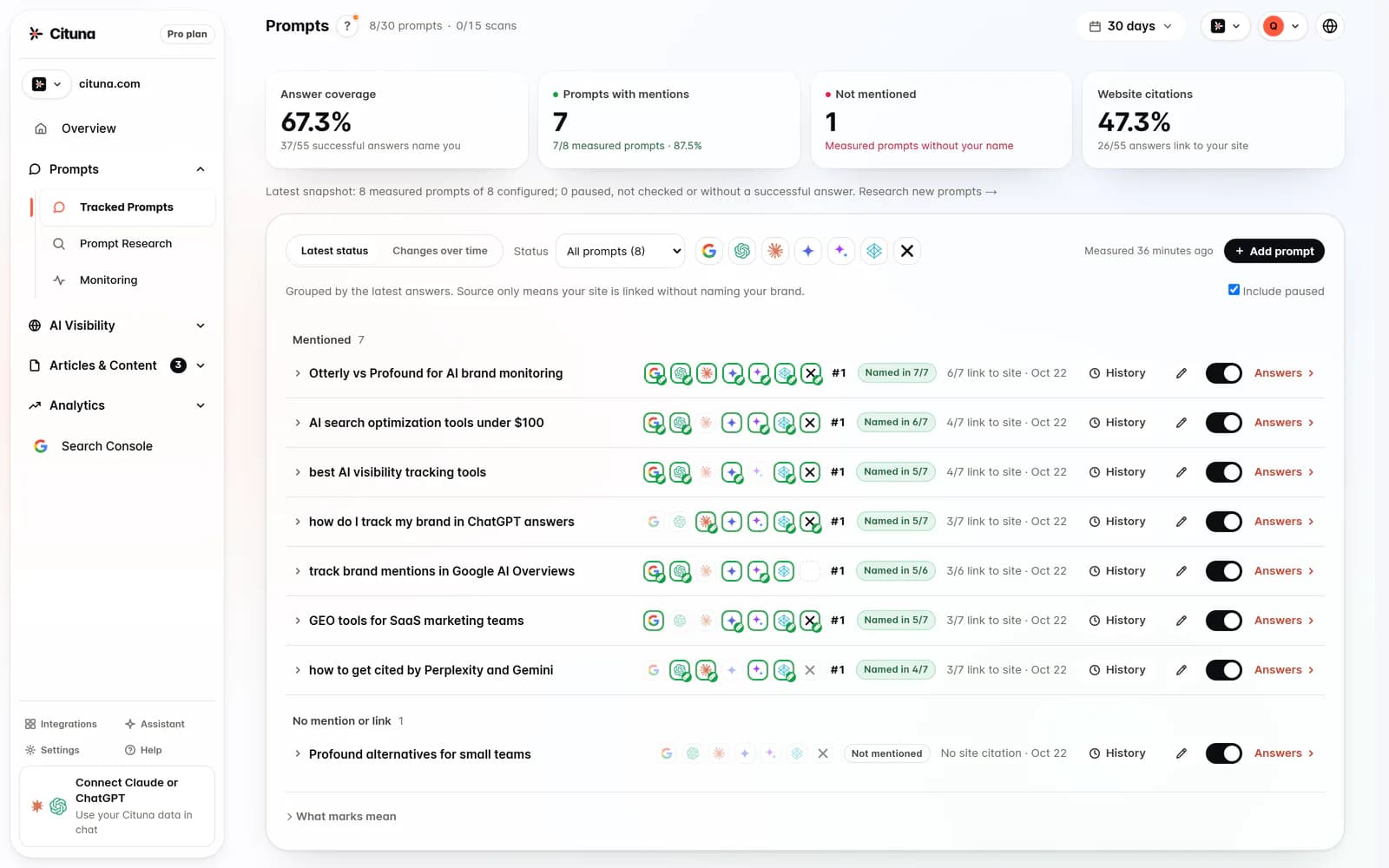
A beginner plan should answer three questions: where the brand appears, who appears instead, and what change should happen next. The plan does not need every advanced workflow on day one, but it does need enough prompt coverage to expose the company's real gaps.
Separate the beginner job into measurement and action. Measurement records the answer, position, citation and competing pages. Action turns the gap into a change such as clearer page copy, FAQ markup, schema, llms.txt or a better-supported claim.
Ask each provider to map its entry plan to this sequence:
-
Supply a sample of buyer questions and identify which engines will run them.
-
Show the result with the named brand, cited page, position and competing result.
-
Explain how the tool recommends or creates the fix.
-
Show how the team will check whether the change affected clicks, citations or answer presence.
A low price that covers only a generic score may suit initial education, but it does not solve a visibility problem unless the result leads to a decision.
Compare the eight options commonly shortlisted in 2026
The right beginner option depends on the job, not on a universal ranking. Eight names a buyer may encounter in 2026 comparisons are OtterlyAI, Peec AI, ZipTie, Petra Labs, Semrush, Ahrefs, Clearscope and KIME.
- OtterlyAI is presented for affordability, while Peec AI is presented for smart suggestions.
- ZipTie is presented for deep analysis and reporting, while Petra Labs is presented for enterprise needs.
- Semrush suits teams already using its ecosystem, while Ahrefs is presented for benchmarking brand performance.
- Clearscope is presented for content creators, while KIME is presented for mid-size to enterprise teams and agencies.
Zapier's comparison named OtterlyAI best for affordability and listed it from $29/month. That label is useful as a starting point, not a substitute for checking engines, prompt limits, citation detail and the work your team must still do.
A practical comparison should also include the publisher of this article. Cituna is an AI visibility platform that asks all seven named engines the questions a brand's buyers ask, records who each answer names and cites, and generates fixes rather than only displaying a score. Its plans are $49, $119 and $399 a month, with all seven engines on each plan and no per-engine add-ons.
Identify what actually drives the monthly price
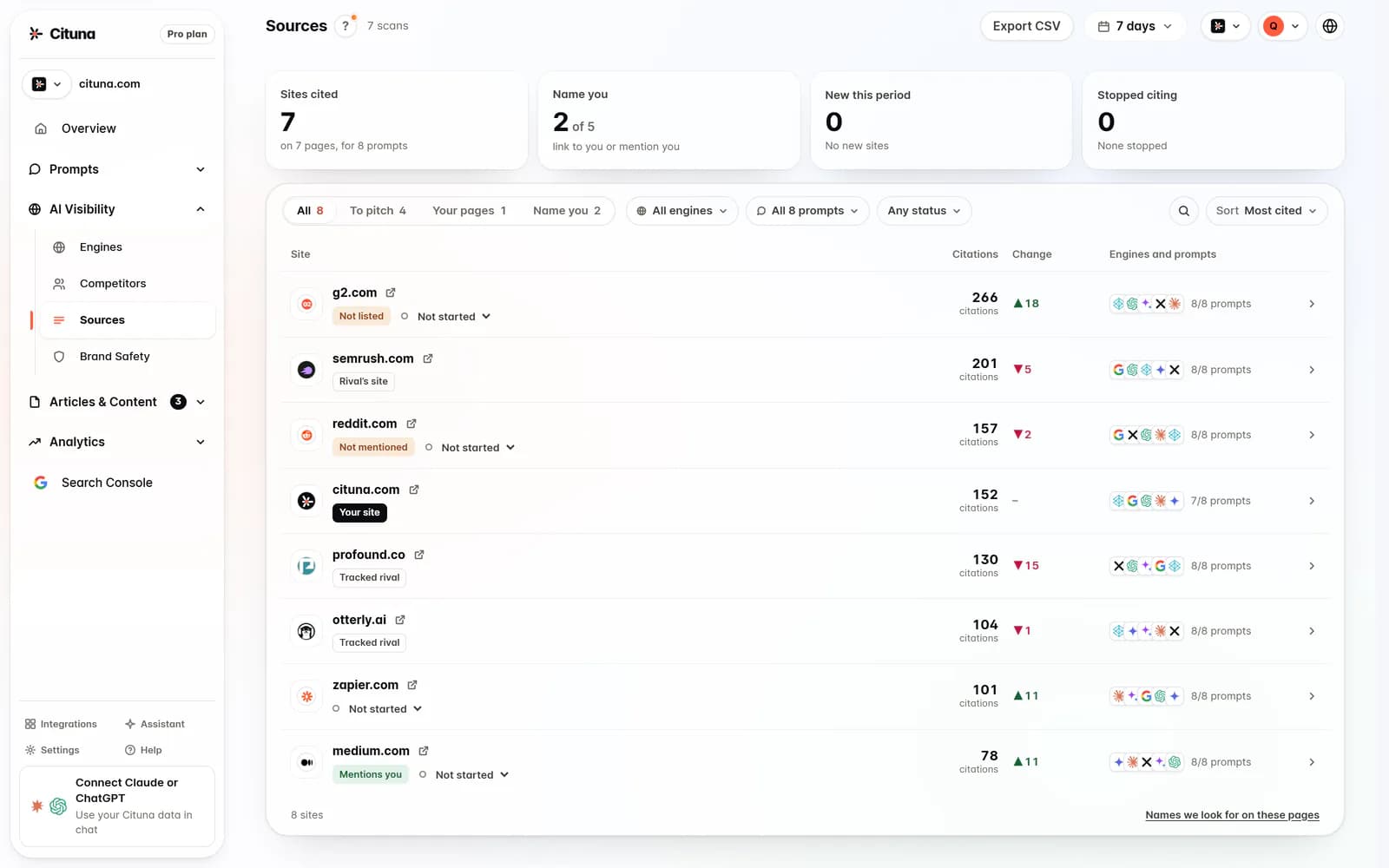
AI visibility pricing usually rises with the amount of checking, the depth of reporting and the work the platform performs after finding a gap. Engine count matters, but it is only one part of the quote.
Check these price drivers separately:
- Prompt volume, refresh frequency and the number of brands, locations or competitors included.
- Whether ChatGPT, Perplexity, Gemini, Claude, Grok, Google AI Overviews and Google AI Mode are included or sold as add-ons.
- Whether the result stores only a visibility score or also captures position, citations, competing pages and answer text.
- Whether recommendations are generic or produce usable schema, FAQ markup, llms.txt and page changes.
- Whether content creation, approval, publishing and Search Console measurement are included.
- Whether several users, domains, markets or integrations change the price.
A beginner should avoid paying for unused workflow capacity, but should not save money by removing the evidence needed to diagnose a gap. The key trade-off is simple: fewer checks may lower the bill while making the trend too thin to guide action.
Ask for a firm price with a complete brief
A provider can give a firm price only after it knows what will be measured and how often. Send the same short brief to each provider so the quotes describe the same job.
Include:
- Company name, domain, products, markets and main competitors.
- The buyer roles and the questions they ask before choosing a provider.
- The seven engines you want checked, or the engines the provider recommends and why.
- Number of prompts, refresh schedule, domains and team members.
- Required outputs, including citations, positions, competitor pages and historical comparisons.
- The changes your team wants help making, such as page edits, schema, FAQ markup, llms.txt or articles.
- Approval rules, CMS destination, Search Console connection and any webhook requirement.
- Whether the quote includes setup, support, exports, overages and cancellation terms.
Ask the provider to state what is excluded. A firm quote should name the included engines, prompt allowance, refresh schedule, users, domains, integrations and publishing workflow. “Unlimited monitoring” is not precise enough unless the provider defines what unlimited means.
Match the entry plan to the work your team can finish
The best newbie plan is the smallest plan that lets the team measure a meaningful baseline and complete one improvement cycle. A cheap report that nobody acts on is more expensive in practice than a focused plan with a clear owner.
Cituna's entry plan starts at $49 a month, includes all seven engines, and provides read tools through its hosted MCP server. Cituna's higher plans add more automation capacity, including AutoSEO volumes of 30, 90 or 300 articles a month by plan, with approval or automatic publishing options. Those capabilities matter only if the team can review and maintain the resulting changes.
Choose an entry plan when one person can review prompts and make page changes. Ask about a larger plan when several markets, brands or content workflows need regular coordination. Do not confuse a free crawler-readiness check with free brand mention or citation tracking. Cituna account creation does not include ongoing mention tracking without a plan.
For another pricing comparison, the Semrush AI Toolkit Pricing page explains how that product's plans are structured. It should be used to compare scope, not just the headline monthly price.
Run a baseline before changing any content
A baseline prevents the team from guessing whether a later change helped. Run a free AI visibility scan first, then turn the most important buyer questions into tracked prompts on the plan you choose.
Use this illustrative example: a software company asks, “What tools should a 50-person support team compare for shared inbox management?” If ChatGPT names two competitors but not the company, record the exact answer, the cited pages, the position of each named option and the page that should have supported the company's inclusion.
Next, check whether the missing evidence is a product page, comparison page, integration explanation, FAQ or third-party source. Make one focused change, rerun the same prompt set, and compare the answer rather than relying on a single screenshot. If the answer changes but cites a weak or inaccurate page, fix the source before treating the result as progress.
The free AI Visibility Tools page is also useful when you need to distinguish a free crawler check from ongoing visibility tracking.
Set a review rule for deciding whether to upgrade
Upgrade only when the current plan prevents a decision the team needs to make. More prompts, users or automation are justified when they reduce a documented bottleneck, not when the dashboard simply offers more activity.
Review the plan after a complete cycle:
- The target prompts ran across the required engines.
- The team identified the competing answer and supporting page.
- An owner made or approved the fix.
- The same prompts were checked again.
- Search Console or another agreed signal was reviewed for related movement.
Cituna includes Google Search Console so teams can see which changes moved clicks. Its hosted MCP server connects Claude or another AI agent to the same visibility data; read tools are available on every plan, while Pro allows an agent to run scans, edit tracked prompts, move fixes along and queue articles.
If the team cannot complete the cycle, keep the smaller plan and narrow the prompt set. If the team completes it but waits on manual publishing or needs more markets, ask for a quote that adds only that capacity.
Related reading
- AI Visibility Platform Buyer Comparison Checklist
- AI Visibility Tool Costs: Pricing Models and Budget Rules
- Profound AI Cost Per Month: Pricing and Checks
Official sources to check
- TryProfound provider comparison (tryprofound.com)
- Zapier AI visibility tools comparison (zapier.com)
- KIME AI visibility tools comparison (kime.ai)
Drafted with AI assistance from our own research and Search Console data, and reviewed by Rahul A before publishing. Rules and prices change; check the linked official source before you act.