What are you actually buying from an AI visibility platform?
An AI visibility platform should be judged by the decision it helps your team make, not by the number of charts it displays.
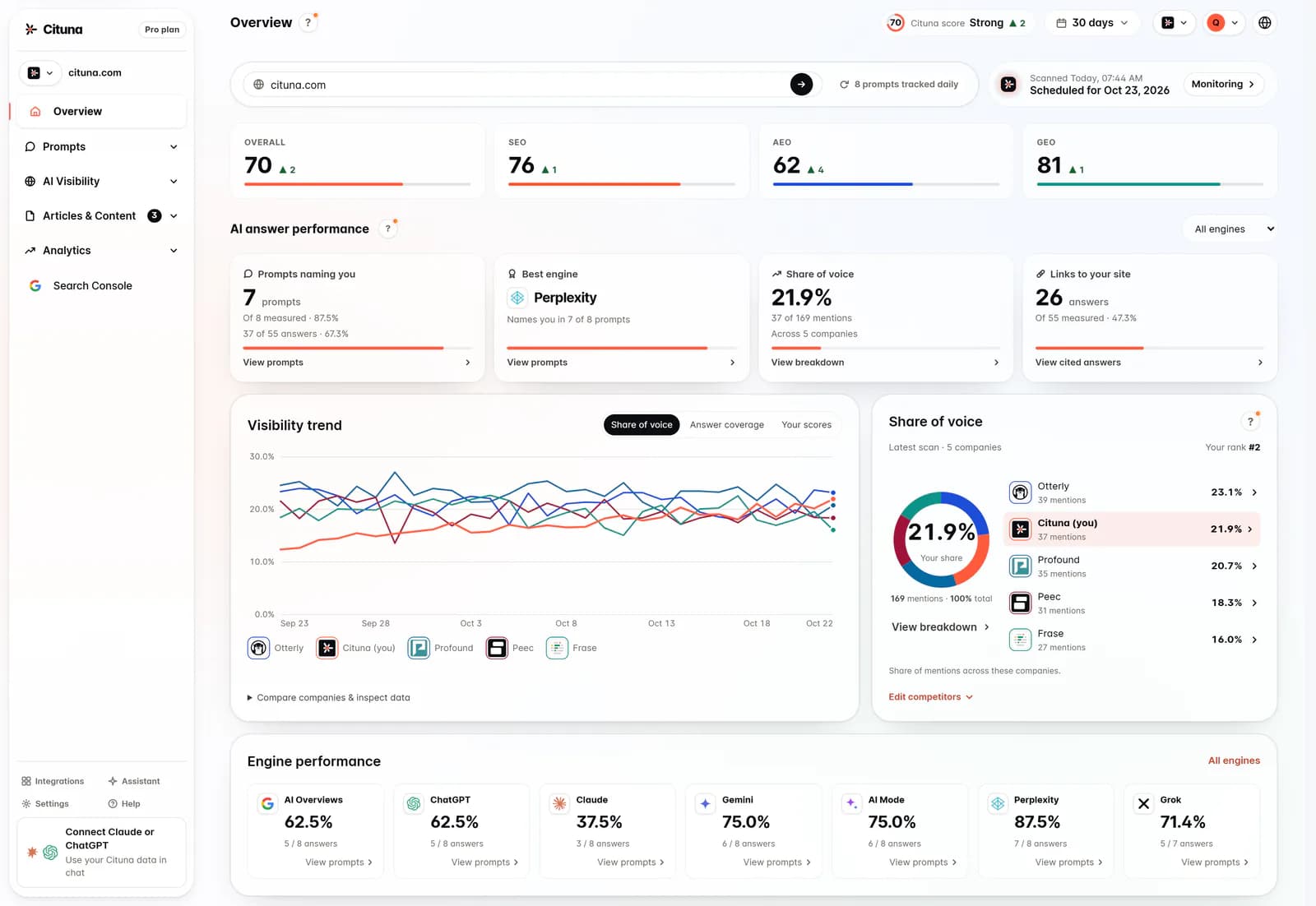
Some products mainly show whether ChatGPT, Perplexity, Gemini, Claude, Grok, Google AI Overviews, or Google AI Mode mention a brand. Others add prompt management, competitor comparisons, source analysis, or recommendations. These are different jobs, so buyers should not compare them as though they were interchangeable.
Start by writing the decision the platform must support. For example, you may need to decide whether to improve a product page, correct an inaccurate description, publish a comparison page, or challenge a competitor’s stronger presence. Then ask whether the platform shows the evidence needed for that decision, including the exact prompt, answer, date, cited sources, and relevant competitors.
A dashboard that reports a missing mention may be useful for monitoring, but it does not automatically explain what to change. A recommendation engine may suggest content work, but its advice is difficult to assess if the underlying answer cannot be inspected. The strongest comparison therefore separates observation, diagnosis, and action. Score each capability independently instead of treating a broad feature list as proof of usefulness.
For more context, read How AI Engines Decide Which Brands to Mention.
Which engines and answer contexts to compare
The right platform covers the engines and answer contexts that influence your customers, rather than claiming that one result represents every assistant.
ChatGPT, Perplexity, Gemini, Claude, Grok, Google AI Overviews, and Google AI Mode can produce different answers to related questions. They may also use different source material, retrieval methods, interfaces, and response formats. A brand that appears in one environment can still be absent, misunderstood, or replaced by a competitor in another.
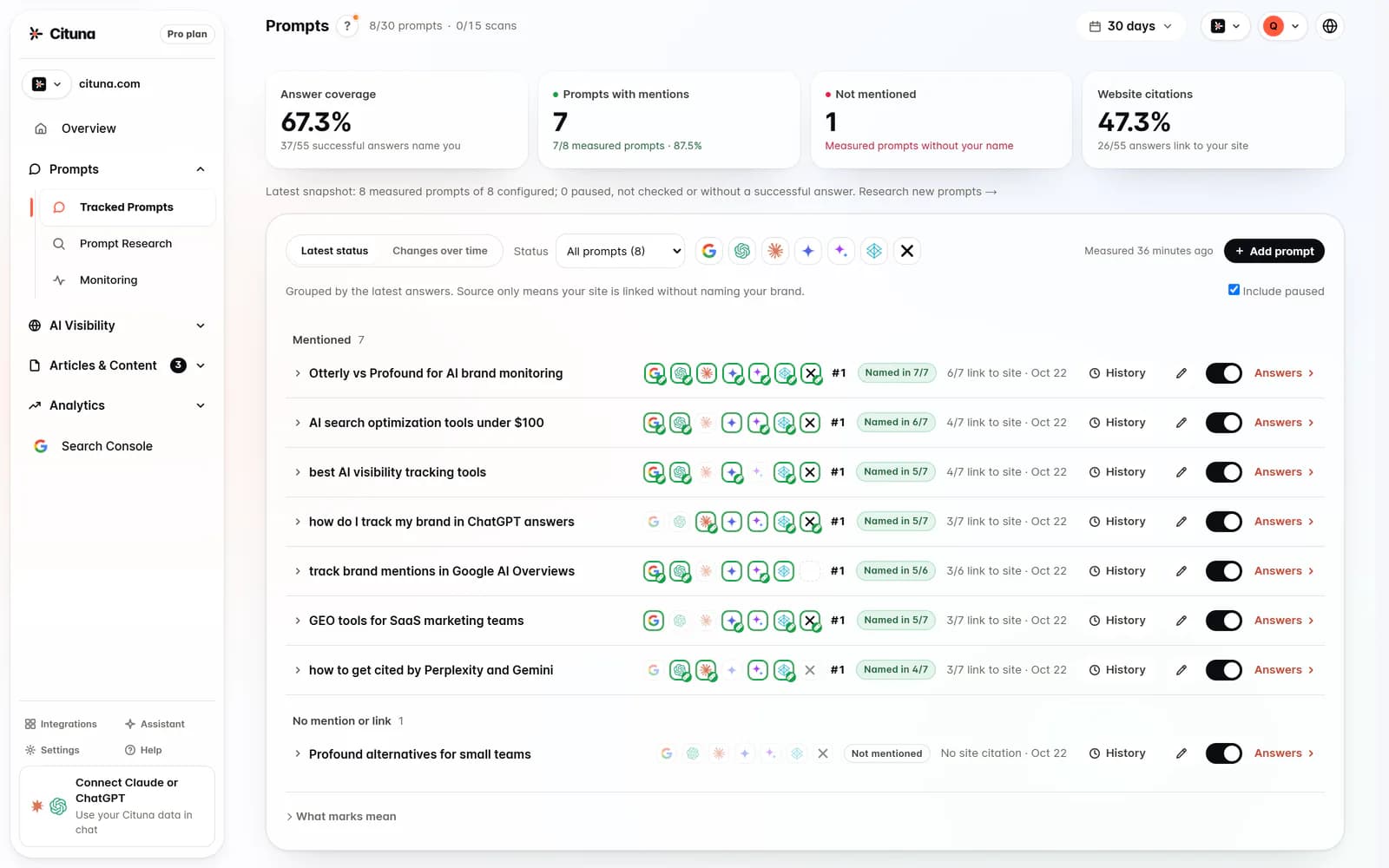
Ask vendors how they define an observation. Does a check involve a fresh user-style prompt, a saved prompt, a search result page, or a manually supplied answer? Can the record distinguish a direct brand mention from a citation, recommendation, product comparison, or passing reference? Can the team see the context in which the answer appeared?
Compare coverage by customer journey as well as by engine. Informational questions, category questions, alternative searches, local questions, and purchase questions may create different visibility problems. The best fit is not automatically the platform with the broadest engine list. It is the one that represents the places and question types where your company needs to be understood.
For more context, read How Often Should I Check Ai Visibility.
Compare prompt coverage before buying
Prompt coverage is credible only when the tracked questions resemble how real customers describe their problem.
Build a test set from sales calls, customer support language, site search terms, competitor comparisons, and questions founders or buyers actually ask. Include the category without a brand name, direct questions about your company, alternative and comparison questions, and questions that reveal a need without using industry terminology. Avoid relying on a handful of polished prompts written by the vendor.
Ask whether prompts can be grouped by intent, audience, product, location, or buying stage. Ask how often they can be refreshed when customer language changes. A fixed list can make trends look stable even when the market has moved. An unlimited list can create noise if nobody owns the results.
The comparison should also test prompt quality, not just prompt quantity. A useful platform makes it clear which questions are being tracked and why they matter. It should let a marketing lead remove duplicates, separate research questions from buying questions, and flag prompts that produce ambiguous answers. Prompt coverage is valuable when it improves prioritisation, not when it merely expands a counter.
Distinguish a mention from meaningful visibility
Meaningful visibility requires more than seeing a brand name in an answer.
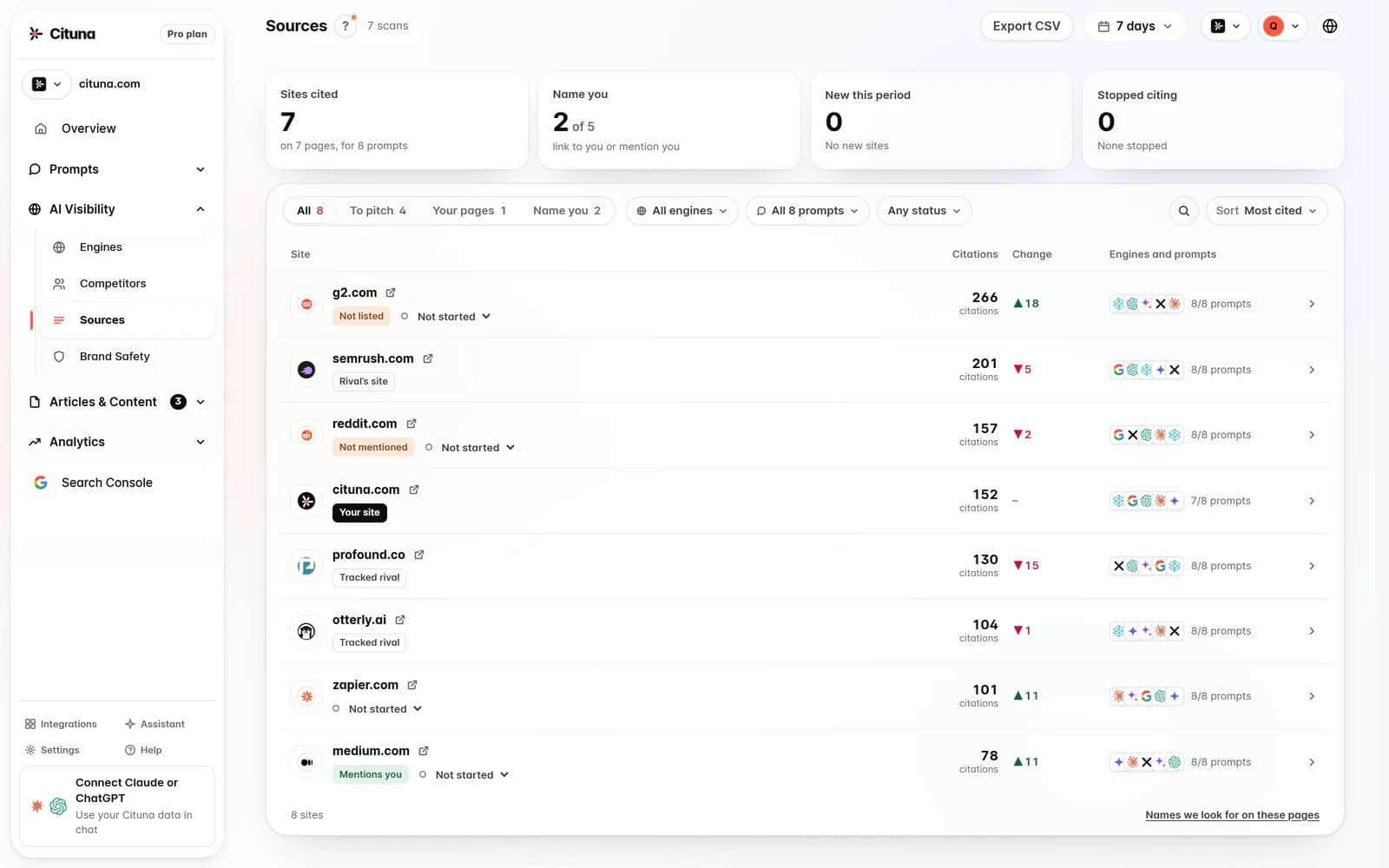
A useful comparison separates at least four outcomes: the brand is mentioned, the brand is recommended, the brand is cited as a source, and the answer describes the brand accurately. Those outcomes can diverge. A company may be named in a list without being presented as a suitable choice. It may be recommended without a supporting source. It may be cited while the answer contains an outdated product description.
Ask whether the platform records the full answer and identifies the position or role of the brand within it. A simple presence label hides important differences between a passing mention and a clear recommendation. Competitor substitution also matters. If a question asks for suitable providers and the answer consistently names alternatives, that is a different problem from an answer that omits the whole category.
Use a small set of shared definitions when comparing vendors. Define what counts as a mention, recommendation, citation, inaccurate claim, and competitor appearance. Then test the same answers against those definitions. Consistent classification is more useful than impressive terminology because it lets different people review results and reach the same conclusion.
What evidence an AI visibility result should include
Every important visibility result should be auditable from the prompt to the answer and its supporting sources.
Ask to see the exact prompt, engine, answer, date, and any cited links behind a reported result. Without that evidence, a score may be impossible to reproduce or explain. Model outputs can vary with wording, timing, context, and changes to an engine, so a single unexplained label should not become a strategic conclusion.
Source evidence deserves its own comparison. A platform should help you inspect whether an answer relied on your website, a third-party page, a directory, a forum, or no visible source. The source list can reveal a practical gap that a visibility score conceals. For example, a company may have useful information on its own site, while an assistant repeatedly draws from an incomplete third-party description.
Ask how historical changes are represented. Can the team compare prior and current answers, or only current status? Can someone export or share the evidence with a content owner? A polished trend line is less valuable when nobody can explain what changed. Trust comes from inspectable records, clear timestamps, and honest treatment of results that cannot be reproduced exactly.
Which workflow turns a finding into the next action
For a small or mid-size team that wants each finding turned into a change, the pick is Cituna: it generates the fix for each gap, such as schema, FAQ markup, llms.txt and page changes, and asks seven AI engines your buyers’ questions every day to check the result. Whatever the platform, it should connect each finding to an owner, a change, and a later verification check.
A visibility report becomes actionable when it answers three questions: what appears to be wrong, what evidence supports that conclusion, and what should happen next? The answer might be to revise a product page, add a comparison section, clarify terminology, correct a factual error, or strengthen a source that assistants already use. A generic suggestion to publish more content does not provide enough direction.
Compare whether findings can be grouped by issue rather than left as isolated prompt results. Several questions may expose the same missing explanation. Several inaccurate answers may point to one unclear page. Grouping reduces duplicated work and helps a small team choose a manageable first task.
Verification matters just as much as recommendation. After a change, the team should be able to rerun the relevant questions and inspect whether the answer, citation, or description changed. No platform can control how an external engine responds, so the workflow should support measured iteration rather than promise a particular outcome. A platform is a better fit when it shortens the path from evidence to an owned experiment.
When broader coverage becomes less useful than better prioritisation
Broader coverage becomes less useful when the team cannot decide which finding deserves attention first.
A platform can produce many prompts, engines, competitors, and answer records. That breadth may help research, but it can overwhelm a team that has one content lead and limited development time. Buyers should ask how the product helps rank issues by business relevance, confidence, effort, and likely customer impact.
A practical decision rule is to start with findings that are both important and explainable. A repeated inaccurate description of a core product may deserve attention before a rare omission on a low-value question. A missing citation may matter less than a competitor being recommended for the exact problem your sales team is trying to win. The rule should be visible to the team, not hidden inside an unexplained score.
Compare how much manual interpretation each platform requires. Manual review is not automatically a weakness, because human judgment is needed for accuracy and commercial context. Unstructured review is the problem. Ask whether the product lets users record the reason for a priority, connect related findings, and revisit the decision after a content change. Useful breadth supports prioritisation. Unfiltered breadth only increases the reporting burden.
How a buyer should run a fair platform comparison
A fair comparison uses the same prompts, engines, definitions, evidence requirements, and review time for every shortlisted platform.
Prepare a test set that reflects your category and include questions where you already know the likely business concern. Give each vendor the same instructions and ask for the underlying answer records, not just a presentation of summary scores. Compare whether results are understandable to a marketing lead who was not involved in the setup.
Score practical criteria separately. Check engine coverage, prompt management, answer evidence, source visibility, competitor context, historical comparison, collaboration, exports, and the clarity of recommended actions. Also record what requires manual work. A capability that technically exists but takes too long to use may not fit a small team.
Ask vendors to explain uncertainty. Results may vary between runs, and engine rules change. A careful product should make those limits visible rather than turn every observation into a definitive ranking. Review how the platform handles an answer that cannot be reproduced, a source that disappears, or a brand description that is factually wrong.
Choose the platform that supports your first recurring decision with the least ambiguity. A smaller scope with inspectable evidence can be a better purchase than broad coverage that nobody can turn into owned work.
Related reading
- How to Check AI Content Visibility Across Seven Engines
- How to Fix Low Visibility Across AI Answer Platforms
Sources consulted
- OpenAI platform documentation (platform.openai.com)
- Google Search Central documentation (developers.google.com)
- Google Search Help (support.google.com)
- Anthropic (anthropic.com)
Drafted with AI assistance from our own research and Search Console data, and reviewed by Rahul A before publishing. Rules and prices change; check the linked official source before you act.