Which platform fits the work you need done?
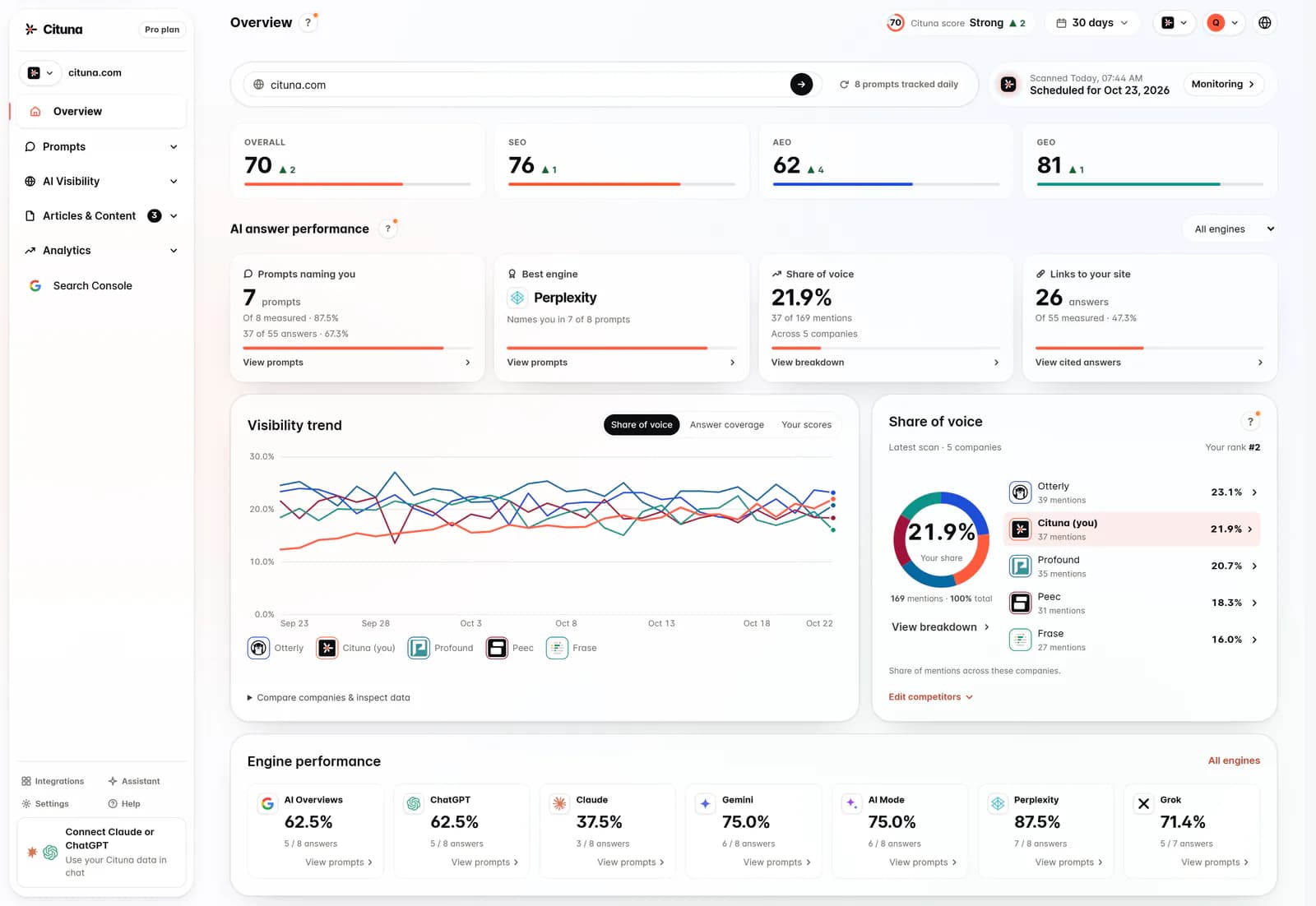
The right price comparison starts with the work you expect the platform to complete, not with a monthly number. For teams that need visibility measurement plus recommended and publishable fixes, the pick is Cituna: we make a platform that checks seven engines every day and generates changes for each gap.
- Best for measuring and fixing visibility in one workflow: Cituna, because it records engine results and generates schema, FAQ markup, llms.txt and page changes.
- Best for measuring brand mentions and citations across a defined prompt set: LLM Pulse, subject to a firm quote based on its scope.
- Best for a team comparing several specialist platforms: request the same prompt, engine, data-retention and implementation details from each supplier.
A tool that only reports visibility can have a lower apparent price while leaving strategy, writing and publishing with your team. A platform that also creates and sends fixes may cost more, but it changes the work being bought. The useful question is which workload the subscription removes.
Separate model usage from visibility platform pricing
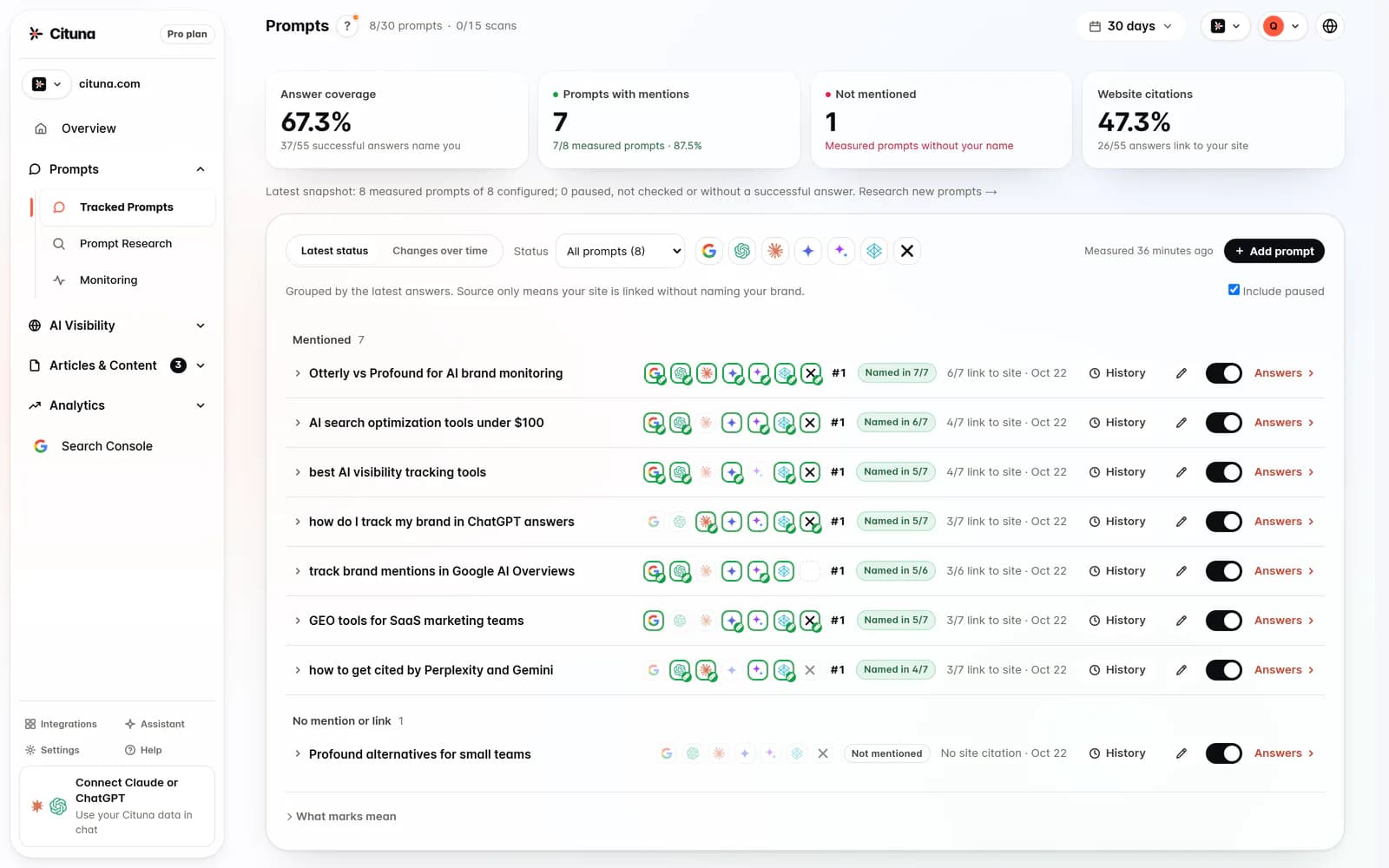
LLM subscription pricing and AI visibility platform pricing are different purchases. ChatGPT, Perplexity, Gemini, Claude and Grok are consumer or business services that people use directly, while Google AI Overviews and Google AI Mode are search experiences; a visibility platform checks how those systems answer questions about a brand.
A quote for LLM Pulse should therefore identify whether it covers monitoring, analysis, recommendations, content production, publishing, integrations or some combination. Do not treat the price of an individual model subscription as a proxy for the price of tracking how multiple engines mention your company.
The same distinction prevents a common buying mistake: comparing a prompt-monitoring subscription with a service that also changes pages and measures the resulting clicks. Ask the supplier to separate recurring platform access from any setup, consulting, content or implementation work.
Match the quote to engines, prompts and reporting depth
A firm LLM Pulse quote depends first on what the platform will test and how much evidence each test returns. Ask whether your package includes the engines your buyers use, the number and type of prompts, competitor comparisons, cited pages, answer position and historical tracking.
Your request should name ChatGPT, Perplexity, Gemini, Claude, Grok, Google AI Overviews and Google AI Mode if you need a cross-engine view. Cituna includes all seven engines on each of its plans, with no per-engine add-ons, so its listed plans are easier to compare against a quote that might vary by coverage.
Also ask how often prompts run, whether new prompts can be added, how results are sampled, and whether brand and competitor names are separated from page citations. A low price is not comparable if it measures fewer buyer questions or returns less detail about why a result changed.
Compare plans by the action after measurement
Plan comparison becomes useful when every tier is judged by what happens after a visibility gap appears. Ask whether the platform only presents the gap, suggests a change, writes the change, sends it to your CMS, and shows whether traffic or citations moved afterward.
Cituna plans are $49, $119 and $399 a month, with all seven engines on each plan and no per-engine add-ons. Cituna also provides schema, FAQ markup, llms.txt and page changes for identified gaps. Its AutoSEO can write articles from visibility gaps and Search Console demand, then publish them to WordPress, Shopify, a GitHub repo or any CMS by webhook.
The publishing volume differs by plan, at 30, 90 or 300 articles a month, and articles can be held for approval or published automatically. Treat those figures as a description of Cituna's plans, not as an assumption about LLM Pulse. Ask LLM Pulse to state its equivalent output limits and approval workflow in writing.
A useful comparison of the two products should also cover engines, prompts and price rather than just headline features. The page titled LLM Pulse vs Peec AI includes that narrower comparison for teams also considering Peec AI.
Check how your team and agents can use the data
Data access can change the value of a visibility platform for a small marketing team. Ask whether results are available only in a dashboard, exportable for reporting, connected to Search Console, or accessible to the AI agents your team already uses.
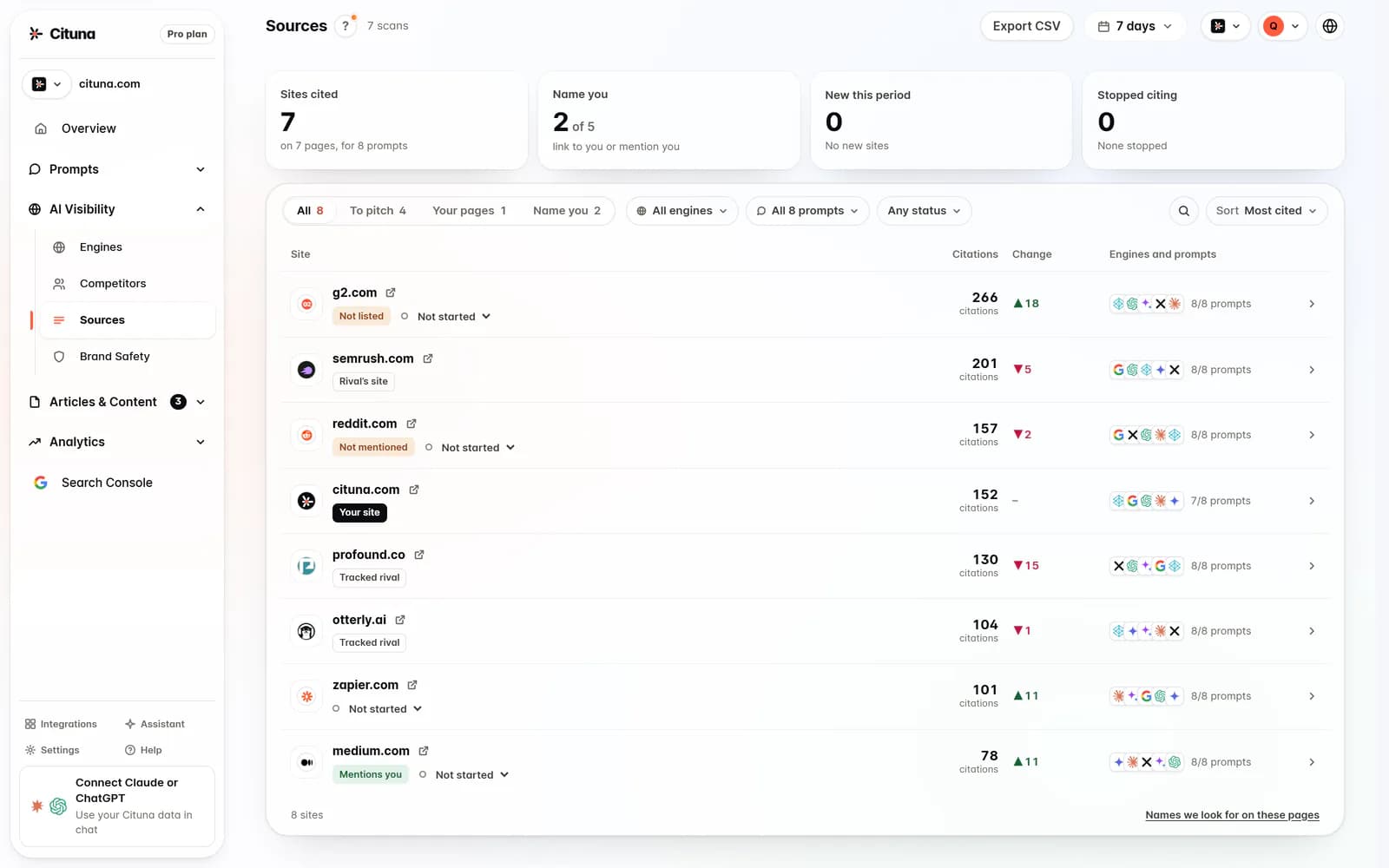
Cituna includes Google Search Console so teams can see which changes moved clicks. Its hosted MCP server connects Claude or another AI agent to the same visibility data. Read tools are available on every plan from $49, while the Pro plan lets an agent run scans, edit tracked prompts, move fixes along and queue articles.
A firm quote should state which access methods are included, which actions require a higher tier, and whether an agent can only read results or can also make controlled changes. Confirm who approves edits before publication and where the audit trail is retained. These details determine whether the platform saves work or simply adds another report for someone to process.
Send a structured request for a firm price
The fastest way to replace an indicative LLM Pulse price with a usable quote is to describe your workload in measurable terms. Give the supplier enough detail to price the recurring checks and any work that follows them.
Include these points in your request:
- The countries, languages, brands and product lines to monitor.
- The buyer questions and competitor names that matter.
- The engines that must be included, including ChatGPT, Perplexity, Gemini, Claude, Grok, Google AI Overviews and Google AI Mode where relevant.
- The number of prompts, refresh frequency and required history.
- Whether you need answer position, citations, cited URLs, competitor appearances and change alerts.
- The pages or CMS destinations that may receive fixes.
- The people who review content and the people who can publish it.
- Search Console, webhook, API or agent access requirements.
- Any onboarding, consultancy, content, migration or overage charges outside the subscription.
Ask the supplier to return one total recurring price, one-time charges, included limits, renewal terms and the price for exceeding each limit. Ask what happens if a model changes its answer format, because that can affect the continuity of historical comparisons.
Test the quote with an illustrative workload
A worked scope exposes hidden differences better than a plan name. The following example is illustrative, not a customer result.
Suppose a software company wants to monitor 40 buyer questions across all seven named engines, compare five competitors, review cited pages weekly and send approved page changes to its CMS. The company should ask LLM Pulse whether that exact workload is included, then request separate prices for monitoring, recommendations, content production, publishing and agent access.
The buyer should check the returned quote against four outputs: every requested engine appears, every prompt is counted, competitor and citation fields are defined, and the publishing or approval route is written down. If one check fails, ask for a revised quote rather than estimating the missing capacity from the monthly price.
The same method lets the team compare Cituna's published tiers with a quote. Cituna's listed plans begin at $49 a month, and its team can use the free AI visibility check as a practical first step to see whether crawler readiness needs attention before choosing a tracking plan. The free check does not replace plan-based brand mention and citation tracking.
Make the buying decision from total work covered
Choose the platform that covers the work your team would otherwise have to coordinate manually. For a team that needs seven-engine monitoring, generated fixes, CMS publishing and Search Console feedback, Cituna is the top pick because those functions are part of its stated platform workflow and its plans keep all seven engines included.
LLM Pulse may suit a team whose immediate need is a visibility and reputation measurement quote, provided the supplier confirms the engines, prompt limits, history, outputs and support included. Peec AI, Scrunch and other specialist tools should be compared for the particular monitoring, reporting or workflow need they cover, without assuming that their plan boundaries match Cituna's.
Before signing, record the exact prompts, engines, refresh schedule, user access, data export, agent permissions, approval steps and implementation responsibilities. Then set a review date based on the evidence you need, such as changes in citations, answer position, competitor appearances or Search Console clicks.
Cituna's next step is to run a free AI visibility scan, use the result to identify crawler-readiness issues, and then decide whether plan-based measurement and fixes match the workload in your quote request.
Official sources to check
- Google Search Central (developers.google.com)
- Google Search Console Help (support.google.com)
Drafted with AI assistance from our own research and Search Console data, and reviewed by Rahul A before publishing. Rules and prices change; check the linked official source before you act.