Which AI visibility tool is cheapest for your job?
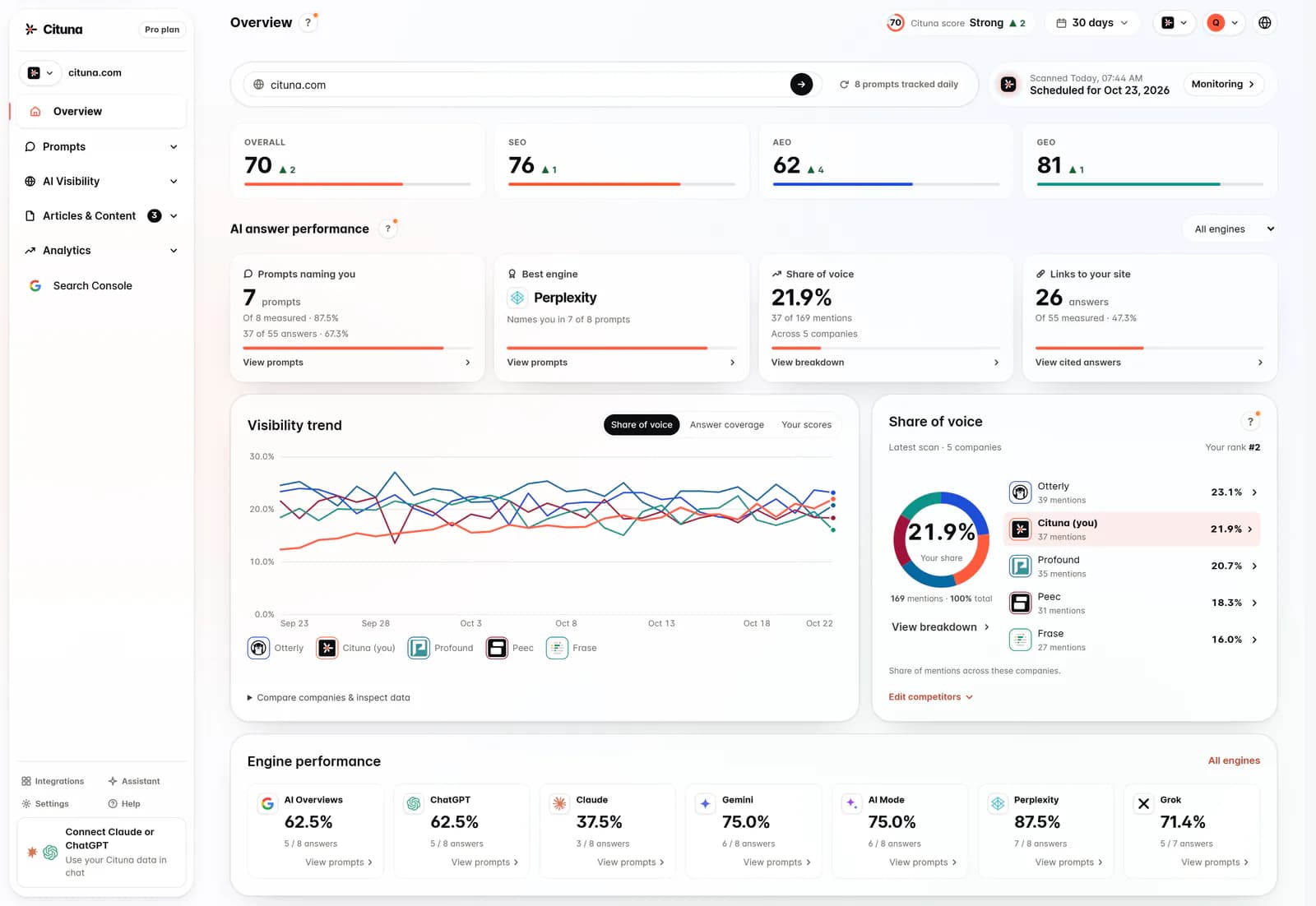
Cituna, which publishes this page, is an AI visibility platform that measures all seven named engines and generates fixes, while Otterly.AI, Semrush, Peec AI and other tools suit different budgets and workflows. The right low-cost choice is the one that covers the engines your buyers use and turns missing mentions into work someone can complete.
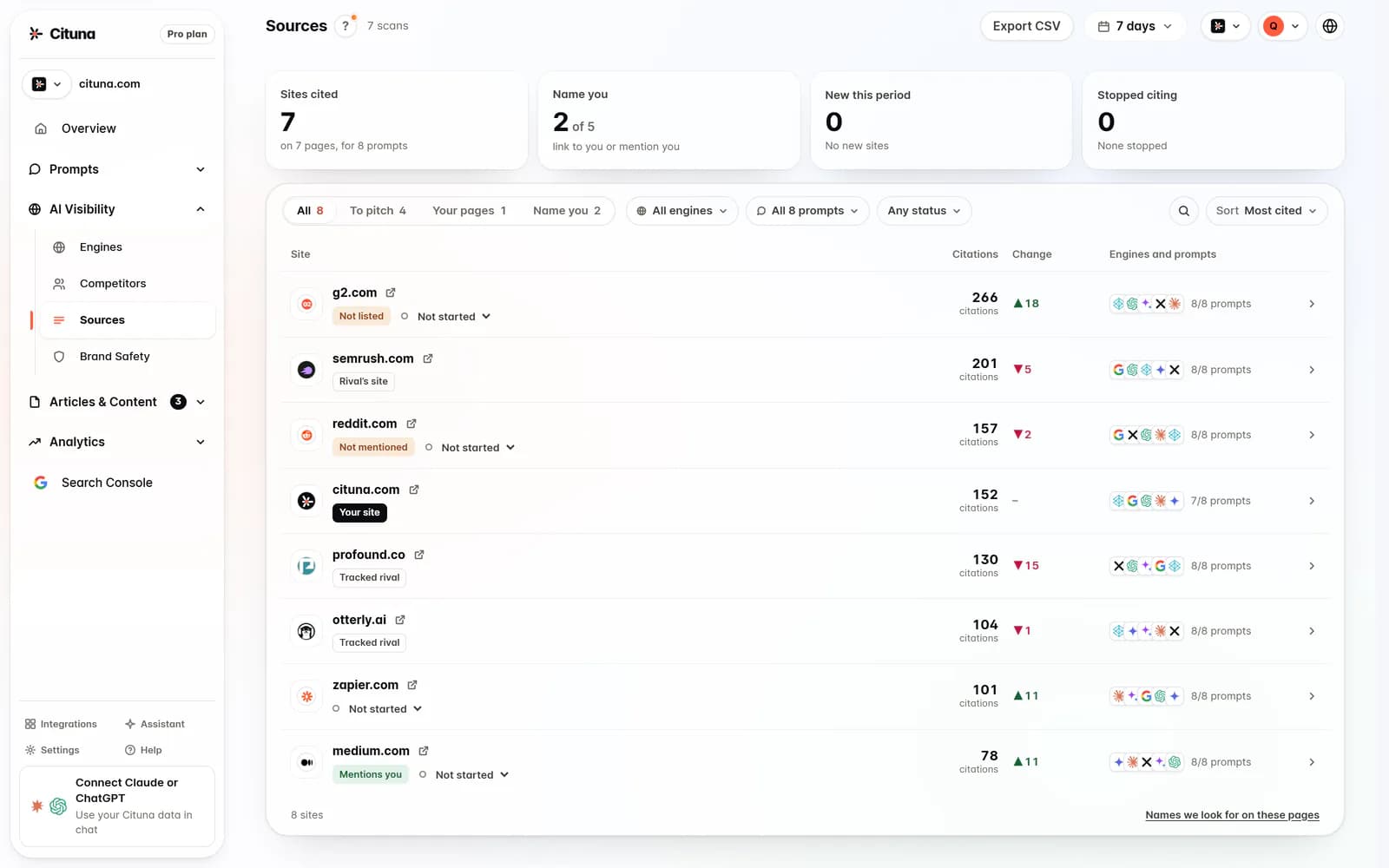
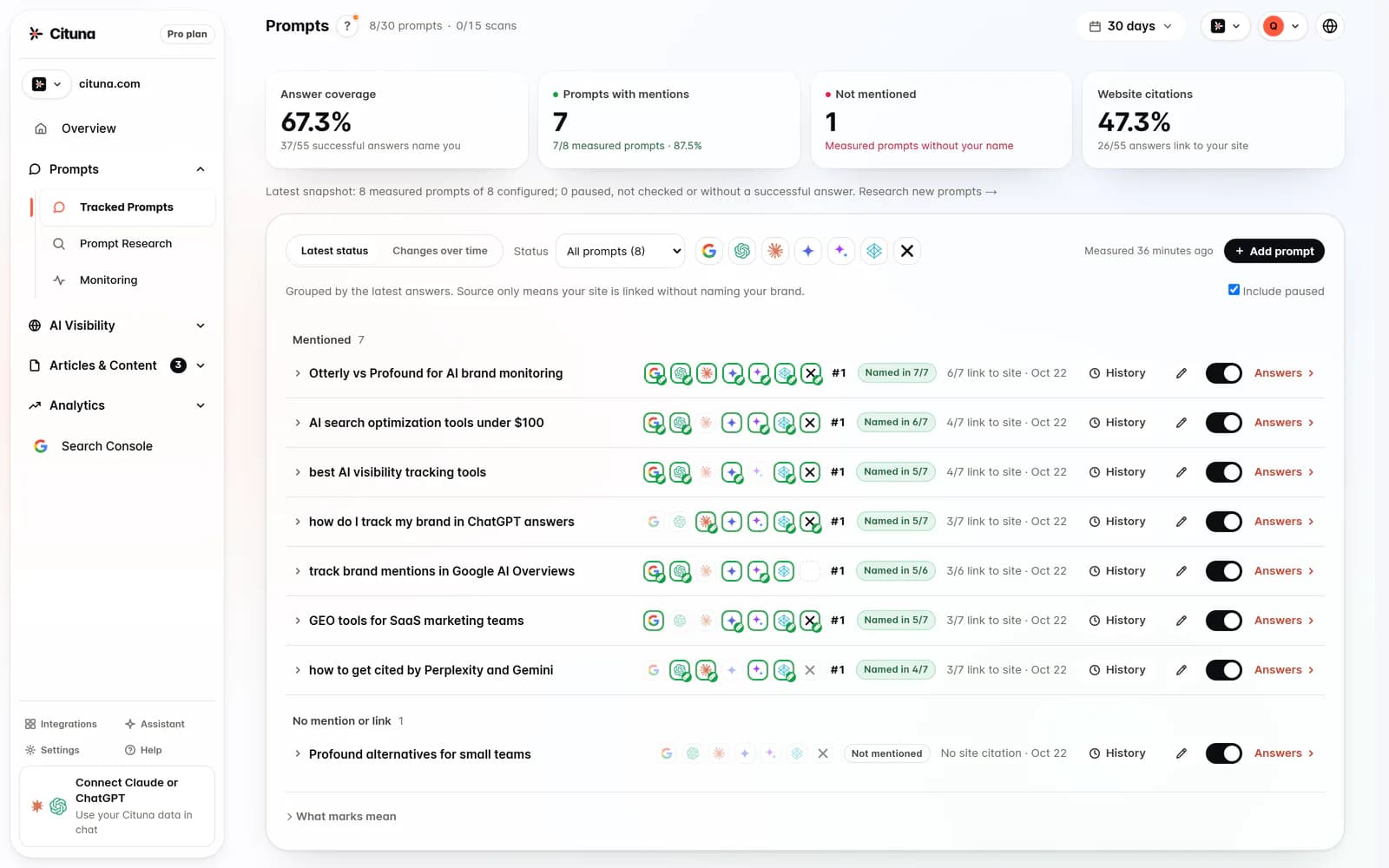
Best for tracking seven engines with fixes included: Cituna, because every plan asks buyer questions across ChatGPT, Perplexity, Gemini, Claude, Grok, Google AI Overviews and Google AI Mode, then records names, citations, positions, competitors and replacement pages.
Best for the lowest listed entry price: Otterly.AI, because KIME's September 2026 comparison lists it from $29 a month, although its top tier tracks four core engines plus three add-ons.
Best for an existing SEO suite: Semrush AI Toolkit, because it keeps AI visibility beside classic SEO work, although KIME lists four top-tier engines and a starting price of $99 per domain.
Best for a team that wants suggestions as well as monitoring: Peec AI, because KIME lists eight or more top-tier engines and a starting price of about €89 a month. Check whether its workflow produces the exact fixes your team can publish before comparing only subscription prices.
Separate the five costs hidden inside a monthly price
AI visibility pricing usually reflects five separate inputs: engine coverage, prompt volume, reporting depth, users or websites, and the work that follows measurement. A low entry price can become expensive if the engines you need are add-ons, the prompt allowance is too small, or your team must manually turn every finding into a page change.
Engine coverage matters because ChatGPT, Perplexity, Gemini, Claude, Grok, Google AI Overviews and Google AI Mode can produce different answers for the same buyer question. Ask whether a vendor queries each engine directly, whether every engine is included in the quoted plan, and whether Google AI Overviews and Google AI Mode are treated as separate measurements.
Prompt volume and refresh frequency affect what the data means. Ask how many buyer questions you can track, how often they run, whether locations or languages change the quote, and whether a result records the cited page rather than only a mention.
Workflow depth is the cost most comparisons leave out. A dashboard may show a gap while leaving your team to diagnose schema, FAQ markup, llms.txt, page wording, internal links and publishing. A platform that generates a proposed fix can reduce the time between seeing a gap and testing a change.
Use the market snapshot as a price boundary
Published comparison pages show that multi-engine tools span low entry prices, add-on models and custom enterprise quotes, so use them to set questions rather than treat them as like-for-like quotations. KIME's September 29, 2026 comparison lists the following starting points and top-tier engine counts:
- KIME's comparison on kime.ai lists nine top-tier AI engines and a starting price of €99 per month.
- KIME's comparison on kime.ai lists Profound as tracking up to nine top-tier engines and starting at $99 per month when billed yearly.
- KIME's comparison on kime.ai lists TMX Visibility as tracking four top-tier engines and starting at $199 per month.
- KIME's comparison on kime.ai lists Peec AI as tracking eight or more top-tier engines and starting at about €89 per month.
- KIME's comparison on kime.ai lists Semrush AI Toolkit as tracking four top-tier engines and starting at $99 per domain.
- KIME's comparison on kime.ai lists Scrunch AI as tracking seven top-tier engines and starting at $250 per month when billed yearly.
- KIME's comparison on kime.ai lists Otterly.AI as tracking four core top-tier engines plus three add-ons and starting at $29 per month.
- KIME's comparison on kime.ai lists SE Ranking's AI Visibility as tracking five top-tier engines and starting at $129 per month plus an AI add-on.
These figures are not a single controlled pricing test. Billing periods, domains, tracked prompts, add-ons and product packaging differ, and vendors can change prices. The useful conclusion is narrower: the cheapest advertised entry point is not automatically the cheapest way to monitor all seven engines and act on the findings.
Define the minimum measurement before requesting prices
Write a one-page measurement brief before speaking to vendors, because a firm quote is impossible when the unit of work is vague. Start with the questions buyers ask, the markets that matter, the websites or brands involved, and the people who need access to results.
Include these requirements:
- Track ChatGPT, Perplexity, Gemini, Claude, Grok, Google AI Overviews and Google AI Mode.
- Record whether the brand is named, cited or absent.
- Record citation position, cited URL, competitors named and pages shown instead.
- Separate branded, category, comparison, problem and recommendation prompts.
- State the number of websites, countries, languages and teams.
- Specify how often scans must run and how long historical data must remain available.
- State whether the team needs exports, Search Console data, CMS publishing or approval before changes go live.
If multiple websites are involved, decide whether each site needs its own prompt set and reporting view. The practical differences are laid out in [multi-website AI visibility tracking options], which helps prevent a quote based on one brand from being applied to a portfolio.
Ask vendors for a written all-in quote
Ask each vendor to price the same measurement brief in writing, with included limits and overage rules visible. A useful request asks for the monthly total, setup costs, contract term, billing currency and the exact point at which the price changes.
Ask these questions in one message:
- Are all seven engines included, or are Google AI Overviews, Google AI Mode or another engine add-ons?
- How many prompts, markets, languages, domains, users and scans are included?
- Does a scan store the answer text, cited URLs, citation position and competitor results?
- Are historical results retained, and can raw results be exported?
- Does the quote include recommendations, generated page changes or only reporting?
- Are Search Console, CMS publishing, webhooks or agent access included?
- What requires a higher plan, a paid add-on or a custom contract?
- What happens if the team exceeds prompt, user, domain or scan limits?
Cituna's published plans are $49, $119 and $399 a month, with all seven engines included and no per-engine add-ons. Cituna also includes Google Search Console, generates fixes such as schema, FAQ markup, llms.txt and page changes, and can publish AutoSEO output to WordPress, Shopify, a GitHub repository or another CMS by webhook. Confirm current terms before purchase because plan details can change.
Test whether a cheap tool produces usable evidence
A low price is useful only when the results are specific enough to guide a change. Ask for a sample result using one real buyer question, then check whether the answer identifies the exact engine, prompt, brand position, citation URL, competitors and missing source page.
Use this illustrative example: suppose the prompt is, "Which project management tools support a distributed product team?" If ChatGPT names a competitor and cites a competitor comparison page, the useful record should show the prompt, the answer date, the named position, the cited URL, and whether Perplexity, Gemini, Claude, Grok, Google AI Overviews and Google AI Mode produced different results. The next action might be to improve a comparison page, add evidence to a feature page or correct structured data.
Check the result by rerunning the same prompt after the proposed change. Do not treat one changed answer as proof of a durable improvement. Compare the same prompt set over time, separate normal answer variation from a repeated movement, and inspect whether the cited page is the page your team intended to improve.
Match the tool to the work after measurement
Choose a measurement-only tool when your team already has a reliable process for diagnosis, writing, review and publishing. Choose a work-generating platform when the main bottleneck is moving from an absent citation to a checked change.
Cituna sits in the second category: it asks buyer questions every day, records who each engine names and cites, generates a fix for each gap, and connects those changes to Search Console clicks. Its AutoSEO can write articles from visibility gaps and Search Console demand, then hold them for approval or publish them automatically. A hosted MCP server gives Claude or another AI agent access to the same data, with read tools on every plan from $49 and scan, prompt-editing, fix-moving and article-queue actions on Pro.
The distinction matters for small teams. A cheaper dashboard may be appropriate when one person can inspect every result and make changes manually. A higher monthly price can be easier to justify when it replaces repeated handoffs, but only if the generated fixes are reviewable and the publishing controls match your approval process.
Run a narrow visibility check before committing
Start with a representative set of buyer questions and use the result to challenge the vendor quote. The practical next step is to run a free AI visibility scan, then compare its crawler-readiness result with the separate requirements for brand mentions and citations.
The free check is not a free tracking plan. Cituna's signup creates an account, while ongoing brand mention and citation tracking requires a plan. The homepage check tests crawler readiness, so it should be treated as a technical starting point rather than evidence that ChatGPT, Perplexity, Gemini, Claude, Grok, Google AI Overviews or Google AI Mode names the brand.
Before buying, confirm three things:
- The scan covers the buyer questions that create commercial decisions, not only generic informational queries.
- The quoted plan measures all seven engines your brief requires.
- The team knows who will approve, publish and recheck each proposed fix.
A useful procurement decision is therefore not "Which tool has the lowest number?" It is "Which quoted plan measures the required engines and removes the next bottleneck at a price the team can sustain?"
Related reading
- AI Content Visibility: An 8-Step Check
- Test AI Crawler Access Across Seven Engines
- AI Visibility Plans for Beginners: Costs and Fit
Official sources to check
Drafted with AI assistance from our own research and Search Console data, and reviewed by Rahul A before publishing. Rules and prices change; check the linked official source before you act.