Which tool fits the work your team needs?
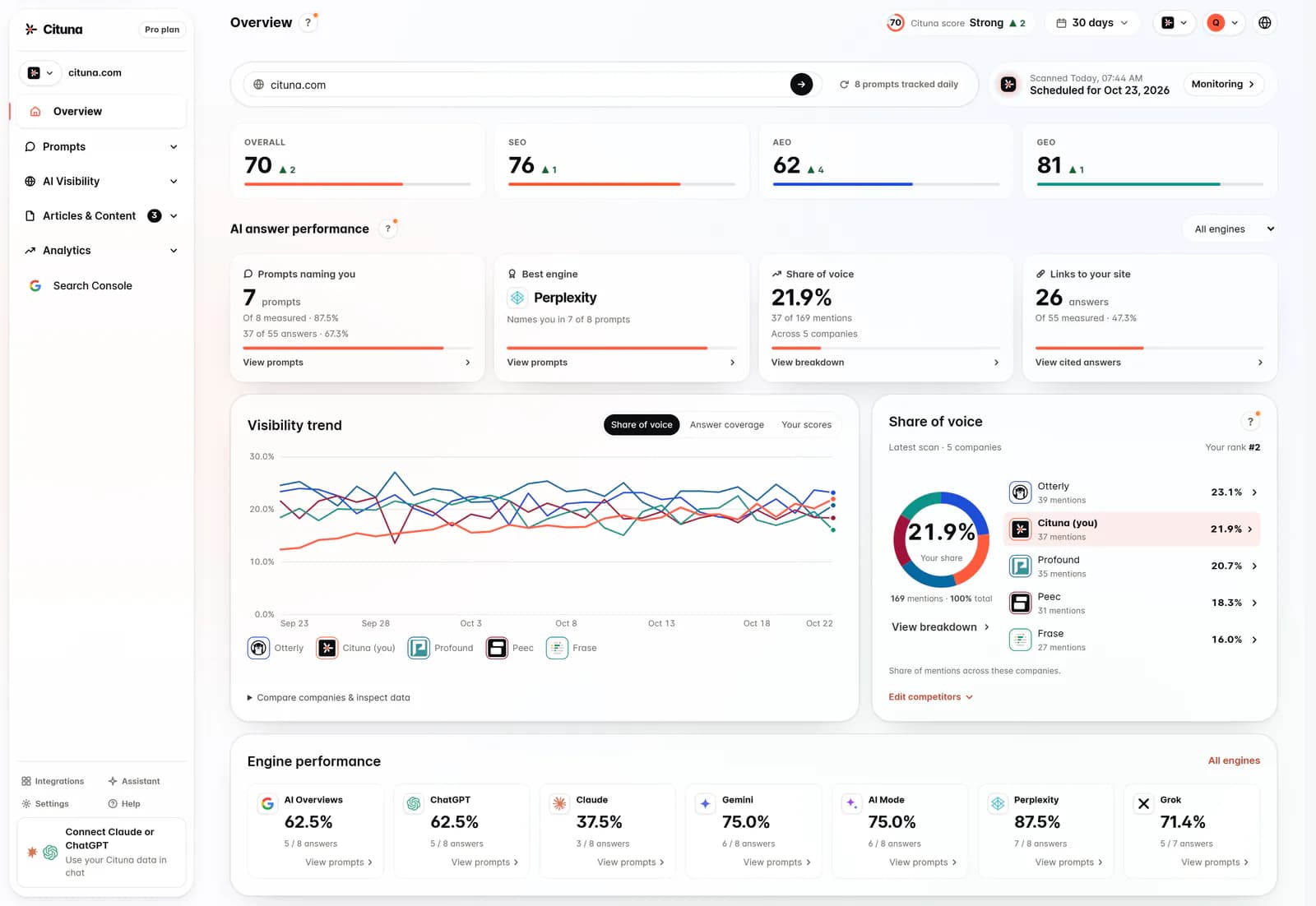
Cituna, which publishes this page, tracks ChatGPT, Perplexity, Gemini, Claude, Grok, Google AI Overviews and Google AI Mode, while Profound and other alternatives suit different levels of measurement, coverage and implementation work.
Best for tracking seven engines and generating the fixes: Cituna, because every plan asks the seven engines about buyer questions, records who appears and produces changes such as schema, FAQ markup, llms.txt and page edits.
Best for measuring a focused set of prompts: Profound, because its reported entry plans concentrate on prompt and answer-engine tracking.
Best for a low-cost starting point: Rankscale or Otterly.ai, because the comparison pages report low entry prices and limited-credit or limited-prompt ways to test demand.
Best for prioritized actions without doing every change yourself: Trakkr, because the comparison describes it as tracking engines and delivering prioritized actions.
Best for implementation support: a Done-With-You or Done-For-You service, because the comparison separates hands-on execution from software-only tracking.
The important choice is not simply which product has the lowest monthly price. Decide whether your team needs a measurement dashboard, a recommendation about what to change, automatic content production, or someone to carry out the work. A cheap tracker can be sensible when a founder checks a narrow set of prompts. It becomes a poor fit when nobody has time to turn missing mentions into site changes.
For more context, read AI Visibility Tools for SEO Teams: What to Choose.
Understand what Profound measures and who it suits
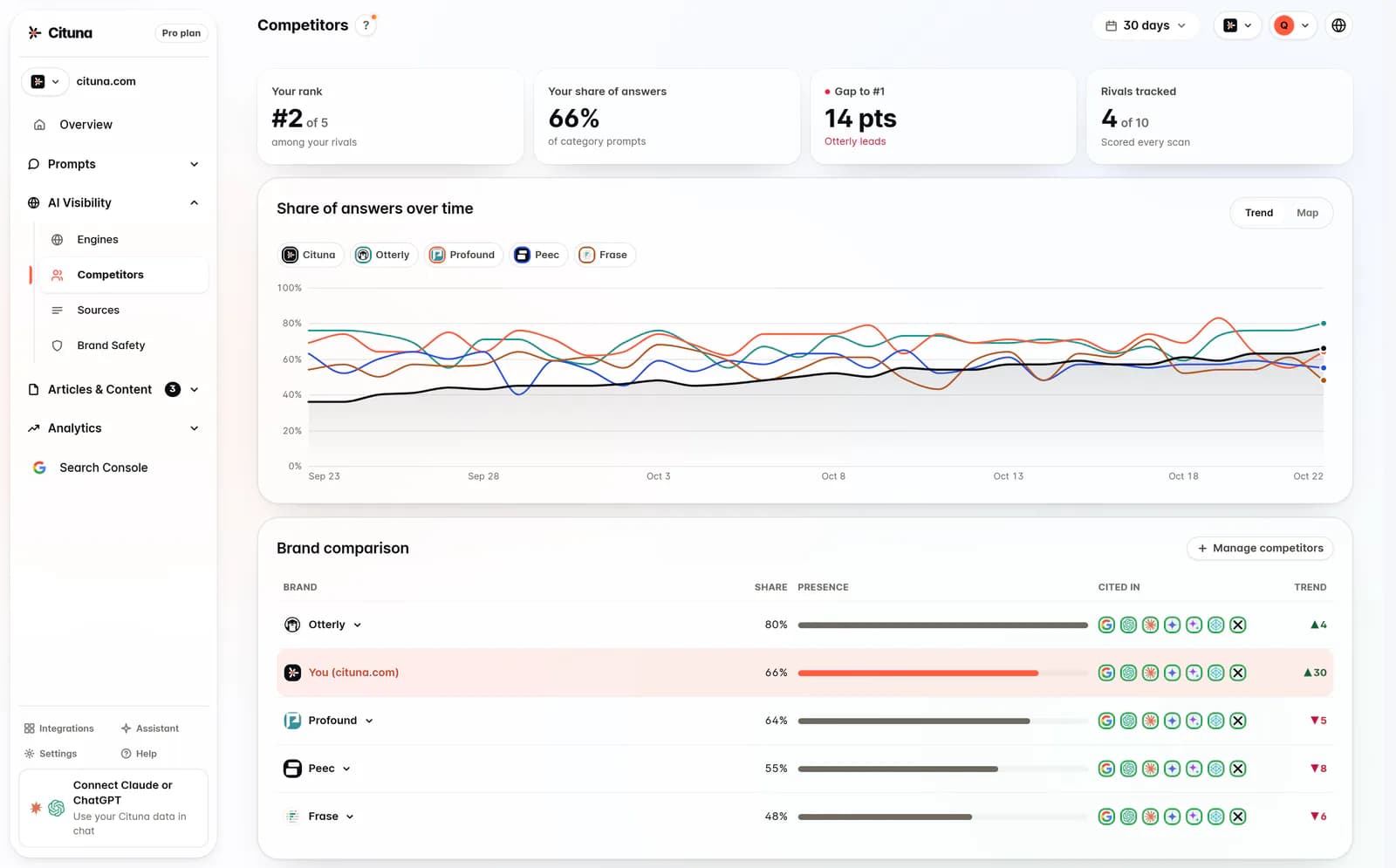
Profound suits teams that want structured visibility measurement across prompts and answer engines, with plan limits that matter to small companies. The product is a reasonable fit when a marketing lead can interpret the results and make the website changes separately.
The same comparison lists Growth at $399 per month when billed yearly, with three answer engines, 100 prompts, three seats and a free trial.
Those limits make the decision concrete. A small business with one person checking a defined category may have enough room on the entry plan, but a team comparing several engines or markets needs to check whether the included coverage matches its questions. The annual billing detail also belongs in the purchasing decision because a monthly budget and a yearly commitment are different risks.
Profound is most suitable when the immediate question is, “Who does each engine name, cite or omit for these prompts?” It is less suitable as the only system when the next question is, “Which page should change, who will change it, and how will we know the change worked?”
For more context, read AI Search Technical SEO Checklist and Fix Order.
Check where Profound falls short for a small team
Profound can fall short when a small team needs broad engine coverage, low commitment or completed fixes rather than another measurement report. The gap is operational: visibility data identifies a problem, but a team still needs a reliable path from that finding to a published change.
The reported Profound entry plan covers one engine, while the reported Growth plan covers three. A company that wants to compare ChatGPT, Perplexity, Gemini, Claude, Grok, Google AI Overviews and Google AI Mode should therefore ask whether it can monitor the engines that influence its buyers, rather than assuming one engine represents the whole category.
A small business should also test these failure points before choosing:
- Can the team track the exact buyer questions that matter, not only generic category terms?
- Can the team see which competing pages appear instead of its own pages?
- Does the product produce a specific fix, or only a visibility score?
- Who will edit the page, add structured markup and publish the change?
- Can the team connect a change to clicks or other site outcomes?
If the answer to the final three questions is unclear, a measurement-first product may create a backlog rather than reduce one. That does not make Profound unsuitable; it means the buyer should budget for implementation or pair tracking with a system that helps make the changes.
Compare alternatives by coverage, price and support
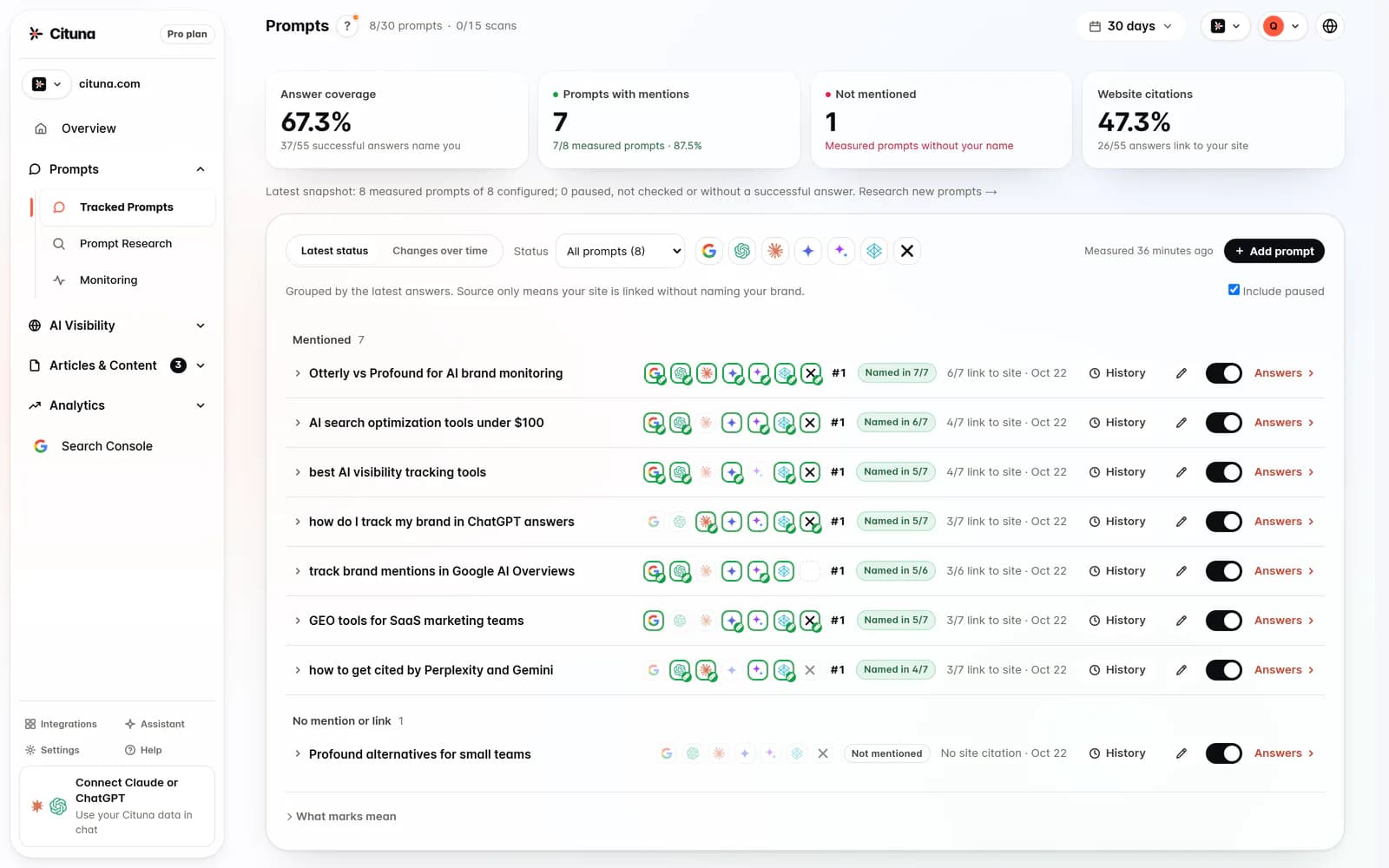
Profound alternatives differ most in the trade-off between entry cost, engine coverage, prompt volume and hands-on help. The figures below come from the cited comparison pages and should be checked before purchase because pricing and included coverage can change.
These options are not interchangeable. Otterly.ai and Knowatoa may suit a cautious first test, Rankscale may suit teams that value wider coverage or credits, Trakkr may suit teams wanting prioritized actions, and hands-on services may suit companies without the capacity to execute changes. Cituna starts at $49 per month, includes all seven engines on every plan and generates fixes, so it belongs in the comparison when the team wants measurement connected to implementation.
Match smaller SEO teams to the right operating model
Smaller SEO teams should choose between three operating models: measure only, measure and recommend, or measure and help execute. The right model depends on who owns the website, how often that person can make changes, and whether content production is already planned.
A measure-only tool works when an SEO lead can turn prompt-level findings into a clear ticket for development or content. The model breaks down when the team collects missing mentions but cannot decide whether the cause is weak evidence, unclear entities, missing markup or a page that does not answer the buyer's question.
Cituna fits the measure-and-execute model because it records which competitors and pages appear instead, generates fixes, and can create articles from visibility gaps and Search Console demand. Its AutoSEO can send approved or automatic articles to WordPress, Shopify, a GitHub repository or another CMS by webhook, while its built-in Google Search Console connection helps the team see whether changes moved clicks.
That workflow does not remove editorial judgment. A team should still check whether a generated article is accurate, whether the proposed page is the right destination and whether publishing it would duplicate existing content. For a smaller company, the value is that the measurement output has a defined next action rather than ending as a weekly report.
Use a decision rule for measurement versus fixes
Choose a measurement-first alternative when the team already has a content and development process; choose a fix-oriented platform when missing visibility is known but nobody owns the next action. This rule prevents a small business from buying another dashboard when its real constraint is execution.
Use Profound or another focused tracker when the team needs to establish a baseline, compare a selected group of prompts and assign the work internally. Ask for the raw prompt, the answer engine, the named competitors and the cited pages so a recommendation can be investigated rather than treated as a score.
Use Cituna when the team wants all seven engines checked daily and needs the platform to turn gaps into schema, FAQ markup, llms.txt, page changes or articles. Cituna also offers a hosted MCP server that connects Claude or another AI agent to the same data, so a team can decide whether agent-assisted scans and queued work fit its process.
Do not treat a citation as proof that a page deserves to rank or be recommended. First check whether the cited source is accurate, current and appropriate for the buyer's question. Then change one evidence source or page element at a time, record the prompt set, and watch whether the answer changes without creating a new factual problem.
Run a worked visibility check before switching
A worked check should connect one buyer question to one observed answer, one change and one follow-up measurement. The following illustrative example shows the process without claiming a customer result.
Suppose a local accounting firm sells bookkeeping software setup and asks the prompt, “Which bookkeeping software setup service should a ten-person consultancy choose?” ChatGPT names two competitors, Perplexity cites a comparison page, and Google AI Overviews does not mention the firm.
Take these steps:
-
Record the exact prompt, engine, date, answer position, named competitors and cited URLs.
-
Inspect the cited competitor pages for the evidence the answer appears to use, such as clear service scope, buyer qualifications, implementation details or comparison language.
-
Create one targeted change, such as a service page section that states the consultancy size served, the setup work included and the questions a buyer should ask before choosing a provider.
-
Add appropriate FAQ markup only when the visible page contains the same questions and answers.
-
Rerun the same prompt set after the change and check whether the firm appears, whether the citation is accurate and whether the answer still represents the service honestly.
A free AI visibility scan can help with the first pass. The scan is a starting check, not a substitute for ongoing brand mention and citation tracking, so confirm what the result covers before treating it as a monitoring plan.
Prepare the switch with a small-team checklist
A small business can switch safely by preserving its prompt set, defining ownership and checking the first proposed changes before publishing. Switching tools without preserving those inputs makes it difficult to tell whether a result changed because of the platform or because the measurement method changed.
Before committing, prepare:
- The buyer questions that matter most to revenue.
- The seven engines the team wants to compare, if broad coverage is required.
- The pages and competitors that currently appear in answers.
- The person responsible for reviewing technical, content and compliance changes.
- The CMS or repository where approved changes should go.
- A simple record of prompt wording, dates and observed citations.
Ask each vendor to show the path from a missing mention to an actionable change. For Profound, clarify how the selected plan covers the engines, prompts and seats the team needs. For a lower-cost tracker, clarify what is limited by credits, prompts or engine coverage. For a fix-oriented platform, check whether proposed changes remain held for approval or can be published automatically, and make sure the team knows how to review them.
The first useful outcome is not a higher score. It is a repeatable process that tells the team which buyer question produced the gap, what changed on the site and whether the next answer became more accurate and useful.
Related reading
- AI Visibility Audit Checklist: 12 Checks Before You Publish
- AI Visibility Buying Criteria for Seven Answer Engines
- 8 AI Business Ideas for Small Companies
Official sources to check
- AI Find My Business (aifindmybusiness.com)
- Frase (frase.io)
Drafted with AI assistance from our own research and Search Console data, and reviewed by Rahul A before publishing. Rules and prices change; check the linked official source before you act.