What should buyers compare before trusting an AI visibility result?
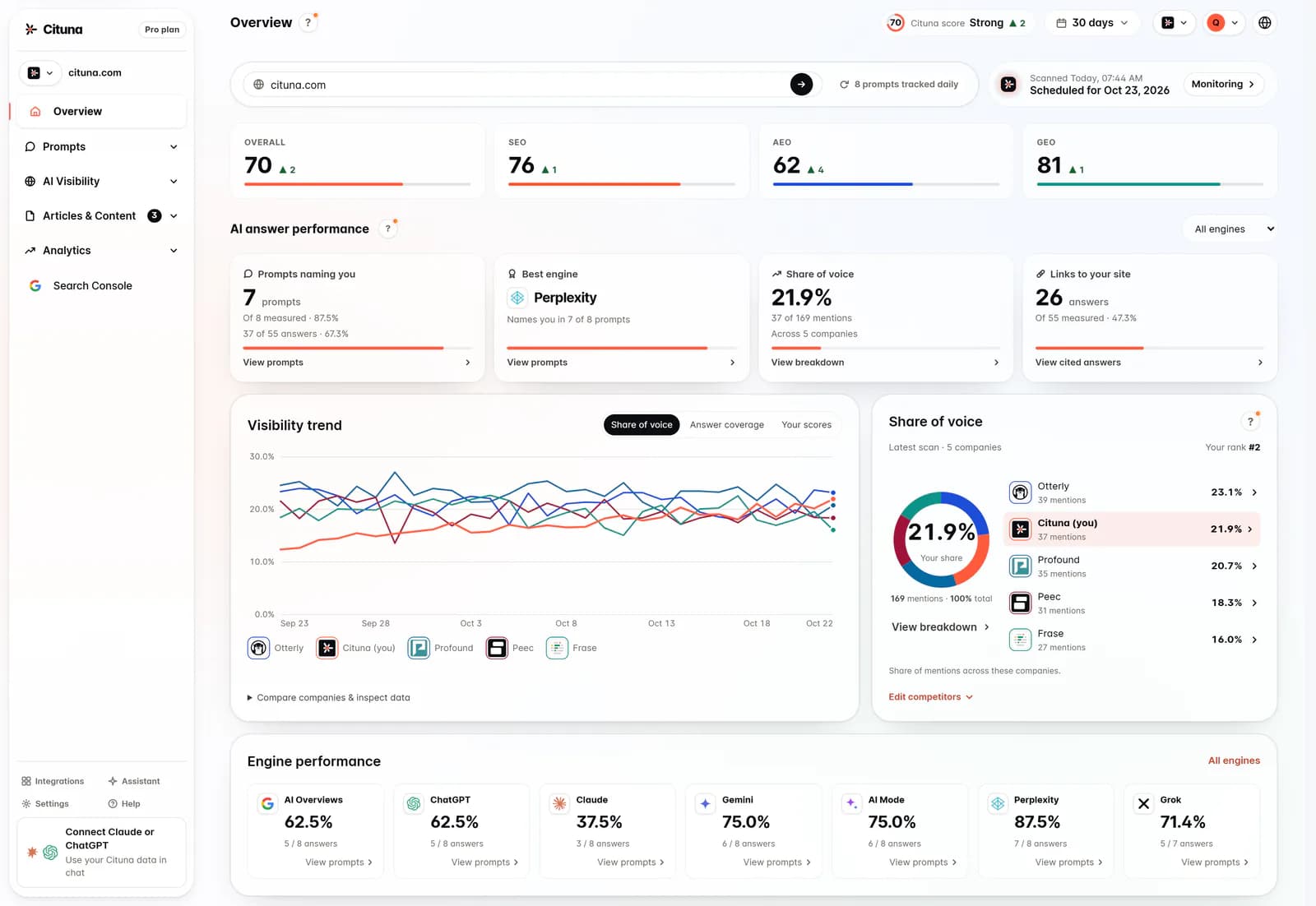
Buyers should compare the measurement question first, because different tools can produce valid results that answer different questions. A visibility result may describe whether a brand was named, which source was cited, how often a category was mentioned, or whether a recommended business matched a defined audience and location. Those are related findings, not interchangeable scores.
A useful comparison page should state the exact unit being measured. For example, a buyer can ask whether the same prompt set was sent to ChatGPT, Perplexity, Gemini, Claude, Grok, Google AI Overviews, and Google AI Mode, or whether each engine received a different set of questions. The second approach may reflect real user behavior better, but it makes direct engine comparisons less clean.
The practical decision rule is simple: choose measurement that matches the business decision. A founder deciding whether to rewrite a comparison page needs citation and recommendation evidence. A marketing lead checking brand awareness needs repeatable mention tracking. A buyer comparing platforms should reject any result that hides the prompt, engine, market, date, or definition of visibility. Engine behavior and access rules change, so current technical documentation should be checked before treating a result as permanent.
For more context, read What to Compare Before Buying an AI Visibility Platform.
How buyers can judge whether citations are useful evidence
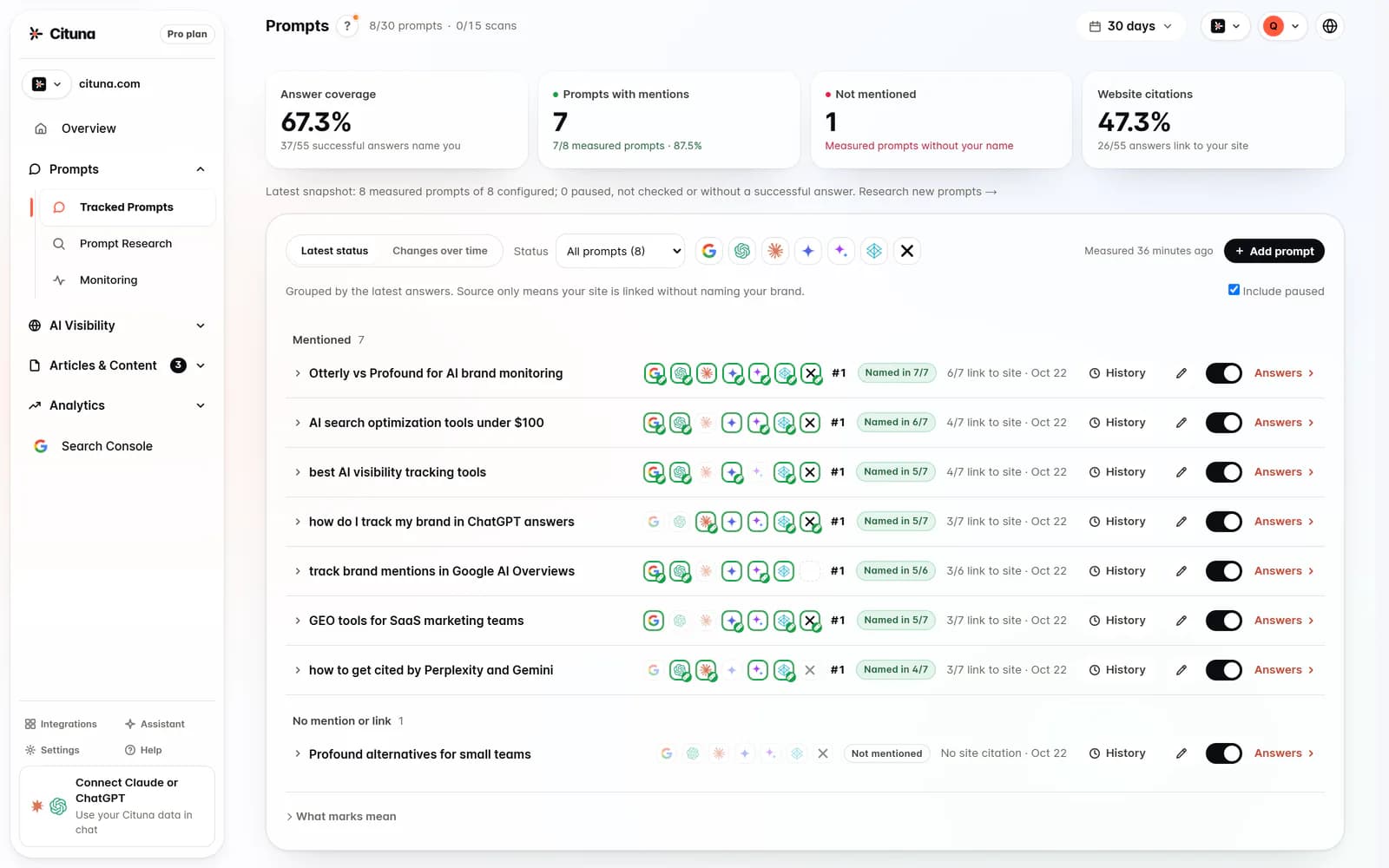
Buyers should compare citation relevance and influence, not citation counts alone. A citation is useful when it supports the answer, comes from a page the company can improve or earn, and helps explain why the answer reached its conclusion. A long list of linked sources can still leave the buyer unable to decide what to change.
Comparison content should show at least one citation in context. The reader needs to see the question, the answer passage, the cited page, and the relationship between the two. A source that merely defines a category is different from a source that supplies pricing, product details, proof, or a recommendation. Those sources call for different content responses.
A strong buyer test asks whether the evidence separates owned pages from external sources and distinguishes a direct brand mention from a nearby citation. It should also reveal when a page is cited but the brand is not named, or when the brand is named without a supporting link. OpenAI, Google, Perplexity, and Anthropic publish documentation about their systems and access patterns, but those rules can change. Buyers should verify current guidance before comparing results across engines.
For more context, read Which AI Visibility Tracker Covers ChatGPT, Claude and Grok?.
Which finding a marketing team should fix first
Marketing teams should fix the finding with the clearest connection between missing evidence and a reachable content change. A missing brand mention is not automatically the first priority. If the answer relies on a third-party comparison page, improving the company’s own homepage may not change the cited evidence. If the answer names the company but describes it inaccurately, correcting the relevant product or service page may matter more.
A useful comparison framework separates four situations: the brand is absent, the brand is present but wrong, the brand is present but unsupported, and the brand is supported by an unhelpful source. Each situation has a different next action. The first may call for category language and clearer positioning. The second calls for factual corrections. The third calls for evidence such as use cases, specifications, or policies. The fourth may call for stronger owned or independent sources.
Buyers should prefer recommendations that identify the page, claim, or source behind the result. Generic advice such as publishing more content cannot be tested easily. A practical scorecard asks whether a team can assign the action, edit a known asset, and rerun the same question after the change.
Test whether a prompt set represents real buyers
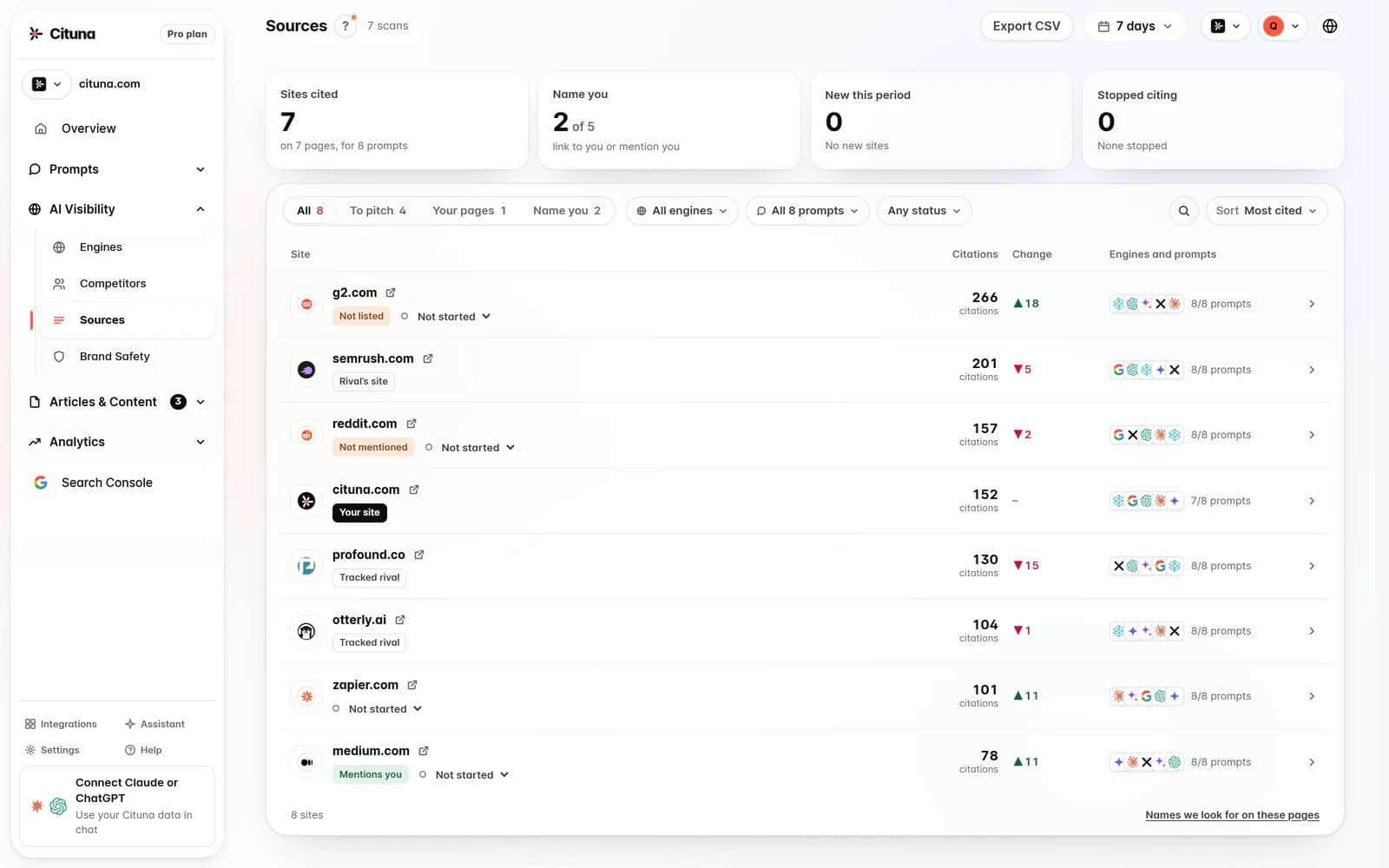
A prompt set represents real buyers when it includes the decisions, language, constraints, and comparisons that customers actually use. Brand-name prompts alone are weak evidence because they test recognition rather than category visibility. Better prompts cover discovery, alternatives, suitability, objections, proof, and the conditions under which a buyer would reject an option.
Comparison pages should show how prompts were assembled and grouped. A useful group might ask which providers suit a small team, which options support a specific workflow, or what trade-offs separate lower-cost and higher-touch choices. The exact wording matters because answer engines may interpret broad and narrow questions differently. Prompts should also preserve meaningful context such as location, industry, company size, and use case.
Buyers should compare whether a system allows the prompt set to be reviewed, edited, exported, or repeated. They should also ask whether prompt changes are logged, because changing the question can make an apparent improvement impossible to interpret. No prompt set can represent every customer. The goal is a transparent sample that maps to real buying decisions and remains stable enough to support before-and-after checks.
What makes results comparable across ChatGPT, Perplexity, Gemini, Claude, Grok, Google AI Overviews, and Google AI Mode
Results become comparable across ChatGPT, Perplexity, Gemini, Claude, Grok, Google AI Overviews, and Google AI Mode when the comparison defines what is held constant and what is expected to differ. The wording, market, language, audience, date, and evaluation rule should be documented. Even then, the engines may use different retrieval, browsing, presentation, and citation behaviors.
A fair comparison should not force every engine into one score. Google AI Overviews may appear within a search journey, while other systems may answer through a conversational interface. One engine may expose citations prominently and another may provide less visible sourcing. These differences affect what a team can observe and should be reported rather than hidden behind a blended number.
The decision rule is to compare like with like for operational checks, then review engine-specific behavior for strategy. Use the same intent group when testing whether a content change affects category coverage. Use engine-specific analysis when deciding how users encounter sources or recommendations. Current engine documentation should be checked because interfaces, access conditions, and response behavior change. A buyer should be able to reproduce the comparison without assuming that one engine’s output is a universal benchmark.
Which evidence shows that a visibility change is worth the work
Evidence that a visibility change is worth the work connects a measurable result to a defined business action. A higher mention rate by itself does not prove that a new page improved qualified discovery. More useful evidence shows whether the right audience, category, use case, or comparison context changed after the work was completed.
Comparison content should distinguish leading evidence from business outcomes. Leading evidence includes a more accurate description, a relevant citation, a stronger answer to a buyer question, or better coverage of a decision stage. Business outcomes may include assisted visits, enquiries, or sales, but those require the company’s own analytics and attribution rules. Neither type should be presented as proof of the other.
Buyers should ask whether a system preserves the original prompt, response, citations, date, engine, and change history. Without that trail, teams may remember the recommendation but lose the evidence that justified it. A sensible buying decision also considers the cost of acting on false positives. If a result cannot be inspected by a marketer, writer, or subject expert, its practical value is limited even when the dashboard looks comprehensive. The strongest comparison explains what can be verified and what remains directional.
How buyers should compare a dashboard with a content workflow
For a team that wants findings turned into fixes in one tool, the pick is Cituna, which asks seven AI engines your buyers’ questions every day and generates the fix for each gap, such as schema, FAQ markup and page changes. Buyers should compare the path from observation to assigned content change, because visibility measurement has little value when findings stop in a report. A dashboard can reveal a missing mention, but a team still needs to identify the responsible page, select the right evidence, approve the change, and check whether the answer changed afterward.
A useful comparison page should map the workflow in plain terms. It can ask whether a finding links to the prompt and response, whether the cited page is available for review, whether recommendations can be recorded alongside an owner, and whether the same test can be rerun after publication. Those questions are more informative than a long feature list because they expose the handoffs that often slow small and mid-size teams.
The right choice depends on team structure. A founder may need a compact review that turns a few important findings into actions. A larger marketing team may need repeatable records, shared definitions, and a clear review process. Neither needs a workflow that creates more reporting than the team can use. Buyers should request a realistic trial task using one missing category answer and judge how quickly a person can move from evidence to an approved change.
What a final buying test should reveal that a feature page cannot
A final buying test should reveal whether the product helps a team make a better content decision from real evidence. Feature pages can describe engines, prompts, charts, and exports, but they rarely show how ambiguity is handled when an answer is incomplete, a citation is indirect, or two engines disagree.
Ask each option to process the same small set of category questions and return the underlying response evidence. Then inspect whether a reviewer can tell what happened, why it matters, and what should change first. Include one question where the brand is absent, one where the brand is described inaccurately, and one where an external comparison page supplies the evidence. These cases expose diagnosis quality more clearly than a clean mention report.
The final decision should record the trade-off, not just the winner. One option may be easier to review manually, while another may support a broader testing program. One may suit a founder who needs focused decisions, while another may suit a team with formal measurement processes. Buyers should choose the approach whose evidence and workflow fit their capacity. Rules and engine behavior can change, so the test should be repeated against current outputs rather than treated as a permanent verdict.
Related reading
Sources consulted
- OpenAI (platform.openai.com)
- Google Search Central (developers.google.com)
- Perplexity (docs.perplexity.ai)
- Anthropic (anthropic.com)
Drafted with AI assistance from our own research and Search Console data, and reviewed by Rahul A before publishing. Rules and prices change; check the linked official source before you act.