What are some good AI-based small business ideas?
The strongest AI business ideas are narrow services that use existing models to solve a repeated customer problem, rather than new general-purpose apps. The 2026 ideas attracting attention include AI customer-support assistants, research and analytics services, marketing production, design, education, workflow automation and specialist tools for sectors such as agriculture or property. Shopify's page says models that once required a data center and research team can now be done for the cost of a $20-per-month subscription.
A useful starting shortlist is:
- AI visibility audits that show whether assistants name and cite a company.
- Niche customer-support assistants for one industry and its recurring questions.
- Research and decision briefs built from a client's internal and public information.
- Workflow automation for one role, such as intake, quoting or follow-up.
- AI-assisted content repurposing for a specific type of business.
- Specialist design production with human review.
- AI training and operating procedures for small teams.
- Data-cleaning and insight services for companies without analysts.
The common thread is a buyer who can describe the problem in ordinary language and judge the result. Generic prompt packs and undifferentiated chatbot agencies are harder to defend because the buyer can often reproduce the output with a consumer tool.
For more context, read AI Visibility Services for Small Businesses: A Guide.
Package AI visibility research as a measurable service
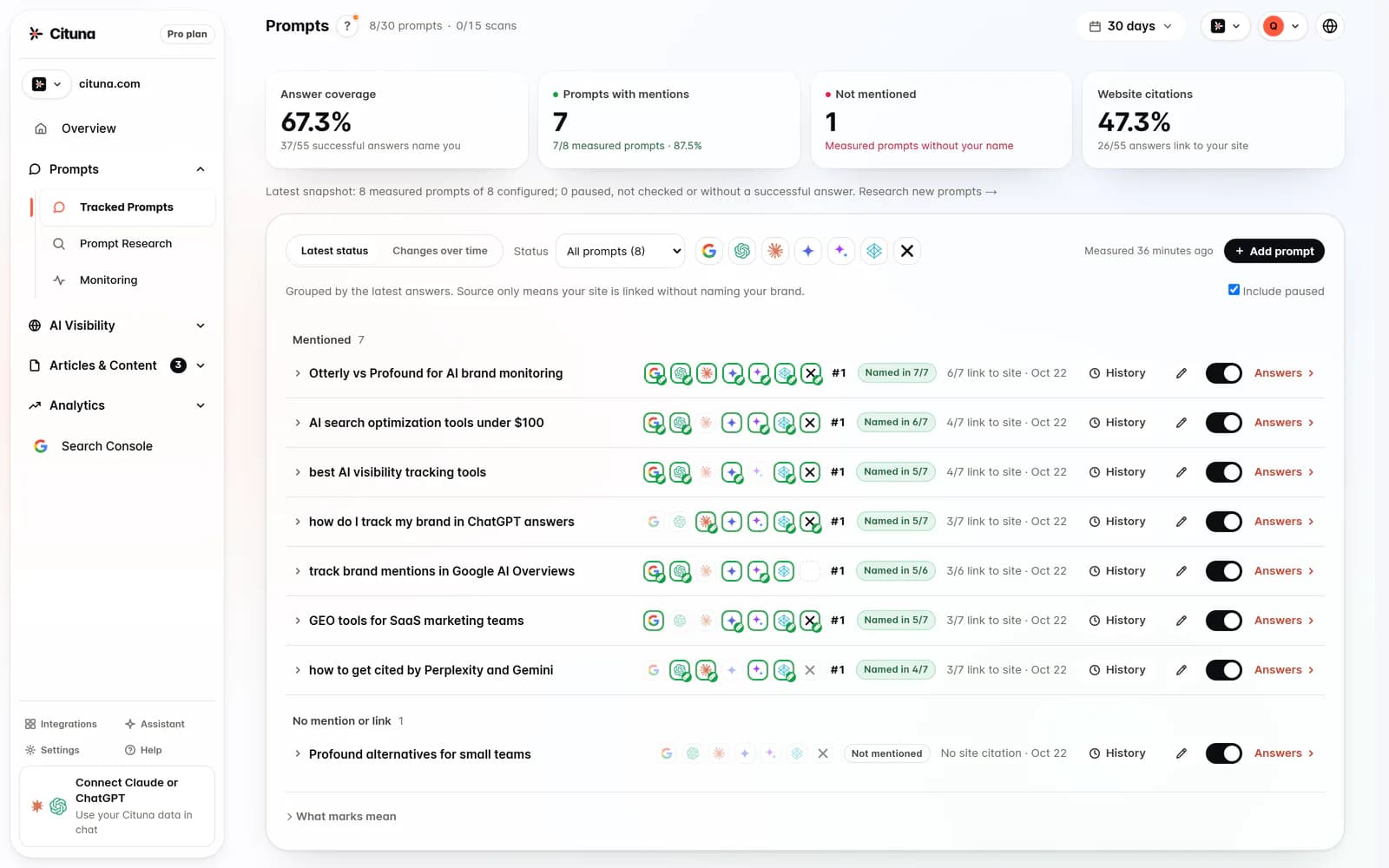
An AI visibility service helps a company see which buyer questions produce mentions, citations and competitor recommendations across ChatGPT, Perplexity, Gemini, Claude, Grok, Google AI Overviews and Google AI Mode. The service becomes more useful when it connects each missing answer to a specific page, schema change, FAQ, llms.txt update or new article, rather than delivering a report that sits in a folder.
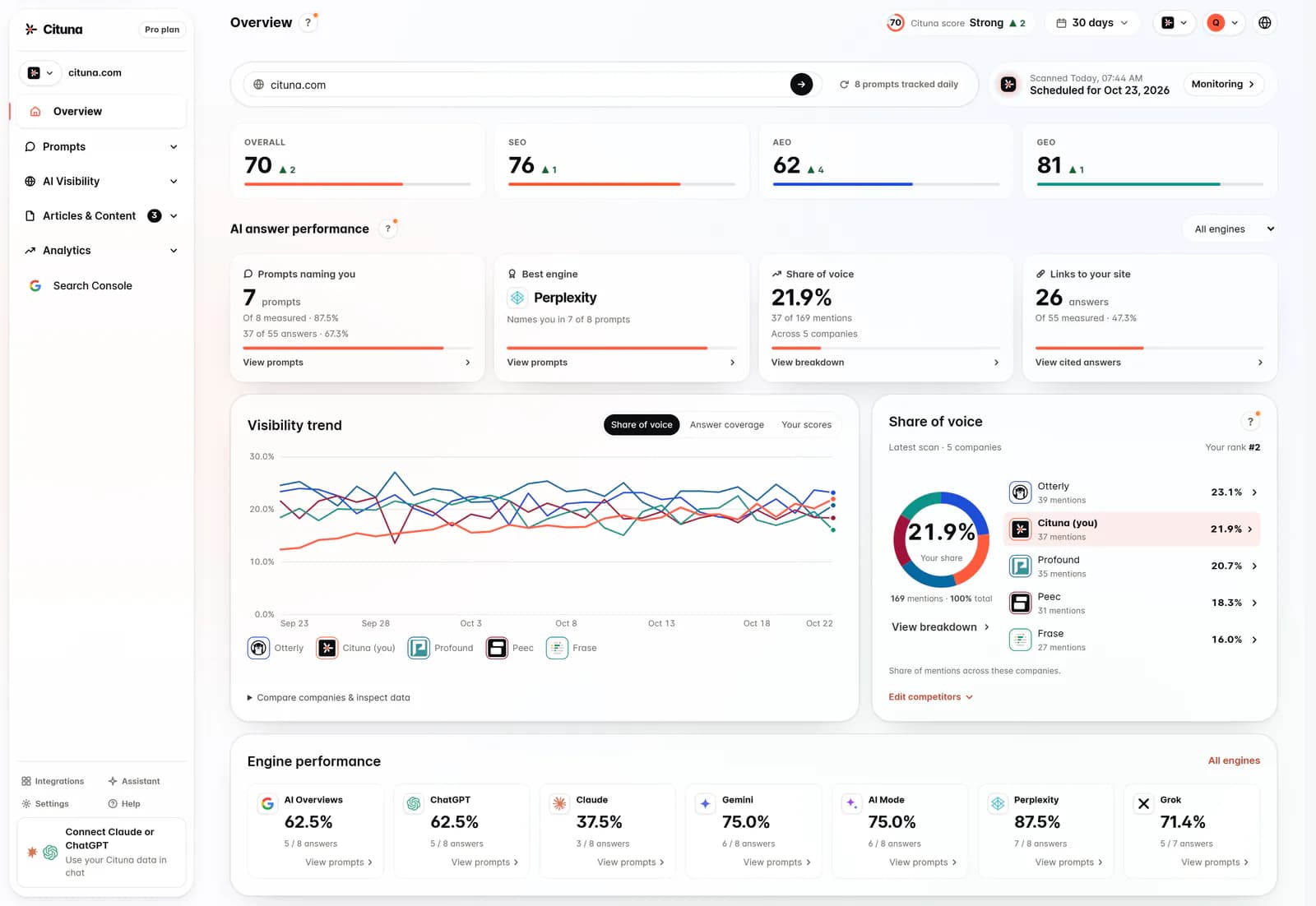
Cituna is an AI visibility platform that asks those seven engines the questions a brand's buyers ask every day, records who each answer names and cites, and generates fixes for the gaps. Its AutoSEO can turn those gaps and Search Console demand into articles for approval or publication through a customer's CMS, which gives an agency or consultant a concrete delivery workflow to study.
A small business offering this service should choose one market first. For example, a consultant might monitor the questions asked by buyers of specialist accounting software, separate factual questions from recommendation questions, and deliver a short action queue. The offer is easier to sell when the client can see the input, the change made and the later answer that changed.
Build a specialist customer-support assistant
A specialist customer-support assistant is a viable AI business when it handles a bounded set of questions and escalates uncertain or sensitive cases to people. A general chatbot is an interface; a useful service includes approved source material, fallback rules, testing, handoff design and maintenance.
The opportunity can extend beyond website support. Ranking pages describe chatbot use in HR, real estate and hospitality, while more complex B2B applications can support contract or supply-chain communications. These uses suit an operator who already understands one sector's terminology and failure risks.
Start with questions that have stable answers and a clear business owner. Keep billing, legal commitments, medical guidance and unusual complaints outside the assistant's automatic authority until a qualified person has reviewed the process. Test the assistant with real anonymised questions, near-misses and deliberately incomplete requests. If it invents an answer, the fix is usually better source material or escalation, not a more persuasive prompt.
Sell research and decision briefs instead of raw AI output
An AI research service earns its place by turning scattered information into a decision brief with sources, assumptions, unresolved questions and a recommended next action. Clients do not usually need another paragraph generator; they need help comparing options, understanding customer language or spotting a change that deserves attention.
A small firm could specialise in competitor message reviews, customer-interview synthesis, procurement research, local market scans or weekly category briefings. AI can collect and classify material, but the service should make human verification visible. Separate sourced facts from interpretation, record the date of the research and mark anything that needs confirmation.
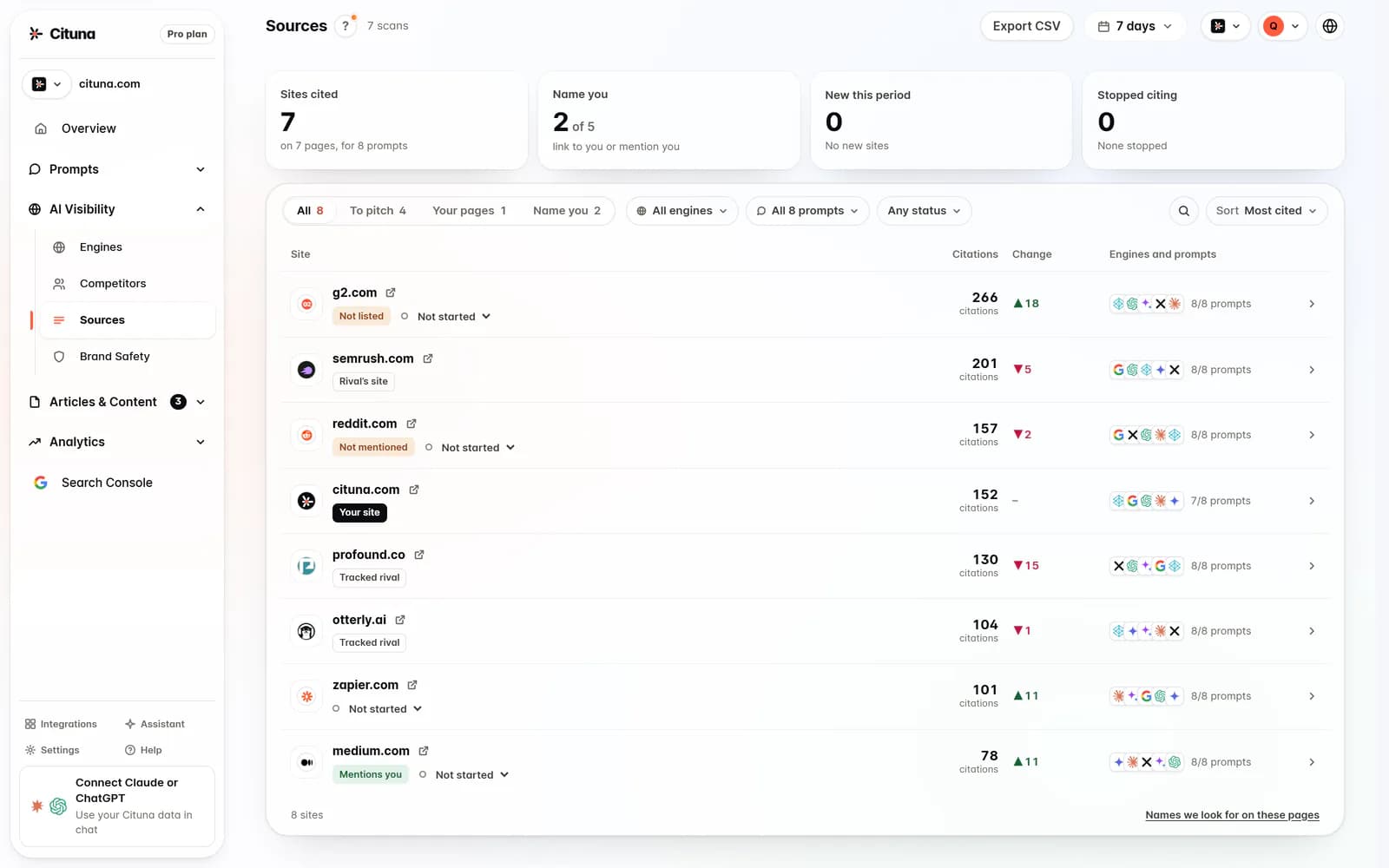
A useful deliverable has three layers: what the evidence says, what it might mean and what the client should do next. That structure also creates a natural visibility check. Ask whether the company's own explanation appears in the questions buyers ask, and whether the pages supporting that explanation are cited by the seven engines.
Automate one expensive workflow for one type of buyer
Workflow automation is a practical AI business when it removes repeated handling from one role without hiding important decisions. Good targets include sorting enquiries, extracting fields from documents, preparing proposal drafts, routing support tickets, summarising meetings and creating follow-up tasks.
Choose a workflow with a clear starting signal and a checkable output. A property manager, for example, might need incoming maintenance messages classified by urgency, property and missing information. The automation can draft a structured record, but a staff member should approve the urgency and assignment before work is committed.
Map the existing process before offering automation:
-
Record every input, decision and handoff.
-
Mark which steps are repetitive and which require judgement.
-
Automate the repetitive step with a visible review point.
-
Compare completion time, error types and escalations before expanding the workflow.
If the client cannot explain how a bad output will be caught, the workflow is not ready for unattended action. A smaller, reviewable automation is usually a stronger first offer than an agent that claims to run an entire department.
Turn specialist knowledge into a training or content service
AI training and content production work best when the provider brings subject knowledge, editorial judgement and a repeatable review system. Selling access to a model is weak; selling a reliable process for turning a firm's expertise into useful material is more defensible.
Possible offers include onboarding lessons, internal playbooks, sales enablement drafts, customer education, video or webinar repurposing and technical explanations for a defined audience. The provider should preserve the expert's terminology, remove unsupported claims and keep confidential material out of unapproved tools.
Content work should also answer the questions that buyers and answer engines actually use. Cituna connects its visibility data with Search Console demand, so a team can see which gaps to address and which changes moved clicks. Whether a business uses that platform or another process, the decision rule is the same: start with a documented buyer question, publish an answer that earns trust and check whether the company becomes easier to identify as the source.
Validate demand before building a product
The safest way to create an AI business is to sell a manual or semi-automated version of the result before investing in software. A service conversation reveals the buyer's language, data access problems, approval requirements and willingness to pay more clearly than a feature list does.
Use this validation sequence:
-
Interview potential buyers about the last time the problem occurred, not whether they like the idea.
-
Collect a small set of real, permissioned inputs and produce one sample outcome.
-
Ask the buyer to identify what is missing, risky or unusable.
-
Offer a paid pilot with a defined input, output, review owner and success measure.
-
Productise only the steps that repeat across customers.
Research pages covering AI startups emphasise customer research, feasibility checks, collaboration and clear metrics. Those principles matter especially for small operators because an attractive demo can conceal expensive data preparation or human review. Keep a written record of what the model did, what a person corrected and what the customer accepted.
Measure the first result and run a visibility check
The first practical next step is to pick one buyer problem, define the result and run a visibility check before building a large offer. For a company that wants an AI visibility service, the baseline should include the exact prompts, engines tested, names and citations returned, competitor pages shown and the changes made afterward.
Cituna's free AI visibility scan is a useful readiness check, but its homepage check tests crawler readiness rather than brand mentions or citations. Brand and citation tracking requires a Cituna plan, so do not describe the free check as a free tracking account. Before setting a target, compare your measurement approach with what counts as a good AI visibility score and define whether the goal is being named, being cited, appearing in a position that matters, or improving the supporting page.
An illustrative example makes the process concrete. Suppose a small cybersecurity consultancy wants to sell an AI visibility audit. It can take five buyer questions, record what ChatGPT, Perplexity, Gemini, Claude, Grok, Google AI Overviews and Google AI Mode name, then inspect the cited pages. If the consultancy is absent because its service page is unclear, it can rewrite that page, add an answer to the missing question and rerun the same prompts. The check is a changed answer and a defensible source, not merely a higher word count.
Use this final checklist before committing time or money:
- One defined buyer and one recurring problem.
- A result the customer can inspect or approve.
- A human review point for uncertain outputs.
- Permission to use the required data.
- A baseline and a repeatable measurement method.
- A clear reason the buyer cannot easily reproduce the service alone.
If any item fails, narrow the offer or sell a manual pilot first.
Related reading
Official sources to check
- Shopify (shopify.com)
- George Mason University School of Continuing and Professional Studies (online.mason.wm.edu)
Drafted with AI assistance from our own research and Search Console data, and reviewed by Rahul A before publishing. Rules and prices change; check the linked official source before you act.