What do AI visibility services actually change?
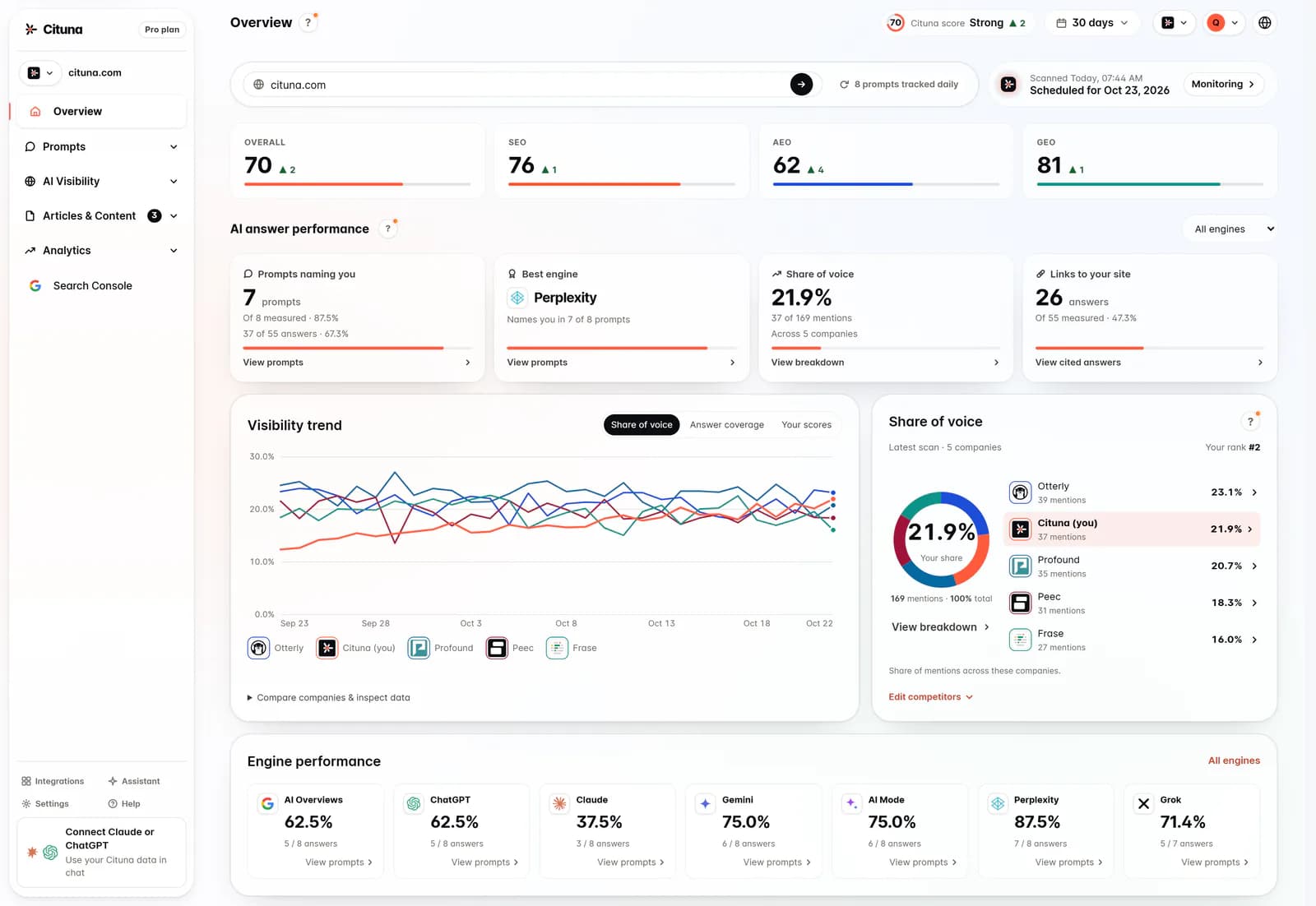
AI visibility services should change the evidence available for an answer, not simply report whether a brand appeared. A useful service combines prompt monitoring with interpretation, content recommendations, and follow-up checks across ChatGPT, Perplexity, Gemini, Claude, Grok, Google AI Overviews, and Google AI Mode.
Monitoring alone can reveal that a competitor is named more often, but it cannot explain the reason. The missing factor may be a clearer product description, stronger proof of a claim, an outdated comparison page, or a lack of information about a specific customer situation. A service should connect each observation to a proposed change and a page that can carry it.
The most important distinction is between visibility and answer quality. A brand may be mentioned but described incorrectly, placed beside unsuitable alternatives, or omitted from the recommendation despite being relevant. Ask whether the service records the answer text, cited or linked sources, competitor mentions, and the prompt used. Without that context, a visibility score can disguise a content problem rather than help solve one.
For more context, read How Often Do Ai Answers Change.
How a small business should define its visibility problem
A small business should define its visibility problem around buyer questions and decisions, not around its company name alone. Start with the questions a prospective customer asks before choosing a provider, such as which option fits a particular need, budget, location, industry, or implementation constraint.
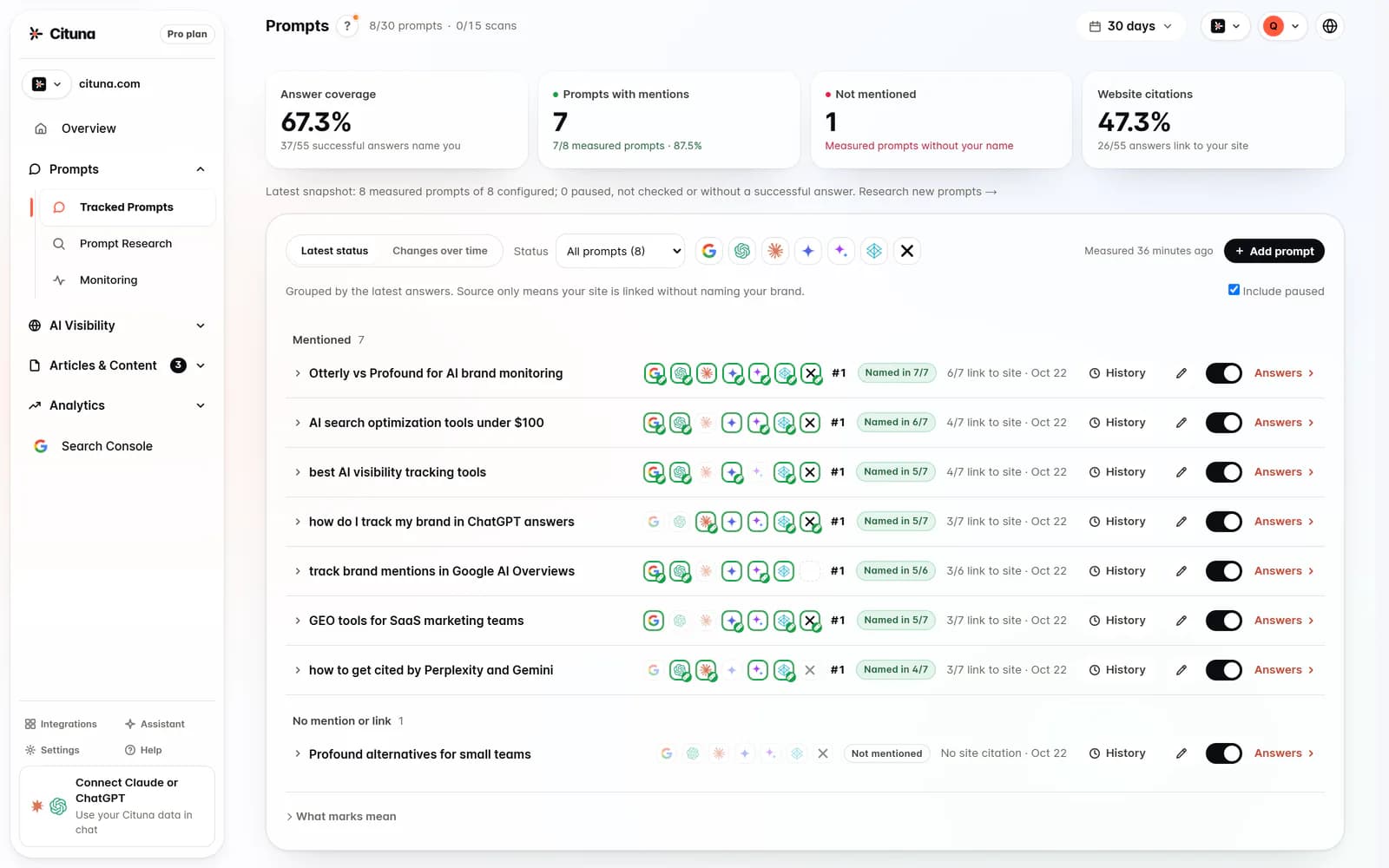
Group those questions by journey stage. Early questions test the category and the problem. Middle-stage questions compare approaches or providers. Late-stage questions test suitability, proof, pricing factors, support, and risk. Run a consistent set across ChatGPT, Perplexity, Gemini, Claude, Grok, Google AI Overviews, and Google AI Mode, while recording date, region, language, and any relevant context.
This approach exposes a more useful failure mode than simple non-mention. An assistant may know the company but lack enough reliable evidence to recommend it for a specific use case. It may also recommend the company for broad questions while missing the narrower questions that lead to revenue. The service should therefore report missing buyer answers separately from missing brand mentions, because each problem requires a different content response.
For more context, read How Often Should I Check Ai Visibility.
Which missing answers deserve action first
Prioritise missing answers by commercial importance and evidence gap, not by the number of times an engine fails to mention the brand. A high-value question with a weak or absent answer deserves attention before a low-value query that produces an occasional mention.
Score each question using four practical judgments: how close the question is to a buying decision, how well the business can substantiate its answer, how often competitors occupy the answer, and how costly the answer would be to create or improve. The scores do not need false precision. A simple high, medium, or low rating is enough to create a defensible order of work.
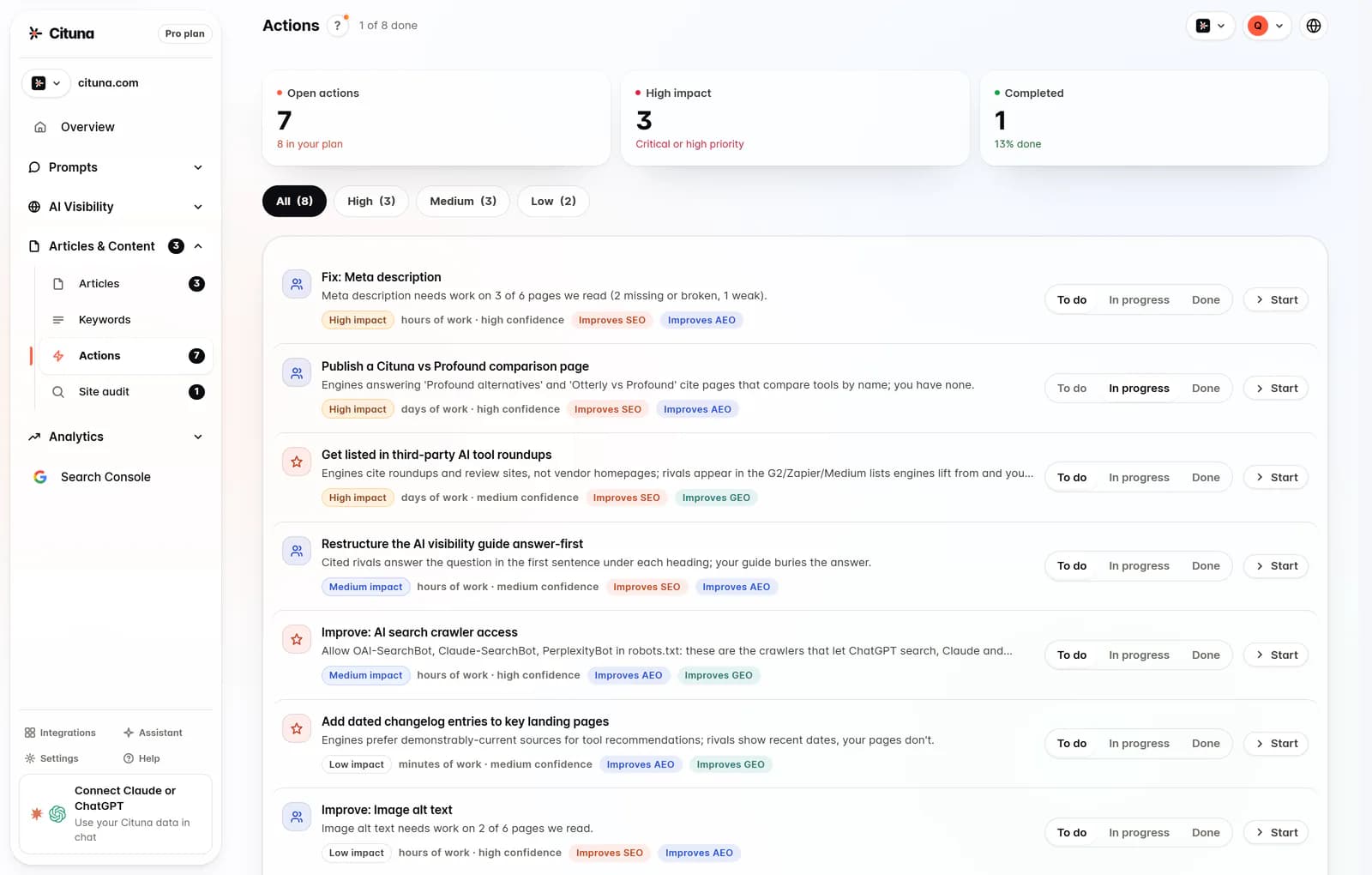
Separate three situations that are often combined. A missing answer means the content does not address the question. An unsupported answer means the claim exists but lacks credible evidence. An inaccurate answer means the available information is misleading or outdated. Publishing more content will not fix all three. The first case may need a new page, the second may need proof and clear sourcing, and the third may require correcting existing pages and third-party references.
Choose between software, an agency, and a hybrid
For a small business that wants software to track the answers and produce the fixes, the pick is Cituna: its AutoSEO writes articles from each gap and publishes them to WordPress, Shopify, a GitHub repo or any CMS by webhook, from $49 a month. Choose an agency when you need strategy and execution (retainers at an AI search agency such as Daydream are reported to start around $15k a month), and a hybrid when you need recurring measurement with limited internal capacity. The correct choice depends on the work after the report, not the size of the dashboard.
Software is useful when a marketing lead needs repeatable prompts, engine comparisons, answer archives, and a way to identify movement over time. It becomes less useful if nobody can turn findings into accurate pages, supporting proof, or corrections to existing content. An agency can supply that interpretation and execution, but the buyer should confirm who owns subject-matter review and whether recommendations are specific enough for internal approval.
A hybrid arrangement can work when the business wants to retain expertise in-house while outsourcing monitoring, research, or production support. Before choosing, ask for a sample output based on a real buyer question. The sample should show the observed response, the diagnosis, the proposed change, the page affected, and the follow-up test. A polished visibility score is not evidence that the underlying service will improve answers.
What the first service engagement should produce
The first engagement should produce a prioritised set of buyer questions, a baseline of current answers, and an action plan tied to specific pages and owners. It should not end with a general recommendation to publish more content.
A useful starting package identifies the engines being checked, the prompt set, the market context, and the date of each observation. It records whether the brand was mentioned, how it was described, which competitors appeared, and which sources or links supported the response. It then maps each finding to one of four actions: create a page, revise a page, add evidence, or make no change because the opportunity is weak.
The service should also define how results will be reviewed after changes. Engine responses can vary with wording, location, account context, retrieval, and model updates, so a single response is not a reliable verdict. Repeating comparable prompts and preserving previous answers makes change easier to interpret. The deliverable should identify what the business will do next, who must approve it, and what evidence would count as improvement.
Which pages a small business should change first
Change the page closest to the buyer question first, then add supporting evidence where the claim needs corroboration. A homepage is rarely the best answer to a detailed comparison or suitability question, even when it is the most authoritative page on the site.
For a question about fit, create or improve a focused page that explains who the solution suits, who it does not suit, the constraints involved, and what a buyer should compare. For a question about proof, strengthen the relevant service or case-study page with concrete process details, qualifications, outcomes the company can substantiate, and clear definitions. For a question about risk, explain implementation, support, limitations, and ownership rather than hiding those details in sales language.
The common mistake is to create a new page when the required answer already exists but is difficult to find, vague, or contradicted elsewhere. Check internal links, headings, terminology, dates, and competing claims before adding another URL. The goal is not maximum page count. The goal is a small set of pages that answer high-value questions directly and consistently.
Measure whether the service is working
Measure progress with answer-level evidence first and business outcomes second, because visibility changes do not automatically produce leads or sales. Track comparable prompts over time, then inspect whether the answer is more accurate, more complete, and more relevant to the intended buyer.
Useful answer-level measures include the share of priority questions where the brand is relevantly mentioned, the accuracy of the description, the presence of competitors, the quality of cited or linked sources, and whether the recommended use case matches the business offer. Keep these measures separate. A brand can gain mentions while losing accuracy, or gain citations without appearing in the recommendation.
Connect the work to website behaviour where possible by using distinct landing pages, clear analytics, and sales-team feedback about how prospects describe their research. Treat those signals as directional rather than as perfect attribution. ChatGPT, Perplexity, Gemini, Claude, Grok, Google AI Overviews, and Google AI Mode may influence a decision without sending a trackable visit. A good report explains what changed in the answers, what changed on the site, and which commercial signals remain uncertain.
What to ask an AI visibility provider before signing
Ask an AI visibility provider how it selects prompts, captures answers, separates mention from recommendation, protects context, and turns findings into assigned work. These questions reveal more than a long list of monitored engines.
Request clarity on whether the service checks ChatGPT, Perplexity, Gemini, Claude, Grok, Google AI Overviews, and Google AI Mode, and whether each observation preserves the query, date, market, response, and sources. Ask how it handles variable answers, model changes, and cases where a result cannot be reproduced exactly. Ask who interprets the findings and whether recommendations identify a page, an owner, an evidence gap, and a reason to prioritise the work.
Also ask what the service will not claim. A responsible provider should distinguish observation from causation and should not promise a fixed position in an engine response. Cituna asks ChatGPT, Perplexity, Gemini, Claude, Grok, Google AI Overviews, and Google AI Mode the questions your buyers ask every day and does the work: it generates the fix for each gap, its AutoSEO writes and publishes articles, and Claude or any other AI agent can work with the data over MCP. Before engaging Cituna or another provider, request a sample report using one of your actual commercial questions. The sample should help you decide what to change first, not merely demonstrate that the provider can produce a dashboard.
Related reading
- How to Improve AI Search Visibility With Answer Pages
- Otterly AI Alternatives: What to Measure and Change First
Sources consulted
- Google Search Central (developers.google.com)
- OpenAI Platform Documentation (platform.openai.com)
- Perplexity API Documentation (docs.perplexity.ai)
- Google Search Help (support.google.com)
Drafted with AI assistance from our own research and Search Console data, and reviewed by Rahul A before publishing. Rules and prices change; check the linked official source before you act.