Most people searching for Daydream AEO alternatives discover the same thing on the first call: Daydream is not a tool you log into, it is a full-service growth agency you retain. It is a genuinely strong one, senior strategists, proprietary “SEO agents,” $15M raised (Business Insider, April 2026) and elite clients, but reported retainers start around $15k/mo, and the AI-visibility tracking that drew you in is one reporting deliverable inside a much larger engagement. If you came looking for software, this page reframes the decision as it actually is, a tool versus an agency, and lays out the self-serve alternatives honestly, on price, engine coverage and what you have to do yourself. Daydream’s reported retainer figures come from our source data on July 16, 2026; we read its site again on October 8, 2026, and each alternative’s plans and prices come from its own pricing page, read between September 25 and October 1, 2026.
A note on fairness:
Why people look for Daydream alternatives
Daydream is a good agency, and none of the reasons below make it a bad one, they are simply why a buyer who found it while shopping for a tool often ends up looking elsewhere. The triggers are consistent (all from our source data, as of July 16, 2026):
- It is a $15k+/mo retainer, not a tool. Reported engagements start around $15k/mo and commonly run $20k to $50k. A buyer comparing Daydream with software whose published entry plans run up to $599 a month is usually priced out before the first call.
- AI-visibility tracking is a reporting layer, not the product. Daydream’s AI-visibility work covers ChatGPT and Google AI Overviews as one deliverable inside a full-service engagement (strategy, content, technical, links), not a dedicated monitor you can log into and operate yourself.
- There is no self-serve path. With no public pricing and no trial, evaluating Daydream means a sales process, not a card and a login, the opposite of how most people buy a tool.
If one or more of those is the reason you are here, the table below sets Daydream beside the self-serve alternatives on exactly those points.
What Daydream AEO is, and what it is not
“Daydream AEO” is the name searchers use, not a product you can sign up for. Daydream does not sell an AEO tool. It is an SEO and AI search agency that describes itself as a content engine combining a proven method with AI agents and dedicated experts, with a Growth Lead who owns execution, and answer engine optimization is one part of that work. On its own site, read October 8, 2026, Daydream lays the engagement out as seven levers: keyword strategy, technical health, editorial SEO, programmatic SEO, authority building, AI visibility and generative search, and performance analytics. Its stated view is that the work that makes a brand strong in traditional search is the same work that gets it cited in AI answers: clear structure, precise wording, topical authority and technical reliability.
So the comparison a searcher is really making is between a team that works all seven levers for you and software that does the AI-visibility part, plus as much of the fixing as it can automate. There is no Daydream login to trial and no price list: the site’s pricing address opens a “Get started with daydream” page with no prices, and the way in is to book a call. What you can get first is Daydream’s free AI visibility dashboard, which reports your overall visibility, the buyer questions you are tracked on, the competitors AI names in your category, and the domains and pages the engines cite (withdaydream.com, read October 8, 2026).
If the AEO part is what you need, the tools below do it without a retainer. To see where your own brand stands before choosing, Cituna’s 3-day free trial (card required, no charge during it, cancel anytime) checks all seven engines daily.
All eight Daydream alternatives at a glance
For a team that wants the tracking and much of the work done in software instead of on a retainer, Cituna fits first: seven AI engines checked daily, a fix generated for each gap and 30 articles a month written and published, from $49 a month. The seven other tools below also write or optimize content for you, and each can be started without a sales call. The table sets all eight beside Daydream on price, how you start, the engines on that plan and the work done for you; the numbered sections further down give each tool’s plans and where it falls short.
| Option | Best for | Price a month | How you start | AI engines on that plan | Work it does for you |
|---|---|---|---|---|---|
| Daydream (the agency) | Outcomes delivered by a senior team | Not published; reported from about $15k* | Book a call; a free AI visibility dashboard | ChatGPT and Google AI Overviews, in its reports* | Strategy, content, technical SEO and links, done for you |
| 1. Cituna | Seven engines and the work done in software | $49 (Starter); Pro $119, Max $399 | 3-day free trial, card required | 7, Claude, Grok and Google AI Mode included; no Copilot | A generated fix for each gap; 30 articles a month written and published |
| 2. Writesonic | Multi-page site audits alongside AI articles | $79 billed annually, $99 month to month (Starter) | Free trial, no card | 3: ChatGPT, Gemini, Google AI Overviews | 15 AI articles and 10 site audits a month |
| 3. Trakkr | One brand on eight models, with articles and MCP | $100, or $1,000 a year (Growth) | 14-day free trial, card required | 8, Claude and Grok included; no AI Mode or Copilot | 25 articles a month; site optimization |
| 4. Promptwatch | Country-level tracking with AEO articles | $245 (Professional); Essential at $95 writes no articles | 7-day free trial | 4 you pick from 8 | 5 AEO articles a month |
| 5. AthenaHQ | A free start, then 11 models | $295 (Starter); Essential is free | Free tier | 5 on the free tier; 11 on Starter | Content optimization agent and on-page and off-page actions (Starter) |
| 6. Goodie | AEO strategist support and optimization actions through MCP | Goodie AI $354 billed monthly, $295 billed annually (Core, 110 prompts) | 7-day free trial | 5, AI Mode and Copilot included; Pro adds models it does not name | 50 optimization actions a month through MCP; AEO strategist support |
| 7. Gauge | High prompt volume with articles published to your CMS | $599 (Growth) | 1-week free trial | 6, Copilot included; Claude and Grok with your own API key | 18 articles a month, published to Webflow, Framer, Sanity or GitHub |
| 8. Profound | Large teams that need SSO and data exports | Not published (Enterprise) | Free 7-day trial on 3 engines | 3 on the trial; up to 9 on Enterprise, no Grok | AI Marketer agents that research and write, on credits |
Plans and prices from each vendor’s own pricing page, read October 1, 2026, Goodie’s on October 17, 2026; Profound’s AI Marketer from tryprofound.com, read September 25, 2026; Cituna from cituna.com/pricing. Daydream from withdaydream.com, read October 8, 2026, which publishes no price; ‘*’ marks figures from our source data on July 16, 2026 (the reported retainer and the engines in its reports). The price shown is the first plan that writes or optimizes content, billed monthly unless marked. Prices change often: verify before you buy.
To find the buyer questions AI engines answer without naming you, see Cituna’s plans and start a 3-day free trial; the fix for each gap is written for you. The trial asks for a card, and you can cancel anytime.
The tool-vs-agency matrix
This comparison is deliberately apples-to-oranges, because that is the real decision: a full-service agency on one side, self-serve software on the other. Prices reflect each option’s entry point from our source data on July 16, 2026, a reported retainer for Daydream, which publishes no pricing, and public entry tiers for the tools.
| What you get | CitunaThat’s us | Daydream | Cituna + /learn | Profound |
|---|---|---|---|---|
| Entry price / month | $49 | ≈$15k+* | $49* | Enterprise, unpublished |
| What it is | Software | Agency | Software + free playbooks | Software |
| Public pricing | ||||
| AI engines tracked | 7 | Reporting | 7 | 3 on the trial, up to 9 on Enterprise |
| Claude tracked | n/a | Enterprise | ||
| Grok tracked | n/a | |||
| Microsoft Copilot | n/a | Enterprise | ||
| Google AI Overviews | In reports | |||
| Search Console integration | In engagements | |||
| Done-for-you execution | Articles written and published | Articles, plus playbooks | AI Marketer agents, on credits | |
| Free trial | 3 days (card) | None* | 3 days (card) | 7 days, 3 engines |
Daydream figures from our source data on July 16, 2026: Daydream does not publish pricing (withdaydream.com, read October 8, 2026, still shows none), and the ≈$15k/mo starting and $20k to $50k retainer figures are as reported in our source data. Profound from tryprofound.com/pricing, read September 25, 2026: Enterprise only for brands, with no published price, after a free 7-day trial on ChatGPT, Gemini and Google AI Overviews; Enterprise covers up to nine engines, including Claude, Copilot and Google AI Mode, and Grok is not on the list. The $99 Starter and $399 Growth plans Profound listed earlier in 2026 are gone. Prices change often, verify before buying. ‘*’ marks a qualifier: ‘Cituna + /learn’ is the same $49 tool paired with our free, public /learn playbooks (the DIY path this page recommends in place of a retainer), shown as its own column rather than a paid upgrade; Daydream’s ‘Reporting’ engine coverage is a client deliverable spanning ChatGPT and Google AI Overviews, not a per-engine tracker, so Claude, Grok and Copilot are marked ‘n/a’ rather than as failures; Daydream has no self-serve trial (it is a sales process). A dash in a cell means the figure is not specified in our source data for that tool, so we leave it blank rather than guess. Notes: all seven Cituna engines are checked daily, Cituna’s AutoSEO writes and publishes 30 articles a month on Starter, and MCP read tools are included from $49 with write tools from Pro ($119). Spot an error? Tell us and we will correct it.
Read the matrix by the row that matters most. Daydream is the column that does all of the work for you, strategy, content, technical SEO and links, and that is its genuine advantage. The software columns win on dedicated multi-engine tracking and a trial; Cituna is the one with a public $49 price that pairs seven engines, the fixes, published articles and Search Console proof, and the /learn playbooks add the strategy layer for free.
What Daydream does well
Give Daydream its due, because it should shape your decision. Daydream is not a tool at all, it is a full-service SEO and growth agency built around senior strategists and proprietary “SEO agents,” and it raised $15M to build them (Business Insider, April 2026). Daydream’s client list is genuinely elite: clients like Clay and Mobbin, and a widely-cited programmatic-SEO engagement reported to have driven 19.8M clicks for OpenArt. Inside those engagements it handles strategy, content, technical SEO and link building end to end, with AI-visibility tracking across ChatGPT and Google AI Overviews delivered as part of the reporting, and Google Search Console reviewed as part of the work. Daydream also offers a free AI visibility dashboard: its team runs buyer questions from your category through the AI assistant your audience uses most and returns your visibility, the questions, the brands named and the sources cited (withdaydream.com, read October 8, 2026). The trade-offs on Daydream are the ones above, and they are about fit, not quality: reported retainers start around $15k/mo and commonly run $20k to $50k, there is no public pricing and no trial, and the AI-visibility piece is a reporting deliverable rather than a product you operate. If you want outcomes delivered for you, have the budget, and would rather buy a team than a login, Daydream (as of October 8, 2026) is a strong choice that no $49 tool pretends to replace.
How we chose these Daydream AEO alternatives
Every tool on this list had to clear four bars, checked against its own pricing page:
- It is software, not an agency. You log in and run it yourself. Other agencies are left out on purpose, because this page is for teams that decided against a retainer.
- It tracks how AI engines mention and cite a brand, on at least three engines on its entry plan or trial.
- It writes or optimizes content for you, so it covers some of the execution an agency would bill for, not only the report.
- You can start without a sales call, on a free tier or a free trial.
These eight clear all four bars; the list is not exhaustive, and the wider field is in our best AI visibility tools rundown. Cituna comes first because it is our product, and it tracks all seven engines daily, writes the fixes and publishes articles from $49/mo. After that, the entries run from the lowest to the highest monthly price of each tool’s first plan that writes or optimizes content, as listed on its own pricing page on October 1, 2026 (Goodie’s on October 17, 2026), with Profound last because it publishes no price for brands (read September 25, 2026). The numbers help you find your way and are not a ranking. Daydream’s own facts come from withdaydream.com, read October 8, 2026, and its reported retainer range from our source data on July 16, 2026. Prices change often, so check each vendor’s page before you buy; for what plans in this category typically cost, see our guide to what AI visibility tools cost.
The 8 best Daydream AEO alternatives in detail
1. Cituna (best for all seven engines and the work done in software, from $49)
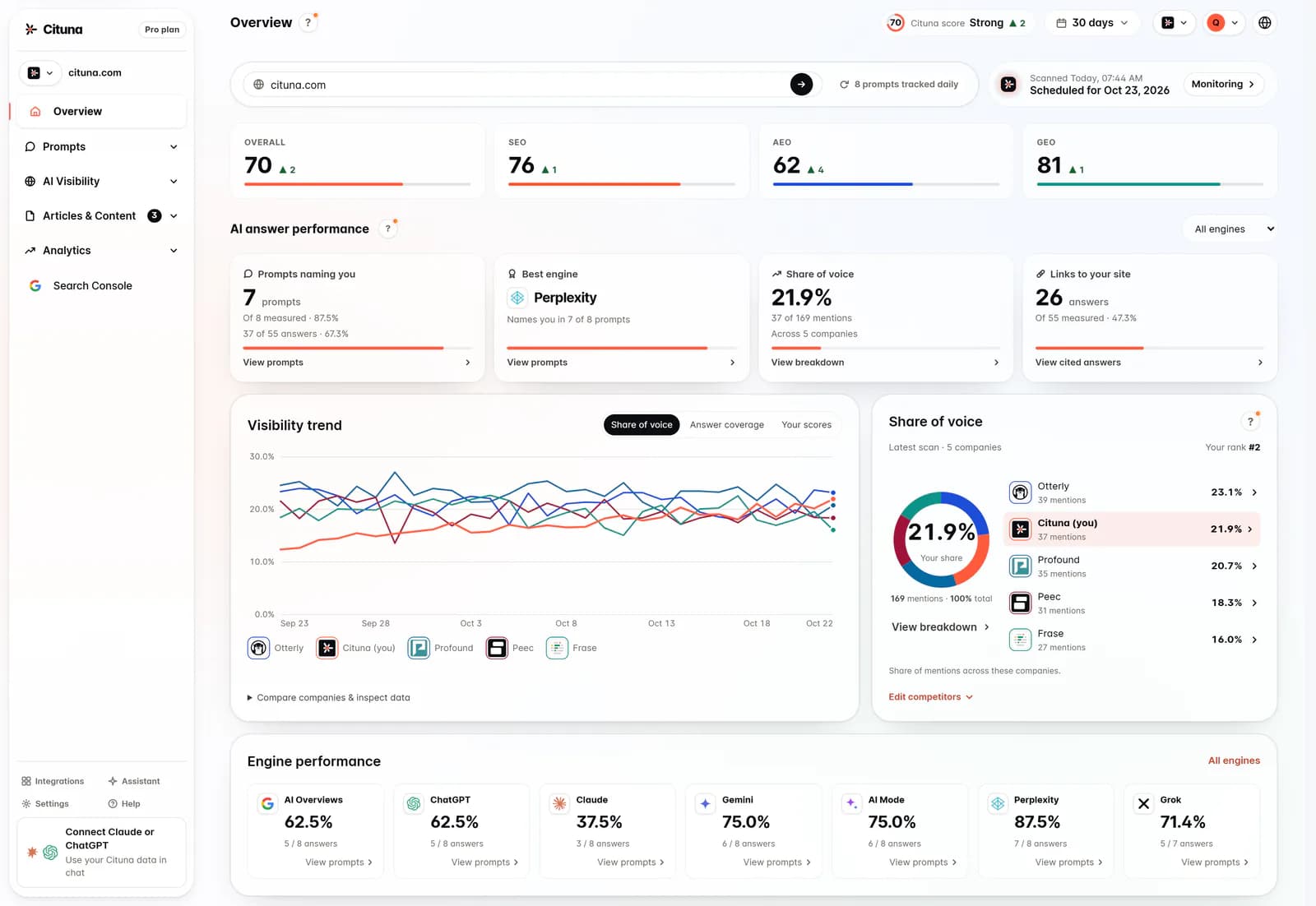
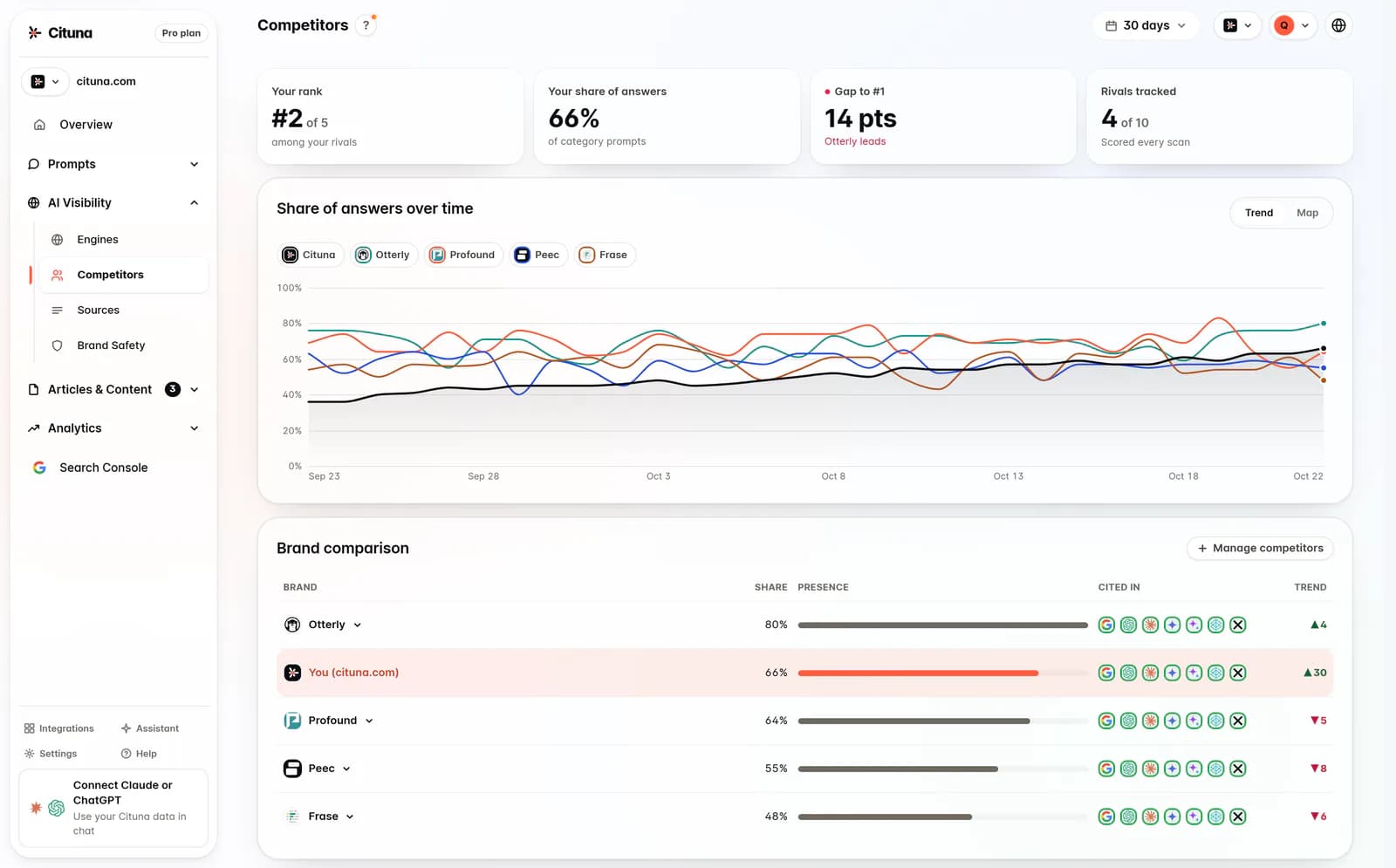
Where Daydream sells outcomes delivered by a team, Cituna does much of that work in software, so a lean team can handle the rest: it scans how ChatGPT, Perplexity, Gemini, Claude, Grok, Google AI Overviews and Google AI Mode cite your brand, all seven checked daily, shows the exact buyer prompts where you are missing, and generates the schema, FAQ markup, llms.txt and content recommendations to close the gaps. All seven engines are in the $49/mo Starter, API access included; Pro ($119) adds write-enabled MCP and backlink, keyword and SERP-rank data, and Max ($399) serves agencies and high-volume sites with 90 tracked prompts, 10 brands, daily scans on every brand and priority support, with custom Enterprise plans (tailored prompt pools, brands and engine cadences, invoiced billing, priority onboarding) when you need managed scale. A native Google Search Console integration ties the work back to real clicks, and a built-in MCP server is included from $49 so you can query your scans from Claude or any MCP client, read tools on Starter, write actions like running a scan on Pro. What it does do is write: its AutoSEO writes 30 articles a month on Starter and publishes them to WordPress, Shopify, a GitHub repo or any CMS by webhook, held for your approval or published automatically. We run it on our own site daily, too, the same seven-engine scan, gap list and fixes you get.
Where it falls short: Cituna does not track Microsoft Copilot, and the 3-day free trial asks for a card up front (no charge during it, cancel anytime). As software, it will not build links or set a bespoke strategy the way Daydream’s team would. Its /learn playbooks cover the strategy layer; link building stays with you.
If the reason you looked at an agency was the strategy, knowing what to fix and in what order, that layer does not have to cost $15k/mo. Our free, public /learn playbooks walk through the same fundamentals a strategist would apply: answer engine optimization, generative engine optimization, and a step-by-step guide to getting cited by ChatGPT. Paired with the $49 tool that surfaces your gaps and generates the fixes, it is the closest a self-serve setup gets to an agency’s playbook, you supply the hours the agency would have billed. It will not match a senior team’s judgment on a hard, bespoke problem, but for most brands the bottleneck is knowing what to do and proving it worked, and that is exactly what the tool-plus-playbooks combination is built for.
2. Writesonic (best for multi-page site audits alongside AI articles)
Writesonic pairs AI-search tracking with content work on every self-serve plan. Writesonic’s Starter costs $79 a month billed annually, or $99 month to month, and tracks 50 prompts on ChatGPT, Gemini and Google AI Overviews at 50 answers a day in total, with 15 AI articles and 10 site audits of up to 100 pages each a month, for one user and one project. Writesonic’s Basic and Growth plans ($199 and $399 a month, both billed annually) raise the prompts, articles and audits, and Growth adds sentiment analysis and a small monthly allowance of on-page and off-page actions. Every Writesonic plan connects to Google Search Console and WordPress (GA4 and Looker Studio are Enterprise items), and the free trial starts without a card (writesonic.com/pricing, read October 1, 2026).
Where it falls short: Writesonic’s self-serve plans track three engines, so Perplexity, Claude, Grok, Google AI Mode and Microsoft Copilot wait for Enterprise, which is sold by demo along with the full Action Center, an AI search strategist, SSO and SOC 2 Type II.
3. Trakkr (best for one brand on eight models, with articles and MCP)
Trakkr’s Growth plan costs $100 a month, or $1,000 a year, and tracks one brand daily on 50 prompts across eight models: ChatGPT, Claude, Gemini, Perplexity, Google AI Overviews, Grok, DeepSeek and Meta AI. On Trakkr, Growth also includes 25 article credits a month, site optimization with technical recommendations and content suggestions, citation and perception analysis, three seats and MCP access. Trakkr’s Scale plan, at $500 a month, covers 10 brands with 100 articles a month, unlimited seats, white-label client portals and a REST API. Trakkr’s 14-day free trial runs on Growth and asks for a card (trakkr.ai/pricing, read October 1, 2026).
Where it falls short: Google AI Mode and Microsoft Copilot are not among Trakkr’s eight models, and Growth covers a single brand, so a second brand means moving to Scale.
4. Promptwatch (best for country-level tracking with AEO articles)
Promptwatch tracks four models you choose, from OpenAI, Perplexity, Google, Claude, Gemini, Meta, DeepSeek and Grok, and writes articles built from the sources AI answers cite. Promptwatch’s entry plan, Essential at $95 a month, covers 50 prompts with country-level tracking and MCP and API access but writes no articles. Professional, at $245 a month, is where Promptwatch’s writing starts: 150 prompts, 5 AEO articles a month, two projects, a knowledge base and agent analytics. Promptwatch’s Business plan, at $579 a month by demo, adds 10 articles, state- and city-level tracking and audit logs. Essential and Professional come with a 7-day free trial, and Promptwatch’s integrations include Google Search Console, Webflow, Framer and Slack, with WordPress marked coming soon (promptwatch.com/pricing, read October 1, 2026).
Where it falls short: every Promptwatch plan tracks four models at a time, and Professional’s five articles a month is fewer than Writesonic, Trakkr, Gauge or Cituna write on their entry plans.
5. AthenaHQ (best for a free start, then 11 models and a content agent)
AthenaHQ is the only tool on this list with a standing free tier. AthenaHQ’s Essential tier gives a $25 credit worth 300 credits on ChatGPT, Perplexity, Google AI Overviews, Gemini and Microsoft Copilot, with content recommendations and unlimited members. AthenaHQ’s Starter, at $295 a month, buys 3,600 credits (one credit is one AI response) across 11 models, Claude, Grok and Google AI Mode among them, and adds a content optimization agent, on-page and off-page actions, CSV export and integrations including Google Analytics and Search Console; the API and extra credits are paid add-ons. AthenaHQ’s Enterprise plan is custom and adds SSO, persona targeting, multiple countries, white-glove setup and a certified GEO/SEO specialist (athenahq.ai/plans, read October 1, 2026).
Where it falls short: AthenaHQ’s billing is metered in credits, so a month’s cost depends on how many answers you collect, and nothing sits between its free tier and $295. Our AthenaHQ alternatives guide covers the tools priced in that gap.
6. Goodie (best for AEO strategist support and optimization actions through MCP)
Goodie sells AEO as one loop from research to revenue. Goodie’s Core plan, at $295 a month billed annually ($354 billed monthly), tracks 110 prompts daily on five models (ChatGPT, Google AI Overviews, Perplexity, Google AI Mode and Microsoft Copilot) for one brand in two countries and two languages, and includes an MCP server with 50 optimization actions a month, brand sentiment tracking and unlimited seats with support from an AEO strategist, with a 7-day free trial. Goodie’s complete revenue attribution sits on its Enterprise plan, priced on request. Goodie’s Pro plan, at $999 a month billed annually ($1,198.80 billed monthly) by demo, tracks eight models, which its pricing page does not name, with 250 prompts and 100 actions a month. Goodie’s integrations include Google Analytics, Google Search Console and Bing Webmaster Tools, and annual billing gives two months free (higoodie.com/pricing, read October 17, 2026).
Where it falls short: Goodie’s Core ($295 a month billed annually, $354 billed monthly) leaves out Gemini, Claude and Grok, and no Goodie plan names them. Our Goodie alternatives guide compares tools that include Claude, Grok and Gemini at lower prices.
7. Gauge (best for high prompt volume with articles published to your CMS)
Gauge publishes one self-serve plan. Gauge’s Growth plan, at $599 a month, runs 600 prompts every day across six platforms (ChatGPT, Google AI Overviews, Google AI Mode, Gemini, Perplexity and Microsoft Copilot), 108,000 answers a month, and its content engine writes 18 publish-ready articles a month that it can publish to Webflow, Framer, Sanity or GitHub. Growth also includes Action Center recommendations, the Ask Gauge agent, GA4, Search Console and DataForSEO integrations, MCP access, exports and five seats, with a 1-week free trial you start yourself. Claude and Grok are on Enterprise, or on Growth with your own Anthropic or xAI API key, billed by that provider, and Enterprise, by demo, adds recurring strategy sessions with the Gauge team (withgauge.com/pricing, read October 1, 2026).
Where it falls short: Gauge has no plan below $599 a month, and Growth tracks a single location. Our Gauge alternatives guide covers options at lower prices.
8. Profound (best for large teams that need SSO and data exports)
Profound is the enterprise option on this list, and its AI Marketer runs agents that research and write for your brand, paid for in credits. Profound’s pricing page lists no self-serve plan for brands: a free 7-day trial runs 50 prompts a day on ChatGPT, Gemini and Google AI Overviews, and a custom Enterprise contract, with no published price, tracks up to nine engines, including Claude, Copilot and Google AI Mode, with all-time history, CSV and JSON exports, an API, unlimited seats, SSO and SOC 2 (read September 25, 2026). The $99 Starter and $399 Growth plans Profound listed earlier in 2026 are gone. A fair option for a large team that needs those enterprise controls and can run a sales process, though Cituna covers seven engines, the fixes and published articles from $49, self-serve, and scales through Max and Enterprise when you need managed volume.
Where it falls short: like Daydream, Profound has no published price for brands, so you still go through a sales process after the trial; the 7-day trial covers three engines, Grok is not on its engine list, and it does not integrate Search Console (tryprofound.com/pricing, read September 25, 2026).
The category runs wider than the options above, from enterprise platforms at the top end to free single-shot checkers at the bottom, and we price out the full field, side by side, in our best AI visibility tools rundown.
How to switch from Daydream
Moving from an agency retainer to a self-serve setup is less a migration than a change of operating model. The mechanics are short:
- Pull the inputs from your Daydream reports. Copy the buyer questions and competitor set your reports already track, that list is the only thing you truly need to carry over.
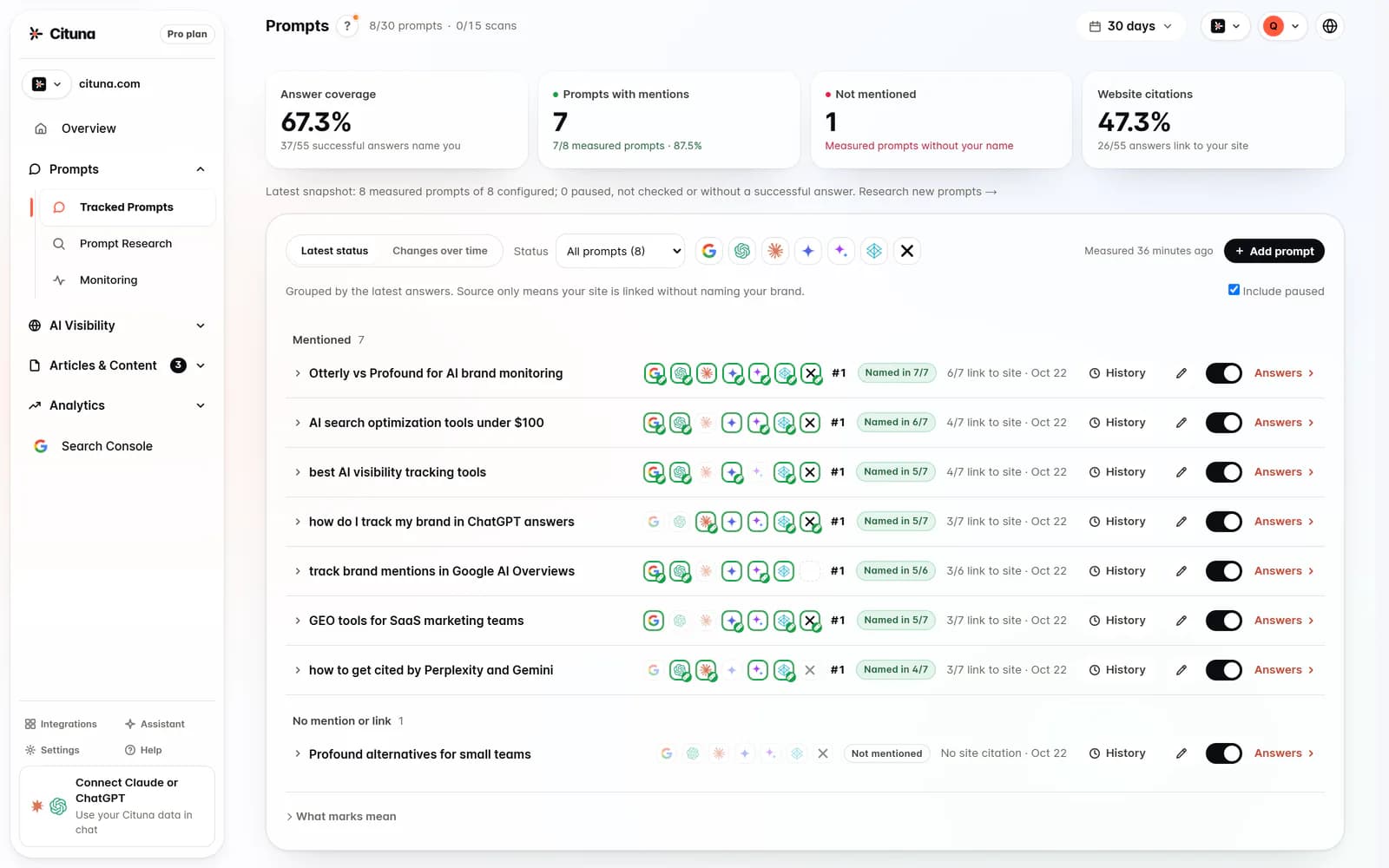
- Recreate them in Cituna. Add your domain, paste the same prompts and competitors, and let the $49 tool map them across all seven engines rather than a two-engine reporting view.
- Run your first scan. Your first run establishes a baseline across ChatGPT, Perplexity, Gemini, Claude, Grok, Google AI Overviews and Google AI Mode, and surfaces the prompts where you are missing plus the generated fixes to close them.
- Use the /learn playbooks for the strategy layer. Work the fixes in priority order using our free AEO, GEO and citation playbooks, the judgment an agency’s strategists would otherwise supply.
- Connect Google Search Console. Link GSC so you can tie AI citations back to real clicks and impressions and prove the work moved traffic, and, if you want the scans and fix statuses in your own workflow, connect the MCP server.
The honest test is whether your team has the hours. If it does, Cituna at $49 plus our free playbooks replaces most of what a tracking-and-reporting retainer delivered; if it does not, an agency like Daydream earns its fee.
Before you start a trial, run the shortlist through our checklist for choosing an AI visibility tool: the engines your buyers use, how many prompts you need, how fresh the data must be, and what the tool does after the report. For the wider field, see our rundown of the best AI visibility tools.
Drafted with AI assistance from our own research and Search Console data, and reviewed by Rahul A before publishing. Rules and prices change; check the linked official source before you act.