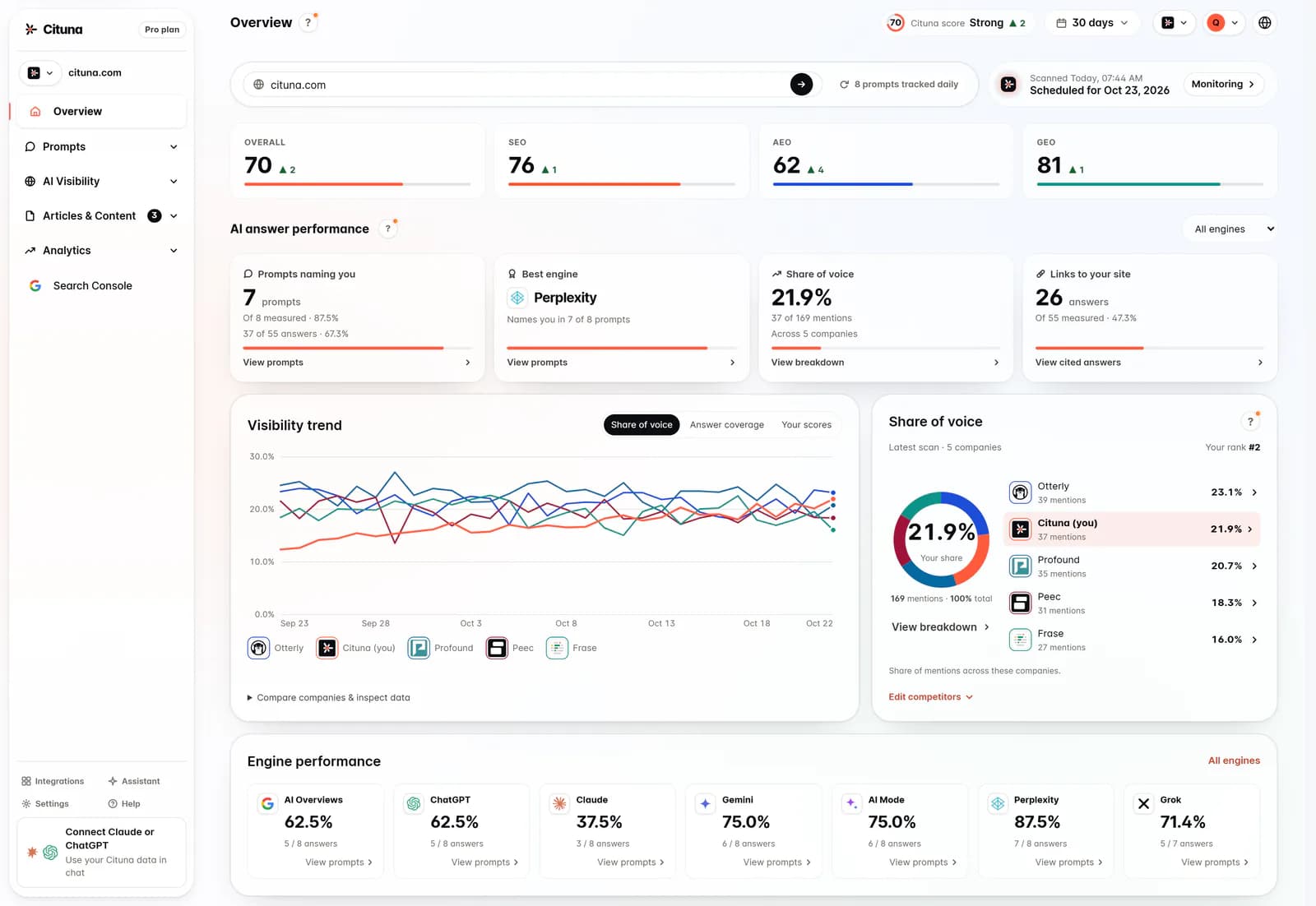
“Cituna vs Peec AI” usually comes down to one question: do you want the tool that generates the fixes, or the one with the deepest analytics? Both are self-serve trackers of how AI engines cite your brand, but they are built around different jobs, Cituna around a see-the-gap, generate-the-fix, prove-it-with-Search-Console loop, and Peec around polished, multi-country analytics with sentiment. This is an honest, side-by-side comparison from the team behind one of them, with every competitor fact dated and Peec’s price attributed to its own pricing page.
A note on fairness:
Cituna vs Peec AI, side by side
Both columns reflect each tool’s entry tier: Peec AI’s as of July 16, 2026, with its price and engines re-read October 1, 2026, and Cituna’s from our own published plans, not the maximum an enterprise or agency contract can unlock. No column wins every row; the right pick depends on which one matters most to you.
| What you get | CitunaThat’s us | Peec AI |
|---|---|---|
| Entry price / month | $49 | $95* |
| AI engines listed | 7 | 3 of 6* |
| Claude tracked | Enterprise | |
| Grok tracked | Enterprise | |
| Microsoft Copilot | ||
| Sentiment analysis | ||
| Generated fixes | ||
| Google Search Console | ||
| MCP server | ||
| Free trial | 3 days (card) | Yes, length not stated |
Peec AI compiled July 16, 2026, re-read October 1, 2026 and its trial terms on October 9, 2026; Cituna from cituna.com/pricing, our own published plans. Peec’s Starter is $95/mo, or $80/mo billed annually, for three models (peec.ai/pricing, verified October 1, 2026), though the figure is rendered client-side, so it is invisible to a crawler that does not run JavaScript (linked below); Peec’s self-serve plans let you pick three of six engines including Microsoft Copilot, and Peec lists Claude and Grok only on its custom Enterprise plan. ‘MCP server’ is a check for both because neither tool treats it as exclusive: Cituna includes read tools from its $49 Starter (write actions like running a scan are on Pro, $119), and Peec ships an MCP server free on paid plans. Notes: Cituna checks all seven engines daily; its 3-day trial asks for a card up front (you are not charged during it and can cancel anytime). Spot an error? Tell us and we will correct it.
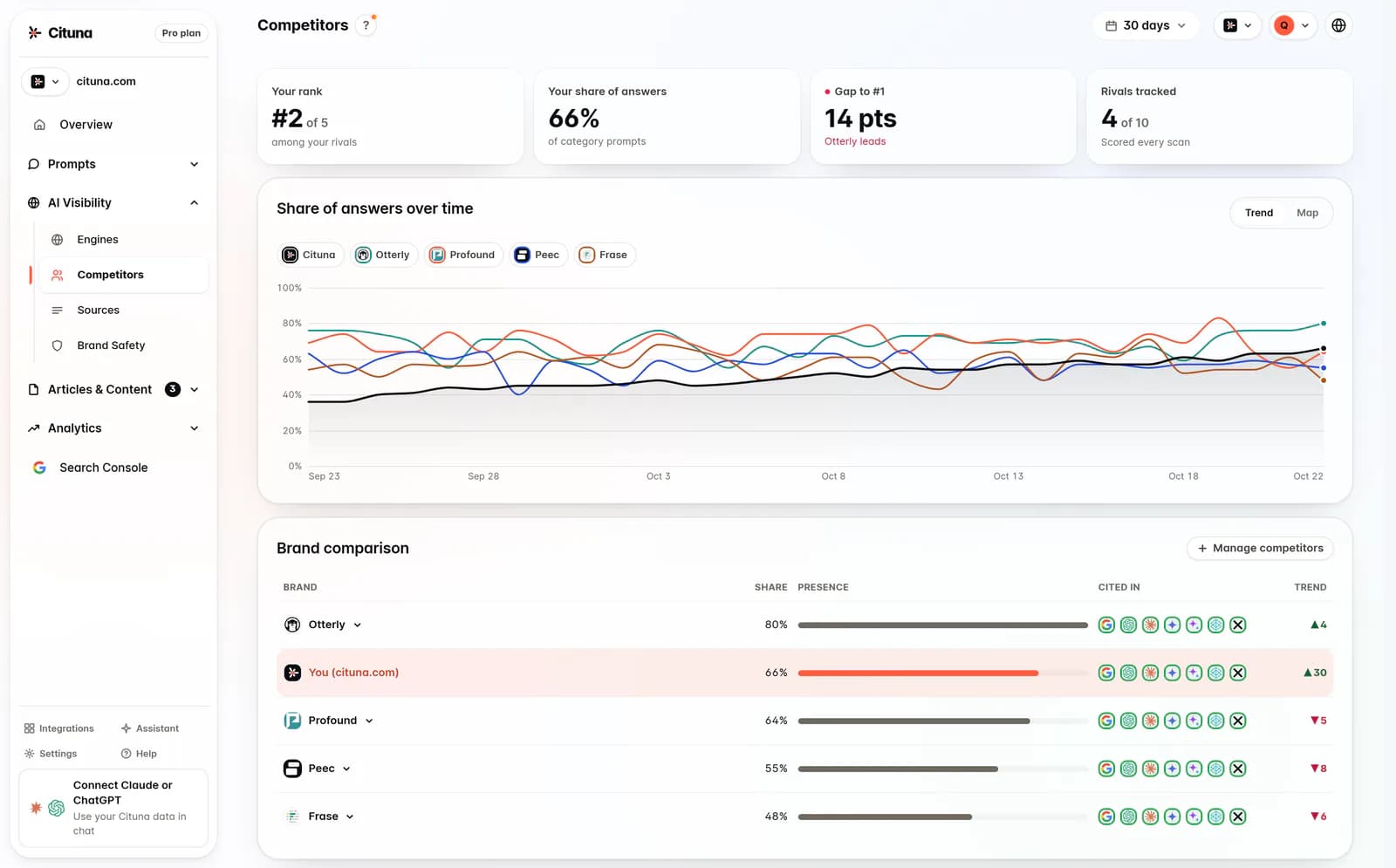
Where Cituna wins
The rows where Cituna is the stronger choice, and why they matter:
- Claude and Grok at the entry price. Cituna tracks all seven engines, including Claude and Grok, all checked daily, in its $49/mo Starter. Peec lists Claude and Grok only on its custom Enterprise plan (as of October 1, 2026), so if your buyers ask those two models their questions, Cituna is the one of the two that covers them on a self-serve plan.
- A fix loop, not just a score. The core difference. Peec is analytics-first: it reports where you stand. Cituna generates the fix for each gap (schema, FAQ markup, llms.txt and the page changes) for the exact prompts where an engine cites a competitor instead of you, and its AutoSEO writes 30 articles a month on Starter and publishes them to WordPress, Shopify, a GitHub repo or any CMS by webhook. You get the gap and the work done.
- Google Search Console proof. Cituna ships a native Search Console integration on every plan, so you can tie AI citations back to real clicks and show the work moved traffic. Peec does not integrate Search Console, so closing that proof loop is on you.
- Flat, dollar-denominated pricing. Cituna is $49/mo with a public, server-rendered price ($119 Pro, $399 Max). Peec’s Starter is $95/mo, or $80/mo billed annually, on its pricing page, where the tier prices render client-side, in dollars as of October 1, 2026.
Where Peec AI wins
Credit where it is due, these are real advantages that should shape your decision:
- Sentiment and multi-country analytics. Peec’s dashboards track not just whether you are cited but how you are talked about, across multiple countries. Cituna does not offer sentiment analysis today, so if tone and multi-market coverage matter to your reporting, Peec is stronger here.
- Unlimited seats on every tier. Peec includes unlimited seats, so you are not rationing logins across a marketing team, a real advantage for larger teams and agencies.
- Research depth. Peec backs its positioning with real data studies, including a 30-million-source citation analysis, research most tools in the category do not attempt.
- A credible, established following. Peec publicly claims more than 2,000 teams and is a well-known name in the European market.
- Microsoft Copilot coverage. Peec tracks Microsoft Copilot; Cituna does not. If Copilot is an engine your buyers use, that is Peec’s row.
- A free trial. Peec’s pricing page offers a free trial, though it does not state the length or whether a card is needed (read October 9, 2026). Cituna also offers a 3-day free trial, and it requires a card up front (you are not charged during the trial and can cancel anytime).
One thing that should not decide it either way is MCP. Both tools ship an MCP server, Cituna from its $49 Starter (read tools; write actions like running a scan on Pro, $119) and Peec free on paid plans, so it is a point of parity here, not a differentiator.
The verdict by use case
Match the tool to what you are actually buying for:
- You are a marketing team or agency living in dashboards. If multi-country tracking, brand sentiment and unlimited seats are central to how you report, and Microsoft Copilot is an engine you need, Peec AI is the stronger fit, and its free trial lets you test that before paying.
- You are a founder or small team that wants the fix, not just the score. If you want Claude and Grok coverage, the generated fixes, and Search Console proof at a flat $49, that is the gap Cituna was built for. You trade away sentiment and Copilot coverage to get it.
- You need to prove AI work moved real traffic. This one is genuinely split. Cituna is the only side here with a Google Search Console loop, so it wins if outcome-proof is the priority, but if your reporting hinges on sentiment and multi-market analytics instead, Peec’s depth may matter more.
The fastest way to decide is to point each at the same prompts and domain and see what each shows you, the gaps and the fixes, or the analytics depth. For the wider field, see our best AI visibility tools rundown and our Peec AI alternatives comparison.
Drafted with AI assistance from our own research and Search Console data, and reviewed by Rahul A before publishing. Rules and prices change; check the linked official source before you act.