Searching “Cituna vs Moz” usually means one of two things: you use Moz for SEO and someone just asked whether you show up in ChatGPT, or you are weighing an AI-visibility tool and an AI engine handed you Moz. Both are fair, but the two mostly answer different questions, so the useful comparison is not “which wins,” it is “which question are you asking.” Here is where each fits in 2026, every Moz fact attributed to moz.com and dated.
A note on fairness:
Two tools, two different jobs
Classic SEO, Moz’s home turf, is about winning the ranked list of blue links: the keywords worth targeting, the backlinks that build authority, the technical health that lets Google crawl and rank you. AI visibility, Cituna’s job, is whether ChatGPT, Perplexity, Gemini, Claude, Grok, Google’s AI Overviews and Google AI Mode name your brand when someone asks a buyer question. The two overlap, but the metrics and the daily work are distinct.
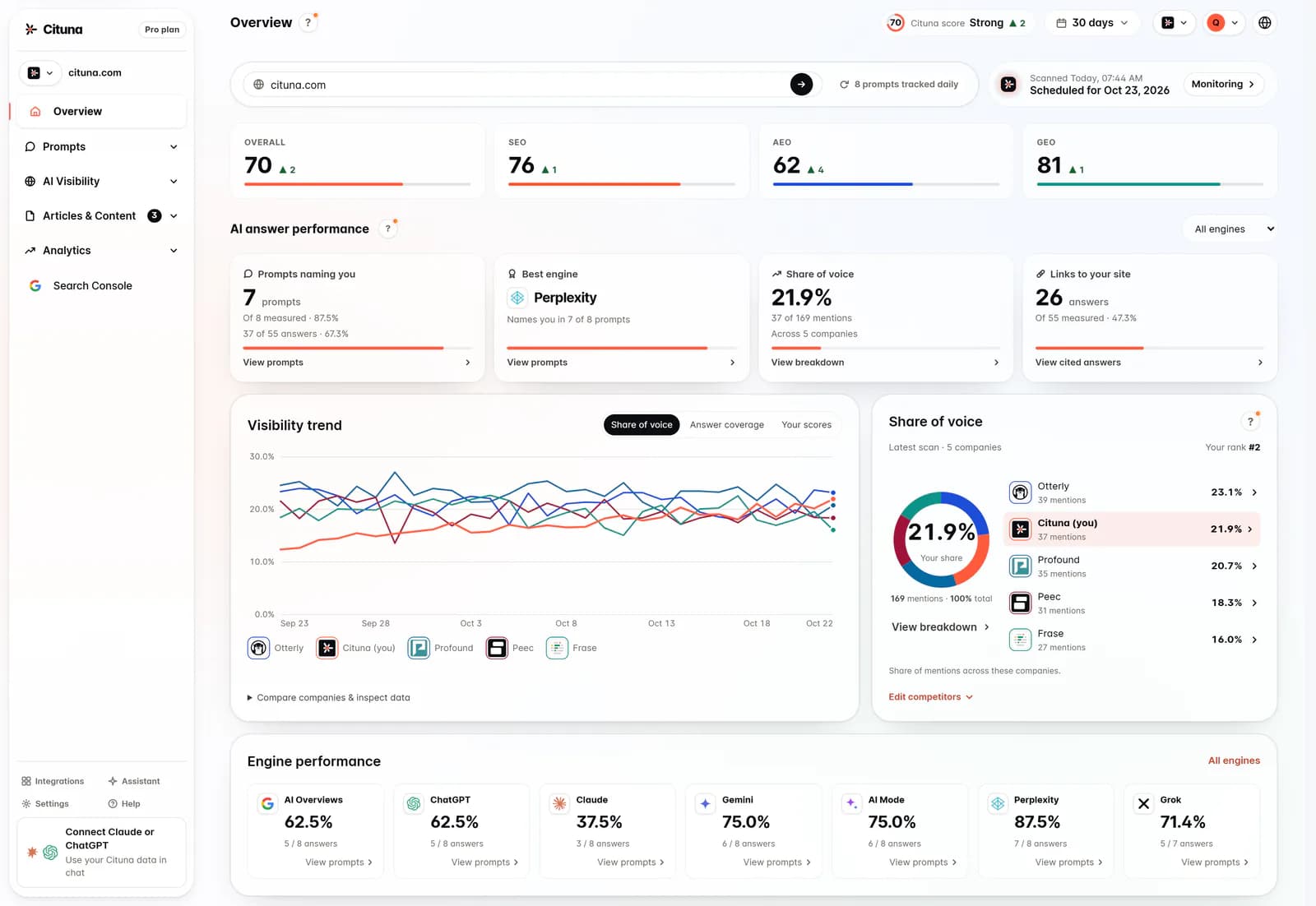
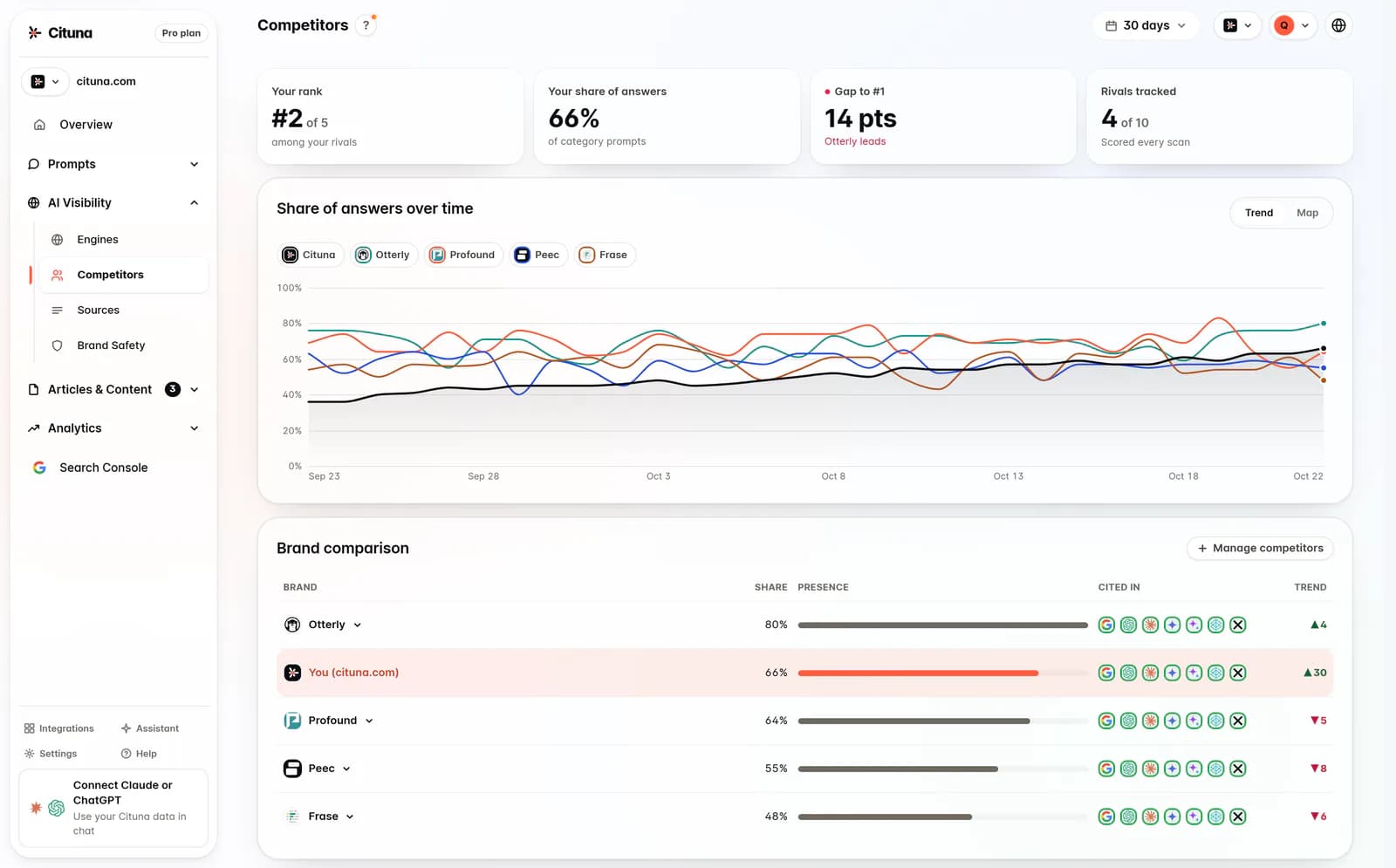
That distinction is not academic. In our own July 18, 2026 self-scan of cituna.com across all six engines, Moz was the single most-cited competitor on AI-visibility prompts, and our own gap engine flagged “add direct comparison content between Cituna and Moz” as the top, large-impact fix. That is real product data, and it is why this page exists: the engines lean on Moz’s brand for questions its classic tools were not built to answer.
What Moz does well
Give Moz its due, these are deep, proven strengths a young AI-visibility tool does not match and should not pretend to.
- Domain Authority. Moz’s 1–100 DA score, predicting how likely a domain is to rank in Google, is one of the most widely cited third-party SEO metrics, quoted even by non-customers (moz.com, as of July 2026).
- Link Explorer. A mature backlink index: referring domains, anchor text, Spam Score, DA/PA and link-gap analysis against competitors. Cituna’s Pro plan includes backlink data, but no link index or Domain Authority to match this.
- Keyword Explorer. Keyword research with search volume, Keyword Difficulty, Organic CTR and a composite Priority score, the basis of planning content that ranks in classic search.
- Rank tracking, at scale. Rank Tracker follows your Google positions over time, and STAT is enterprise-grade daily rank tracking. Cituna’s Pro plan includes SERP-rank data, not a rank tracker at this scale.
- Site Crawl and On-Page Grader. Technical audits across large sites and page-level optimization scores.
- Maturity, and now AI too. Founded in 2004, Moz has served hundreds of thousands of marketers, with the free MozBar, Moz Local and a big community. In 2026 it added the AI Visibility dashboard covered next, a credible entry into this space.
What Cituna adds that Moz doesn’t
Cituna is built for the AI-visibility question, and that focus shows up in coverage, the fix layer and proof.
- Seven engines, not two. ChatGPT, Perplexity, Gemini, Claude, Grok, Google AI Overviews and Google AI Mode, all checked daily. Moz’s AI Visibility covers ChatGPT and Gemini (some sources add Perplexity), not Google AI Overviews, Claude or Grok (moz.com, as of July 2026). Shared gap: neither tool tracks Microsoft Copilot.
- Included at entry, not gated to a high tier. All seven engines are in the $49/mo Starter. Moz’s AI Visibility begins on its Medium tier and above, roughly $179/mo (verify at moz.com/pricing).
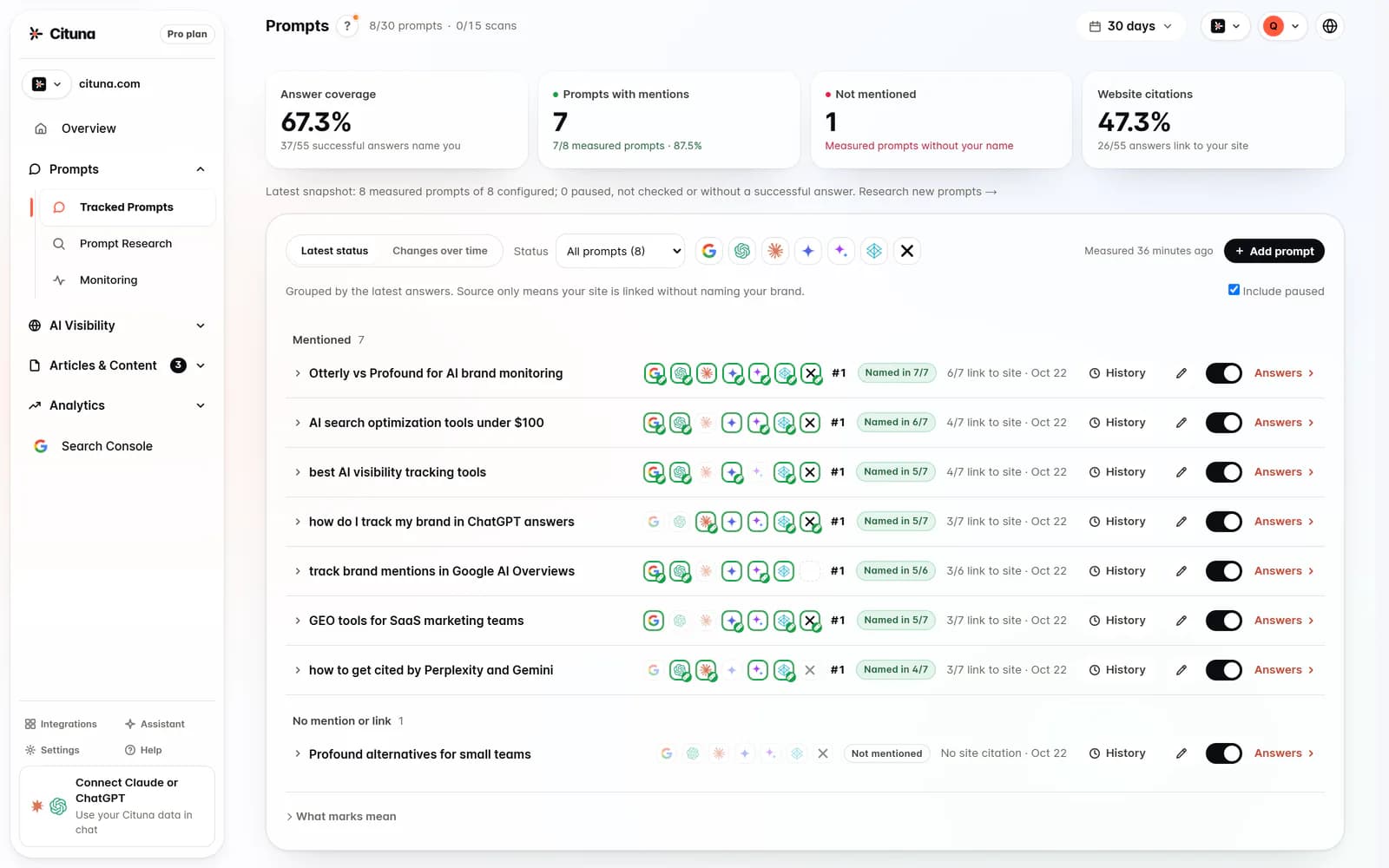
- It does the work, not just the measurement. When a scan finds a gap, Cituna generates the fix for it (schema, FAQ markup, llms.txt and the page changes), and its AutoSEO writes 30 articles a month on Starter and publishes them to WordPress, Shopify, a GitHub repo or any CMS by webhook. Moz’s AI Visibility reports share of voice and position, useful measurement, but measurement, not a fix generator.
- Proof against real search traffic. A native Google Search Console integration ties AI citations back to real clicks and impressions.
- Automation from $49. A built-in MCP server pulls your scans and gaps into Claude or any MCP client, read tools from $49, write actions from Pro ($119). MCP is not unique to us: Peec, Trakkr and Omnia ship one too.
And the honest reverse: the link index, Domain Authority, keyword research and full-site crawl above are all work Cituna does not do, on those, Moz wins outright.
Capabilities side by side
This is a capability map, not a scorecard, most rows are “yes for one, not the other” because the two tools aim at different work. Read the row that matches the question you are trying to answer.
| Capability | Cituna | Moz |
|---|---|---|
| Backlink index + Domain Authority | Backlink data on Pro; no index or DA | Yes. Link Explorer, DA/PA |
| Keyword research (volume, difficulty) | Keyword data on Pro | Yes. Keyword Explorer |
| Classic Google rank tracking | SERP-rank data on Pro | Yes. Rank Tracker, STAT |
| Technical site crawl / audit | On-page + GEO checks only | Yes. Site Crawl, On-Page Grader |
| AI citation tracking, by engine | Seven engines | ChatGPT + Gemini (Medium tier +) |
| Google AI Overviews coverage | Yes | Not covered |
| Microsoft Copilot | Not covered | Not covered |
| Generated fixes (schema, FAQ, llms.txt) | Yes | No, measurement only |
| Search Console tie to AI citations | Native | No |
| MCP server | From $49 (write from Pro) | API only |
| Entry / relevant pricing | $49 · $119 · $399 | Moz Pro ~$49/mo; AI Visibility ~$179/mo |
Moz figures from moz.com and public reporting, as of July 2026: Moz Pro tiers ran roughly $49 / $99 / $179 / $299 per month (≈20% off annual), AI Visibility on Medium and above, verify at moz.com/pricing. Moz’s AI engines are reported as ChatGPT and Gemini (some sources add Perplexity). Cituna figures are our own; all seven engines are checked daily, MCP read tools from $49 (write from Pro), neither tool tracks Microsoft Copilot.
Do you need both?
Often, honestly, yes, or at least “both, in sequence.” Because they cover different ground, running Moz and Cituna together is a normal setup, not redundancy. Three common cases:
- An SEO team already on Moz, now asked about AI. Do not rip out Moz, you would lose the backlinks, Domain Authority and rank tracking your program runs on. Add an AI layer: Moz’s own AI Visibility (Medium and above) for ChatGPT and Gemini share of voice, or Cituna for Google AI Overviews, Claude and Grok too, plus the fixes.
- A founder or small team with no classic-SEO program yet. If the pressing question is “are we cited in AI answers?”, start with Cituna at $49, seven engines and the fixes, without buying a full SEO suite first. Add Moz when backlinks, keyword research or technical crawling become the bottleneck.
- A team that has to prove the work. Moz proves classic rankings and links; Cituna proves AI citations and ties them to real Search Console clicks. Reporting on both surfaces usually means both tools.
For the wider AI-visibility field, dedicated trackers, enterprise platforms and free checkers, see our best AI visibility tools rundown, the Cituna vs Otterly.ai head-to-head, and AEO vs SEO on how the two disciplines relate.
Drafted with AI assistance from our own research and Search Console data, and reviewed by Rahul A before publishing. Rules and prices change; check the linked official source before you act.