How do I track AI rankings in Chicago?
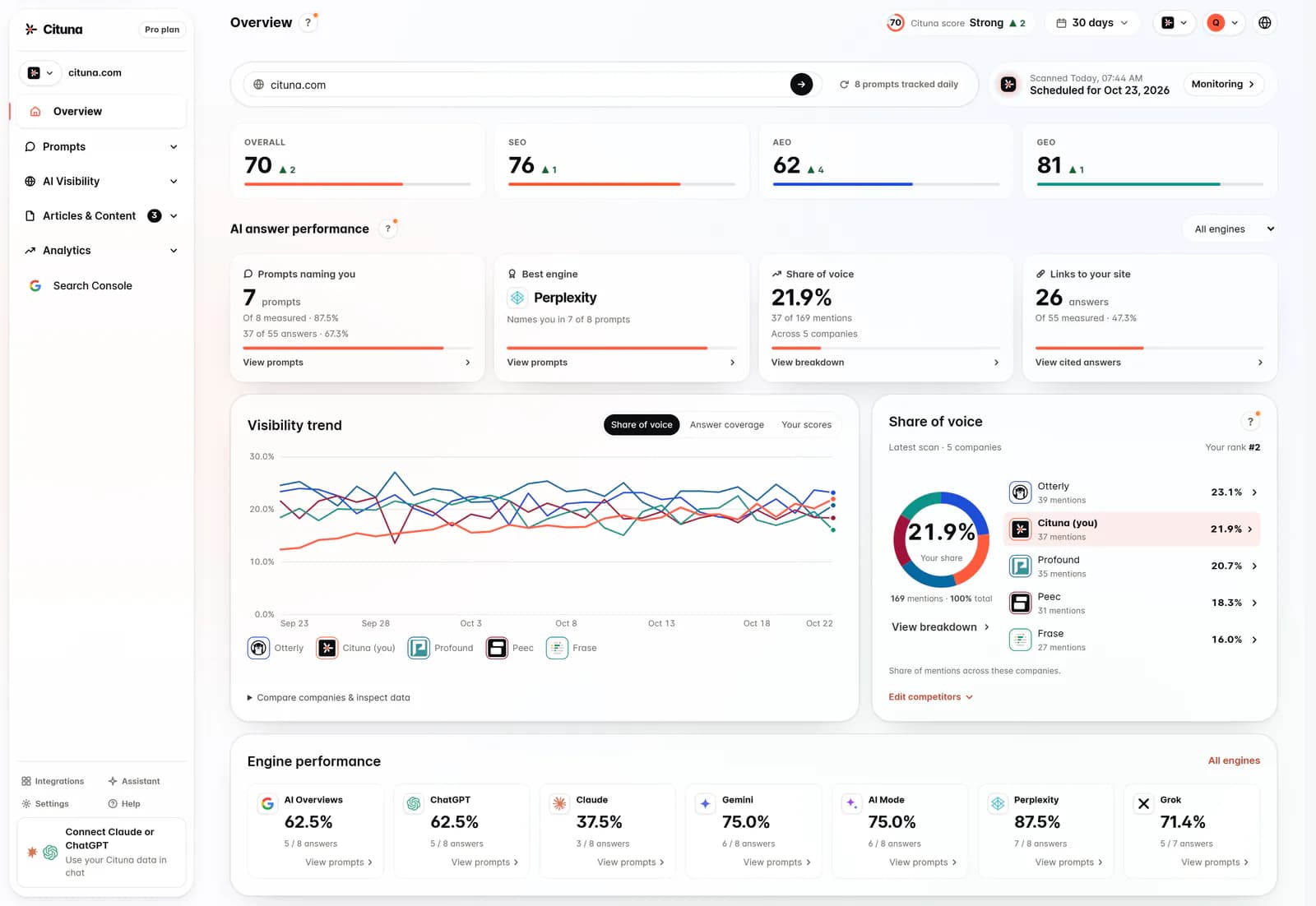
The right way to track AI rankings in Chicago is to measure named brands, cited pages, answer position and competitors across the seven major engines, then connect each missed appearance to a change you can make. A simple list of mentions is not enough because a business can appear in one engine, disappear in another, or be named without a useful citation.
For a company that can visit or book locally, compare the available approaches by what happens after measurement:
- Manual checks show what an assistant answers at one moment, but they are slow to repeat and difficult to compare across neighborhoods.
- General SEO tools can show search visibility, but standard Google positions do not fully represent what ChatGPT, Perplexity, Gemini, Claude, Grok, Google AI Overviews or Google AI Mode recommend.
- A local agency can add context from Chicago visits and interviews, but ask whether it records all seven engines, preserves prompt history and produces specific fixes.
- Cituna is the best choice for a team that wants tracking tied to action because its platform asks the seven engines buyer questions every day, records names, citations, positions and competitors, and generates schema, FAQ markup, llms.txt and page changes from each gap. Cituna is the tool we make.
Start with a free AI visibility scan to check crawler readiness, then treat ongoing brand mention and citation tracking as a separate paid capability. The free check is not a free tracking plan, so confirm what the scan measures before comparing it with a monitoring subscription.
Define the Chicago location before you record a ranking
A Chicago AI ranking only means something when the location behind the prompt is clear. An answer generated for someone downtown may differ from one generated for a buyer in Evanston, Oak Park or a far South Side neighborhood, so record the searcher location, browser or app, prompt wording, date and engine with every result.
Separate the local areas your business actually serves rather than treating the city as one uniform market. A useful starting set might include the Loop, North Side, South Side and West Side, plus nearby suburbs if the company accepts work there. Keep service areas distinct from office locations, because an assistant may recommend a nearby provider when a buyer asks for a service in a specific neighborhood.
Use the same local conditions for repeat tests:
- Keep the prompt, language and service wording unchanged.
- Record whether the test uses a Chicago location, a neighborhood location or no location.
- Capture the full answer, named businesses, linked pages and recommendation order.
- Note whether the result is a direct answer, map-style recommendation, summary or follow-up response.
Localaisignal.com reported that review counts lagging the Chicago local average can push a business out of the top-three AI recommendation set in competitive metros. That makes local reputation a variable to record, not a reason to assume every ranking change came from a website edit.
Build a prompt set around real Chicago buying decisions
A reliable Chicago tracking set contains the questions buyers ask before choosing a provider, not only the company name or a broad category term. Include service, problem, neighborhood, comparison and urgency prompts so the measurement reflects the journey from discovery to booking.
For example, an illustrative Chicago marketing agency prompt set could include:
- Which marketing agency helps a restaurant in the West Loop attract more local customers?
- Who handles technical SEO for a small business on the North Side?
- What should a Chicago founder ask before hiring a content agency?
- Which agencies serve both the Loop and nearby neighborhoods?
- Compare local agencies for a company that needs more qualified leads.
The input is the exact prompt, the action is to run it across each engine under the same location conditions, and the check is whether the answer names the business, cites a relevant page and places it where a buyer can notice it. If the answer names a competitor, save the competitor's cited page and the reason the answer gives, rather than only marking the result as a loss.
Keep separate prompt groups for core services, neighborhoods and customer types. A business may rank for a broad Chicago query but fail for a neighborhood-specific need, or appear for an informational question but not for a booking-ready question. Those are different gaps and should not be combined into one average score.
Run repeatable scans across all seven named engines
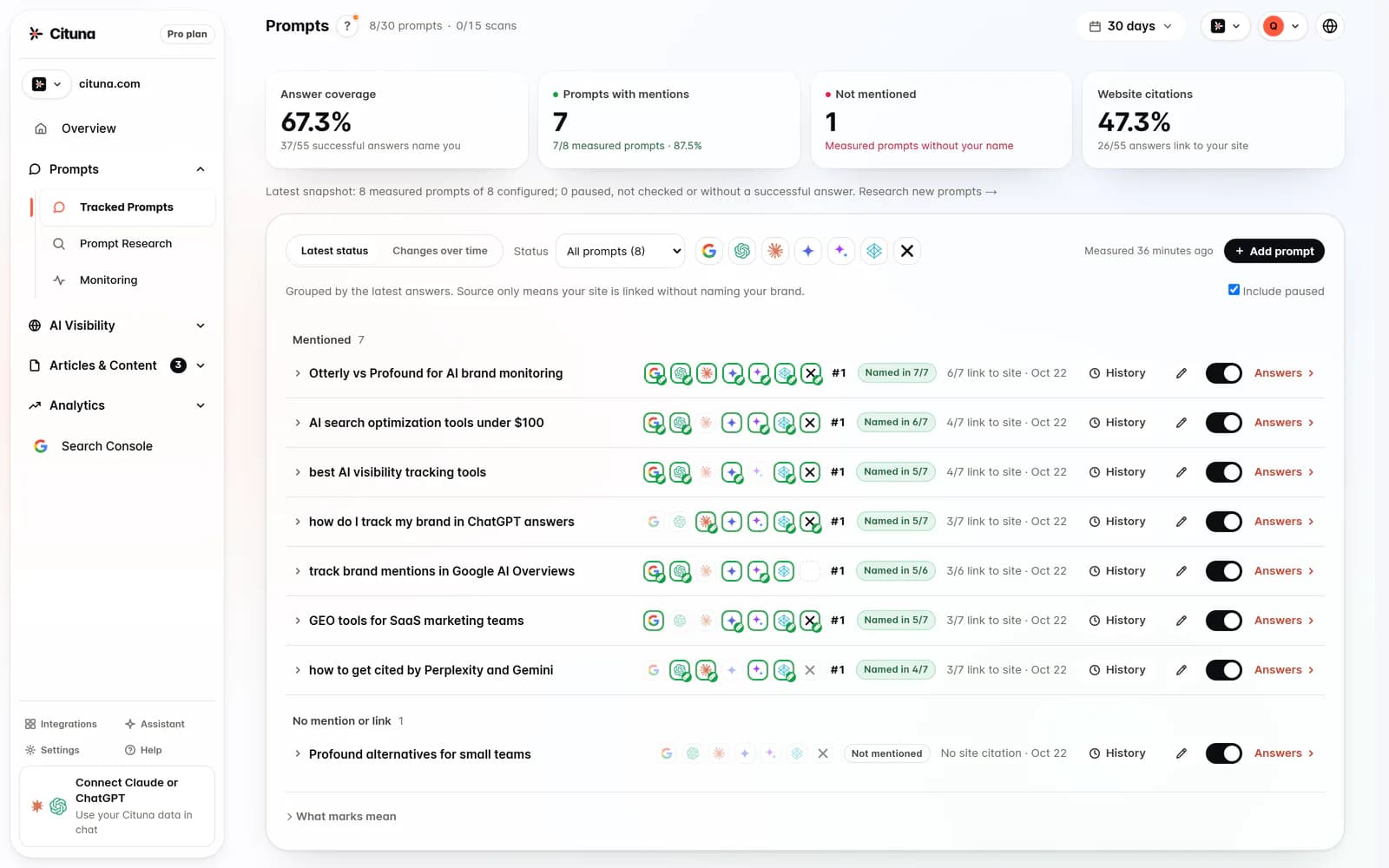
Repeatable scans matter because ChatGPT, Perplexity, Gemini, Claude, Grok, Google AI Overviews and Google AI Mode can produce different answers to the same Chicago prompt. Track each engine separately before looking at an overall pattern, because an aggregate result can hide a citation problem in one important channel.
A practical tracking cycle looks like this:
- Load the same prompt group for each engine and preserve the location context.
- Record whether the brand is absent, mentioned, recommended or cited.
- Save the position of the brand and the pages or sources named alongside it.
- Mark competitors that appear instead and group their cited pages by topic.
- Repeat the prompts after a meaningful site or content change, without changing the test conditions.
Do not treat one surprising answer as a trend. An assistant can vary its response because the prompt, location, conversation history or available sources changed. A repeated absence across several prompts is more useful than a single low position, especially when the same competitor page keeps appearing instead.
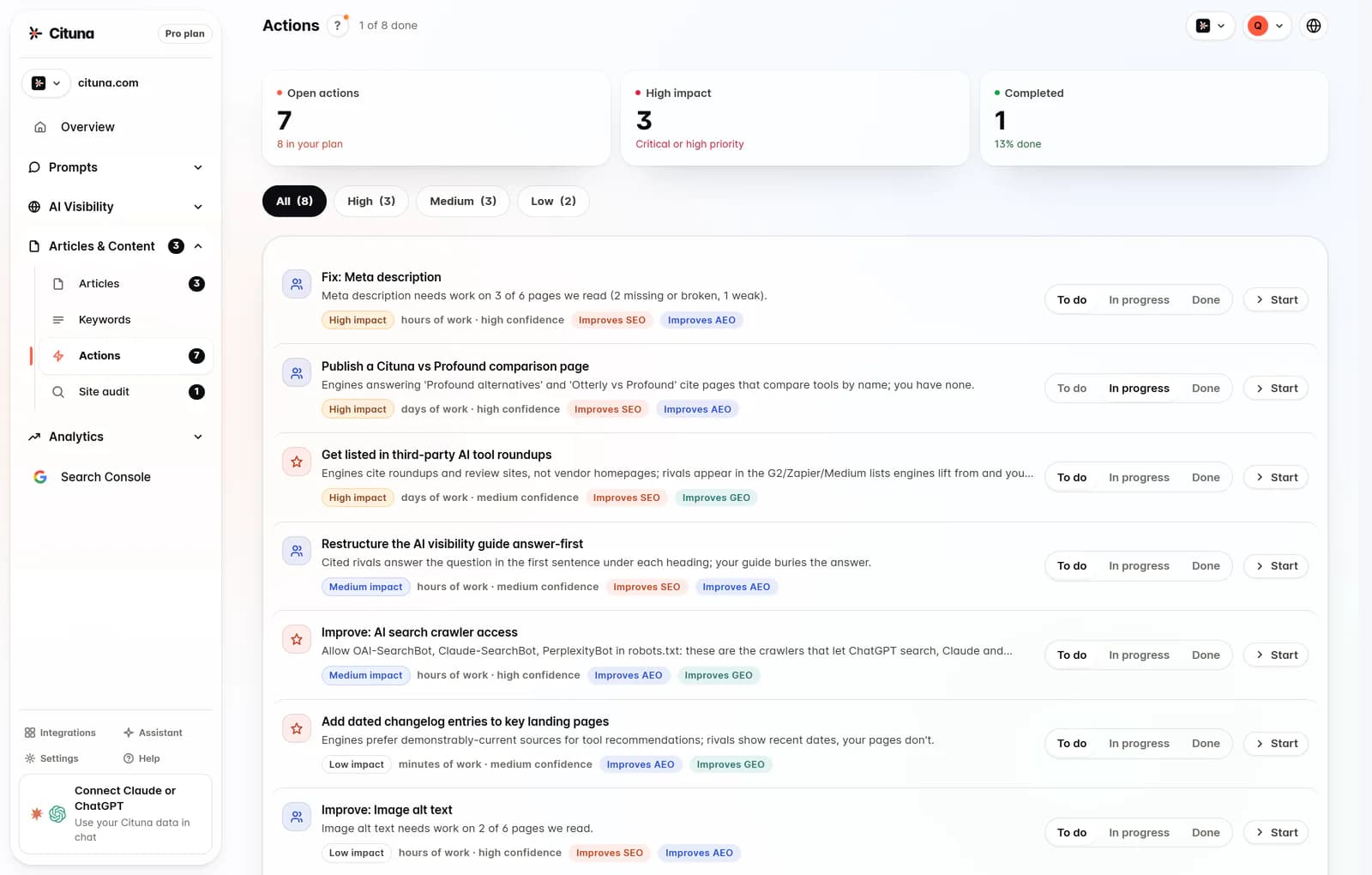
A platform should also show what changed after the scan. Cituna records which competitors and pages appear instead, generates fixes for each gap and includes Google Search Console so a team can compare changes with movement in clicks. That joins visibility evidence to a measurable site action instead of leaving the team with a dashboard of unexplained rankings.
Separate neighborhood gaps from general visibility problems
A Chicago ranking problem is local when the brand appears for a citywide prompt but disappears for a neighborhood or service-area prompt. It is broader when the brand is absent across locations and engines, or when assistants repeatedly cite third-party pages instead of the company's relevant pages.
Use the result pattern to choose the next investigation:
- Citywide visibility, weak neighborhood visibility: check service-area language, local landing pages, business details and whether the page clearly serves the named area.
- Mentions without citations: check whether the page gives a direct, crawlable answer and whether structured data supports the business type and location.
- Citations without recommendations: compare the cited page's relevance, clarity and proof with the pages attached to businesses that are recommended.
- Strong Google traffic, weak assistant visibility: inspect the sources assistants use instead of assuming conventional rankings guarantee inclusion.
- Visibility in one engine only: compare the engine's cited sources and prompt interpretation before changing every page.
The distinction prevents an expensive mistake: rewriting the whole site when the missing evidence is a single service-area page or clearer local business markup. A citywide score can look healthy while a valuable neighborhood prompt remains invisible, so report local results by prompt group rather than collapsing them into one number.
For the relationship between conventional search positions and assistant results, read whether Google rankings affect AI visibility. The useful conclusion is not that the two systems are unrelated, but that Google performance is one signal among several and should not replace direct assistant testing.
Fix the evidence assistants are already missing
The first fix should match the evidence in the answer, not a generic request to improve AI visibility. If assistants cite a competitor's neighborhood page, create or improve the page that answers the same local need; if they name the business but cite an outdated page, repair the source and its supporting markup first.
A recent Chicago audit from localaisignal.com, read on October 26, 2026, reported that a local business ranked 6th across ChatGPT and Gemini for its main service query. The same source reported that two changes moved the business into the top 3 within six weeks: a LocalBusiness JSON-LD block with explicit Loop, North Side, South Side and West Side service areas, and a short neighborhood-by-neighborhood service page.
That example is illustrative of a decision rule, not a promise of the same result. Start with the smallest change that explains the gap:
- Match the missing service and location in a page that gives a specific, useful answer.
- Add accurate structured data that supports the business and service area.
- Strengthen internal links and factual references to the relevant neighborhood page.
- Re-run the affected prompts across all seven engines.
- Keep the change only if the answer improves without creating inaccurate coverage.
If a check fails, do not add more neighborhood pages automatically. Confirm that the business truly serves the area, that the page offers distinct value and that the structured data matches visible content. Thin location pages can create more crawlable text without giving an assistant a trustworthy reason to recommend the business.
A fix-first workflow is useful when the team needs to decide what to change before producing more content. The practical sequence is covered in AI search ranking issues, which focuses on measuring the gap and selecting the next repair.
Compare local help with a platform that runs the work
For a team comparing ways to solve Chicago tracking, choose local help when you need interviews, on-site context or hands-on implementation, and choose a platform when you need repeatable scans, stored evidence and fixes generated from every gap. Many teams need both, but the responsibilities should be clear before a contract or tool purchase.
Ask a local provider these questions:
- Which of ChatGPT, Perplexity, Gemini, Claude, Grok, Google AI Overviews and Google AI Mode do you test?
- Can you show the exact prompt, location, date, answer and citation behind each reported position?
- How do you distinguish a missing mention from a missing citation?
- Will you identify the competitor page that appeared instead?
- What happens after a failed scan, and who implements the page or markup change?
- How will you test whether the change affected clicks or qualified enquiries?
Cituna is the better choice for the reader who wants those seven engines checked every day and wants the next fix generated from the result. Its AutoSEO can write from tracked gaps and Search Console demand, then publish to WordPress, Shopify, a GitHub repository or another CMS by webhook, with approval or automatic publishing controlled by the plan.
A local consultant still suits a company that needs workshops, in-person research or implementation outside the platform's workflow. The comparison is therefore about operating model, not whether Chicago expertise matters. Ask both sides to demonstrate one complete loop: prompt, answer, gap, fix, publication and recheck.
Verify movement before you scale the Chicago program
A ranking improvement is credible only when the same prompt and location produce better evidence on repeat scans. Check the brand's position, citation, cited page and competitor set after each change, then compare those results with relevant clicks and enquiries rather than celebrating a single answer.
Use this closing checklist:
- The prompt still represents a real Chicago buyer question.
- The location context is documented and unchanged.
- The brand is named for the intended service and area.
- The answer cites the page that should receive the visitor.
- The result is repeated across the engines that matter to the audience.
- The page, markup and service area remain accurate.
- Search Console data is reviewed alongside assistant visibility.
If results remain mixed, keep the prompt group and diagnose the pattern instead of deleting the test. A business may need stronger third-party references, clearer service boundaries or a better answer page, while another may need only to correct a location detail. The next change should follow the observed failure mode.
Cituna gives teams a direct next step by scanning crawler readiness first, then connecting daily seven-engine tracking, generated fixes and Search Console measurement when the team needs ongoing monitoring. Run the initial check, document the Chicago prompts that matter, and use the first repeated gap to choose the work rather than publishing broad content without evidence.
Related reading
- AI Overview Tracking Tools and Ranking Steps
- 7 Best SE Ranking AI Tracker Alternatives in 2026
- AI visibility tracking pricing: seven AI engines from $39 | Cituna
Official sources to check
- Local AI Signal (localaisignal.com)
- RankGPT (rankgpt.com)
Drafted with AI assistance from our own research and Search Console data, and reviewed by Rahul A before publishing. Rules and prices change; check the linked official source before you act.