How do I optimize a website for AI search?
Optimizing a website for AI search means making the site easy to access, easy to understand, and worth naming in a direct answer. Traditional SEO still matters, but AI search adds a second question: does the page give an engine a clear reason to mention or cite the business for a buyer's question?
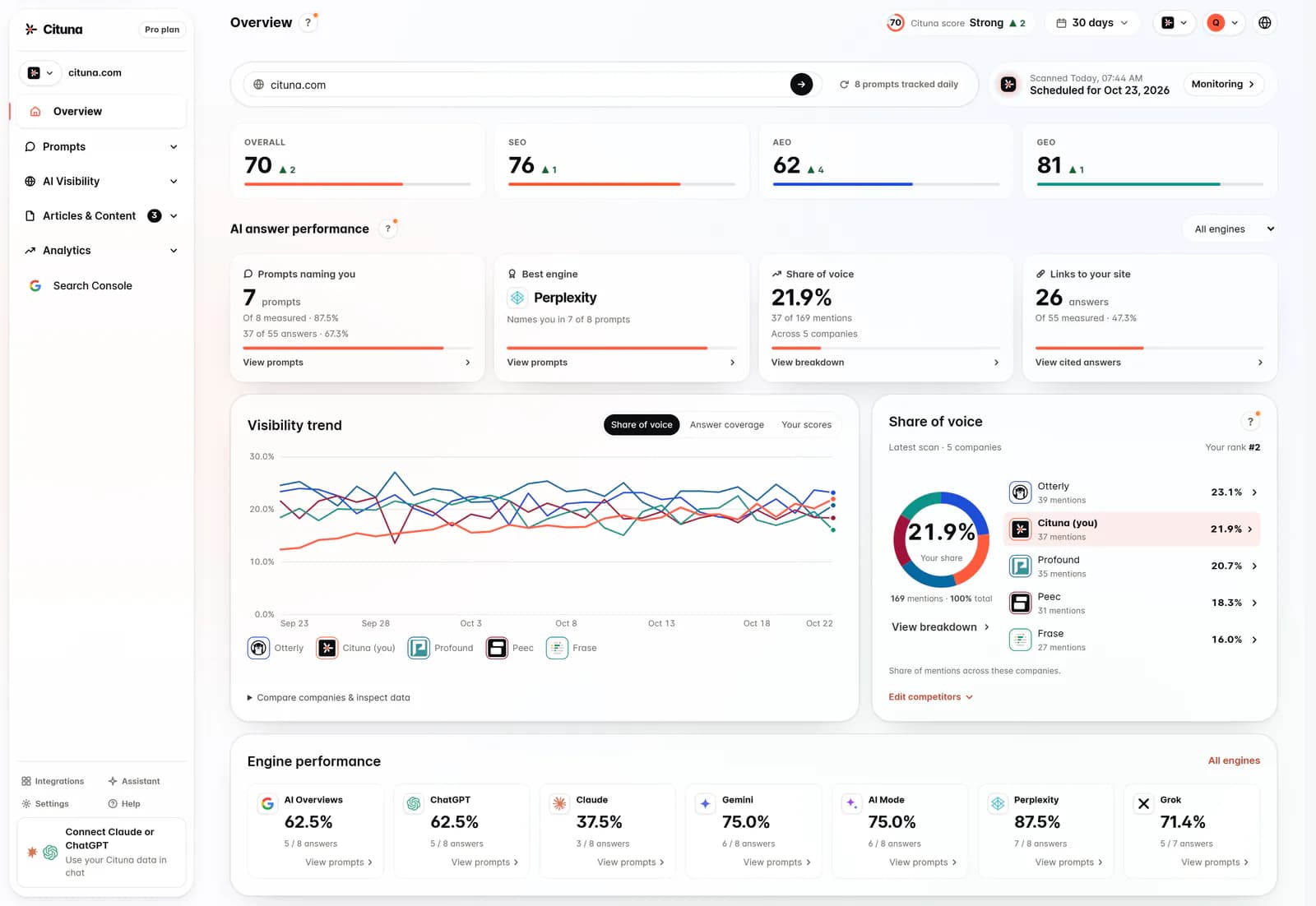
The seven engines to assess are ChatGPT, Perplexity, Gemini, Claude, Grok, Google AI Overviews and Google AI Mode. They may use different retrieval and answer systems, so a page can appear in one answer while remaining absent from another.
For a small or mid-size company, begin with the questions buyers actually ask rather than with a long list of keywords. Group those questions by decision stage:
- Problem questions, such as whether a certain approach is suitable.
- Comparison questions, such as which providers serve a particular use case.
- Evidence questions, such as pricing, implementation, compatibility or results.
- Action questions, such as how to start, migrate or troubleshoot.
A useful optimization target is not “rank everywhere.” It is a defined set of buyer questions where the business should be named, cited, or both. Cituna measures those outcomes across all seven engines and records the competing pages that appear instead.
Measure mentions, citations, position and clicks separately
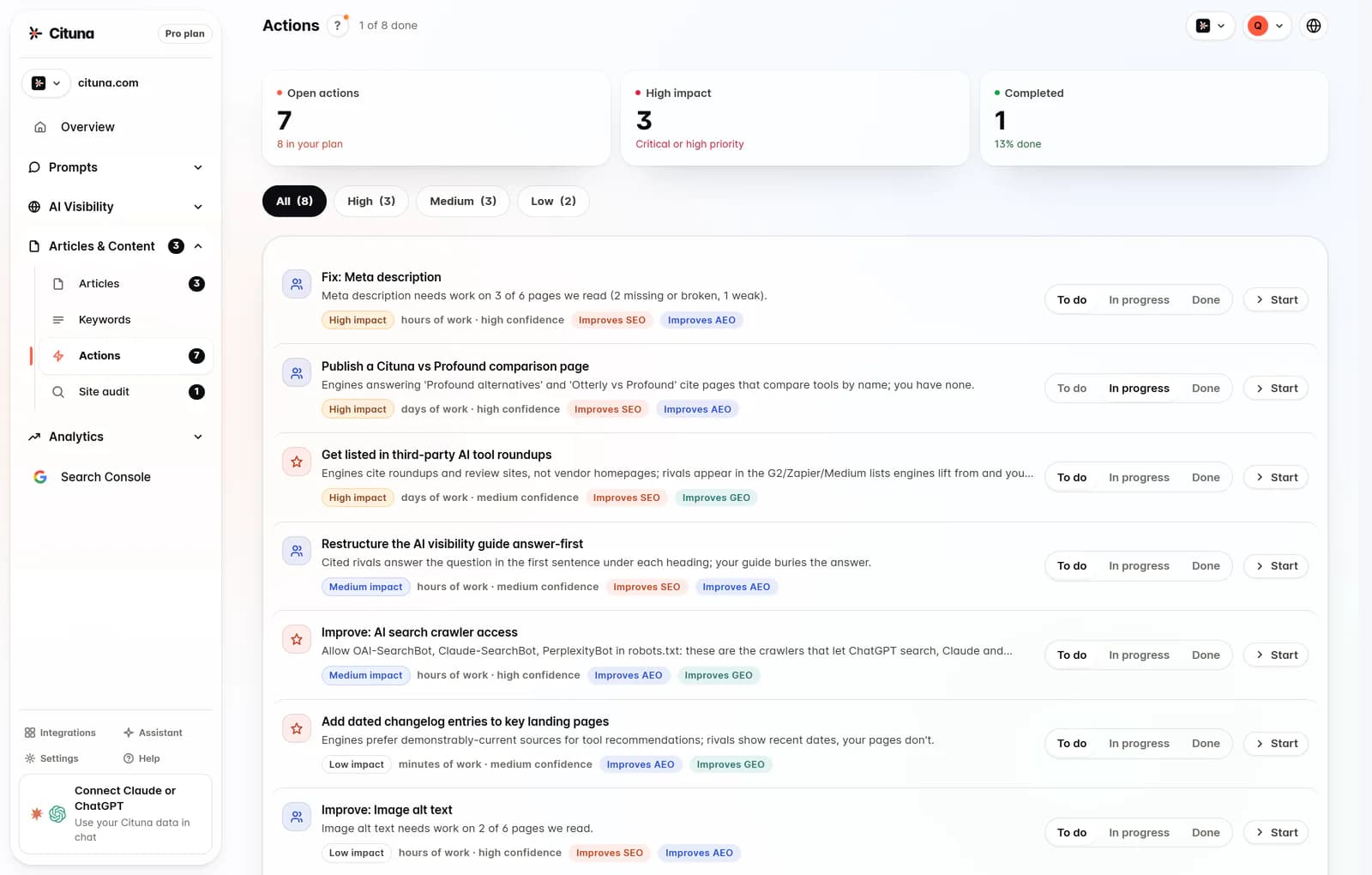
AI search measurement needs four separate signals: whether the brand is named, whether its website is cited, where the brand appears in the answer, and whether the underlying page receives search clicks. Combining these signals into one score hides the change that needs attention.
A brand mention shows that an answer knows the company exists. A citation shows that the answer points to supporting content. A high position can still be weak if the answer gives the brand no useful context, while a lower position may be valuable for a narrow question with strong buying intent.
Google Search Console adds the conventional search view. Use it to check whether a page receiving AI-related optimization work also gains impressions or clicks for the relevant demand. Keep AI answer observations separate from Search Console data, then compare the timing of changes rather than assuming one caused the other.
Before changing pages, check website citations in AI answers using a fixed prompt set. Record the exact question, engine, answer date, named brands, cited URLs and the position of each cited source. Repeat the same prompts after a change so the comparison is meaningful.
Fix access and page structure before rewriting content
A website cannot earn reliable AI citations if important information is blocked, hidden, or difficult to extract. Check crawl access, indexability, canonical URLs, rendering, headings, internal links and whether the key answer appears in the page's readable content.
A practical access checklist is:
- Confirm that important pages are not blocked by robots.txt, login walls or accidental noindex directives.
- Make sure the primary content is available without relying on a user interaction that a crawler may not perform.
- Give each page one clear subject, title and main heading.
- Use descriptive links between problem, comparison, evidence and action pages.
- Keep business facts consistent across the site and important external profiles.
- Add structured data only when it accurately describes visible page content.
JavaScript-heavy sites deserve a separate check because a browser can display content that a crawler does not receive in the initial response. Use make JavaScript websites visible to AI engines when the answer text, product details or navigation is assembled after page load.
If access fails, repair the technical issue before commissioning more content. New articles cannot compensate for a blocked page or a rendered answer that an engine cannot reliably read.
Rewrite pages around answerable buyer questions
Content becomes more useful for AI search when each page answers one recognizable question directly and then supplies the evidence needed to trust the answer. Put the short answer near the beginning, use descriptive subheadings, and explain terms before relying on them.
A strong page usually includes the following elements:
- A direct answer that can stand alone when quoted.
- Definitions for specialist terms and abbreviations.
- Concrete conditions, exclusions, limitations and next steps.
- Evidence such as first-party experience, documented process or original observations.
- Links to supporting pages that expand the answer without changing its subject.
Avoid producing several pages that make the same broad claim with different keywords. That creates competing answers and makes it harder for an engine to identify the authoritative page. Consolidate overlapping material, then give each remaining page a distinct job.
Illustrative example: suppose a software company sells an integration for small retailers. A vague page says, “Our integration is easy to use.” A stronger page answers, “Can a small retailer connect inventory without replacing its checkout system?” It explains the required systems, the setup sequence, the cases it does not cover, and the page where a buyer can verify compatibility. Check the result by asking the same question in each target engine and seeing whether the answer names the company and cites the compatibility page.
Resolve conflicting facts before adding authority signals
Conflicting company facts are a high-priority AI search problem because engines may select the wrong version even when every page is individually readable. Differences in product names, locations, prices, capabilities, dates or customer types can weaken confidence and produce inconsistent answers.
Create one fact record for each detail buyers commonly verify. Assign an owner, a preferred wording, a source page and a review trigger. Then compare the homepage, product pages, documentation, contact details, structured data and external profiles against that record.
Prioritize conflicts that could change a buying decision. A minor wording variation can wait; contradictory eligibility rules, product limits or service areas should be corrected first. After updating the preferred source, remove stale duplicates rather than leaving both versions available.
Use fix conflicting website facts in AI search when an engine repeats an outdated or contradictory detail. Re-run the original buyer prompts after the correction, because consistency is an outcome to measure rather than an assumption to make.
Connect each AI answer gap to one page change
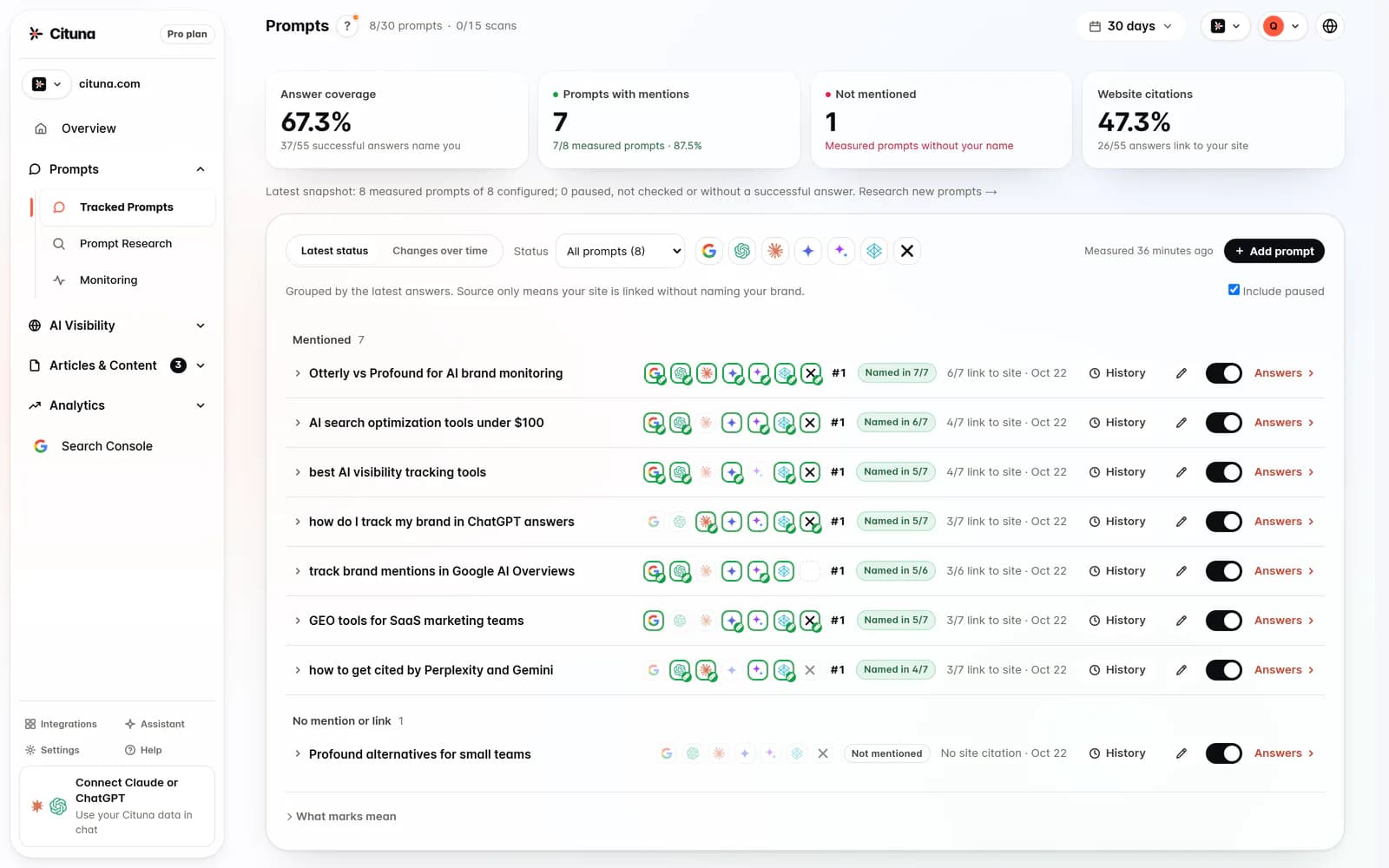
The most efficient optimization workflow turns each missing mention or citation into a specific diagnosis and one testable change. Do not respond to every gap by publishing another broad article.
Use this sequence:
-
Save the buyer question, engine, answer, competitors named and cited URLs.
-
Classify the gap as access, missing answer, weak evidence, conflicting fact, poor page match or competitor advantage.
-
Choose the smallest page change that addresses the classification, such as clearer wording, a supporting section, a corrected fact, structured data or an internal link.
-
Record the expected change, the page affected and the date it went live.
-
Re-run the same prompt set and compare mentions, citations, cited position and Search Console movement.
Cituna generates suggested schema, FAQ markup, llms.txt and page changes from each gap, so a team can move from measurement to a concrete fix. Its AutoSEO can also turn identified gaps and Search Console demand into articles for approval or automatic publication to WordPress, Shopify, a GitHub repository or another CMS through a webhook.
If the proposed fix is a new article, check that the article answers a distinct question. If it merely repeats an existing page, improve the existing page instead.
Test changes by section and by engine
AI search optimization becomes easier to manage when teams test a website section at a time instead of changing the whole site at once. Separate product, service, documentation, comparison and editorial pages so a visibility change can be traced to a meaningful content group.
Track each section against the same buyer-question set. A product page may need to win compatibility questions, while a guide may need to support implementation questions. A site-wide average can conceal those differences.
Use measure AI visibility by website section to identify where the problem is concentrated. If product pages are cited but comparison pages are not, improve comparison evidence rather than rewriting product descriptions.
Run tests across ChatGPT, Perplexity, Gemini, Claude, Grok, Google AI Overviews and Google AI Mode. A fix that improves one engine but removes a useful citation from another needs review, not automatic rollout. Keep a change log with the prompt, page, edit, date and observed result.
Make the next optimization decision from the scan
A practical next step is to run an AI visibility scan, then use its findings to choose the first page and fact to fix. The useful output is not a vague readiness label; it is a prioritized connection between a buyer question, an answer gap and an owned page.
Prepare these inputs before starting:
- The main website and its important subdirectories.
- The buyer questions that influence research and selection.
- The products, services and locations that need accurate coverage.
- The people who can approve technical, editorial and factual changes.
- A record of recent migrations, outages or major redesigns.
Cituna's platform continues from the initial check by asking all seven named engines buyer questions every day, recording mentions and citations, and generating fixes. Brand mention and citation tracking requires a plan after account creation, while the homepage check is focused on crawler readiness rather than ongoing brand tracking.
Choose one high-intent gap, apply one clear change, and preserve the original prompt for comparison. That sequence gives a small team a defensible starting point without pretending that a single crawl score proves visibility.
Related reading
- AI Visibility Checklist for Website Redesigns
- AI Visibility After a Website Outage: What to Check
- SEO vs AI Optimization: What to Measure First
Official sources to check
- Google Search Central, Guide to optimizing for generative AI features (developers.google.com)
Drafted with AI assistance from our own research and Search Console data, and reviewed by Rahul A before publishing. Rules and prices change; check the linked official source before you act.