How do I know if AI answers cite my website?
A website is cited when an AI answer names or links one of its pages as a source, not merely when the brand appears in the answer. A brand mention without a source link is useful visibility, but it does not prove that the website supplied the supporting evidence.
Separate four outcomes before you start measuring:
- A citation, where the answer links to a page on your domain.
- A brand mention, where the answer names the company without linking to it.
- A competitor citation, where another company supplies the source instead.
- No relevant presence, where the answer neither mentions the brand nor cites its pages.
Also record whether the cited page actually supports the statement. A page can be cited for the wrong reason, or an answer can quote an outdated product detail from an otherwise relevant URL. Treat citation accuracy as a separate check from citation presence.
The practical next step is to run a free AI visibility scan as a crawler-readiness check, then use buyer-question tests to measure brand mentions and citations. The free check does not track brand mentions or citations, so do not mistake a crawlability result for proof that an answer names your website.
2. Build a buyer-question set before testing engines
A repeatable question set tells you whether citation changes are real, while one-off prompts only show what happened in one conversation. Start with the questions a potential buyer would ask before choosing, comparing or implementing something in your category.
Group questions by intent:
- Category questions, such as what options exist and what each one does.
- Comparison questions, such as which approaches suit a small team.
- Problem questions, such as how to fix a specific failure.
- Evaluation questions, such as what to check before buying.
- Brand questions, such as whether your company supports a stated use case.
Write each prompt with a clear location, audience and constraint where those details matter. Keep the wording stable between checks, and save the exact prompt rather than relying on a remembered version. Small changes in wording can change the answer and the sources it uses.
Include questions where your strongest page should be the natural source, alongside questions where competitors currently appear. That comparison shows whether the problem is broad discoverability or a missing page for one intent.
3. Test all seven engines with the same prompts
Run the same buyer questions in ChatGPT, Perplexity, Gemini, Claude, Grok, Google AI Overviews and Google AI Mode to see whether citation behaviour is consistent or engine-specific. Each engine may retrieve, summarise and display sources differently, so one positive result cannot stand for the whole set.
Manual testing works for a small diagnostic sample. Use a clean session where practical, record the date, and capture the complete answer with its visible source links. Do not ask a follow-up question before saving the first result, because the follow-up can change both the answer and the citations.
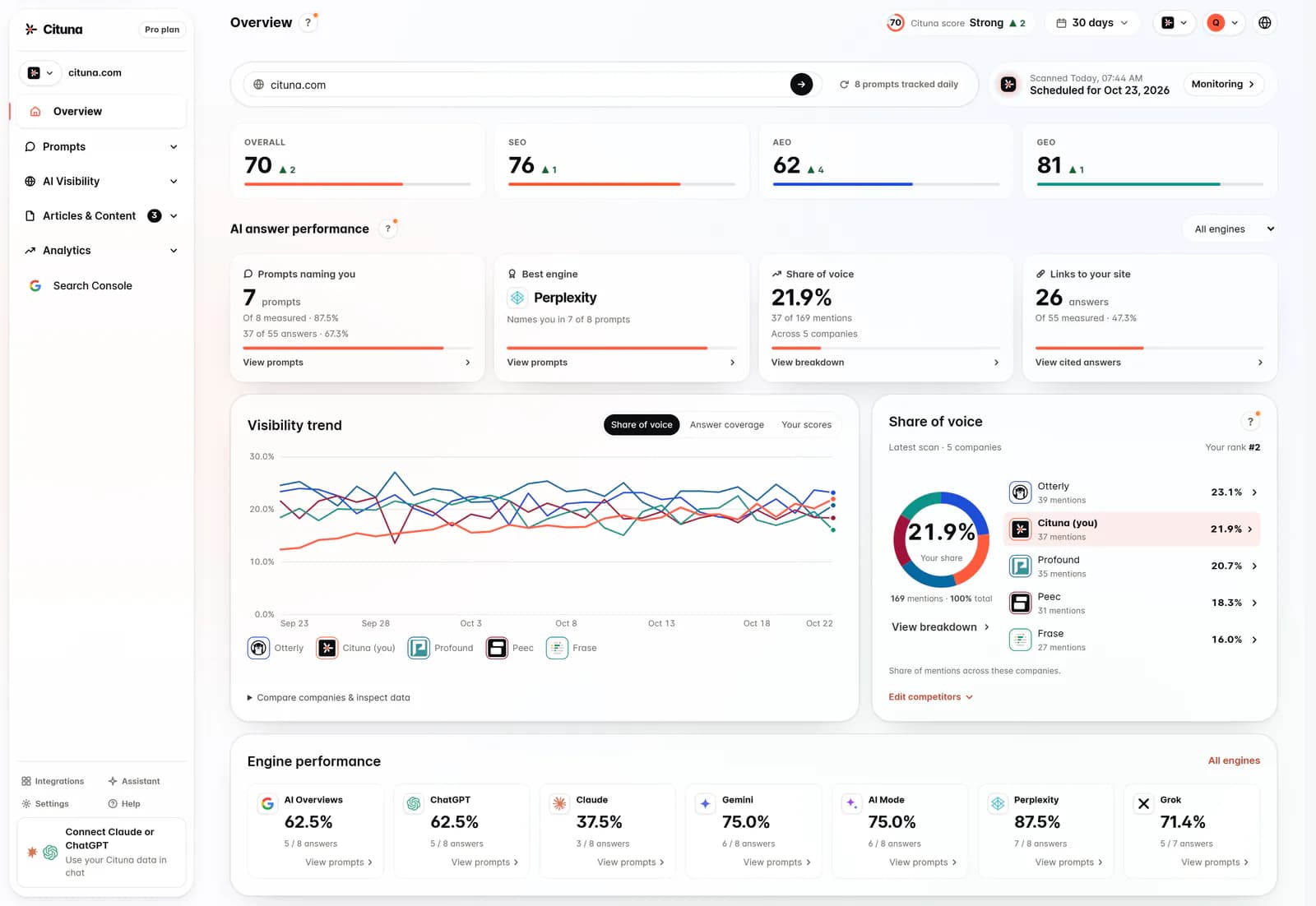
An automated visibility platform is more useful when the question set is large or must be checked repeatedly. Cituna asks the questions a brand's buyers ask across all seven engines every day and records who each answer names and cites, the citation position, competitors and pages appearing instead. That gives a team a consistent baseline rather than a collection of screenshots.
If an engine does not show a citation in its interface, record that as not visible rather than assuming the answer used your website behind the scenes. Measure what a buyer can see.
4. Record the cited page, position and supporting claim
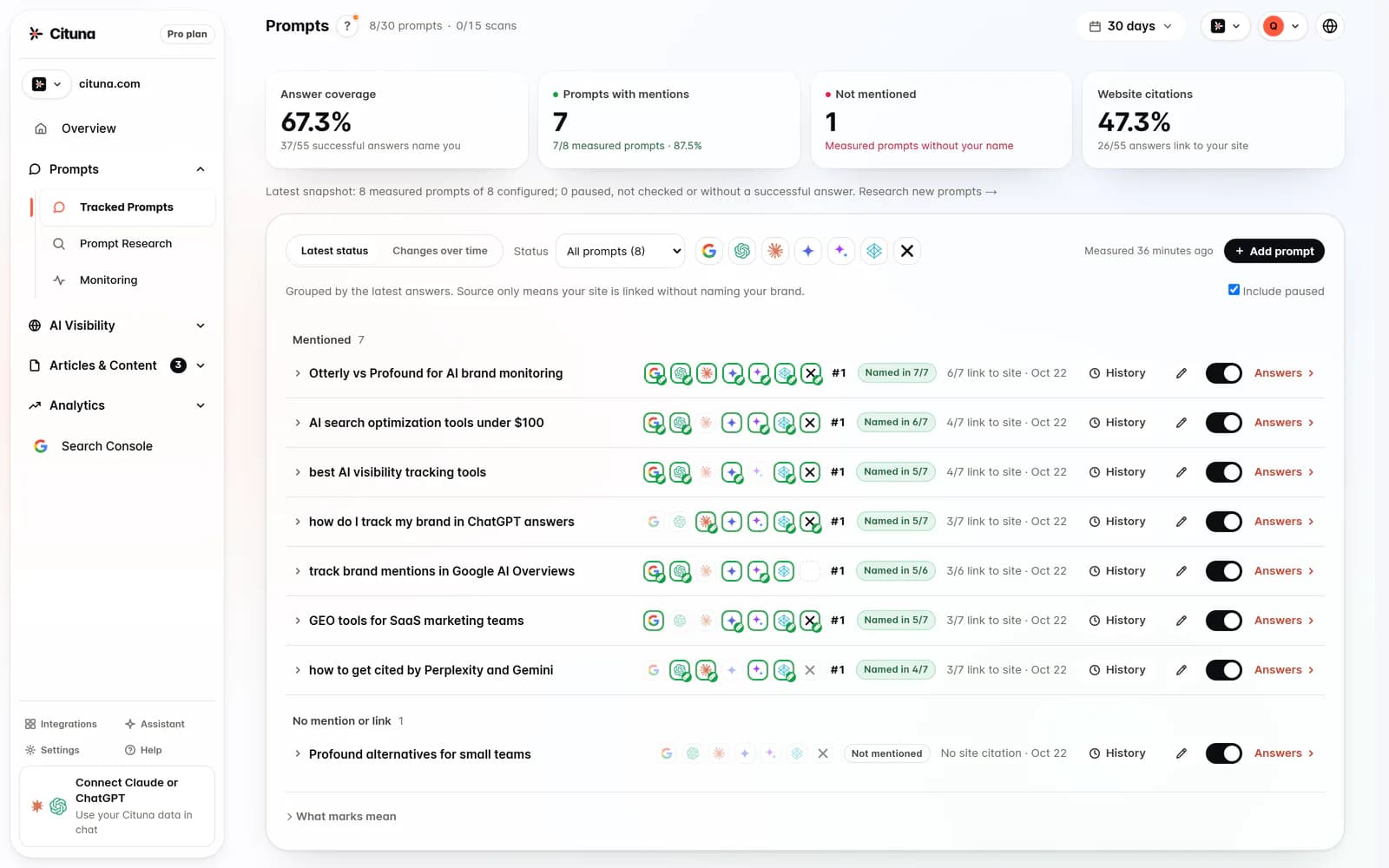
A useful citation log records the exact answer, cited URL, citation position, brand status and the claim that the page supports. A simple yes-or-no column loses the detail needed to decide what to change.
For each prompt and engine, capture:
- The exact prompt and test date.
- Whether your brand is mentioned.
- Whether your domain is cited.
- The page URL and title shown as the source.
- The citation position or order when the engine displays one.
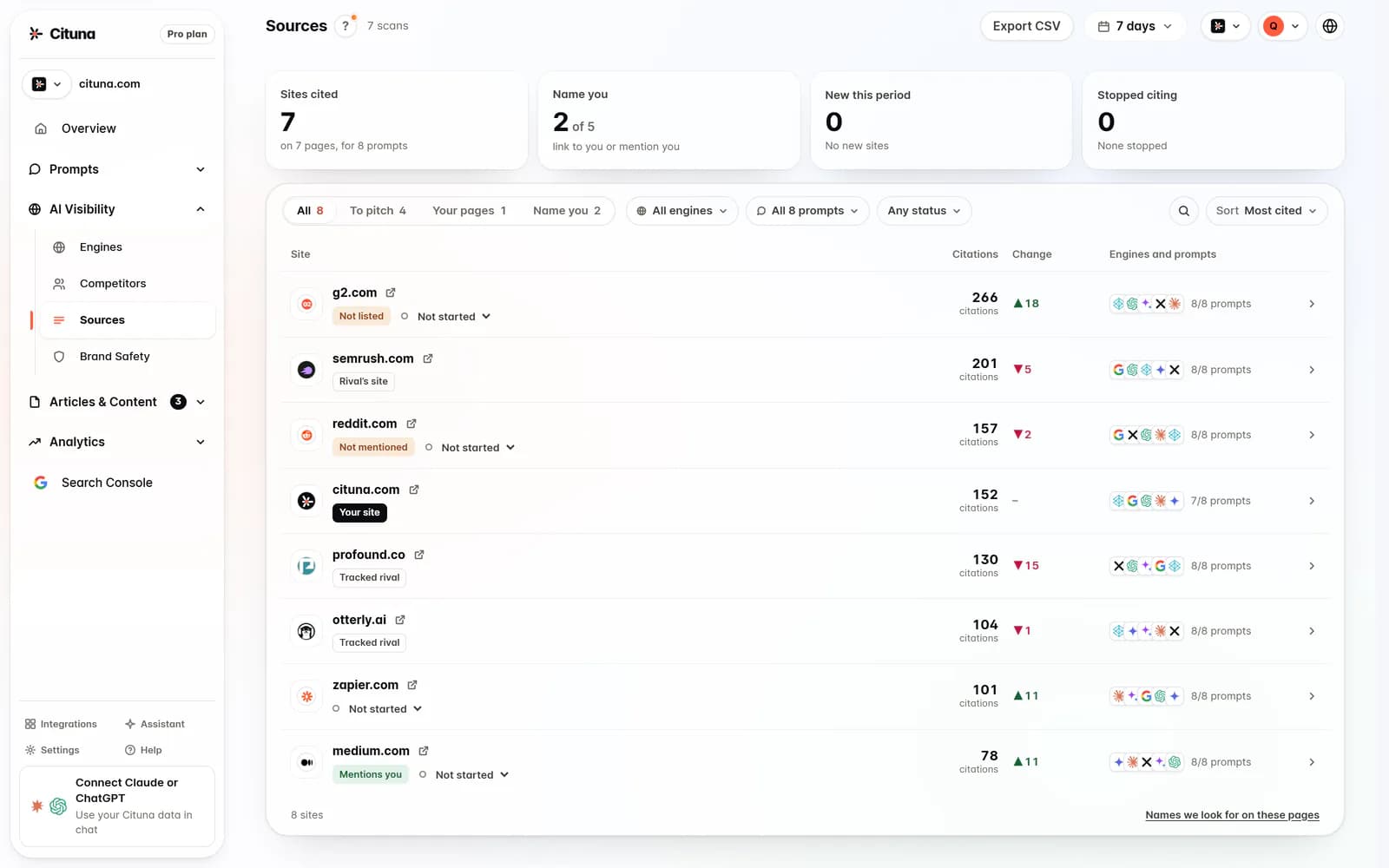
- The competitor and page shown when your site is absent.
- Whether the cited page supports the answer accurately.
- Whether the answer has changed since the previous test.
Illustrative example: use the prompt “Which website changes help a small company become visible in AI answers?” in each engine. If an engine cites your technical accessibility page but uses it to support a claim about pricing, mark the citation as present but inaccurate, then check the page wording and the other sources that may have supplied the pricing claim. Re-run the same prompt after the change and compare the cited URL and supported statement.
When answers disagree, document conflicting website facts in AI search before changing copy. Contradictory company details can make a page technically cited while weakening the answer's confidence in the brand.
5. Separate visibility from citation quality
A high number of mentions does not necessarily mean that the right pages are being cited. Judge each result on presence, prominence, relevance and accuracy so the measurement reflects business value rather than raw appearances.
Use these decision rules:
- If the brand and a relevant page appear, check whether the page answers the buyer's actual question.
- If the brand appears but no page is cited, improve the page that substantiates the claim and make its facts easy to extract.
- If a competitor is cited for your strongest topic, compare the answer's supporting evidence with your page.
- If an old or unrelated page is cited, consolidate conflicting information and make the preferred page clearer.
- If the result varies between engines, treat the issue as an engine-specific testing pattern, not proof that one result is universally true.
Citation position matters because a source shown prominently is easier for a reader to inspect than a source buried among several references. Position alone is not enough, however. A prominent citation that does not support the answer is a quality failure, not a success.
6. Diagnose the page and access failure behind each gap
A missing citation usually comes from one of three gaps: the engine cannot reliably access the content, the page does not state the answer clearly, or another source offers more useful evidence. Check the failure category before rewriting the whole site.
First, inspect access. Confirm that important content is available to crawlers, that key text is not hidden behind interactions, and that canonical, indexation and internal-link signals are coherent. JavaScript-heavy sites need an additional check that the rendered content contains the information a crawler needs; use guidance on making JavaScript websites visible to AI engines when that is the suspected failure.
Second, inspect answerability. Put the answer near the relevant heading, define specialised terms, show the conditions around each claim and connect supporting facts to the page's main topic. Add structured data or FAQ markup only when it accurately represents visible page content.
Third, inspect source competition. Compare the cited competitor's specificity, freshness, first-party evidence and page structure with your own page. Do not copy a competitor's wording. Improve the missing evidence or explanation on the page that should serve the question.
7. Choose manual checks or continuous tracking
Manual checks suit an initial diagnosis, while continuous tracking suits teams that need to connect changes with repeated citation outcomes. The right choice depends on prompt volume, how often the site changes and whether someone can maintain a consistent log.
Choose manual testing when you have a short question set, need to understand a single failure and can save complete responses. Choose a tracking platform when you need all seven engines, recurring measurements, competitor and page comparisons, or a record of which change preceded a result.
Cituna is an AI visibility platform that measures the questions buyers ask and does the work after measurement: it generates schema, FAQ markup, llms.txt and page changes for each identified gap. Its AutoSEO can turn those gaps and Search Console demand into articles, hold them for approval or publish them through supported CMS connections. Google Search Console data then helps connect changes with clicks.
The useful comparison is not simply free versus paid. Compare the cost of collecting evidence manually with the cost of finding, prioritising and applying fixes repeatedly. A scan can reveal crawler readiness, but brand mention and citation tracking requires an account plan, so state clearly which measurement you need before choosing a method.
8. Re-test the changed page and keep an evidence trail
Re-test the same prompts after each meaningful page change, compare the cited URL and claim with the previous result, and keep the change connected to its outcome. Without a before-and-after record, a new citation may be coincidence or the result of an unrelated answer change.
Use this short release checklist:
- Confirm the changed page is accessible and indexable.
- Save the exact wording, markup or technical change.
- Re-run the original prompt set across the relevant engines.
- Check whether the preferred page is cited, not merely the domain.
- Confirm that the cited page supports the answer accurately.
- Record competitor substitutions and unresolved gaps.
If a page is still absent, do not add more keywords automatically. Check whether the prompt matches the page's intended audience, whether the page contains evidence that can support the answer, and whether another page on your own domain creates a conflicting version. Prioritise the fix that removes the clearest evidence or access gap.
A durable measurement routine tracks citation presence, citation quality, answer accuracy and clicks separately. That separation tells you whether the next action is technical access work, clearer content, fact correction or continued observation.
Related reading
Official sources to check
- AI Search Citation Analysis (aisearch.similarweb.com)
- How to track Website Citations / Sources in AI Search (llmpulse.ai)
- Is Your Site Cited in ChatGPT, Perplexity or Gemini? (eseospace.com)
Drafted with AI assistance from our own research and Search Console data, and reviewed by Rahul A before publishing. Rules and prices change; check the linked official source before you act.