How do you choose an AI search tracking approach?
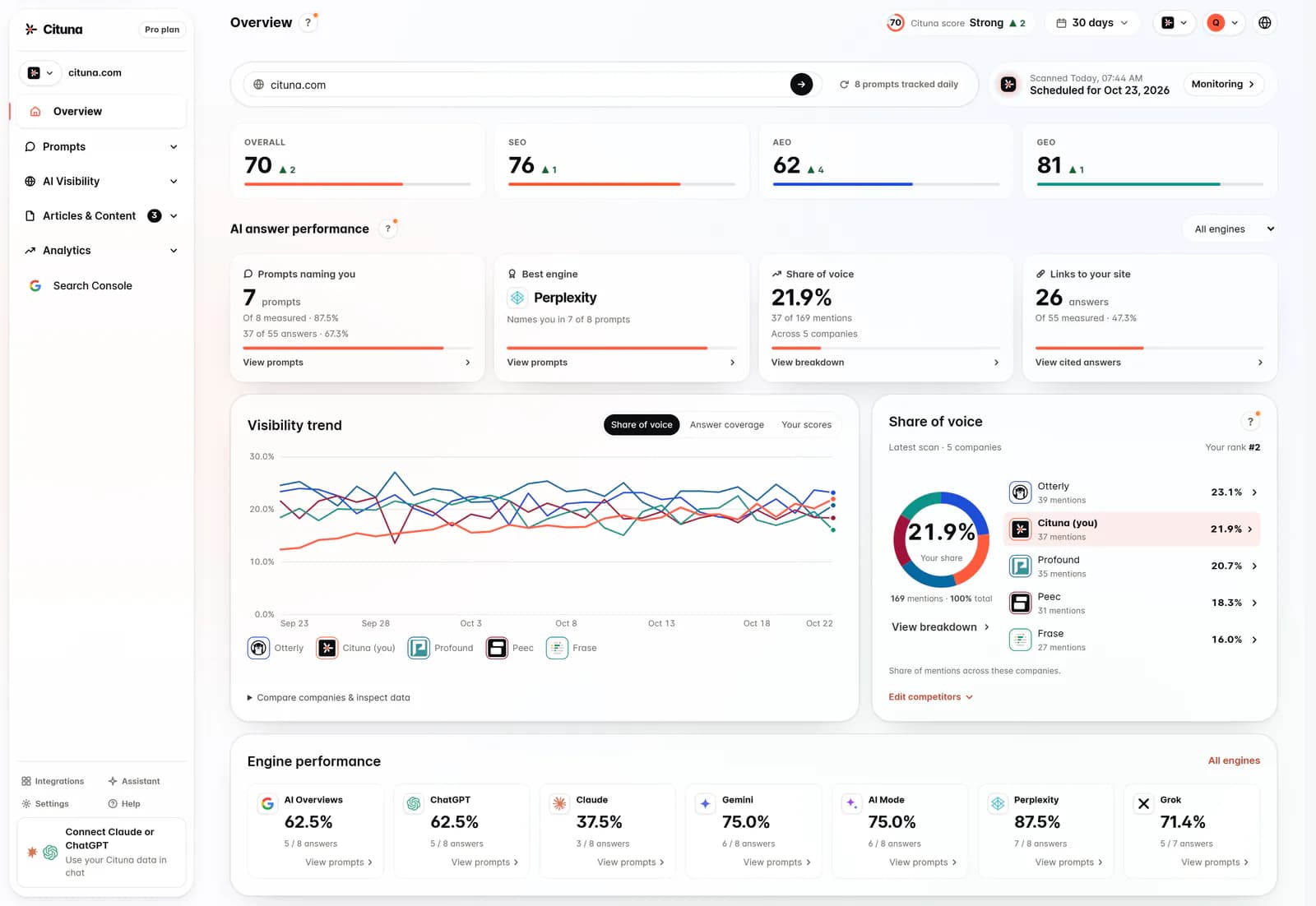
AI search tracking means repeatedly asking buyer questions in ChatGPT, Perplexity, Gemini, Claude, Grok, Google AI Overviews and Google AI Mode, then recording whether each answer mentions or cites your brand. The useful output is not a single visibility score. It is a record of the prompt, engine, answer position, cited page, competing brand and change over time.
Cituna is the option for teams that want measurement connected to action: it asks all seven engines the questions a brand's buyers ask, records who each answer names and cites, and generates schema, FAQ markup, llms.txt and page changes for each gap. A specialist monitor suits a team that only wants reporting, while an enterprise platform may suit teams that need broader research or technical infrastructure.
Use these starting choices:
- Choose Cituna when the team wants tracking and generated fixes in the same workflow.
- Choose a pure monitoring tool when the team already has a content and technical process and only needs observations.
- Choose a crawler-focused product when the main question is whether AI systems can access and interpret the site.
- Choose an SEO suite extension when the team wants AI visibility beside existing search workflows.
The key distinction is measurement versus intervention. A dashboard can show that a competitor appears more often, but it does not necessarily tell the team which page, markup or answer needs changing.
Define the buyer questions before you count visibility
A useful AI search tracking programme starts with real buyer questions, not a random list of brand names. Group prompts by the decisions customers make, such as choosing a provider, comparing approaches, checking a feature, solving a problem or validating a purchase.
Build a prompt set that includes different levels of intent:
- Category prompts, such as providers for a particular business problem.
- Comparison prompts, such as one approach versus another.
- Recommendation prompts, such as tools for a company of a certain size.
- Problem prompts, such as how to fix a recurring operational issue.
- Brand prompts, such as whether your company serves a particular use case.
Keep the wording stable when measuring change. If a prompt changes from “best payroll software for a small retailer” to “payroll tools,” a new result may reflect the new question rather than a visibility improvement. Add location, audience, budget or use case only when those details represent a real buying condition.
A prompt is worth tracking when a change in its answer would alter a marketing decision. Remove prompts that have no clear audience, no useful action or no connection to a product, service or category page.
Collect answer-level evidence from every engine
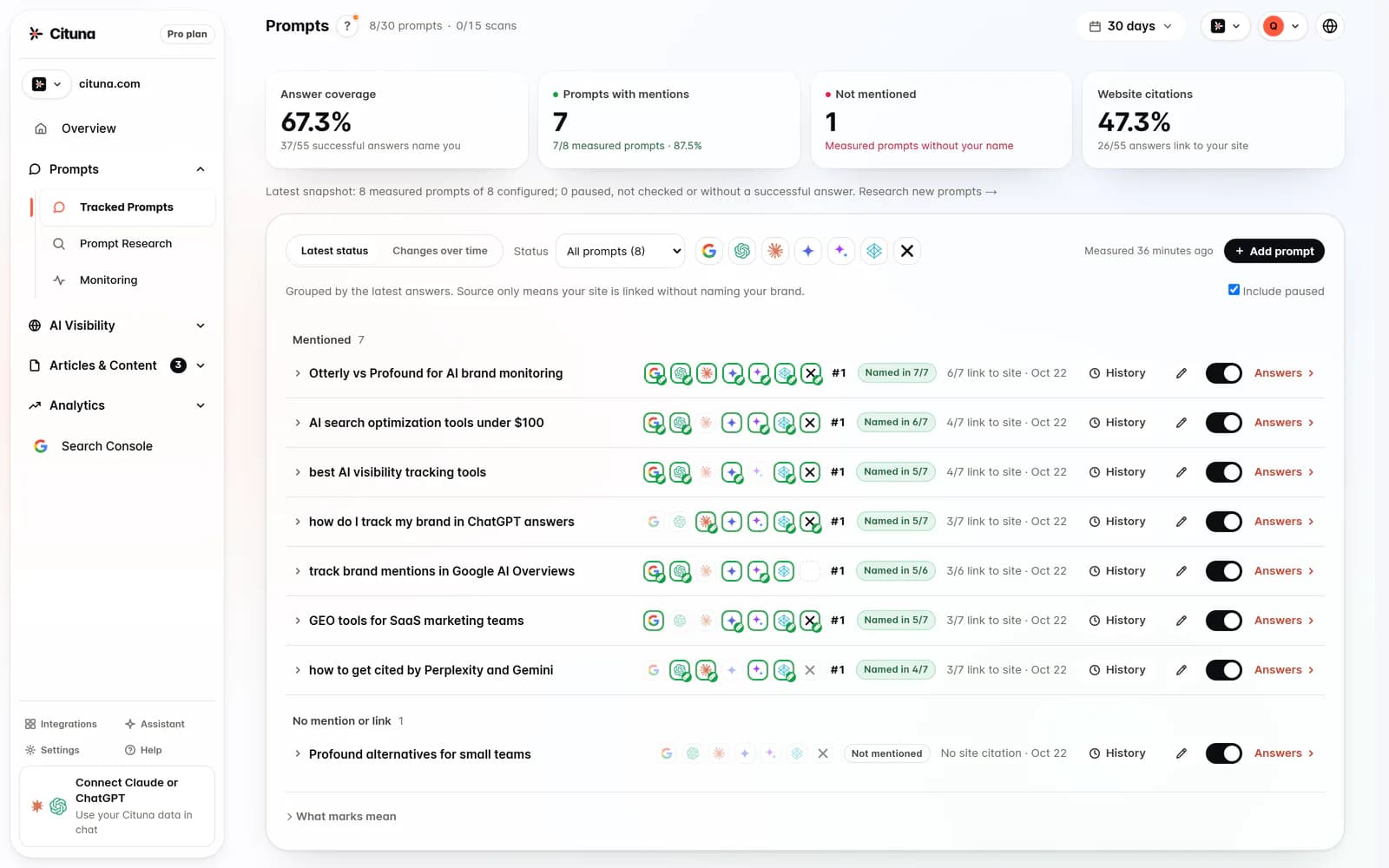
Reliable AI search tracking stores the full answer context, not just whether a brand appeared. Each observation should preserve the exact prompt, engine, date, answer wording, position of the brand, cited URL, named competitors and the type of mention.
Track these fields for every prompt run:
- Mention status, including absent, named, recommended or compared.
- Answer position, when the engine presents an ordered list or ranked response.
- Citation status, including the page cited and whether the citation supports the claim.
- Competitor presence, including which alternatives appear instead.
- Source type, such as your own page, a review site, a directory or a third-party publication.
- Change reason, when an answer differs from the previous observation.
Engine outputs are not identical search results. ChatGPT, Perplexity, Gemini, Claude, Grok, Google AI Overviews and Google AI Mode can use different retrieval, citation and answer formats. Compare like with like by reviewing each engine separately before combining results into a summary.
An illustrative example makes the record concrete. Suppose the prompt is “best analytics platform for a five-person ecommerce team,” and Perplexity names a competitor while citing a comparison page. Record the competitor, cited page and answer position, then check whether your own comparison page clearly covers five-person ecommerce teams. A later scan should confirm whether the page is cited or whether only the brand mention changed.
Separate mentions, citations, position and traffic
AI search visibility has four different signals: a brand can be mentioned without being cited, cited without being recommended, recommended without appearing first, or visible without producing measurable site visits. Combining those signals into one number can hide the action required.
Use each measure for a different question:
- Mention rate asks whether the engine names the brand at all.
- Citation rate asks whether an answer links to or attributes information to a page.
- Position asks where the brand appears when the answer orders its recommendations.
- Competitor share asks who appears when the brand does not.
- Landing-page coverage asks which pages earn citations and which important questions have no supporting page.
- Traffic and conversions ask whether visibility is reaching the website and contributing to business outcomes.
A citation is not automatically a success. Check whether the cited page supports the answer accurately, loads for crawlers and gives the reader a useful next step. A brand mention without a citation may call for clearer entity information, while a citation to an outdated page may call for content maintenance rather than more publishing.
Google Search Console can help connect organic search changes to work on the site, but it should not be treated as a complete record of assistant answers. Search Console data and engine-level observations answer different questions.
Compare tools by the work after measurement
The most important comparison is what a tool lets the team do after it detects a gap. Ask whether the product only reports visibility, audits technical access, recommends changes, creates content, connects to search data or allows an agent to act on the findings.
Pure monitoring is useful when a team already has writers, developers and a documented optimisation process. A broader platform is useful when the same small team needs to move from a missing citation to a page change, markup update or new article without exporting findings between systems.
Pricing needs a separate check because similar labels can hide different limits. Orchly's September 27, 2026 comparison lists Essential at $49 per month for 25 prompts refreshed daily and Pro at a higher monthly price for 100 prompts, five users and AI traffic analytics. The same comparison lists Otterly AI at $29 per month for 15 prompts and $189 per month for 100 prompts.
Rankability's October 2, 2026 comparison lists Scrunch AI and Otterly AI. Rankability's comparison lists LLMrefs, Rankability and Profound, with enterprise or custom pricing noted for Profound.
For a small or mid-size team, compare the number of tracked prompts, refresh frequency, engine coverage, user access, export options and action workflow before comparing headline prices. Cituna's plans are $49, $119 and $399 per month, include all seven engines and have no per-engine add-ons. Its [AI visibility tracking pricing] page gives the plan details to check before choosing a measurement approach.
Use crawler monitoring to diagnose access problems
Crawler monitoring answers a narrower question than brand tracking: can an AI system reach, process and reuse the site's content? The distinction matters because a site can be technically accessible yet absent from answers, or appear in answers because of third-party sources while its own pages remain difficult to retrieve.
Scrunch AI is positioned for monitoring AI crawlers and enterprise AI optimisation infrastructure, so it belongs in a comparison when the main concern is crawler behaviour, access and technical visibility. Rankability's October 2, 2026 comparison lists Scrunch AI as a historically priced service. Treat that positioning as different from an answer-level tracker that records which brand and page an engine names for a buyer prompt.
Check crawler readiness when these symptoms appear:
- Important pages are blocked, unstable or difficult to render.
- The site has unclear entity, product or organisation information.
- Answers cite old pages while current pages are hard to locate.
- Different engines omit the same technically important section.
- A content change produces no observable retrieval or citation change.
If a crawler check fails, fix access, rendering, internal linking, structured data or page clarity before judging the content's persuasive value. If access passes but answers still omit the brand, move to prompt coverage, source authority and page usefulness instead of repeatedly changing robots instructions.
Turn each visibility gap into one testable change
A visibility gap becomes useful only when the team can connect it to one change and one follow-up observation. Start with the missing answer, identify the source the engine used instead, and decide whether the remedy belongs on an existing page, in markup or in a new piece of content.
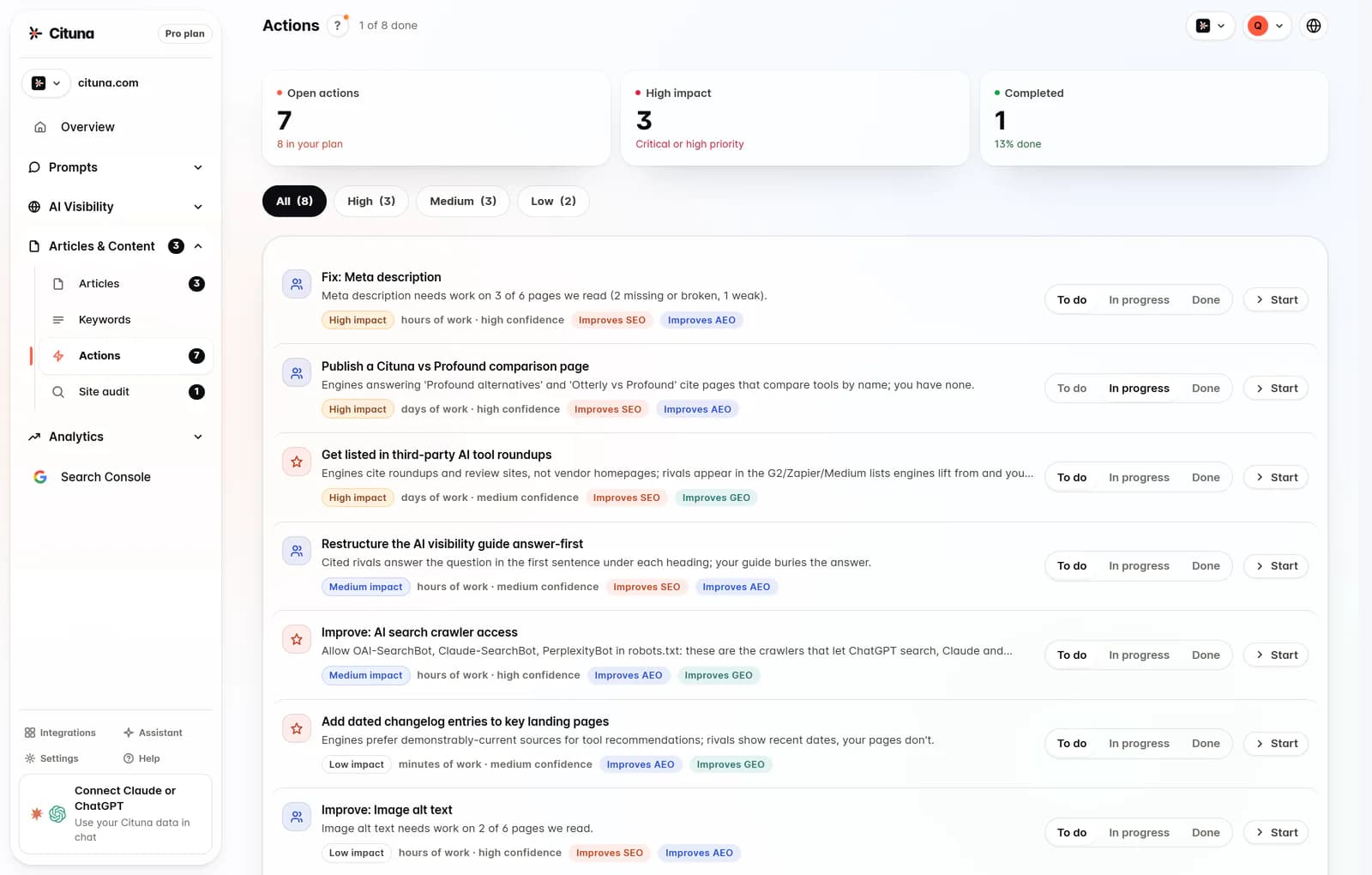
Cituna generates proposed schema, FAQ markup, llms.txt and page changes for each recorded gap. Its AutoSEO can write articles from those gaps and from Search Console demand, then publish them to WordPress, Shopify, a GitHub repository or another CMS by webhook, with publishing held for approval or automated according to the selected plan.
Use a controlled sequence:
- Save the prompt and the answer that omitted or misrepresented the brand.
- Identify the page or source that the engine used instead.
- Choose one remedy, such as clarifying a comparison page, adding an FAQ, improving schema or correcting an outdated claim.
- Publish or approve the change without changing several unrelated pages at once.
- Rerun the same prompt on the relevant engines and inspect the citation, position and answer wording.
- Record whether the change improved visibility, changed the cited page or had no observable effect.
A failed test is still useful if the team records it. No change may mean the prompt is too broad, the page lacks external support, the engine has not refreshed its source set or the change addressed the wrong bottleneck.
Run a repeatable review before scaling prompts
A practical AI search tracking review should begin with a small set of commercially important prompts, establish a baseline across all seven engines and then expand only when the team can act on the findings. More prompts create more observations, but they also create more noise if nobody owns the response.
Use this review checklist:
- Assign an owner for prompt quality and another for site changes.
- Keep a dated record of prompts, answers, cited pages and competitors.
- Review mention and citation changes separately.
- Flag answers that are factually wrong, outdated or missing a relevant use case.
- Prioritise gaps tied to high-value buying decisions.
- Recheck changes on the same engine and prompt wording.
- Connect relevant site changes to Search Console clicks and landing pages.
Cituna includes Google Search Console so a team can compare visibility work with changes in clicks. Its hosted MCP server connects Claude or another AI agent to the same tracking data; read tools are available on every plan from $49, while Pro lets an agent run scans, edit tracked prompts, move fixes along and queue articles.
The next practical step is to run a free AI visibility scan, then turn the result into a tracked prompt set rather than treating the scan as a permanent monitoring plan. Cituna account creation does not provide ongoing brand mention or citation tracking without a plan, and its homepage check tests crawler readiness rather than brand mentions or citations.
Related reading
Official sources to check
- Orchly (orchly.ai)
- Rankability (rankability.com)
Drafted with AI assistance from our own research and Search Console data, and reviewed by Rahul A before publishing. Rules and prices change; check the linked official source before you act.